* Fix bug in ControlNetPipelines with MultiControlNetModel of length 1
* Add tests for varying number of ControlNet models
* Fix missing indexing for control_guidance_start and control_guidance_end
* Fix code quality
* Separate test for MultiControlNet with one model
* Revert formatting of earlier test
* Add controlnet from single file
* Updates
* make style
* finish
* Apply suggestions from code review
Co-authored-by: Sayak Paul <spsayakpaul@gmail.com>
---------
Co-authored-by: Sayak Paul <spsayakpaul@gmail.com>
* feat: add act_fn param to OutValueFunctionBlock
* feat: update unet1d tests to not use mish
* feat: add `mish` as the default activation function
Co-authored-by: Patrick von Platen <patrick.v.platen@gmail.com>
* feat: drop mish tests from unet1d
---------
Co-authored-by: Patrick von Platen <patrick.v.platen@gmail.com>
* add: controlnet sdxl.
* modifications to controlnet.
* run styling.
* add: __init__.pys
* incorporate https://github.com/huggingface/diffusers/pull/4019 changes.
* run make fix-copies.
* resize the conditioning images.
* remove autocast.
* run styling.
* disable autocast.
* debugging
* device placement.
* back to autocast.
* remove comment.
* save some memory by reusing the vae and unet in the pipeline.
* apply styling.
* Allow low precision sd xl
* finish
* finish
* changes to accommodate the improved VAE.
* modifications to how we handle vae encoding in the training.
* make style
* make existing controlnet fast tests pass.
* change vae checkpoint cli arg.
* fix: vae pretrained paths.
* fix: steps in get_scheduler().
* debugging.
* debugging./
* fix: weight conversion.
* add: docs.
* add: limited tests./
* add: datasets to the requirements.
* update docstrings and incorporate the usage of watermarking.
* incorporate fix from #4083
* fix watermarking dependency handling.
* run make-fix-copies.
* Empty-Commit
* Update requirements_sdxl.txt
* remove vae upcasting part.
* Apply suggestions from code review
Co-authored-by: Patrick von Platen <patrick.v.platen@gmail.com>
* run make style
* run make fix-copies.
* disable suppot for multicontrolnet.
* Apply suggestions from code review
Co-authored-by: Patrick von Platen <patrick.v.platen@gmail.com>
* run make fix-copies.
* dtyle/.
* fix-copies.
---------
Co-authored-by: Patrick von Platen <patrick.v.platen@gmail.com>
* Add Recent Timestep Scheduling Improvements to DDIM Inverse Scheduler
Roll timesteps by one to reflect origin-destination semantic discrepancy
Restore `set_alpha_to_one` option to handle negative initial timesteps
Remove `set_alpha_to_zero` option not used due to previous truncation
* Bugfix
* Remove unnecessary calls to `detach()`
Use `self.image_processor.preprocess` in DiffEdit pipeline functions
* Preprocess list input for inverted image latents in diffedit pipeline
* Add `timestep_spacing` and `steps_offset` to `DPMSolverMultistepInverseScheduler`
* Update expected test results to account for inverting last forward diffusion step
* Fix inversion progress bar bug
* Add first draft for proper fast tests for DDIMInverseScheduler
* Add deprecated DDIMInverseScheduler kwarg to ConfigMixer registry
* Fix test failure in DPMMultistepInverseScheduler
Invert step specification leads to negative noise variance in SDE-based algs
Add first draft for proper fast tests for DPMMultistepInverseScheduler
* Update expected test results to account for inverting last forward diffusion step
Clean up diffedit fast test
* Quick implementation of t2i-adapter
Load adapter module with from_pretrained
Prototyping generalized adapter framework
Writeup doc string for sideload framework(WIP) + some minor update on implementation
Update adapter models
Remove old adapter optional args in UNet
Add StableDiffusionAdapterPipeline unit test
Handle cpu offload in StableDiffusionAdapterPipeline
Auto correct coding style
Update model repo name to "RzZ/sd-v1-4-adapter-pipeline"
Refactor MultiAdapter to better compatible with config system
Export MultiAdapter
Create pipeline document template from controlnet
Create dummy objects
Supproting new AdapterLight model
Fix StableDiffusionAdapterPipeline common pipeline test
[WIP] Update adapter pipeline document
Handle num_inference_steps in StableDiffusionAdapterPipeline
Update definition of Adapter "channels_in"
Update documents
Apply code style
Fix doc typo and merge error
Update doc string and example
Quality of life improvement
Remove redundant code and file from prototyping
Remove unused pageage
Remove comments
Fix title
Fix typo
Add conditioning scale arg
Bring back old implmentation
Offload sideload
Add supply info on document
Update src/diffusers/models/adapter.py
Co-authored-by: Will Berman <wlbberman@gmail.com>
Update MultiAdapter constructor
Swap out custom checkpoint and update pipeline constructor
Update docment
Apply suggestions from code review
Co-authored-by: Will Berman <wlbberman@gmail.com>
Correcting style
Following single-file policy
Update auto size in image preprocess func
Update src/diffusers/pipelines/stable_diffusion/pipeline_stable_diffusion_adapter.py
Co-authored-by: Will Berman <wlbberman@gmail.com>
fix copies
Update adapter pipeline behavior
Add adapter_conditioning_scale doc string
Add the missing doc string
Apply suggestions from code review
Co-authored-by: Patrick von Platen <patrick.v.platen@gmail.com>
Fix few bugs from suggestion
Handle L-mode PIL image as control image
Rename to differentiate adapter resblock
Update src/diffusers/models/adapter.py
Co-authored-by: Sayak Paul <spsayakpaul@gmail.com>
Fix typo
Update adapter parameter name
Update test case and code style
Fix copies
Fix typo
Update src/diffusers/pipelines/stable_diffusion/pipeline_stable_diffusion_adapter.py
Co-authored-by: Will Berman <wlbberman@gmail.com>
Update Adapter class name
Add checkpoint converting script
Fix style
Fix-copies
Remove dev script
Apply suggestions from code review
Co-authored-by: Patrick von Platen <patrick.v.platen@gmail.com>
Updates for parameter rename
Fix convert_adapter
remove main
fix diff
more
refactoring
more
more
small fixes
refactor
tests
more slow tests
more tests
Update docs/source/en/api/pipelines/overview.mdx
Co-authored-by: Sayak Paul <spsayakpaul@gmail.com>
add community contributor to docs
Update docs/source/en/api/pipelines/stable_diffusion/adapter.mdx
Co-authored-by: Sayak Paul <spsayakpaul@gmail.com>
Update docs/source/en/api/pipelines/stable_diffusion/adapter.mdx
Co-authored-by: Sayak Paul <spsayakpaul@gmail.com>
Update docs/source/en/api/pipelines/stable_diffusion/adapter.mdx
Co-authored-by: Sayak Paul <spsayakpaul@gmail.com>
Update docs/source/en/api/pipelines/stable_diffusion/adapter.mdx
Co-authored-by: Sayak Paul <spsayakpaul@gmail.com>
Update docs/source/en/api/pipelines/stable_diffusion/adapter.mdx
Co-authored-by: Sayak Paul <spsayakpaul@gmail.com>
fix
remove from_adapters
license
paper link
docs
more url fixes
more docs
fix
fixes
fix
fix
* fix sample inplace add
* additional_kwargs -> additional_residuals
* move t2i adapter pipeline to own module
* preprocess -> _preprocess_adapter_image
* add TencentArc to license
* fix example code links
* add image converter and fix example doc string
* fix links
* clearer additional residual application
---------
Co-authored-by: HimariO <dsfhe49854@gmail.com>
* 📝 Update doc with more descriptive title and filename for "IF" section
Updated the documentation to provide a more descriptive title and filename for the "IF" section. Previously, having only "IF" as the title was not conveying a clear meaning. By renaming the section to "DeepFloyd IF," we provide users with a more informative and context-specific heading.
Thanks! 🙌
* 📝 Update name for "IF" section in 📝 Update name for "IF" section in README
Updated the link and name for the "IF" section in the README file to reflect the new heading "DeepFloyd IF."
* 📝 Fix broken link for "Instruct Pix2Pix" section in README
Fixed the broken link for the "Instruct Pix2Pix" section in the README file. Previously, the link was pointing to an incorrect location due to the presence of "stable_diffusion" in the URL. By removing "stable_diffusion" from the URL, I have corrected the error and ensured that users are directed to the correct section.
* 🔧💼 Updated parameters in _toctree.yml file
- ✏️ Updated 'local' parameter to 'api/pipelines/deepfloyd_if'.
- ✏️ Updated 'title' parameter to 'DeepFloyd IF'.
🎯 These changes aim to improve visibility and accessibility in the documentation of the DeepFloyd IF pipeline. 🚀📚
* add noise_sampler to StableDiffusionKDiffusionPipeline
* fix/docs: Fix the broken doc links (#3897)
* fix/docs: Fix the broken doc links
Signed-off-by: GitHub <noreply@github.com>
* Update docs/source/en/using-diffusers/write_own_pipeline.mdx
Co-authored-by: Pedro Cuenca <pedro@huggingface.co>
---------
Signed-off-by: GitHub <noreply@github.com>
Co-authored-by: Pedro Cuenca <pedro@huggingface.co>
* Add video img2img (#3900)
* Add image to image video
* Improve
* better naming
* make fix copies
* add docs
* finish tests
* trigger tests
* make style
* correct
* finish
* Fix more
* make style
* finish
* fix/doc-code: Updating to the latest version parameters (#3924)
fix/doc-code: update to use the new parameter
Signed-off-by: GitHub <noreply@github.com>
* fix/doc: no import torch issue (#3923)
Ffix/doc: no import torch issue
Signed-off-by: GitHub <noreply@github.com>
* Correct controlnet out of list error (#3928)
* Correct controlnet out of list error
* Apply suggestions from code review
* correct tests
* correct tests
* fix
* test all
* Apply suggestions from code review
* test all
* test all
* Apply suggestions from code review
* Apply suggestions from code review
* fix more tests
* Fix more
* Apply suggestions from code review
* finish
* Apply suggestions from code review
* Update src/diffusers/schedulers/scheduling_k_dpm_2_ancestral_discrete.py
* finish
* Adding better way to define multiple concepts and also validation capabilities. (#3807)
* - Added validation parameters
- Changed some parameter descriptions to better explain their use.
- Fixed a few typos.
- Added concept_list parameter for better management of multiple subjects
- changed logic for image validation
* - Fixed bad logic for class data root directories
* Defaulting validation_steps to None for an easier logic
* Fixed multiple validation prompts
* Fixed bug on validation negative prompt
* Changed validation logic for tracker.
* Added uuid for validation image labeling
* Fix error when comparing validation prompts and validation negative prompts
* Improved error message when negative prompts for validation are more than the number of prompts
* - Changed image tracking number from epoch to global_step
- Added Typing for functions
* Added some validations more when using concept_list parameter and the regular ones.
* Fixed error message
* Added more validations for validation parameters
* Improved messaging for errors
* Fixed validation error for parameters with default values
* - Added train step to image name for validation
- reformatted code
* - Added train step to image's name for validation
- reformatted code
* Updated README.md file.
* reverted back original script of train_dreambooth.py
* reverted back original script of train_dreambooth.py
* left one blank line at the eof
* reverted back setup.py
* reverted back setup.py
* added same logic for when parameters for prior preservation are used without enabling the flag while using concept_list parameter.
* Ran black formatter.
* fixed a few strings
* fixed import sort with isort and removed fstrings without placeholder
* fixed import order with ruff (since with isort wasn't ok)
---------
Co-authored-by: Patrick von Platen <patrick.v.platen@gmail.com>
* [ldm3d] Update code to be functional with the new checkpoints (#3875)
* fixed typo
* updated doc to be consistent in naming
* make style/quality
* preprocessing for 4 channels and not 6
* make style
* test for 4c
* make style/quality
* fixed test on cpu
---------
Co-authored-by: Aflalo <estellea@isl-iam1.rr.intel.com>
Co-authored-by: Aflalo <estellea@isl-gpu33.rr.intel.com>
Co-authored-by: Aflalo <estellea@isl-gpu38.rr.intel.com>
* Improve memory text to video (#3930)
* Improve memory text to video
* Apply suggestions from code review
* add test
* Apply suggestions from code review
Co-authored-by: Pedro Cuenca <pedro@huggingface.co>
* finish test setup
---------
Co-authored-by: Pedro Cuenca <pedro@huggingface.co>
* revert automatic chunking (#3934)
* revert automatic chunking
* Apply suggestions from code review
* revert automatic chunking
* avoid upcasting by assigning dtype to noise tensor (#3713)
* avoid upcasting by assigning dtype to noise tensor
* make style
* Update train_unconditional.py
* Update train_unconditional.py
* make style
* add unit test for pickle
* revert change
---------
Co-authored-by: root <root@orttrainingdev8.d32nl1ml4oruzj4qz3bqlggovf.px.internal.cloudapp.net>
Co-authored-by: Patrick von Platen <patrick.v.platen@gmail.com>
Co-authored-by: Prathik Rao <prathikrao@microsoft.com@orttrainingdev8.d32nl1ml4oruzj4qz3bqlggovf.px.internal.cloudapp.net>
* Fix failing np tests (#3942)
* Fix failing np tests
* Apply suggestions from code review
* Update tests/pipelines/test_pipelines_common.py
* Add `timestep_spacing` and `steps_offset` to schedulers (#3947)
* Add timestep_spacing to DDPM, LMSDiscrete, PNDM.
* Remove spurious line.
* More easy schedulers.
* Add `linspace` to DDIM
* Noise sigma for `trailing`.
* Add timestep_spacing to DEISMultistepScheduler.
Not sure the range is the way it was intended.
* Fix: remove line used to debug.
* Support timestep_spacing in DPMSolverMultistep, DPMSolverSDE, UniPC
* Fix: convert to numpy.
* Use sched. defaults when instantiating from_config
For params not present in the original configuration.
This makes it possible to switch pipeline schedulers even if they use
different timestep_spacing (or any other param).
* Apply suggestions from code review
Co-authored-by: Patrick von Platen <patrick.v.platen@gmail.com>
* Missing args in DPMSolverMultistep
* Test: default args not in config
* Style
* Fix scheduler name in test
* Remove duplicated entries
* Add test for solver_type
This test currently fails in main. When switching from DEIS to UniPC,
solver_type is "logrho" (the default value from DEIS), which gets
translated to "bh1" by UniPC. This is different to the default value for
UniPC: "bh2". This is where the translation happens: https://github.com/huggingface/diffusers/blob/36d22d0709dc19776e3016fb3392d0f5578b0ab2/src/diffusers/schedulers/scheduling_unipc_multistep.py#L171
* UniPC: use same default for solver_type
Fixes a bug when switching from UniPC from another scheduler (i.e.,
DEIS) that uses a different solver type. The solver is now the same as
if we had instantiated the scheduler directly.
* do not save use default values
* fix more
* fix all
* fix schedulers
* fix more
* finish for real
* finish for real
* flaky tests
* Update tests/pipelines/stable_diffusion/test_stable_diffusion_pix2pix_zero.py
* Default steps_offset to 0.
* Add missing docstrings
* Apply suggestions from code review
---------
Co-authored-by: Patrick von Platen <patrick.v.platen@gmail.com>
* Add Consistency Models Pipeline (#3492)
* initial commit
* Improve consistency models sampling implementation.
* Add CMStochasticIterativeScheduler, which implements the multi-step sampler (stochastic_iterative_sampler) in the original code, and make further improvements to sampling.
* Add Unet blocks for consistency models
* Add conversion script for Unet
* Fix bug in new unet blocks
* Fix attention weight loading
* Make design improvements to ConsistencyModelPipeline and CMStochasticIterativeScheduler and add initial version of tests.
* make style
* Make small random test UNet class conditional and set resnet_time_scale_shift to 'scale_shift' to better match consistency model checkpoints.
* Add support for converting a test UNet and non-class-conditional UNets to the consistency models conversion script.
* make style
* Change num_class_embeds to 1000 to better match the original consistency models implementation.
* Add support for distillation in pipeline_consistency_models.py.
* Improve consistency model tests:
- Get small testing checkpoints from hub
- Modify tests to take into account "distillation" parameter of ConsistencyModelPipeline
- Add onestep, multistep tests for distillation and distillation + class conditional
- Add expected image slices for onestep tests
* make style
* Improve ConsistencyModelPipeline:
- Add initial support for class-conditional generation
- Fix initial sigma for onestep generation
- Fix some sigma shape issues
* make style
* Improve ConsistencyModelPipeline:
- add latents __call__ argument and prepare_latents method
- add check_inputs method
- add initial docstrings for ConsistencyModelPipeline.__call__
* make style
* Fix bug when randomly generating class labels for class-conditional generation.
* Switch CMStochasticIterativeScheduler to configuring a sigma schedule and make related changes to the pipeline and tests.
* Remove some unused code and make style.
* Fix small bug in CMStochasticIterativeScheduler.
* Add expected slices for multistep sampling tests and make them pass.
* Work on consistency model fast tests:
- in pipeline, call self.scheduler.scale_model_input before denoising
- get expected slices for Euler and Heun scheduler tests
- make Euler test pass
- mark Heun test as expected fail because it doesn't support prediction_type "sample" yet
- remove DPM and Euler Ancestral tests because they don't support use_karras_sigmas
* make style
* Refactor conversion script to make it easier to add more model architectures to convert in the future.
* Work on ConsistencyModelPipeline tests:
- Fix device bug when handling class labels in ConsistencyModelPipeline.__call__
- Add slow tests for onestep and multistep sampling and make them pass
- Refactor fast tests
- Refactor ConsistencyModelPipeline.__init__
* make style
* Remove the add_noise and add_noise_to_input methods from CMStochasticIterativeScheduler for now.
* Run python utils/check_copies.py --fix_and_overwrite
python utils/check_dummies.py --fix_and_overwrite to make dummy objects for new pipeline and scheduler.
* Make fast tests from PipelineTesterMixin pass.
* make style
* Refactor consistency models pipeline and scheduler:
- Remove support for Karras schedulers (only support CMStochasticIterativeScheduler)
- Move sigma manipulation, input scaling, denoising from pipeline to scheduler
- Make corresponding changes to tests and ensure they pass
* make style
* Add docstrings and further refactor pipeline and scheduler.
* make style
* Add initial version of the consistency models documentation.
* Refactor custom timesteps logic following DDPMScheduler/IFPipeline and temporarily add torch 2.0 SDPA kernel selection logic for debugging.
* make style
* Convert current slow tests to use fp16 and flash attention.
* make style
* Add slow tests for normal attention on cuda device.
* make style
* Fix attention weights loading
* Update consistency model fast tests for new test checkpoints with attention fix.
* make style
* apply suggestions
* Add add_noise method to CMStochasticIterativeScheduler (copied from EulerDiscreteScheduler).
* Conversion script now outputs pipeline instead of UNet and add support for LSUN-256 models and different schedulers.
* When both timesteps and num_inference_steps are supplied, raise warning instead of error (timesteps take precedence).
* make style
* Add remaining diffusers model checkpoints for models in the original consistency model release and update usage example.
* apply suggestions from review
* make style
* fix attention naming
* Add tests for CMStochasticIterativeScheduler.
* make style
* Make CMStochasticIterativeScheduler tests pass.
* make style
* Override test_step_shape in CMStochasticIterativeSchedulerTest instead of modifying it in SchedulerCommonTest.
* make style
* rename some models
* Improve API
* rename some models
* Remove duplicated block
* Add docstring and make torch compile work
* More fixes
* Fixes
* Apply suggestions from code review
* Apply suggestions from code review
* add more docstring
* update consistency conversion script
---------
Co-authored-by: ayushmangal <ayushmangal@microsoft.com>
Co-authored-by: Ayush Mangal <43698245+ayushtues@users.noreply.github.com>
Co-authored-by: Patrick von Platen <patrick.v.platen@gmail.com>
* add test case for StableDiffusionKDiffusionPipeline noise_sampler
---------
Signed-off-by: GitHub <noreply@github.com>
Co-authored-by: Aisuko <urakiny@gmail.com>
Co-authored-by: Pedro Cuenca <pedro@huggingface.co>
Co-authored-by: Patrick von Platen <patrick.v.platen@gmail.com>
Co-authored-by: Andrés Mauricio Repetto Ferrero <amd.repetto@gmail.com>
Co-authored-by: estelleafl <estelle.aflalo@intel.com>
Co-authored-by: Aflalo <estellea@isl-iam1.rr.intel.com>
Co-authored-by: Aflalo <estellea@isl-gpu33.rr.intel.com>
Co-authored-by: Aflalo <estellea@isl-gpu38.rr.intel.com>
Co-authored-by: Prathik Rao <prathikr@usc.edu>
Co-authored-by: root <root@orttrainingdev8.d32nl1ml4oruzj4qz3bqlggovf.px.internal.cloudapp.net>
Co-authored-by: Prathik Rao <prathikrao@microsoft.com@orttrainingdev8.d32nl1ml4oruzj4qz3bqlggovf.px.internal.cloudapp.net>
Co-authored-by: dg845 <58458699+dg845@users.noreply.github.com>
Co-authored-by: ayushmangal <ayushmangal@microsoft.com>
Co-authored-by: Ayush Mangal <43698245+ayushtues@users.noreply.github.com>
* Add circular padding option
* Fix style with black
* Fix corner case with small image size
* Add circular padding test cases
* Fix docstring
* Improve docstring for circular padding, remove slow test case
* Update docs for circular padding argument
* Add images comparison for circular padding
* diffusers#4003 - initial implementation of max_inference_steps
* diffusers#4003 - initial implementation of max_inference_steps and first_inference_step for img2img
* diffusers#4003 - use first_inference_step as an input arg for get_timestamps in img2img
* diffusers#4003 Do not add noise during img2img when we have a defined first timestep
* diffusers#4003 Mild updates after revert
* diffusers#4003 Missing change
* Show implementation with denoising_start and end
* Apply suggestions from code review
* Update src/diffusers/pipelines/stable_diffusion_xl/pipeline_stable_diffusion_xl.py
Co-authored-by: Pedro Cuenca <pedro@huggingface.co>
* move to 0.19.0dev
* Apply suggestions from code review
* add exhaustive tests
* add docs
* finish
* Apply suggestions from code review
Co-authored-by: Sayak Paul <spsayakpaul@gmail.com>
* make style
---------
Co-authored-by: bghira <bghira@users.github.com>
Co-authored-by: Patrick von Platen <patrick.v.platen@gmail.com>
Co-authored-by: Pedro Cuenca <pedro@huggingface.co>
Co-authored-by: Sayak Paul <spsayakpaul@gmail.com>
* 📝 Fix broken link to models documentation
Corrected the link to the models documentation in the README. Previously, the link was pointing to an incorrect URL. Now, the link directs users to the correct documentation page for more details on the models.
Thanks! 🙌
* Update src/diffusers/models/README.md
Co-authored-by: Steven Liu <59462357+stevhliu@users.noreply.github.com>
---------
Co-authored-by: Steven Liu <59462357+stevhliu@users.noreply.github.com>
* refactor to support patching LoRA into T5
instantiate the lora linear layer on the same device as the regular linear layer
get lora rank from state dict
tests
fmt
can create lora layer in float32 even when rest of model is float16
fix loading model hook
remove load_lora_weights_ and T5 dispatching
remove Unet#attn_processors_state_dict
docstrings
* text encoder monkeypatch class method
* fix test
---------
Co-authored-by: Patrick von Platen <patrick.v.platen@gmail.com>
* refactor prior_transformer
adding conversion script
add pipeline
add step_index from pipeline, + remove permute
add zero pad token
remove copy from statement for betas_for_alpha_bar function
* add
* add
* update conversion script for renderer model
* refactor camera a little bit
* clean up
* style
* fix copies
* Update src/diffusers/schedulers/scheduling_heun_discrete.py
Co-authored-by: Patrick von Platen <patrick.v.platen@gmail.com>
* Update src/diffusers/pipelines/shap_e/pipeline_shap_e.py
Co-authored-by: Patrick von Platen <patrick.v.platen@gmail.com>
* Update src/diffusers/pipelines/shap_e/pipeline_shap_e.py
Co-authored-by: Patrick von Platen <patrick.v.platen@gmail.com>
* alpha_transform_type
* remove step_index argument
* remove get_sigmas_karras
* remove _yiyi_sigma_to_t
* move the rescale prompt_embeds from prior_transformer to pipeline
* replace baddbmm with einsum to match origial repo
* Revert "replace baddbmm with einsum to match origial repo"
This reverts commit 3f6b435d65.
* add step_index to scale_model_input
* Revert "move the rescale prompt_embeds from prior_transformer to pipeline"
This reverts commit 5b5a8e6be9.
* move rescale from prior_transformer to pipeline
* correct step_index in scale_model_input
* remove print lines
* refactor prior - reduce arguments
* make style
* add prior_image
* arg embedding_proj_norm -> norm_embedding_proj
* add pre-norm for proj_embedding
* move rescale prompt from pipeline to _encode_prompt
* add img2img pipeline
* style
* copies
* Update src/diffusers/models/prior_transformer.py
Co-authored-by: Patrick von Platen <patrick.v.platen@gmail.com>
* Update src/diffusers/models/prior_transformer.py
Co-authored-by: Patrick von Platen <patrick.v.platen@gmail.com>
* Update src/diffusers/models/prior_transformer.py
Co-authored-by: Patrick von Platen <patrick.v.platen@gmail.com>
* Update src/diffusers/models/prior_transformer.py
add arg: encoder_hid_proj
Co-authored-by: Patrick von Platen <patrick.v.platen@gmail.com>
* Update src/diffusers/models/prior_transformer.py
add new config: norm_in_type
Co-authored-by: Patrick von Platen <patrick.v.platen@gmail.com>
* Update src/diffusers/models/prior_transformer.py
add new config: added_emb_type
Co-authored-by: Patrick von Platen <patrick.v.platen@gmail.com>
* Update src/diffusers/models/prior_transformer.py
rename out_dim -> clip_embed_dim
Co-authored-by: Patrick von Platen <patrick.v.platen@gmail.com>
* Update src/diffusers/models/prior_transformer.py
rename config: out_dim -> clip_embed_dim
Co-authored-by: Patrick von Platen <patrick.v.platen@gmail.com>
* Update src/diffusers/models/prior_transformer.py
Co-authored-by: Patrick von Platen <patrick.v.platen@gmail.com>
* Update src/diffusers/models/prior_transformer.py
Co-authored-by: Patrick von Platen <patrick.v.platen@gmail.com>
* finish refactor prior_tranformer
* make style
* refactor renderer
* fix
* make style
* refactor img2img
* remove params_proj
* add test
* add upcast_softmax to prior_transformer
* enable num_images_per_prompt, add save_gif utility
* add
* add fast test
* make style
* add slow test
* style
* add test for img2img
* refactor
* enable batching
* style
* refactor scheduler
* update test
* style
* attempt to solve batch related tests timeout
* add doc
* Update src/diffusers/pipelines/shap_e/pipeline_shap_e.py
Co-authored-by: Patrick von Platen <patrick.v.platen@gmail.com>
* Update src/diffusers/pipelines/shap_e/pipeline_shap_e_img2img.py
Co-authored-by: Patrick von Platen <patrick.v.platen@gmail.com>
* hardcode rendering related config
* update betas_for_alpha_bar on ddpm_scheduler
* fix copies
* fix
* export_to_gif
* style
* second attempt to speed up batching tests
* add doc page to index
* Remove intermediate clipping
* 3rd attempt to speed up batching tests
* Remvoe time index
* simplify scheduler
* Fix more
* Fix more
* fix more
* make style
* fix schedulers
* fix some more tests
* finish
* add one more test
* Apply suggestions from code review
Co-authored-by: Sayak Paul <spsayakpaul@gmail.com>
Co-authored-by: Pedro Cuenca <pedro@huggingface.co>
Co-authored-by: Patrick von Platen <patrick.v.platen@gmail.com>
* style
* apply feedbacks
* style
* fix copies
* add one example
* style
* add example for img2img
* fix doc
* fix more doc strings
* size -> frame_size
* style
* update doc
* style
* fix on doc
* update repo name
* improve the usage example in shap-e img2img
* add usage examples in the shap-e docs.
* consolidate examples.
* minor fix.
* update doc
* Apply suggestions from code review
* Apply suggestions from code review
* remove upcast
* Make sure background is white
* Update src/diffusers/pipelines/shap_e/pipeline_shap_e.py
* Apply suggestions from code review
* Finish
* Apply suggestions from code review
* Update src/diffusers/pipelines/shap_e/pipeline_shap_e.py
* Make style
---------
Co-authored-by: yiyixuxu <yixu310@gmail,com>
Co-authored-by: Patrick von Platen <patrick.v.platen@gmail.com>
Co-authored-by: Sayak Paul <spsayakpaul@gmail.com>
Co-authored-by: Pedro Cuenca <pedro@huggingface.co>
* Kandinsky2_2
* fix init kandinsky2_2
* kandinsky2_2 fix inpainting
* rename pipelines: remove decoder + 2_2 -> V22
* Update scheduling_unclip.py
* remove text_encoder and tokenizer arguments from doc string
* add test for text2img
* add tests for text2img & img2img
* fix
* add test for inpaint
* add prior tests
* style
* copies
* add controlnet test
* style
* add a test for controlnet_img2img
* update prior_emb2emb api to accept image_embedding or image
* add a test for prior_emb2emb
* style
* remove try except
* example
* fix
* add doc string examples to all kandinsky pipelines
* style
* update doc
* style
* add a top about 2.2
* Apply suggestions from code review
Co-authored-by: Patrick von Platen <patrick.v.platen@gmail.com>
* vae -> movq
* vae -> movq
* style
* fix the #copied from
* remove decoder from file name
* update doc: add a section for kandinsky 2.2
* fix
* fix-copies
* add coped from
* add copies from for prior
* add copies from for prior emb2emb
* copy from for img2img
* copied from for inpaint
* more copied from
* more copies from
* more copies
* remove the yiyi comments
* Apply suggestions from code review
* Self-contained example, pipeline order
* Import prior output instead of redefining.
* Style
* Make VQModel compatible with model offload.
* Fix copies
---------
Co-authored-by: Shahmatov Arseniy <62886550+cene555@users.noreply.github.com>
Co-authored-by: yiyixuxu <yixu310@gmail,com>
Co-authored-by: Patrick von Platen <patrick.v.platen@gmail.com>
Co-authored-by: Pedro Cuenca <pedro@huggingface.co>
* Add new text encoder
* add transformers depth
* More
* Correct conversion script
* Fix more
* Fix more
* Correct more
* correct text encoder
* Finish all
* proof that in works in run local xl
* clean up
* Get refiner to work
* Add red castle
* Fix batch size
* Improve pipelines more
* Finish text2image tests
* Add img2img test
* Fix more
* fix import
* Fix embeddings for classic models (#3888)
Fix embeddings for classic SD models.
* Allow multiple prompts to be passed to the refiner (#3895)
* finish more
* Apply suggestions from code review
* add watermarker
* Model offload (#3889)
* Model offload.
* Model offload for refiner / img2img
* Hardcode encoder offload on img2img vae encode
Saves some GPU RAM in img2img / refiner tasks so it remains below 8 GB.
---------
Co-authored-by: Patrick von Platen <patrick.v.platen@gmail.com>
* correct
* fix
* clean print
* Update install warning for `invisible-watermark`
* add: missing docstrings.
* fix and simplify the usage example in img2img.
* fix setup for watermarking.
* Revert "fix setup for watermarking."
This reverts commit 491bc9f5a6.
* fix: watermarking setup.
* fix: op.
* run make fix-copies.
* make sure tests pass
* improve convert
* make tests pass
* make tests pass
* better error message
* fiinsh
* finish
* Fix final test
---------
Co-authored-by: Pedro Cuenca <pedro@huggingface.co>
Co-authored-by: Sayak Paul <spsayakpaul@gmail.com>
* use sample directly instead of the dataclass.
* more usage of directly samples instead of dataclasses
* more usage of directly samples instead of dataclasses
* use direct sample in the pipeline.
* direct usage of sample in the img2img case.
* add default to unet output to prevent it from being a required arg
* add unit test
* make style
* adjust unit test
* mark as fast test
* adjust assert statement in test
---------
Co-authored-by: Prathik Rao <prathikrao@microsoft.com@orttrainingdev8.d32nl1ml4oruzj4qz3bqlggovf.px.internal.cloudapp.net>
Co-authored-by: root <root@orttrainingdev8.d32nl1ml4oruzj4qz3bqlggovf.px.internal.cloudapp.net>
* initial commit
* Improve consistency models sampling implementation.
* Add CMStochasticIterativeScheduler, which implements the multi-step sampler (stochastic_iterative_sampler) in the original code, and make further improvements to sampling.
* Add Unet blocks for consistency models
* Add conversion script for Unet
* Fix bug in new unet blocks
* Fix attention weight loading
* Make design improvements to ConsistencyModelPipeline and CMStochasticIterativeScheduler and add initial version of tests.
* make style
* Make small random test UNet class conditional and set resnet_time_scale_shift to 'scale_shift' to better match consistency model checkpoints.
* Add support for converting a test UNet and non-class-conditional UNets to the consistency models conversion script.
* make style
* Change num_class_embeds to 1000 to better match the original consistency models implementation.
* Add support for distillation in pipeline_consistency_models.py.
* Improve consistency model tests:
- Get small testing checkpoints from hub
- Modify tests to take into account "distillation" parameter of ConsistencyModelPipeline
- Add onestep, multistep tests for distillation and distillation + class conditional
- Add expected image slices for onestep tests
* make style
* Improve ConsistencyModelPipeline:
- Add initial support for class-conditional generation
- Fix initial sigma for onestep generation
- Fix some sigma shape issues
* make style
* Improve ConsistencyModelPipeline:
- add latents __call__ argument and prepare_latents method
- add check_inputs method
- add initial docstrings for ConsistencyModelPipeline.__call__
* make style
* Fix bug when randomly generating class labels for class-conditional generation.
* Switch CMStochasticIterativeScheduler to configuring a sigma schedule and make related changes to the pipeline and tests.
* Remove some unused code and make style.
* Fix small bug in CMStochasticIterativeScheduler.
* Add expected slices for multistep sampling tests and make them pass.
* Work on consistency model fast tests:
- in pipeline, call self.scheduler.scale_model_input before denoising
- get expected slices for Euler and Heun scheduler tests
- make Euler test pass
- mark Heun test as expected fail because it doesn't support prediction_type "sample" yet
- remove DPM and Euler Ancestral tests because they don't support use_karras_sigmas
* make style
* Refactor conversion script to make it easier to add more model architectures to convert in the future.
* Work on ConsistencyModelPipeline tests:
- Fix device bug when handling class labels in ConsistencyModelPipeline.__call__
- Add slow tests for onestep and multistep sampling and make them pass
- Refactor fast tests
- Refactor ConsistencyModelPipeline.__init__
* make style
* Remove the add_noise and add_noise_to_input methods from CMStochasticIterativeScheduler for now.
* Run python utils/check_copies.py --fix_and_overwrite
python utils/check_dummies.py --fix_and_overwrite to make dummy objects for new pipeline and scheduler.
* Make fast tests from PipelineTesterMixin pass.
* make style
* Refactor consistency models pipeline and scheduler:
- Remove support for Karras schedulers (only support CMStochasticIterativeScheduler)
- Move sigma manipulation, input scaling, denoising from pipeline to scheduler
- Make corresponding changes to tests and ensure they pass
* make style
* Add docstrings and further refactor pipeline and scheduler.
* make style
* Add initial version of the consistency models documentation.
* Refactor custom timesteps logic following DDPMScheduler/IFPipeline and temporarily add torch 2.0 SDPA kernel selection logic for debugging.
* make style
* Convert current slow tests to use fp16 and flash attention.
* make style
* Add slow tests for normal attention on cuda device.
* make style
* Fix attention weights loading
* Update consistency model fast tests for new test checkpoints with attention fix.
* make style
* apply suggestions
* Add add_noise method to CMStochasticIterativeScheduler (copied from EulerDiscreteScheduler).
* Conversion script now outputs pipeline instead of UNet and add support for LSUN-256 models and different schedulers.
* When both timesteps and num_inference_steps are supplied, raise warning instead of error (timesteps take precedence).
* make style
* Add remaining diffusers model checkpoints for models in the original consistency model release and update usage example.
* apply suggestions from review
* make style
* fix attention naming
* Add tests for CMStochasticIterativeScheduler.
* make style
* Make CMStochasticIterativeScheduler tests pass.
* make style
* Override test_step_shape in CMStochasticIterativeSchedulerTest instead of modifying it in SchedulerCommonTest.
* make style
* rename some models
* Improve API
* rename some models
* Remove duplicated block
* Add docstring and make torch compile work
* More fixes
* Fixes
* Apply suggestions from code review
* Apply suggestions from code review
* add more docstring
* update consistency conversion script
---------
Co-authored-by: ayushmangal <ayushmangal@microsoft.com>
Co-authored-by: Ayush Mangal <43698245+ayushtues@users.noreply.github.com>
Co-authored-by: Patrick von Platen <patrick.v.platen@gmail.com>
* Add timestep_spacing to DDPM, LMSDiscrete, PNDM.
* Remove spurious line.
* More easy schedulers.
* Add `linspace` to DDIM
* Noise sigma for `trailing`.
* Add timestep_spacing to DEISMultistepScheduler.
Not sure the range is the way it was intended.
* Fix: remove line used to debug.
* Support timestep_spacing in DPMSolverMultistep, DPMSolverSDE, UniPC
* Fix: convert to numpy.
* Use sched. defaults when instantiating from_config
For params not present in the original configuration.
This makes it possible to switch pipeline schedulers even if they use
different timestep_spacing (or any other param).
* Apply suggestions from code review
Co-authored-by: Patrick von Platen <patrick.v.platen@gmail.com>
* Missing args in DPMSolverMultistep
* Test: default args not in config
* Style
* Fix scheduler name in test
* Remove duplicated entries
* Add test for solver_type
This test currently fails in main. When switching from DEIS to UniPC,
solver_type is "logrho" (the default value from DEIS), which gets
translated to "bh1" by UniPC. This is different to the default value for
UniPC: "bh2". This is where the translation happens: https://github.com/huggingface/diffusers/blob/36d22d0709dc19776e3016fb3392d0f5578b0ab2/src/diffusers/schedulers/scheduling_unipc_multistep.py#L171
* UniPC: use same default for solver_type
Fixes a bug when switching from UniPC from another scheduler (i.e.,
DEIS) that uses a different solver type. The solver is now the same as
if we had instantiated the scheduler directly.
* do not save use default values
* fix more
* fix all
* fix schedulers
* fix more
* finish for real
* finish for real
* flaky tests
* Update tests/pipelines/stable_diffusion/test_stable_diffusion_pix2pix_zero.py
* Default steps_offset to 0.
* Add missing docstrings
* Apply suggestions from code review
---------
Co-authored-by: Patrick von Platen <patrick.v.platen@gmail.com>
* Improve memory text to video
* Apply suggestions from code review
* add test
* Apply suggestions from code review
Co-authored-by: Pedro Cuenca <pedro@huggingface.co>
* finish test setup
---------
Co-authored-by: Pedro Cuenca <pedro@huggingface.co>
* - Added validation parameters
- Changed some parameter descriptions to better explain their use.
- Fixed a few typos.
- Added concept_list parameter for better management of multiple subjects
- changed logic for image validation
* - Fixed bad logic for class data root directories
* Defaulting validation_steps to None for an easier logic
* Fixed multiple validation prompts
* Fixed bug on validation negative prompt
* Changed validation logic for tracker.
* Added uuid for validation image labeling
* Fix error when comparing validation prompts and validation negative prompts
* Improved error message when negative prompts for validation are more than the number of prompts
* - Changed image tracking number from epoch to global_step
- Added Typing for functions
* Added some validations more when using concept_list parameter and the regular ones.
* Fixed error message
* Added more validations for validation parameters
* Improved messaging for errors
* Fixed validation error for parameters with default values
* - Added train step to image name for validation
- reformatted code
* - Added train step to image's name for validation
- reformatted code
* Updated README.md file.
* reverted back original script of train_dreambooth.py
* reverted back original script of train_dreambooth.py
* left one blank line at the eof
* reverted back setup.py
* reverted back setup.py
* added same logic for when parameters for prior preservation are used without enabling the flag while using concept_list parameter.
* Ran black formatter.
* fixed a few strings
* fixed import sort with isort and removed fstrings without placeholder
* fixed import order with ruff (since with isort wasn't ok)
---------
Co-authored-by: Patrick von Platen <patrick.v.platen@gmail.com>
* Correct controlnet out of list error
* Apply suggestions from code review
* correct tests
* correct tests
* fix
* test all
* Apply suggestions from code review
* test all
* test all
* Apply suggestions from code review
* Apply suggestions from code review
* fix more tests
* Fix more
* Apply suggestions from code review
* finish
* Apply suggestions from code review
* Update src/diffusers/schedulers/scheduling_k_dpm_2_ancestral_discrete.py
* finish
* Support for manual CLIP loading in StableDiffusionPipeline - txt2img.
* Update src/diffusers/pipelines/stable_diffusion/convert_from_ckpt.py
* Update variables & according docs to match previous style.
* Updated to match style & quality of 'diffusers'
---------
Co-authored-by: Patrick von Platen <patrick.v.platen@gmail.com>
* Add guidance start/stop
* Add guidance start/stop to inpaint class
* Black formatting
* Add support for guidance for multicontrolnet
* Add inclusive end
* Improve design
* correct imports
* Finish
* Finish all
* Correct more
* make style
---------
Co-authored-by: Patrick von Platen <patrick.v.platen@gmail.com>
* add paradigms parallel sampling pipeline
* linting
* ran make fix-copies
* add paradigms parallel sampling pipeline
* linting
* ran make fix-copies
* Apply suggestions from code review
Co-authored-by: Sayak Paul <spsayakpaul@gmail.com>
* changes based on review
* add docs for paradigms
* update docs with paradigms abstract
* improve documentation, and add tests for ddim/ddpm batch_step_no_noise
* fix docs and run make fix-copies
* minor changes to docs.
* Apply suggestions from code review
Co-authored-by: Patrick von Platen <patrick.v.platen@gmail.com>
* move parallel scheduler to new classes for DDPMParallelScheduler and DDIMParallelScheduler
* remove changes for scheduling_ddim, adjust licenses, credits, and commented code
* fix tensor type that is breaking tests
---------
Co-authored-by: Sayak Paul <spsayakpaul@gmail.com>
Co-authored-by: Patrick von Platen <patrick.v.platen@gmail.com>
* add entry for safe stable diffusion to the sd overview page.
* add missing pipelines o the broader overview section in the pipelines.
* address PR feedback./
* refactor: readme serialized from the example when push_to_hub is True.
* fix: batch size arg.
* a bit better formatting
* minor fixes.
* add note on env.
* Apply suggestions from code review
Co-authored-by: Pedro Cuenca <pedro@huggingface.co>
* condition wandb info better
* make mixed_precision assignment in cli args explicit.
* separate inference block for sample images.
* Apply suggestions from code review
Co-authored-by: Pedro Cuenca <pedro@huggingface.co>
* address more comments.
* autocast mode.
* correct none image type problem.
* ifx: list assignment.
* minor fix.
---------
Co-authored-by: Pedro Cuenca <pedro@huggingface.co>
* added ldm3d pipeline and updated image processor to support depth
* added description
* added paper reference
* added docs
* fixed bug
* added test
* Update tests/pipelines/stable_diffusion/test_stable_diffusion_ldm3d.py
Co-authored-by: Patrick von Platen <patrick.v.platen@gmail.com>
* Update tests/pipelines/stable_diffusion/test_stable_diffusion_ldm3d.py
Co-authored-by: Patrick von Platen <patrick.v.platen@gmail.com>
* Update src/diffusers/pipelines/stable_diffusion/pipeline_stable_diffusion_ldm3d.py
Co-authored-by: Patrick von Platen <patrick.v.platen@gmail.com>
* Update src/diffusers/pipelines/stable_diffusion/pipeline_stable_diffusion_ldm3d.py
Co-authored-by: Patrick von Platen <patrick.v.platen@gmail.com>
* Update src/diffusers/pipelines/stable_diffusion/pipeline_stable_diffusion_ldm3d.py
Co-authored-by: Patrick von Platen <patrick.v.platen@gmail.com>
* Update src/diffusers/pipelines/stable_diffusion/pipeline_stable_diffusion_ldm3d.py
Co-authored-by: Patrick von Platen <patrick.v.platen@gmail.com>
* Update src/diffusers/pipelines/stable_diffusion/pipeline_stable_diffusion_ldm3d.py
Co-authored-by: Patrick von Platen <patrick.v.platen@gmail.com>
* Update src/diffusers/pipelines/stable_diffusion/pipeline_stable_diffusion_ldm3d.py
Co-authored-by: Patrick von Platen <patrick.v.platen@gmail.com>
* Update src/diffusers/pipelines/stable_diffusion/pipeline_stable_diffusion_ldm3d.py
Co-authored-by: Patrick von Platen <patrick.v.platen@gmail.com>
* Update src/diffusers/pipelines/stable_diffusion/pipeline_stable_diffusion_ldm3d.py
Co-authored-by: Patrick von Platen <patrick.v.platen@gmail.com>
* Update src/diffusers/pipelines/stable_diffusion/pipeline_stable_diffusion_ldm3d.py
Co-authored-by: Patrick von Platen <patrick.v.platen@gmail.com>
* Update src/diffusers/pipelines/stable_diffusion/pipeline_stable_diffusion_ldm3d.py
Co-authored-by: Patrick von Platen <patrick.v.platen@gmail.com>
* Update src/diffusers/pipelines/stable_diffusion/pipeline_stable_diffusion_ldm3d.py
Co-authored-by: Patrick von Platen <patrick.v.platen@gmail.com>
* added reference in indexmdx
* reverted changes tto image processor'
* added LDM3DOutput
* Fixes with make style
* fix failing tests for make fix-copies
* aligned with our version
* Update pipeline_stable_diffusion_ldm3d.py
updated the guidance scale
* Fix for failing check_code_quality test
* Code review feedback
* Fix typo in ldm3d_diffusion.mdx
* updated the doc accordnlgy
* copyrights
* fixed test failure
* make style
* added image processor of LDM3D in the documentation:
* added ldm3d doc to toctree
* run make style && make quality
* run make fix-copies
* Update docs/source/en/api/image_processor.mdx
Co-authored-by: Sayak Paul <spsayakpaul@gmail.com>
* Update docs/source/en/api/pipelines/stable_diffusion/ldm3d_diffusion.mdx
Co-authored-by: Sayak Paul <spsayakpaul@gmail.com>
* Update docs/source/en/api/pipelines/stable_diffusion/ldm3d_diffusion.mdx
Co-authored-by: Sayak Paul <spsayakpaul@gmail.com>
* updated the safety checker to accept tuple
* make style and make quality
* Update src/diffusers/pipelines/stable_diffusion/__init__.py
Co-authored-by: Patrick von Platen <patrick.v.platen@gmail.com>
* Update src/diffusers/pipelines/stable_diffusion/pipeline_stable_diffusion_ldm3d.py
Co-authored-by: Patrick von Platen <patrick.v.platen@gmail.com>
* Update src/diffusers/pipelines/stable_diffusion/pipeline_stable_diffusion_ldm3d.py
Co-authored-by: Patrick von Platen <patrick.v.platen@gmail.com>
* Update src/diffusers/pipelines/stable_diffusion/pipeline_stable_diffusion_ldm3d.py
Co-authored-by: Patrick von Platen <patrick.v.platen@gmail.com>
* LDM3D output
* up
---------
Co-authored-by: Patrick von Platen <patrick.v.platen@gmail.com>
Co-authored-by: Aflalo <estellea@isl-gpu27.rr.intel.com>
Co-authored-by: Anahita Bhiwandiwalla <anahita.bhiwandiwalla@intel.com>
Co-authored-by: Aflalo <estellea@isl-gpu26.rr.intel.com>
Co-authored-by: Aflalo <estellea@isl-iam1.rr.intel.com>
Co-authored-by: Sayak Paul <spsayakpaul@gmail.com>
Co-authored-by: Aflalo <estellea@isl-gpu42.rr.intel.com>
Co-authored-by: Aflalo <estellea@isl-gpu43.rr.intel.com>
* modify the issue template to include core maintainers.
* add: entry for audio.
* Update .github/ISSUE_TEMPLATE/bug-report.yml
Co-authored-by: Patrick von Platen <patrick.v.platen@gmail.com>
---------
Co-authored-by: Patrick von Platen <patrick.v.platen@gmail.com>
Update pipeline_flax_controlnet.py
Change type of images array from jax.numpy.array to numpy.ndarray to permit in-place modification of the array when the safety checker detects a NSFW image.
* fix docs typos. add frame_ids argument to text2video-zero pipeline call
* make style && make quality
* add support of pytorch 2.0 scaled_dot_product_attention for CrossFrameAttnProcessor
* add chunk-by-chunk processing to text2video-zero docs
* make style && make quality
* Update docs/source/en/api/pipelines/text_to_video_zero.mdx
Co-authored-by: Sayak Paul <spsayakpaul@gmail.com>
---------
Co-authored-by: Sayak Paul <spsayakpaul@gmail.com>
* added StableDiffusionCanvasPipeline pipeline
* Added utils codes to pipe_utils file.
* make style
* delete mixture.py and Text2ImageRegion class
* make style
* Added the codes to the readme.md file.
* Moved functions from pipeline_utils to mix_canvas
* Implement option for rescaling betas to zero terminal SNR
* Implement rescale classifier free guidance in pipeline_stable_diffusion.py
* focus on DDIM
* make style
* make style
* make style
* make style
* Apply suggestions from Peter Lin
* Apply suggestions from Peter Lin
* make style
* Apply suggestions from code review
* Apply suggestions from code review
* make style
* make style
---------
Co-authored-by: MaxWe00 <gitlab.9v1lq@slmail.me>
Co-authored-by: Patrick von Platen <patrick.v.platen@gmail.com>
* Add draft for lora text encoder scale
* Improve naming
* fix: training dreambooth lora script.
* Apply suggestions from code review
* Update examples/dreambooth/train_dreambooth_lora.py
* Apply suggestions from code review
* Apply suggestions from code review
* add lora mixin when fit
* add lora mixin when fit
* add lora mixin when fit
* fix more
* fix more
---------
Co-authored-by: Sayak Paul <spsayakpaul@gmail.com>
* support views batch for panorama
* add entry for the new argument
* format entry for the new argument
* add view_batch_size test
* fix batch test and a boundary condition
* add more docstrings
* fix a typos
* fix typos
* add: entry to the doc about view_batch_size.
* Revert "add: entry to the doc about view_batch_size."
This reverts commit a36aeaa9ed.
* add a tip on .
---------
Co-authored-by: Sayak Paul <spsayakpaul@gmail.com>
VaeImageProcessor.preprocess refactor
* refactored VaeImageProcessor
- allow passing optional height and width argument to resize()
- add convert_to_rgb
* refactored prepare_latents method for img2img pipelines so that if we pass latents directly as image input, it will not encode it again
* added a test in test_pipelines_common.py to test latents as image inputs
* refactored img2img pipelines that accept latents as image:
- controlnet img2img, stable diffusion img2img , instruct_pix2pix
---------
Co-authored-by: yiyixuxu <yixu310@gmail,com>
Co-authored-by: Patrick von Platen <patrick.v.platen@gmail.com>
Co-authored-by: Pedro Cuenca <pedro@huggingface.co>
Co-authored-by: Sayak Paul <spsayakpaul@gmail.com>
* dreambooth if docs - stage II, more info
* Update docs/source/en/training/dreambooth.mdx
Co-authored-by: Patrick von Platen <patrick.v.platen@gmail.com>
* Update docs/source/en/training/dreambooth.mdx
Co-authored-by: Patrick von Platen <patrick.v.platen@gmail.com>
* Update docs/source/en/training/dreambooth.mdx
Co-authored-by: Sayak Paul <spsayakpaul@gmail.com>
* download instructions for downsized images
* update source README to match docs
---------
Co-authored-by: Patrick von Platen <patrick.v.platen@gmail.com>
Co-authored-by: Sayak Paul <spsayakpaul@gmail.com>
* iterate over unique tokens to avoid duplicate replacements
* added test for multiple references to multi embedding
* adhere to black formatting
* reorder test post-rebase
* add _convert_kohya_lora_to_diffusers
* make style
* add scaffold
* match result: unet attention only
* fix monkey-patch for text_encoder
* with CLIPAttention
While the terrible images are no longer produced,
the results do not match those from the hook ver.
This may be due to not setting the network_alpha value.
* add to support network_alpha
* generate diff image
* fix monkey-patch for text_encoder
* add test_text_encoder_lora_monkey_patch()
* verify that it's okay to release the attn_procs
* fix closure version
* add comment
* Revert "fix monkey-patch for text_encoder"
This reverts commit bb9c61e6fa.
* Fix to reuse utility functions
* make LoRAAttnProcessor targets to self_attn
* fix LoRAAttnProcessor target
* make style
* fix split key
* Update src/diffusers/loaders.py
* remove TEXT_ENCODER_TARGET_MODULES loop
* add print memory usage
* remove test_kohya_loras_scaffold.py
* add: doc on LoRA civitai
* remove print statement and refactor in the doc.
* fix state_dict test for kohya-ss style lora
* Apply suggestions from code review
Co-authored-by: Takuma Mori <takuma104@gmail.com>
---------
Co-authored-by: Sayak Paul <spsayakpaul@gmail.com>
* update code to reflect latest changes as of May 30th
* update text to image example
* reflect changes to textual inversion
* make style
* fix typo
* Revert unnecessary readme changes
---------
Co-authored-by: root <root@orttrainingdev8.d32nl1ml4oruzj4qz3bqlggovf.px.internal.cloudapp.net>
Co-authored-by: Prathik Rao <prathikrao@microsoft.com@orttrainingdev8.d32nl1ml4oruzj4qz3bqlggovf.px.internal.cloudapp.net>
* Throw error if strength adjusted num_inference_steps < 1
* Added new fast test to check ValueError raised when num_inference_steps < 1
when strength adjusts the num_inference_steps then the inpainting pipeline should fail
* fix#3487 initial latents are now only scaled by init_noise_sigma when pure noise
updated this commit w.r.t the latest merge here: https://github.com/huggingface/diffusers/pull/3533
* fix
---------
Co-authored-by: Patrick von Platen <patrick.v.platen@gmail.com>
* Fix a bug of pano when not doing CFG (#3030)
* Fix a bug of pano when not doing CFG
* enhance code quality
* apply formatting.
---------
Co-authored-by: Sayak Paul <spsayakpaul@gmail.com>
* Text2video zero refinements (#3070)
* fix progress bar issue in pipeline_text_to_video_zero.py. Copy scheduler after first backward
* fix tensor loading in test_text_to_video_zero.py
* make style && make quality
* Release: v0.15.0
* [Tests] Speed up panorama tests (#3067)
* fix: norm group test for UNet3D.
* chore: speed up the panorama tests (fast).
* set default value of _test_inference_batch_single_identical.
* fix: batch_sizes default value.
* [Post release] v0.16.0dev (#3072)
* Adds profiling flags, computes train metrics average. (#3053)
* WIP controlnet training
- bugfix --streaming
- bugfix running report_to!='wandb'
- adds memory profile before validation
* Adds final logging statement.
* Sets train epochs to 11.
Looking at a longer ~16ep run, we see only good validation images
after ~11ep:
https://wandb.ai/andsteing/controlnet_fill50k/runs/3j2hx6n8
* Removes --logging_dir (it's not used).
* Adds --profile flags.
* Updates --output_dir=runs/fill-circle-{timestamp}.
* Compute mean of `train_metrics`.
Previously `train_metrics[-1]` was logged, resulting in very bumpy train
metrics.
* Improves logging a bit.
- adds l2_grads gradient norm logging
- adds steps_per_sec
- sets walltime as x coordinate of train/step
- logs controlnet_params config
* Adds --ccache (doesn't really help though).
* minor fix in controlnet flax example (#2986)
* fix the error when push_to_hub but not log validation
* contronet_from_pt & controlnet_revision
* add intermediate checkpointing to the guide
* Bugfix --profile_steps
* Sets `RACKER_PROJECT_NAME='controlnet_fill50k'`.
* Logs fractional epoch.
* Adds relative `walltime` metric.
* Adds `StepTraceAnnotation` and uses `global_step` insetad of `step`.
* Applied `black`.
* Streamlines commands in README a bit.
* Removes `--ccache`.
This makes only a very small difference (~1 min) with this model size, so removing
the option introduced in cdb3cc.
* Re-ran `black`.
* Update examples/controlnet/README.md
Co-authored-by: Sayak Paul <spsayakpaul@gmail.com>
* Converts spaces to tab.
* Removes repeated args.
* Skips first step (compilation) in profiling
* Updates README with profiling instructions.
* Unifies tabs/spaces in README.
* Re-ran style & quality.
---------
Co-authored-by: Sayak Paul <spsayakpaul@gmail.com>
* [Pipelines] Make sure that None functions are correctly not saved (#3080)
* doc string example remove from_pt (#3083)
* [Tests] parallelize (#3078)
* [Tests] parallelize
* finish folder structuring
* Parallelize tests more
* Correct saving of pipelines
* make sure logging level is correct
* try again
* Apply suggestions from code review
Co-authored-by: Pedro Cuenca <pedro@huggingface.co>
---------
Co-authored-by: Pedro Cuenca <pedro@huggingface.co>
* Throw deprecation warning for return_cached_folder (#3092)
Throw deprecation warning
* Allow SD attend and excite pipeline to work with any size output images (#2835)
Allow stable diffusion attend and excite pipeline to work with any size output image. Re: #2476, #2603
* [docs] Update community pipeline docs (#2989)
* update community pipeline docs
* fix formatting
* explain sharing workflows
* Add to support Guess Mode for StableDiffusionControlnetPipleline (#2998)
* add guess mode (WIP)
* fix uncond/cond order
* support guidance_scale=1.0 and batch != 1
* remove magic coeff
* add docstring
* add intergration test
* add document to controlnet.mdx
* made the comments a bit more explanatory
* fix table
* fix default value for attend-and-excite (#3099)
* fix default
* remvoe one line as requested by gc team (#3077)
remvoe one line
* ddpm custom timesteps (#3007)
add custom timesteps test
add custom timesteps descending order check
docs
timesteps -> custom_timesteps
can only pass one of num_inference_steps and timesteps
* Fix breaking change in `pipeline_stable_diffusion_controlnet.py` (#3118)
fix breaking change
* Add global pooling to controlnet (#3121)
* [Bug fix] Fix img2img processor with safety checker (#3127)
Fix img2img processor with safety checker
* [Bug fix] Make sure correct timesteps are chosen for img2img (#3128)
Make sure correct timesteps are chosen for img2img
* Improve deprecation warnings (#3131)
* Fix config deprecation (#3129)
* Better deprecation message
* Better deprecation message
* Better doc string
* Fixes
* fix more
* fix more
* Improve __getattr__
* correct more
* fix more
* fix
* Improve more
* more improvements
* fix more
* Apply suggestions from code review
Co-authored-by: Pedro Cuenca <pedro@huggingface.co>
* make style
* Fix all rest & add tests & remove old deprecation fns
---------
Co-authored-by: Pedro Cuenca <pedro@huggingface.co>
* feat: verfication of multi-gpu support for select examples. (#3126)
* feat: verfication of multi-gpu support for select examples.
* add: multi-gpu training sections to the relvant doc pages.
* speed up attend-and-excite fast tests (#3079)
* Optimize log_validation in train_controlnet_flax (#3110)
extract pipeline from log_validation
* make style
* Correct textual inversion readme (#3145)
* Update README.md
* Apply suggestions from code review
* Add unet act fn to other model components (#3136)
Adding act fn config to the unet timestep class embedding and conv
activation.
The custom activation defaults to silu which is the default
activation function for both the conv act and the timestep class
embeddings so default behavior is not changed.
The only unet which use the custom activation is the stable diffusion
latent upscaler https://huggingface.co/stabilityai/sd-x2-latent-upscaler/blob/main/unet/config.json
(I ran a script against the hub to confirm).
The latent upscaler does not use the conv activation nor the timestep
class embeddings so we don't change its behavior.
* class labels timestep embeddings projection dtype cast (#3137)
This mimics the dtype cast for the standard time embeddings
* [ckpt loader] Allow loading the Inpaint and Img2Img pipelines, while loading a ckpt model (#2705)
* [ckpt loader] Allow loading the Inpaint and Img2Img pipelines, while loading a ckpt model
* Address review comment from PR
* PyLint formatting
* Some more pylint fixes, unrelated to our change
* Another pylint fix
* Styling fix
* add from_ckpt method as Mixin (#2318)
* add mixin class for pipeline from original sd ckpt
* Improve
* make style
* merge main into
* Improve more
* fix more
* up
* Apply suggestions from code review
* finish docs
* rename
* make style
---------
Co-authored-by: Patrick von Platen <patrick.v.platen@gmail.com>
* Add TensorRT SD/txt2img Community Pipeline to diffusers along with TensorRT utils (#2974)
* Add SD/txt2img Community Pipeline to diffusers along with TensorRT utils
Signed-off-by: Asfiya Baig <asfiyab@nvidia.com>
* update installation command
Signed-off-by: Asfiya Baig <asfiyab@nvidia.com>
* update tensorrt installation
Signed-off-by: Asfiya Baig <asfiyab@nvidia.com>
* changes
1. Update setting of cache directory
2. Address comments: merge utils and pipeline code.
3. Address comments: Add section in README
Signed-off-by: Asfiya Baig <asfiyab@nvidia.com>
* apply make style
Signed-off-by: Asfiya Baig <asfiyab@nvidia.com>
---------
Signed-off-by: Asfiya Baig <asfiyab@nvidia.com>
Co-authored-by: Patrick von Platen <patrick.v.platen@gmail.com>
* Correct `Transformer2DModel.forward` docstring (#3074)
⚙️chore(transformer_2d) update function signature for encoder_hidden_states
* Update pipeline_stable_diffusion_inpaint_legacy.py (#2903)
* Update pipeline_stable_diffusion_inpaint_legacy.py
* fix preprocessing of Pil images with adequate batch size
* revert map
* add tests
* reformat
* Update test_stable_diffusion_inpaint_legacy.py
* Update test_stable_diffusion_inpaint_legacy.py
* Update test_stable_diffusion_inpaint_legacy.py
* Update test_stable_diffusion_inpaint_legacy.py
* next try to fix the style
* wth is this
* Update testing_utils.py
* Update testing_utils.py
* Update test_stable_diffusion_inpaint_legacy.py
* Update test_stable_diffusion_inpaint_legacy.py
* Update test_stable_diffusion_inpaint_legacy.py
* Update test_stable_diffusion_inpaint_legacy.py
* Update test_stable_diffusion_inpaint_legacy.py
* Update test_stable_diffusion_inpaint_legacy.py
---------
Co-authored-by: Patrick von Platen <patrick.v.platen@gmail.com>
* Modified altdiffusion pipline to support altdiffusion-m18 (#2993)
* Modified altdiffusion pipline to support altdiffusion-m18
* Modified altdiffusion pipline to support altdiffusion-m18
* Modified altdiffusion pipline to support altdiffusion-m18
* Modified altdiffusion pipline to support altdiffusion-m18
* Modified altdiffusion pipline to support altdiffusion-m18
* Modified altdiffusion pipline to support altdiffusion-m18
* Modified altdiffusion pipline to support altdiffusion-m18
---------
Co-authored-by: root <fulong_ye@163.com>
* controlnet training resize inputs to multiple of 8 (#3135)
controlnet training center crop input images to multiple of 8
The pipeline code resizes inputs to multiples of 8.
Not doing this resizing in the training script is causing
the encoded image to have different height/width dimensions
than the encoded conditioning image (which uses a separate
encoder that's part of the controlnet model).
We resize and center crop the inputs to make sure they're the
same size (as well as all other images in the batch). We also
check that the initial resolution is a multiple of 8.
* adding custom diffusion training to diffusers examples (#3031)
* diffusers==0.14.0 update
* custom diffusion update
* custom diffusion update
* custom diffusion update
* custom diffusion update
* custom diffusion update
* custom diffusion update
* custom diffusion
* custom diffusion
* custom diffusion
* custom diffusion
* custom diffusion
* apply formatting and get rid of bare except.
* refactor readme and other minor changes.
* misc refactor.
* fix: repo_id issue and loaders logging bug.
* fix: save_model_card.
* fix: save_model_card.
* fix: save_model_card.
* add: doc entry.
* refactor doc,.
* custom diffusion
* custom diffusion
* custom diffusion
* apply style.
* remove tralining whitespace.
* fix: toctree entry.
* remove unnecessary print.
* custom diffusion
* custom diffusion
* custom diffusion test
* custom diffusion xformer update
* custom diffusion xformer update
* custom diffusion xformer update
---------
Co-authored-by: Nupur Kumari <nupurkumari@Nupurs-MacBook-Pro.local>
Co-authored-by: Sayak Paul <spsayakpaul@gmail.com>
Co-authored-by: Patrick von Platen <patrick.v.platen@gmail.com>
Co-authored-by: Nupur Kumari <nupurkumari@nupurs-mbp.wifi.local.cmu.edu>
* make style
* Update custom_diffusion.mdx (#3165)
Add missing newlines for rendering the links correctly
* Added distillation for quantization example on textual inversion. (#2760)
* Added distillation for quantization example on textual inversion.
Signed-off-by: Ye, Xinyu <xinyu.ye@intel.com>
* refined readme and code style.
Signed-off-by: Ye, Xinyu <xinyu.ye@intel.com>
* Update text2images.py
* refined code of model load and added compatibility check.
Signed-off-by: Ye, Xinyu <xinyu.ye@intel.com>
* fixed code style.
Signed-off-by: Ye, Xinyu <xinyu.ye@intel.com>
* fix C403 [*] Unnecessary `list` comprehension (rewrite as a `set` comprehension)
Signed-off-by: Ye, Xinyu <xinyu.ye@intel.com>
---------
Signed-off-by: Ye, Xinyu <xinyu.ye@intel.com>
* Update Noise Autocorrelation Loss Function for Pix2PixZero Pipeline (#2942)
* Update Pix2PixZero Auto-correlation Loss
* Add fast inversion tests
* Clarify purpose and mark as deprecated
Fix inversion prompt broadcasting
* Register modules set to `None` in config for `test_save_load_optional_components`
* Update new tests to coordinate with #2953
* [DreamBooth] add text encoder LoRA support in the DreamBooth training script (#3130)
* add: LoRA text encoder support for DreamBooth example.
* fix initialization.
* fix: modification call.
* add: entry in the readme.
* use dog dataset from hub.
* fix: params to clip.
* add entry to the LoRA doc.
* add: tests for lora.
* remove unnecessary list comprehension./
* Update Habana Gaudi documentation (#3169)
* Update Habana Gaudi doc
* Fix tables
* Add model offload to x4 upscaler (#3187)
* Add model offload to x4 upscaler
* fix
* [docs] Deterministic algorithms (#3172)
deterministic algos
* Update custom_diffusion.mdx to credit the author (#3163)
* Update custom_diffusion.mdx
* fix: unnecessary list comprehension.
* Fix TensorRT community pipeline device set function (#3157)
pass silence_dtype_warnings as kwarg
Signed-off-by: Asfiya Baig <asfiyab@nvidia.com>
Co-authored-by: Patrick von Platen <patrick.v.platen@gmail.com>
* make `from_flax` work for controlnet (#3161)
fix from_flax
Co-authored-by: Patrick von Platen <patrick.v.platen@gmail.com>
* [docs] Clarify training args (#3146)
* clarify training arg
* apply feedback
* Multi Vector Textual Inversion (#3144)
* Multi Vector
* Improve
* fix multi token
* improve test
* make style
* Update examples/test_examples.py
* Apply suggestions from code review
Co-authored-by: Suraj Patil <surajp815@gmail.com>
* update
* Finish
* Apply suggestions from code review
---------
Co-authored-by: Suraj Patil <surajp815@gmail.com>
* Add `Karras sigmas` to HeunDiscreteScheduler (#3160)
* Add karras pattern to discrete heun scheduler
* Add integration test
* Fix failing CI on pytorch test on M1 (mps)
---------
Co-authored-by: Patrick von Platen <patrick.v.platen@gmail.com>
* [AudioLDM] Fix dtype of returned waveform (#3189)
* Fix bug in train_dreambooth_lora (#3183)
* Update train_dreambooth_lora.py
fix bug
* Update train_dreambooth_lora.py
* [Community Pipelines] Update lpw_stable_diffusion pipeline (#3197)
* Update lpw_stable_diffusion.py
* fix cpu offload
* Make sure VAE attention works with Torch 2_0 (#3200)
* Make sure attention works with Torch 2_0
* make style
* Fix more
* Revert "[Community Pipelines] Update lpw_stable_diffusion pipeline" (#3201)
Revert "[Community Pipelines] Update lpw_stable_diffusion pipeline (#3197)"
This reverts commit 9965cb50ea.
* [Bug fix] Fix batch size attention head size mismatch (#3214)
* fix mixed precision training on train_dreambooth_inpaint_lora (#3138)
cast to weight dtype
* adding enable_vae_tiling and disable_vae_tiling functions (#3225)
adding enable_vae_tiling and disable_val_tiling functions
* Add ControlNet v1.1 docs (#3226)
Add v1.1 docs
* Fix issue in maybe_convert_prompt (#3188)
When the token used for textual inversion does not have any special symbols (e.g. it is not surrounded by <>), the tokenizer does not properly split the replacement tokens. Adding a space for the padding tokens fixes this.
* Sync cache version check from transformers (#3179)
sync cache version check from transformers
* Fix docs text inversion (#3166)
* Fix docs text inversion
* Apply suggestions from code review
* add model (#3230)
* add
* clean
* up
* clean up more
* fix more tests
* Improve docs further
* improve
* more fixes docs
* Improve docs more
* Update src/diffusers/models/unet_2d_condition.py
* fix
* up
* update doc links
* make fix-copies
* add safety checker and watermarker to stage 3 doc page code snippets
* speed optimizations docs
* memory optimization docs
* make style
* add watermarking snippets to doc string examples
* make style
* use pt_to_pil helper functions in doc strings
* skip mps tests
* Improve safety
* make style
* new logic
* fix
* fix bad onnx design
* make new stable diffusion upscale pipeline model arguments optional
* define has_nsfw_concept when non-pil output type
* lowercase linked to notebook name
---------
Co-authored-by: William Berman <WLBberman@gmail.com>
* Allow return pt x4 (#3236)
* Add all files
* update
* Allow fp16 attn for x4 upscaler (#3239)
* Add all files
* update
* Make sure vae is memory efficient for PT 1
* make style
* fix fast test (#3241)
* Adds a document on token merging (#3208)
* add document on token merging.
* fix headline.
* fix: headline.
* add some samples for comparison.
* [AudioLDM] Update docs to use updated ckpt (#3240)
* [AudioLDM] Update docs to use updated ckpt
* make style
* Release: v0.16.0
* Post release for 0.16.0 (#3244)
* Post release
* fix more
* [docs] only mention one stage (#3246)
* [docs] only mention one stage
* add blurb on auto accepting
---------
Co-authored-by: William Berman <WLBberman@gmail.com>
* Write model card in controlnet training script (#3229)
Write model card in controlnet training script.
* [2064]: Add stochastic sampler (sample_dpmpp_sde) (#3020)
* [2064]: Add stochastic sampler
* [2064]: Add stochastic sampler
* [2064]: Add stochastic sampler
* [2064]: Add stochastic sampler
* [2064]: Add stochastic sampler
* [2064]: Add stochastic sampler
* [2064]: Add stochastic sampler
* Review comments
* [Review comment]: Add is_torchsde_available()
* [Review comment]: Test and docs
* [Review comment]
* [Review comment]
* [Review comment]
* [Review comment]
* [Review comment]
---------
Co-authored-by: njindal <njindal@adobe.com>
* [Stochastic Sampler][Slow Test]: Cuda test fixes (#3257)
[Slow Test]: Cuda test fixes
Co-authored-by: njindal <njindal@adobe.com>
* Remove required from tracker_project_name (#3260)
Remove required from tracker_project_name.
As observed by https://github.com/off99555 in https://github.com/huggingface/diffusers/issues/2695#issuecomment-1470755050, it already has a default value.
* adding required parameters while calling the get_up_block and get_down_block (#3210)
* removed unnecessary parameters from get_up_block and get_down_block functions
* adding resnet_skip_time_act, resnet_out_scale_factor and cross_attention_norm to get_up_block and get_down_block functions
---------
Co-authored-by: Sayak Paul <spsayakpaul@gmail.com>
* [docs] Update interface in repaint.mdx (#3119)
Update repaint.mdx
accomodate to #1701
* Update IF name to XL (#3262)
Co-authored-by: multimodalart <joaopaulo.passos+multimodal@gmail.com>
* fix typo in score sde pipeline (#3132)
* Fix typo in textual inversion JAX training script (#3123)
The pipeline is built as `pipe` but then used as `pipeline`.
* AudioDiffusionPipeline - fix encode method after config changes (#3114)
* config fixes
* deprecate get_input_dims
* Revert "Revert "[Community Pipelines] Update lpw_stable_diffusion pipeline"" (#3265)
Revert "Revert "[Community Pipelines] Update lpw_stable_diffusion pipeline" (#3201)"
This reverts commit 91a2a80eb2.
* Fix community pipelines (#3266)
* update notebook (#3259)
Co-authored-by: yiyixuxu <yixu@yis-macbook-pro.lan>
* [docs] add notes for stateful model changes (#3252)
* [docs] add notes for stateful model changes
* Update docs/source/en/optimization/fp16.mdx
Co-authored-by: Pedro Cuenca <pedro@huggingface.co>
* link to accelerate docs for discarding hooks
---------
Co-authored-by: Pedro Cuenca <pedro@huggingface.co>
* [LoRA] quality of life improvements in the loading semantics and docs (#3180)
* 👽 qol improvements for LoRA.
* better function name?
* fix: LoRA weight loading with the new format.
* address Patrick's comments.
* Apply suggestions from code review
Co-authored-by: Patrick von Platen <patrick.v.platen@gmail.com>
* change wording around encouraging the use of load_lora_weights().
* fix: function name.
---------
Co-authored-by: Patrick von Platen <patrick.v.platen@gmail.com>
* [Community Pipelines] EDICT pipeline implementation (#3153)
* EDICT pipeline initial commit
- Starting point taking from https://github.com/Joqsan/edict-diffusion
* refactor __init__() method
* minor refactoring
* refactor scheduler code
- remove scheduler and move its methods to the EDICTPipeline class
* make CFG optional
- refactor encode_prompt().
- include optional generator for sampling with vae.
- minor variable renaming
* add EDICT pipeline description to README.md
* replace preprocess() with VaeImageProcessor
* run make style and make quality commands
---------
Co-authored-by: Patrick von Platen <patrick.v.platen@gmail.com>
* [Docs]zh translated docs update (#3245)
* zh translated docs update
* update _toctree
* Update logging.mdx (#2863)
Fix typos
* Add multiple conditions to StableDiffusionControlNetInpaintPipeline (#3125)
* try multi controlnet inpaint
* multi controlnet inpaint
* multi controlnet inpaint
* Let's make sure that dreambooth always uploads to the Hub (#3272)
* Update Dreambooth README
* Adapt all docs as well
* automatically write model card
* fix
* make style
* Diffedit Zero-Shot Inpainting Pipeline (#2837)
* Update Pix2PixZero Auto-correlation Loss
* Add Stable Diffusion DiffEdit pipeline
* Add draft documentation and import code
* Bugfixes and refactoring
* Add option to not decode latents in the inversion process
* Harmonize preprocessing
* Revert "Update Pix2PixZero Auto-correlation Loss"
This reverts commit b218062fed.
* Update annotations
* rename `compute_mask` to `generate_mask`
* Update documentation
* Update docs
* Update Docs
* Fix copy
* Change shape of output latents to batch first
* Update docs
* Add first draft for tests
* Bugfix and update tests
* Add `cross_attention_kwargs` support for all pipeline methods
* Fix Copies
* Add support for PIL image latents
Add support for mask broadcasting
Update docs and tests
Align `mask` argument to `mask_image`
Remove height and width arguments
* Enable MPS Tests
* Move example docstrings
* Fix test
* Fix test
* fix pipeline inheritance
* Harmonize `prepare_image_latents` with StableDiffusionPix2PixZeroPipeline
* Register modules set to `None` in config for `test_save_load_optional_components`
* Move fixed logic to specific test class
* Clean changes to other pipelines
* Update new tests to coordinate with #2953
* Update slow tests for better results
* Safety to avoid potential problems with torch.inference_mode
* Add reference in SD Pipeline Overview
* Fix tests again
* Enforce determinism in noise for generate_mask
* Fix copies
* Widen test tolerance for fp16 based on `test_stable_diffusion_upscale_pipeline_fp16`
* Add LoraLoaderMixin and update `prepare_image_latents`
* clean up repeat and reg
* bugfix
* Remove invalid args from docs
Suppress spurious warning by repeating image before latent to mask gen
* add constant learning rate with custom rule (#3133)
* add constant lr with rules
* add constant with rules in TYPE_TO_SCHEDULER_FUNCTION
* add constant lr rate with rule
* hotfix code quality
* fix doc style
* change name constant_with_rules to piecewise constant
* Allow disabling torch 2_0 attention (#3273)
* Allow disabling torch 2_0 attention
* make style
* Update src/diffusers/models/attention.py
* [doc] add link to training script (#3271)
add link to training script
Co-authored-by: yiyixuxu <yixu@yis-macbook-pro.lan>
* temp disable spectogram diffusion tests (#3278)
The note-seq package throws an error on import because the default installed version of Ipython
is not compatible with python 3.8 which we run in the CI.
https://github.com/huggingface/diffusers/actions/runs/4830121056/jobs/8605954838#step:7:9
* Changed sample[0] to images[0] (#3304)
A pipeline object stores the results in `images` not in `sample`.
Current code blocks don't work.
* Typo in tutorial (#3295)
* Torch compile graph fix (#3286)
* fix more
* Fix more
* fix more
* Apply suggestions from code review
* fix
* make style
* make fix-copies
* fix
* make sure torch compile
* Clean
* fix test
* Postprocessing refactor img2img (#3268)
* refactor img2img VaeImageProcessor.postprocess
* remove copy from for init, run_safety_checker, decode_latents
Co-authored-by: Sayak Paul <spsayakpaul@gmail.com>
---------
Co-authored-by: yiyixuxu <yixu@yis-macbook-pro.lan>
Co-authored-by: Sayak Paul <spsayakpaul@gmail.com>
* [Torch 2.0 compile] Fix more torch compile breaks (#3313)
* Fix more torch compile breaks
* add tests
* Fix all
* fix controlnet
* fix more
* Add Horace He as co-author.
>
>
Co-authored-by: Horace He <horacehe2007@yahoo.com>
* Add Horace He as co-author.
Co-authored-by: Horace He <horacehe2007@yahoo.com>
---------
Co-authored-by: Horace He <horacehe2007@yahoo.com>
* fix: scale_lr and sync example readme and docs. (#3299)
* fix: scale_lr and sync example readme and docs.
* fix doc link.
* Update stable_diffusion.mdx (#3310)
fixed import statement
* Fix missing variable assign in DeepFloyd-IF-II (#3315)
Fix missing variable assign
lol
* Correct doc build for patch releases (#3316)
Update build_documentation.yml
* Add Stable Diffusion RePaint to community pipelines (#3320)
* Add Stable Diffsuion RePaint to community pipelines
- Adds Stable Diffsuion RePaint to community pipelines
- Add Readme enty for pipeline
* Fix: Remove wrong import
- Remove wrong import
- Minor change in comments
* Fix: Code formatting of stable_diffusion_repaint
* Fix: ruff errors in stable_diffusion_repaint
* Fix multistep dpmsolver for cosine schedule (suitable for deepfloyd-if) (#3314)
* fix multistep dpmsolver for cosine schedule (deepfloy-if)
* fix a typo
* Update src/diffusers/schedulers/scheduling_dpmsolver_multistep.py
Co-authored-by: Patrick von Platen <patrick.v.platen@gmail.com>
* Update src/diffusers/schedulers/scheduling_dpmsolver_multistep.py
Co-authored-by: Patrick von Platen <patrick.v.platen@gmail.com>
* Update src/diffusers/schedulers/scheduling_dpmsolver_multistep.py
Co-authored-by: Patrick von Platen <patrick.v.platen@gmail.com>
* Update src/diffusers/schedulers/scheduling_dpmsolver_multistep.py
Co-authored-by: Patrick von Platen <patrick.v.platen@gmail.com>
* Update src/diffusers/schedulers/scheduling_dpmsolver_multistep.py
Co-authored-by: Patrick von Platen <patrick.v.platen@gmail.com>
* update all dpmsolver (singlestep, multistep, dpm, dpm++) for cosine noise schedule
* add test, fix style
---------
Co-authored-by: Patrick von Platen <patrick.v.platen@gmail.com>
* [docs] Improve LoRA docs (#3311)
* update docs
* add to toctree
* apply feedback
* Added input pretubation (#3292)
* Added input pretubation
* Fixed spelling
* Update write_own_pipeline.mdx (#3323)
* update controlling generation doc with latest goodies. (#3321)
* [Quality] Make style (#3341)
* Fix config dpm (#3343)
* Add the SDE variant of DPM-Solver and DPM-Solver++ (#3344)
* add SDE variant of DPM-Solver and DPM-Solver++
* add test
* fix typo
* fix typo
* Add upsample_size to AttnUpBlock2D, AttnDownBlock2D (#3275)
The argument `upsample_size` needs to be added to these modules to allow compatibility with other blocks that require this argument.
* Add UniDiffuser classes to __init__ files, modify transformer block to support pre- and post-LN, add fast default tests, fix some bugs.
* Update fast tests to use test checkpoints stored on the hub and to better match the reference UniDiffuser implementation.
* Fix code with make style.
* Revert "Fix code style with make style."
This reverts commit 10a174a12c.
* Add self.image_encoder, self.text_decoder to list of models to offload to CPU in the enable_sequential_cpu_offload(...)/enable_model_cpu_offload(...) methods to make test_cpu_offload_forward_pass pass.
* Fix code quality with make style.
* Support using a data type embedding for UniDiffuser-v1.
* Add fast test for checking UniDiffuser-v1 sampling.
* Make changes so that the repository consistency tests pass.
* Add UniDiffuser dummy objects via make fix-copies.
* Fix bugs and make improvements to the UniDiffuser pipeline:
- Improve batch size inference and fix bugs when num_images_per_prompt or num_prompts_per_image > 1
- Add tests for num_images_per_prompt, num_prompts_per_image > 1
- Improve check_inputs, especially regarding checking supplied latents
- Add reset_mode method so that mode inference can be re-enabled after mode is set manually
- Fix some warnings related to accessing class members directly instead of through their config
- Small amount of refactoring in pipeline_unidiffuser.py
* Fix code style with make style.
* Add/edit docstrings for added classes and public pipeline methods. Also do some light refactoring.
* Add documentation for UniDiffuser and fix some typos/formatting in docstrings.
* Fix code with make style.
* Refactor and improve the UniDiffuser convert_from_ckpt.py script.
* Move the UniDiffusers convert_from_ckpy.py script to diffusers/scripts/convert_unidiffuser_to_diffusers.py
* Fix code quality via make style.
* Improve UniDiffuser slow tests.
* make style
* Fix some typos in the UniDiffuser docs.
* Remove outdated logic based on transformers version in UniDiffuser pipeline __init__.py
* Remove dependency on einops by refactoring einops operations to pure torch operations.
* make style
* Add slow test on full checkpoint for joint mode and correct expected image slices/text prefixes.
* make style
* Fix mixed precision issue by wrapping the offending code with the torch.autocast context manager.
* Revert "Fix mixed precision issue by wrapping the offending code with the torch.autocast context manager."
This reverts commit 1a58958ab4.
* Add fast test for CUDA/fp16 model behavior (currently failing).
* Fix the mixed precision issue and add additional tests of the pipeline cuda/fp16 functionality.
* make style
* Use a CLIPVisionModelWithProjection instead of CLIPVisionModel for image_encoder to better match the original UniDiffuser implementation.
* Make style and remove some testing code.
* Fix shape errors for the 'joint' and 'img2text' modes.
* Fix tests and remove some testing code.
* Add option to use fixed latents for UniDiffuserPipelineSlowTests and fix issue in modeling_text_decoder.py.
* Improve UniDiffuser docs, particularly the usage examples, and improve slow tests with new expected outputs.
* make style
* Fix examples to load model in float16.
* In image-to-text mode, sample from the autoencoder moment distribution instead of always getting its mode.
* make style
* When encoding the image using the VAE, scale the image latents by the VAE's scaling factor.
* make style
* Clean up code and make slow tests pass.
* make fix-copies
* [docs] Fix docstring (#3334)
fix docstring
Co-authored-by: Patrick von Platen <patrick.v.platen@gmail.com>
* if dreambooth lora (#3360)
* update IF stage I pipelines
add fixed variance schedulers and lora loading
* added kv lora attn processor
* allow loading into alternative lora attn processor
* make vae optional
* throw away predicted variance
* allow loading into added kv lora layer
* allow load T5
* allow pre compute text embeddings
* set new variance type in schedulers
* fix copies
* refactor all prompt embedding code
class prompts are now included in pre-encoding code
max tokenizer length is now configurable
embedding attention mask is now configurable
* fix for when variance type is not defined on scheduler
* do not pre compute validation prompt if not present
* add example test for if lora dreambooth
* add check for train text encoder and pre compute text embeddings
* Postprocessing refactor all others (#3337)
* add text2img
* fix-copies
* add
* add all other pipelines
* add
* add
* add
* add
* add
* make style
* style + fix copies
---------
Co-authored-by: yiyixuxu <yixu310@gmail,com>
* [docs] Improve safetensors docstring (#3368)
* clarify safetensor docstring
* fix typo
* apply feedback
* add: a warning message when using xformers in a PT 2.0 env. (#3365)
* add: a warning message when using xformers in a PT 2.0 env.
* Apply suggestions from code review
Co-authored-by: Patrick von Platen <patrick.v.platen@gmail.com>
---------
Co-authored-by: Patrick von Platen <patrick.v.platen@gmail.com>
* StableDiffusionInpaintingPipeline - resize image w.r.t height and width (#3322)
* StableDiffusionInpaintingPipeline now resizes input images and masks w.r.t to passed input height and width. Default is already set to 512. This addresses the common tensor mismatch error. Also moved type check into relevant funciton to keep main pipeline body tidy.
* Fixed StableDiffusionInpaintingPrepareMaskAndMaskedImageTests
Due to previous commit these tests were failing as height and width need to be passed into the prepare_mask_and_masked_image function, I have updated the code and added a height/width variable per unit test as it seemed more appropriate than the current hard coded solution
* Added a resolution test to StableDiffusionInpaintPipelineSlowTests
this unit test simply gets the input and resizes it into some that would fail (e.g. would throw a tensor mismatch error/not a mult of 8). Then passes it through the pipeline and verifies it produces output with correct dims w.r.t the passed height and width
---------
Co-authored-by: Patrick von Platen <patrick.v.platen@gmail.com>
* make style
* [docs] Adapt a model (#3326)
* first draft
* apply feedback
* conv_in.weight thrown away
* [docs] Load safetensors (#3333)
* safetensors
* apply feedback
* apply feedback
* Apply suggestions from code review
---------
Co-authored-by: Patrick von Platen <patrick.v.platen@gmail.com>
* make style
* [Docs] Fix stable_diffusion.mdx typo (#3398)
Fix typo in last code block. Correct "prommpts" to "prompt"
* Support ControlNet v1.1 shuffle properly (#3340)
* add inferring_controlnet_cond_batch
* Revert "add inferring_controlnet_cond_batch"
This reverts commit abe8d6311d.
* set guess_mode to True
whenever global_pool_conditions is True
Co-authored-by: Patrick von Platen <patrick.v.platen@gmail.com>
* nit
* add integration test
---------
Co-authored-by: Patrick von Platen <patrick.v.platen@gmail.com>
* [Tests] better determinism (#3374)
* enable deterministic pytorch and cuda operations.
* disable manual seeding.
* make style && make quality for unet_2d tests.
* enable determinism for the unet2dconditional model.
* add CUBLAS_WORKSPACE_CONFIG for better reproducibility.
* relax tolerance (very weird issue, though).
* revert to torch manual_seed() where needed.
* relax more tolerance.
* better placement of the cuda variable and relax more tolerance.
* enable determinism for 3d condition model.
* relax tolerance.
* add: determinism to alt_diffusion.
* relax tolerance for alt diffusion.
* dance diffusion.
* dance diffusion is flaky.
* test_dict_tuple_outputs_equivalent edit.
* fix two more tests.
* fix more ddim tests.
* fix: argument.
* change to diff in place of difference.
* fix: test_save_load call.
* test_save_load_float16 call.
* fix: expected_max_diff
* fix: paint by example.
* relax tolerance.
* add determinism to 1d unet model.
* torch 2.0 regressions seem to be brutal
* determinism to vae.
* add reason to skipping.
* up tolerance.
* determinism to vq.
* determinism to cuda.
* determinism to the generic test pipeline file.
* refactor general pipelines testing a bit.
* determinism to alt diffusion i2i
* up tolerance for alt diff i2i and audio diff
* up tolerance.
* determinism to audioldm
* increase tolerance for audioldm lms.
* increase tolerance for paint by paint.
* increase tolerance for repaint.
* determinism to cycle diffusion and sd 1.
* relax tol for cycle diffusion 🚲
* relax tol for sd 1.0
* relax tol for controlnet.
* determinism to img var.
* relax tol for img variation.
* tolerance to i2i sd
* make style
* determinism to inpaint.
* relax tolerance for inpaiting.
* determinism for inpainting legacy
* relax tolerance.
* determinism to instruct pix2pix
* determinism to model editing.
* model editing tolerance.
* panorama determinism
* determinism to pix2pix zero.
* determinism to sag.
* sd 2. determinism
* sd. tolerance
* disallow tf32 matmul.
* relax tolerance is all you need.
* make style and determinism to sd 2 depth
* relax tolerance for depth.
* tolerance to diffedit.
* tolerance to sd 2 inpaint.
* up tolerance.
* determinism in upscaling.
* tolerance in upscaler.
* more tolerance relaxation.
* determinism to v pred.
* up tol for v_pred
* unclip determinism
* determinism to unclip img2img
* determinism to text to video.
* determinism to last set of tests
* up tol.
* vq cumsum doesn't have a deterministic kernel
* relax tol
* relax tol
* [docs] Add transformers to install (#3388)
add transformers to install
* [deepspeed] partial ZeRO-3 support (#3076)
* [deepspeed] partial ZeRO-3 support
* cleanup
* improve deepspeed fixes
* Improve
* make style
---------
Co-authored-by: Patrick von Platen <patrick.v.platen@gmail.com>
* Add omegaconf for tests (#3400)
Add omegaconfg
* Fix various bugs with LoRA Dreambooth and Dreambooth script (#3353)
* Improve checkpointing lora
* fix more
* Improve doc string
* Update src/diffusers/loaders.py
* make stytle
* Apply suggestions from code review
* Update src/diffusers/loaders.py
* Apply suggestions from code review
* Apply suggestions from code review
* better
* Fix all
* Fix multi-GPU dreambooth
* Apply suggestions from code review
Co-authored-by: Pedro Cuenca <pedro@huggingface.co>
* Fix all
* make style
* make style
---------
Co-authored-by: Pedro Cuenca <pedro@huggingface.co>
* Fix docker file (#3402)
* up
* up
* fix: deepseepd_plugin retrieval from accelerate state (#3410)
* [Docs] Add `sigmoid` beta_scheduler to docstrings of relevant Schedulers (#3399)
* Add `sigmoid` beta scheduler to `DDPMScheduler` docstring
* Add `sigmoid` beta scheduler to `RePaintScheduler` docstring
---------
Co-authored-by: Patrick von Platen <patrick.v.platen@gmail.com>
* Don't install accelerate and transformers from source (#3415)
* Don't install transformers and accelerate from source (#3414)
* Improve fast tests (#3416)
Update pr_tests.yml
* attention refactor: the trilogy (#3387)
* Replace `AttentionBlock` with `Attention`
* use _from_deprecated_attn_block check re: @patrickvonplaten
* [Docs] update the PT 2.0 optimization doc with latest findings (#3370)
* add: benchmarking stats for A100 and V100.
* Apply suggestions from code review
Co-authored-by: Patrick von Platen <patrick.v.platen@gmail.com>
* address patrick's comments.
* add: rtx 4090 stats
* ⚔ benchmark reports done
* Apply suggestions from code review
Co-authored-by: Pedro Cuenca <pedro@huggingface.co>
* 3313 pr link.
* add: plots.
Co-authored-by: Pedro <pedro@huggingface.co>
* fix formattimg
* update number percent.
---------
Co-authored-by: Patrick von Platen <patrick.v.platen@gmail.com>
Co-authored-by: Pedro Cuenca <pedro@huggingface.co>
* Fix style rendering (#3433)
* Fix style rendering.
* Fix typo
* unCLIP scheduler do not use note (#3417)
* Replace deprecated command with environment file (#3409)
Co-authored-by: Patrick von Platen <patrick.v.platen@gmail.com>
* fix warning message pipeline loading (#3446)
* add stable diffusion tensorrt img2img pipeline (#3419)
* add stable diffusion tensorrt img2img pipeline
Signed-off-by: Asfiya Baig <asfiyab@nvidia.com>
* update docstrings
Signed-off-by: Asfiya Baig <asfiyab@nvidia.com>
---------
Signed-off-by: Asfiya Baig <asfiyab@nvidia.com>
* Refactor controlnet and add img2img and inpaint (#3386)
* refactor controlnet and add img2img and inpaint
* First draft to get pipelines to work
* make style
* Fix more
* Fix more
* More tests
* Fix more
* Make inpainting work
* make style and more tests
* Apply suggestions from code review
* up
* make style
* Fix imports
* Fix more
* Fix more
* Improve examples
* add test
* Make sure import is correctly deprecated
* Make sure everything works in compile mode
* make sure authorship is correctly attributed
* [Scheduler] DPM-Solver (++) Inverse Scheduler (#3335)
* Add DPM-Solver Multistep Inverse Scheduler
* Add draft tests for DiffEdit
* Add inverse sde-dpmsolver steps to tune image diversity from inverted latents
* Fix tests
---------
Co-authored-by: Patrick von Platen <patrick.v.platen@gmail.com>
* [Docs] Fix incomplete docstring for resnet.py (#3438)
Fix incomplete docstrings for resnet.py
* fix tiled vae blend extent range (#3384)
fix tiled vae bleand extent range
* Small update to "Next steps" section (#3443)
Small update to "Next steps" section:
- PyTorch 2 is recommended.
- Updated improvement figures.
* Allow arbitrary aspect ratio in IFSuperResolutionPipeline (#3298)
* Update pipeline_if_superresolution.py
Allow arbitrary aspect ratio in IFSuperResolutionPipeline by using the input image shape
* IFSuperResolutionPipeline: allow the user to override the height and width through the arguments
* update IFSuperResolutionPipeline width/height doc string to match StableDiffusionInpaintPipeline conventions
---------
Co-authored-by: Patrick von Platen <patrick.v.platen@gmail.com>
* Adding 'strength' parameter to StableDiffusionInpaintingPipeline (#3424)
* Added explanation of 'strength' parameter
* Added get_timesteps function which relies on new strength parameter
* Added `strength` parameter which defaults to 1.
* Swapped ordering so `noise_timestep` can be calculated before masking the image
this is required when you aren't applying 100% noise to the masked region, e.g. strength < 1.
* Added strength to check_inputs, throws error if out of range
* Changed `prepare_latents` to initialise latents w.r.t strength
inspired from the stable diffusion img2img pipeline, init latents are initialised by converting the init image into a VAE latent and adding noise (based upon the strength parameter passed in), e.g. random when strength = 1, or the init image at strength = 0.
* WIP: Added a unit test for the new strength parameter in the StableDiffusionInpaintingPipeline
still need to add correct regression values
* Created a is_strength_max to initialise from pure random noise
* Updated unit tests w.r.t new strength parameter + fixed new strength unit test
* renamed parameter to avoid confusion with variable of same name
* Updated regression values for new strength test - now passes
* removed 'copied from' comment as this method is now different and divergent from the cpy
* Update src/diffusers/pipelines/stable_diffusion/pipeline_stable_diffusion_inpaint.py
Co-authored-by: Patrick von Platen <patrick.v.platen@gmail.com>
* Ensure backwards compatibility for prepare_mask_and_masked_image
created a return_image boolean and initialised to false
* Ensure backwards compatibility for prepare_latents
* Fixed copy check typo
* Fixes w.r.t backward compibility changes
* make style
* keep function argument ordering same for backwards compatibility in callees with copied from statements
* make fix-copies
---------
Co-authored-by: Patrick von Platen <patrick.v.platen@gmail.com>
Co-authored-by: William Berman <WLBberman@gmail.com>
* [WIP] Bugfix - Pipeline.from_pretrained is broken when the pipeline is partially downloaded (#3448)
Added bugfix using f strings.
* Fix gradient checkpointing bugs in freezing part of models (requires_grad=False) (#3404)
* gradient checkpointing bug fix
* bug fix; changes for reviews
* reformat
* reformat
---------
Co-authored-by: Patrick von Platen <patrick.v.platen@gmail.com>
* Make dreambooth lora more robust to orig unet (#3462)
* Make dreambooth lora more robust to orig unet
* up
* Reduce peak VRAM by releasing large attention tensors (as soon as they're unnecessary) (#3463)
Release large tensors in attention (as soon as they're no longer required). Reduces peak VRAM by nearly 2 GB for 1024x1024 (even after slicing), and the savings scale up with image size.
* Add min snr to text2img lora training script (#3459)
add min snr to text2img lora training script
* Add inpaint lora scale support (#3460)
* add inpaint lora scale support
* add inpaint lora scale test
---------
Co-authored-by: yueyang.hyy <yueyang.hyy@alibaba-inc.com>
* [From ckpt] Fix from_ckpt (#3466)
* Correct from_ckpt
* make style
* Update full dreambooth script to work with IF (#3425)
* Add IF dreambooth docs (#3470)
* parameterize pass single args through tuple (#3477)
* attend and excite tests disable determinism on the class level (#3478)
* dreambooth docs torch.compile note (#3471)
* dreambooth docs torch.compile note
* Update examples/dreambooth/README.md
Co-authored-by: Sayak Paul <spsayakpaul@gmail.com>
* Update examples/dreambooth/README.md
Co-authored-by: Pedro Cuenca <pedro@huggingface.co>
---------
Co-authored-by: Sayak Paul <spsayakpaul@gmail.com>
Co-authored-by: Pedro Cuenca <pedro@huggingface.co>
* add: if entry in the dreambooth training docs. (#3472)
* [docs] Textual inversion inference (#3473)
* add textual inversion inference to docs
* add to toctree
---------
Co-authored-by: Sayak Paul <spsayakpaul@gmail.com>
* [docs] Distributed inference (#3376)
* distributed inference
* move to inference section
* apply feedback
* update with split_between_processes
* apply feedback
* [{Up,Down}sample1d] explicit view kernel size as number elements in flattened indices (#3479)
explicit view kernel size as number elements in flattened indices
* mps & onnx tests rework (#3449)
* Remove ONNX tests from PR.
They are already a part of push_tests.yml.
* Remove mps tests from PRs.
They are already performed on push.
* Fix workflow name for fast push tests.
* Extract mps tests to a workflow.
For better control/filtering.
* Remove --extra-index-url from mps tests
* Increase tolerance of mps test
This test passes in my Mac (Ventura 13.3) but fails in the CI hardware
(Ventura 13.2). I ran the local tests following the same steps that
exist in the CI workflow.
* Temporarily run mps tests on pr
So we can test.
* Revert "Temporarily run mps tests on pr"
Tests passed, go back to running on push.
* [Attention processor] Better warning message when shifting to `AttnProcessor2_0` (#3457)
* add: debugging to enabling memory efficient processing
* add: better warning message.
* [Docs] add note on local directory path. (#3397)
add note on local directory path.
Co-authored-by: Patrick von Platen <patrick.v.platen@gmail.com>
* Refactor full determinism (#3485)
* up
* fix more
* Apply suggestions from code review
* fix more
* fix more
* Check it
* Remove 16:8
* fix more
* fix more
* fix more
* up
* up
* Test only stable diffusion
* Test only two files
* up
* Try out spinning up processes that can be killed
* up
* Apply suggestions from code review
* up
* up
* Fix DPM single (#3413)
* Fix DPM single
* add test
* fix one more bug
* Apply suggestions from code review
Co-authored-by: StAlKeR7779 <stalkek7779@yandex.ru>
---------
Co-authored-by: StAlKeR7779 <stalkek7779@yandex.ru>
* Add `use_Karras_sigmas` to DPMSolverSinglestepScheduler (#3476)
* add use_karras_sigmas
* add karras test
* add doc
* Adds local_files_only bool to prevent forced online connection (#3486)
* make style
* [Docs] Korean translation (optimization, training) (#3488)
* feat) optimization kr translation
* fix) typo, italic setting
* feat) dreambooth, text2image kr
* feat) lora kr
* fix) LoRA
* fix) fp16 fix
* fix) doc-builder style
* fix) fp16 일부 단어 수정
* fix) fp16 style fix
* fix) opt, training docs update
* feat) toctree update
* feat) toctree update
---------
Co-authored-by: Chanran Kim <seriousran@gmail.com>
* DataLoader respecting EXIF data in Training Images (#3465)
* DataLoader will now bake in any transforms or image manipulations contained in the EXIF
Images may have rotations stored in EXIF. Training using such images will cause those transforms to be ignored while training and thus produce unexpected results
* Fixed the Dataloading EXIF issue in main DreamBooth training as well
* Run make style (black & isort)
* make style
* feat: allow disk offload for diffuser models (#3285)
* allow disk offload for diffuser models
* sort import
* add max_memory argument
* Changed sample[0] to images[0] (#3304)
A pipeline object stores the results in `images` not in `sample`.
Current code blocks don't work.
* Typo in tutorial (#3295)
* Torch compile graph fix (#3286)
* fix more
* Fix more
* fix more
* Apply suggestions from code review
* fix
* make style
* make fix-copies
* fix
* make sure torch compile
* Clean
* fix test
* Postprocessing refactor img2img (#3268)
* refactor img2img VaeImageProcessor.postprocess
* remove copy from for init, run_safety_checker, decode_latents
Co-authored-by: Sayak Paul <spsayakpaul@gmail.com>
---------
Co-authored-by: yiyixuxu <yixu@yis-macbook-pro.lan>
Co-authored-by: Sayak Paul <spsayakpaul@gmail.com>
* [Torch 2.0 compile] Fix more torch compile breaks (#3313)
* Fix more torch compile breaks
* add tests
* Fix all
* fix controlnet
* fix more
* Add Horace He as co-author.
>
>
Co-authored-by: Horace He <horacehe2007@yahoo.com>
* Add Horace He as co-author.
Co-authored-by: Horace He <horacehe2007@yahoo.com>
---------
Co-authored-by: Horace He <horacehe2007@yahoo.com>
* fix: scale_lr and sync example readme and docs. (#3299)
* fix: scale_lr and sync example readme and docs.
* fix doc link.
* Update stable_diffusion.mdx (#3310)
fixed import statement
* Fix missing variable assign in DeepFloyd-IF-II (#3315)
Fix missing variable assign
lol
* Correct doc build for patch releases (#3316)
Update build_documentation.yml
* Add Stable Diffusion RePaint to community pipelines (#3320)
* Add Stable Diffsuion RePaint to community pipelines
- Adds Stable Diffsuion RePaint to community pipelines
- Add Readme enty for pipeline
* Fix: Remove wrong import
- Remove wrong import
- Minor change in comments
* Fix: Code formatting of stable_diffusion_repaint
* Fix: ruff errors in stable_diffusion_repaint
* Fix multistep dpmsolver for cosine schedule (suitable for deepfloyd-if) (#3314)
* fix multistep dpmsolver for cosine schedule (deepfloy-if)
* fix a typo
* Update src/diffusers/schedulers/scheduling_dpmsolver_multistep.py
Co-authored-by: Patrick von Platen <patrick.v.platen@gmail.com>
* Update src/diffusers/schedulers/scheduling_dpmsolver_multistep.py
Co-authored-by: Patrick von Platen <patrick.v.platen@gmail.com>
* Update src/diffusers/schedulers/scheduling_dpmsolver_multistep.py
Co-authored-by: Patrick von Platen <patrick.v.platen@gmail.com>
* Update src/diffusers/schedulers/scheduling_dpmsolver_multistep.py
Co-authored-by: Patrick von Platen <patrick.v.platen@gmail.com>
* Update src/diffusers/schedulers/scheduling_dpmsolver_multistep.py
Co-authored-by: Patrick von Platen <patrick.v.platen@gmail.com>
* update all dpmsolver (singlestep, multistep, dpm, dpm++) for cosine noise schedule
* add test, fix style
---------
Co-authored-by: Patrick von Platen <patrick.v.platen@gmail.com>
* [docs] Improve LoRA docs (#3311)
* update docs
* add to toctree
* apply feedback
* Added input pretubation (#3292)
* Added input pretubation
* Fixed spelling
* Update write_own_pipeline.mdx (#3323)
* update controlling generation doc with latest goodies. (#3321)
* [Quality] Make style (#3341)
* Fix config dpm (#3343)
* Add the SDE variant of DPM-Solver and DPM-Solver++ (#3344)
* add SDE variant of DPM-Solver and DPM-Solver++
* add test
* fix typo
* fix typo
* Add upsample_size to AttnUpBlock2D, AttnDownBlock2D (#3275)
The argument `upsample_size` needs to be added to these modules to allow compatibility with other blocks that require this argument.
* Rename --only_save_embeds to --save_as_full_pipeline (#3206)
* Set --only_save_embeds to False by default
Due to how the option is named, it makes more sense to behave like this.
* Refactor only_save_embeds to save_as_full_pipeline
* [AudioLDM] Generalise conversion script (#3328)
Co-authored-by: Patrick von Platen <patrick.v.platen@gmail.com>
* Fix TypeError when using prompt_embeds and negative_prompt (#2982)
* test: Added test case
* fix: fixed type checking issue on _encode_prompt
* fix: fixed copies consistency
* fix: one copy was not sufficient
* Fix pipeline class on README (#3345)
Update README.md
* Inpainting: typo in docs (#3331)
Typo in docs
Co-authored-by: Patrick von Platen <patrick.v.platen@gmail.com>
* Add `use_Karras_sigmas` to LMSDiscreteScheduler (#3351)
* add karras sigma to lms discrete scheduler
* add test for lms_scheduler karras
* reformat test lms
* Batched load of textual inversions (#3277)
* Batched load of textual inversions
- Only call resize_token_embeddings once per batch as it is the most expensive operation
- Allow pretrained_model_name_or_path and token to be an optional list
- Remove Dict from type annotation pretrained_model_name_or_path as it was not supported in this function
- Add comment that single files (e.g. .pt/.safetensors) are supported
- Add comment for token parameter
- Convert token override log message from warning to info
* Update src/diffusers/loaders.py
Check for duplicate tokens
Co-authored-by: Patrick von Platen <patrick.v.platen@gmail.com>
* Update condition for None tokens
---------
Co-authored-by: Patrick von Platen <patrick.v.platen@gmail.com>
* make fix-copies
* [docs] Fix docstring (#3334)
fix docstring
Co-authored-by: Patrick von Platen <patrick.v.platen@gmail.com>
* if dreambooth lora (#3360)
* update IF stage I pipelines
add fixed variance schedulers and lora loading
* added kv lora attn processor
* allow loading into alternative lora attn processor
* make vae optional
* throw away predicted variance
* allow loading into added kv lora layer
* allow load T5
* allow pre compute text embeddings
* set new variance type in schedulers
* fix copies
* refactor all prompt embedding code
class prompts are now included in pre-encoding code
max tokenizer length is now configurable
embedding attention mask is now configurable
* fix for when variance type is not defined on scheduler
* do not pre compute validation prompt if not present
* add example test for if lora dreambooth
* add check for train text encoder and pre compute text embeddings
* Postprocessing refactor all others (#3337)
* add text2img
* fix-copies
* add
* add all other pipelines
* add
* add
* add
* add
* add
* make style
* style + fix copies
---------
Co-authored-by: yiyixuxu <yixu310@gmail,com>
* [docs] Improve safetensors docstring (#3368)
* clarify safetensor docstring
* fix typo
* apply feedback
* add: a warning message when using xformers in a PT 2.0 env. (#3365)
* add: a warning message when using xformers in a PT 2.0 env.
* Apply suggestions from code review
Co-authored-by: Patrick von Platen <patrick.v.platen@gmail.com>
---------
Co-authored-by: Patrick von Platen <patrick.v.platen@gmail.com>
* StableDiffusionInpaintingPipeline - resize image w.r.t height and width (#3322)
* StableDiffusionInpaintingPipeline now resizes input images and masks w.r.t to passed input height and width. Default is already set to 512. This addresses the common tensor mismatch error. Also moved type check into relevant funciton to keep main pipeline body tidy.
* Fixed StableDiffusionInpaintingPrepareMaskAndMaskedImageTests
Due to previous commit these tests were failing as height and width need to be passed into the prepare_mask_and_masked_image function, I have updated the code and added a height/width variable per unit test as it seemed more appropriate than the current hard coded solution
* Added a resolution test to StableDiffusionInpaintPipelineSlowTests
this unit test simply gets the input and resizes it into some that would fail (e.g. would throw a tensor mismatch error/not a mult of 8). Then passes it through the pipeline and verifies it produces output with correct dims w.r.t the passed height and width
---------
Co-authored-by: Patrick von Platen <patrick.v.platen@gmail.com>
* make style
* [docs] Adapt a model (#3326)
* first draft
* apply feedback
* conv_in.weight thrown away
* [docs] Load safetensors (#3333)
* safetensors
* apply feedback
* apply feedback
* Apply suggestions from code review
---------
Co-authored-by: Patrick von Platen <patrick.v.platen@gmail.com>
* make style
* [Docs] Fix stable_diffusion.mdx typo (#3398)
Fix typo in last code block. Correct "prommpts" to "prompt"
* Support ControlNet v1.1 shuffle properly (#3340)
* add inferring_controlnet_cond_batch
* Revert "add inferring_controlnet_cond_batch"
This reverts commit abe8d6311d.
* set guess_mode to True
whenever global_pool_conditions is True
Co-authored-by: Patrick von Platen <patrick.v.platen@gmail.com>
* nit
* add integration test
---------
Co-authored-by: Patrick von Platen <patrick.v.platen@gmail.com>
* [Tests] better determinism (#3374)
* enable deterministic pytorch and cuda operations.
* disable manual seeding.
* make style && make quality for unet_2d tests.
* enable determinism for the unet2dconditional model.
* add CUBLAS_WORKSPACE_CONFIG for better reproducibility.
* relax tolerance (very weird issue, though).
* revert to torch manual_seed() where needed.
* relax more tolerance.
* better placement of the cuda variable and relax more tolerance.
* enable determinism for 3d condition model.
* relax tolerance.
* add: determinism to alt_diffusion.
* relax tolerance for alt diffusion.
* dance diffusion.
* dance diffusion is flaky.
* test_dict_tuple_outputs_equivalent edit.
* fix two more tests.
* fix more ddim tests.
* fix: argument.
* change to diff in place of difference.
* fix: test_save_load call.
* test_save_load_float16 call.
* fix: expected_max_diff
* fix: paint by example.
* relax tolerance.
* add determinism to 1d unet model.
* torch 2.0 regressions seem to be brutal
* determinism to vae.
* add reason to skipping.
* up tolerance.
* determinism to vq.
* determinism to cuda.
* determinism to the generic test pipeline file.
* refactor general pipelines testing a bit.
* determinism to alt diffusion i2i
* up tolerance for alt diff i2i and audio diff
* up tolerance.
* determinism to audioldm
* increase tolerance for audioldm lms.
* increase tolerance for paint by paint.
* increase tolerance for repaint.
* determinism to cycle diffusion and sd 1.
* relax tol for cycle diffusion 🚲
* relax tol for sd 1.0
* relax tol for controlnet.
* determinism to img var.
* relax tol for img variation.
* tolerance to i2i sd
* make style
* determinism to inpaint.
* relax tolerance for inpaiting.
* determinism for inpainting legacy
* relax tolerance.
* determinism to instruct pix2pix
* determinism to model editing.
* model editing tolerance.
* panorama determinism
* determinism to pix2pix zero.
* determinism to sag.
* sd 2. determinism
* sd. tolerance
* disallow tf32 matmul.
* relax tolerance is all you need.
* make style and determinism to sd 2 depth
* relax tolerance for depth.
* tolerance to diffedit.
* tolerance to sd 2 inpaint.
* up tolerance.
* determinism in upscaling.
* tolerance in upscaler.
* more tolerance relaxation.
* determinism to v pred.
* up tol for v_pred
* unclip determinism
* determinism to unclip img2img
* determinism to text to video.
* determinism to last set of tests
* up tol.
* vq cumsum doesn't have a deterministic kernel
* relax tol
* relax tol
* [docs] Add transformers to install (#3388)
add transformers to install
* [deepspeed] partial ZeRO-3 support (#3076)
* [deepspeed] partial ZeRO-3 support
* cleanup
* improve deepspeed fixes
* Improve
* make style
---------
Co-authored-by: Patrick von Platen <patrick.v.platen@gmail.com>
* Add omegaconf for tests (#3400)
Add omegaconfg
* Fix various bugs with LoRA Dreambooth and Dreambooth script (#3353)
* Improve checkpointing lora
* fix more
* Improve doc string
* Update src/diffusers/loaders.py
* make stytle
* Apply suggestions from code review
* Update src/diffusers/loaders.py
* Apply suggestions from code review
* Apply suggestions from code review
* better
* Fix all
* Fix multi-GPU dreambooth
* Apply suggestions from code review
Co-authored-by: Pedro Cuenca <pedro@huggingface.co>
* Fix all
* make style
* make style
---------
Co-authored-by: Pedro Cuenca <pedro@huggingface.co>
* Fix docker file (#3402)
* up
* up
* fix: deepseepd_plugin retrieval from accelerate state (#3410)
* [Docs] Add `sigmoid` beta_scheduler to docstrings of relevant Schedulers (#3399)
* Add `sigmoid` beta scheduler to `DDPMScheduler` docstring
* Add `sigmoid` beta scheduler to `RePaintScheduler` docstring
---------
Co-authored-by: Patrick von Platen <patrick.v.platen@gmail.com>
* Don't install accelerate and transformers from source (#3415)
* Don't install transformers and accelerate from source (#3414)
* Improve fast tests (#3416)
Update pr_tests.yml
* attention refactor: the trilogy (#3387)
* Replace `AttentionBlock` with `Attention`
* use _from_deprecated_attn_block check re: @patrickvonplaten
* [Docs] update the PT 2.0 optimization doc with latest findings (#3370)
* add: benchmarking stats for A100 and V100.
* Apply suggestions from code review
Co-authored-by: Patrick von Platen <patrick.v.platen@gmail.com>
* address patrick's comments.
* add: rtx 4090 stats
* ⚔ benchmark reports done
* Apply suggestions from code review
Co-authored-by: Pedro Cuenca <pedro@huggingface.co>
* 3313 pr link.
* add: plots.
Co-authored-by: Pedro <pedro@huggingface.co>
* fix formattimg
* update number percent.
---------
Co-authored-by: Patrick von Platen <patrick.v.platen@gmail.com>
Co-authored-by: Pedro Cuenca <pedro@huggingface.co>
* Fix style rendering (#3433)
* Fix style rendering.
* Fix typo
* unCLIP scheduler do not use note (#3417)
* Replace deprecated command with environment file (#3409)
Co-authored-by: Patrick von Platen <patrick.v.platen@gmail.com>
* fix warning message pipeline loading (#3446)
* add stable diffusion tensorrt img2img pipeline (#3419)
* add stable diffusion tensorrt img2img pipeline
Signed-off-by: Asfiya Baig <asfiyab@nvidia.com>
* update docstrings
Signed-off-by: Asfiya Baig <asfiyab@nvidia.com>
---------
Signed-off-by: Asfiya Baig <asfiyab@nvidia.com>
* Refactor controlnet and add img2img and inpaint (#3386)
* refactor controlnet and add img2img and inpaint
* First draft to get pipelines to work
* make style
* Fix more
* Fix more
* More tests
* Fix more
* Make inpainting work
* make style and more tests
* Apply suggestions from code review
* up
* make style
* Fix imports
* Fix more
* Fix more
* Improve examples
* add test
* Make sure import is correctly deprecated
* Make sure everything works in compile mode
* make sure authorship is correctly attributed
* [Scheduler] DPM-Solver (++) Inverse Scheduler (#3335)
* Add DPM-Solver Multistep Inverse Scheduler
* Add draft tests for DiffEdit
* Add inverse sde-dpmsolver steps to tune image diversity from inverted latents
* Fix tests
---------
Co-authored-by: Patrick von Platen <patrick.v.platen@gmail.com>
* [Docs] Fix incomplete docstring for resnet.py (#3438)
Fix incomplete docstrings for resnet.py
* fix tiled vae blend extent range (#3384)
fix tiled vae bleand extent range
* Small update to "Next steps" section (#3443)
Small update to "Next steps" section:
- PyTorch 2 is recommended.
- Updated improvement figures.
* Allow arbitrary aspect ratio in IFSuperResolutionPipeline (#3298)
* Update pipeline_if_superresolution.py
Allow arbitrary aspect ratio in IFSuperResolutionPipeline by using the input image shape
* IFSuperResolutionPipeline: allow the user to override the height and width through the arguments
* update IFSuperResolutionPipeline width/height doc string to match StableDiffusionInpaintPipeline conventions
---------
Co-authored-by: Patrick von Platen <patrick.v.platen@gmail.com>
* Adding 'strength' parameter to StableDiffusionInpaintingPipeline (#3424)
* Added explanation of 'strength' parameter
* Added get_timesteps function which relies on new strength parameter
* Added `strength` parameter which defaults to 1.
* Swapped ordering so `noise_timestep` can be calculated before masking the image
this is required when you aren't applying 100% noise to the masked region, e.g. strength < 1.
* Added strength to check_inputs, throws error if out of range
* Changed `prepare_latents` to initialise latents w.r.t strength
inspired from the stable diffusion img2img pipeline, init latents are initialised by converting the init image into a VAE latent and adding noise (based upon the strength parameter passed in), e.g. random when strength = 1, or the init image at strength = 0.
* WIP: Added a unit test for the new strength parameter in the StableDiffusionInpaintingPipeline
still need to add correct regression values
* Created a is_strength_max to initialise from pure random noise
* Updated unit tests w.r.t new strength parameter + fixed new strength unit test
* renamed parameter to avoid confusion with variable of same name
* Updated regression values for new strength test - now passes
* removed 'copied from' comment as this method is now different and divergent from the cpy
* Update src/diffusers/pipelines/stable_diffusion/pipeline_stable_diffusion_inpaint.py
Co-authored-by: Patrick von Platen <patrick.v.platen@gmail.com>
* Ensure backwards compatibility for prepare_mask_and_masked_image
created a return_image boolean and initialised to false
* Ensure backwards compatibility for prepare_latents
* Fixed copy check typo
* Fixes w.r.t backward compibility changes
* make style
* keep function argument ordering same for backwards compatibility in callees with copied from statements
* make fix-copies
---------
Co-authored-by: Patrick von Platen <patrick.v.platen@gmail.com>
Co-authored-by: William Berman <WLBberman@gmail.com>
* [WIP] Bugfix - Pipeline.from_pretrained is broken when the pipeline is partially downloaded (#3448)
Added bugfix using f strings.
* Fix gradient checkpointing bugs in freezing part of models (requires_grad=False) (#3404)
* gradient checkpointing bug fix
* bug fix; changes for reviews
* reformat
* reformat
---------
Co-authored-by: Patrick von Platen <patrick.v.platen@gmail.com>
* Make dreambooth lora more robust to orig unet (#3462)
* Make dreambooth lora more robust to orig unet
* up
* Reduce peak VRAM by releasing large attention tensors (as soon as they're unnecessary) (#3463)
Release large tensors in attention (as soon as they're no longer required). Reduces peak VRAM by nearly 2 GB for 1024x1024 (even after slicing), and the savings scale up with image size.
* Add min snr to text2img lora training script (#3459)
add min snr to text2img lora training script
* Add inpaint lora scale support (#3460)
* add inpaint lora scale support
* add inpaint lora scale test
---------
Co-authored-by: yueyang.hyy <yueyang.hyy@alibaba-inc.com>
* [From ckpt] Fix from_ckpt (#3466)
* Correct from_ckpt
* make style
* Update full dreambooth script to work with IF (#3425)
* Add IF dreambooth docs (#3470)
* parameterize pass single args through tuple (#3477)
* attend and excite tests disable determinism on the class level (#3478)
* dreambooth docs torch.compile note (#3471)
* dreambooth docs torch.compile note
* Update examples/dreambooth/README.md
Co-authored-by: Sayak Paul <spsayakpaul@gmail.com>
* Update examples/dreambooth/README.md
Co-authored-by: Pedro Cuenca <pedro@huggingface.co>
---------
Co-authored-by: Sayak Paul <spsayakpaul@gmail.com>
Co-authored-by: Pedro Cuenca <pedro@huggingface.co>
* add: if entry in the dreambooth training docs. (#3472)
* [docs] Textual inversion inference (#3473)
* add textual inversion inference to docs
* add to toctree
---------
Co-authored-by: Sayak Paul <spsayakpaul@gmail.com>
* [docs] Distributed inference (#3376)
* distributed inference
* move to inference section
* apply feedback
* update with split_between_processes
* apply feedback
* [{Up,Down}sample1d] explicit view kernel size as number elements in flattened indices (#3479)
explicit view kernel size as number elements in flattened indices
* mps & onnx tests rework (#3449)
* Remove ONNX tests from PR.
They are already a part of push_tests.yml.
* Remove mps tests from PRs.
They are already performed on push.
* Fix workflow name for fast push tests.
* Extract mps tests to a workflow.
For better control/filtering.
* Remove --extra-index-url from mps tests
* Increase tolerance of mps test
This test passes in my Mac (Ventura 13.3) but fails in the CI hardware
(Ventura 13.2). I ran the local tests following the same steps that
exist in the CI workflow.
* Temporarily run mps tests on pr
So we can test.
* Revert "Temporarily run mps tests on pr"
Tests passed, go back to running on push.
---------
Signed-off-by: Asfiya Baig <asfiyab@nvidia.com>
Co-authored-by: Ilia Larchenko <41329713+IliaLarchenko@users.noreply.github.com>
Co-authored-by: Patrick von Platen <patrick.v.platen@gmail.com>
Co-authored-by: YiYi Xu <yixu310@gmail.com>
Co-authored-by: yiyixuxu <yixu@yis-macbook-pro.lan>
Co-authored-by: Sayak Paul <spsayakpaul@gmail.com>
Co-authored-by: Horace He <horacehe2007@yahoo.com>
Co-authored-by: Umar <55330742+mu94-csl@users.noreply.github.com>
Co-authored-by: Mylo <36931363+gitmylo@users.noreply.github.com>
Co-authored-by: Markus Pobitzer <markuspobitzer@gmail.com>
Co-authored-by: Cheng Lu <lucheng.lc15@gmail.com>
Co-authored-by: Steven Liu <59462357+stevhliu@users.noreply.github.com>
Co-authored-by: Isamu Isozaki <isamu.website@gmail.com>
Co-authored-by: Cesar Aybar <csaybar@gmail.com>
Co-authored-by: Will Rice <will@spokestack.io>
Co-authored-by: Adrià Arrufat <1671644+arrufat@users.noreply.github.com>
Co-authored-by: Sanchit Gandhi <93869735+sanchit-gandhi@users.noreply.github.com>
Co-authored-by: At-sushi <dkahw210@kyoto.zaq.ne.jp>
Co-authored-by: Lucca Zenóbio <luccazen@gmail.com>
Co-authored-by: Lysandre Debut <lysandre@huggingface.co>
Co-authored-by: Isotr0py <41363108+Isotr0py@users.noreply.github.com>
Co-authored-by: pdoane <pdoane2@gmail.com>
Co-authored-by: Will Berman <wlbberman@gmail.com>
Co-authored-by: yiyixuxu <yixu310@gmail,com>
Co-authored-by: Rupert Menneer <71332436+rupertmenneer@users.noreply.github.com>
Co-authored-by: sudowind <wfpkueecs@163.com>
Co-authored-by: Takuma Mori <takuma104@gmail.com>
Co-authored-by: Stas Bekman <stas00@users.noreply.github.com>
Co-authored-by: Pedro Cuenca <pedro@huggingface.co>
Co-authored-by: Laureηt <laurentfainsin@protonmail.com>
Co-authored-by: Jongwoo Han <jongwooo.han@gmail.com>
Co-authored-by: asfiyab-nvidia <117682710+asfiyab-nvidia@users.noreply.github.com>
Co-authored-by: clarencechen <clarencechenct@gmail.com>
Co-authored-by: Laureηt <laurent@fainsin.bzh>
Co-authored-by: superlabs-dev <133080491+superlabs-dev@users.noreply.github.com>
Co-authored-by: Dev Aggarwal <devxpy@gmail.com>
Co-authored-by: Vimarsh Chaturvedi <vimarsh.c@gmail.com>
Co-authored-by: 7eu7d7 <31194890+7eu7d7@users.noreply.github.com>
Co-authored-by: cmdr2 <shashank.shekhar.global@gmail.com>
Co-authored-by: wfng92 <43742196+wfng92@users.noreply.github.com>
Co-authored-by: Glaceon-Hyy <ffheyy0017@gmail.com>
Co-authored-by: yueyang.hyy <yueyang.hyy@alibaba-inc.com>
* [Community] reference only control (#3435)
* add reference only control
* add reference only control
* add reference only control
* fix lint
* fix lint
* reference adain
* bugfix EulerAncestralDiscreteScheduler
* fix style fidelity rule
* fix default output size
* del unused line
* fix deterministic
* Support for cross-attention bias / mask (#2634)
* Cross-attention masks
prefer qualified symbol, fix accidental Optional
prefer qualified symbol in AttentionProcessor
prefer qualified symbol in embeddings.py
qualified symbol in transformed_2d
qualify FloatTensor in unet_2d_blocks
move new transformer_2d params attention_mask, encoder_attention_mask to the end of the section which is assumed (e.g. by functions such as checkpoint()) to have a stable positional param interface. regard return_dict as a special-case which is assumed to be injected separately from positional params (e.g. by create_custom_forward()).
move new encoder_attention_mask param to end of CrossAttn block interfaces and Unet2DCondition interface, to maintain positional param interface.
regenerate modeling_text_unet.py
remove unused import
unet_2d_condition encoder_attention_mask docs
Co-authored-by: Pedro Cuenca <pedro@huggingface.co>
versatile_diffusion/modeling_text_unet.py encoder_attention_mask docs
Co-authored-by: Pedro Cuenca <pedro@huggingface.co>
transformer_2d encoder_attention_mask docs
Co-authored-by: Pedro Cuenca <pedro@huggingface.co>
unet_2d_blocks.py: add parameter name comments
Co-authored-by: Pedro Cuenca <pedro@huggingface.co>
revert description. bool-to-bias treatment happens in unet_2d_condition only.
comment parameter names
fix copies, style
* encoder_attention_mask for SimpleCrossAttnDownBlock2D, SimpleCrossAttnUpBlock2D
* encoder_attention_mask for UNetMidBlock2DSimpleCrossAttn
* support attention_mask, encoder_attention_mask in KCrossAttnDownBlock2D, KCrossAttnUpBlock2D, KAttentionBlock. fix binding of attention_mask, cross_attention_kwargs params in KCrossAttnDownBlock2D, KCrossAttnUpBlock2D checkpoint invocations.
* fix mistake made during merge conflict resolution
* regenerate versatile_diffusion
* pass time embedding into checkpointed attention invocation
* always assume encoder_attention_mask is a mask (i.e. not a bias).
* style, fix-copies
* add tests for cross-attention masks
* add test for padding of attention mask
* explain mask's query_tokens dim. fix explanation about broadcasting over channels; we actually broadcast over query tokens
* support both masks and biases in Transformer2DModel#forward. document behaviour
* fix-copies
* delete attention_mask docs on the basis I never tested self-attention masking myself. not comfortable explaining it, since I don't actually understand how a self-attn mask can work in its current form: the key length will be different in every ResBlock (we don't downsample the mask when we downsample the image).
* review feedback: the standard Unet blocks shouldn't pass temb to attn (only to resnet). remove from KCrossAttnDownBlock2D,KCrossAttnUpBlock2D#forward.
* remove encoder_attention_mask param from SimpleCrossAttn{Up,Down}Block2D,UNetMidBlock2DSimpleCrossAttn, and mask-choice in those blocks' #forward, on the basis that they only do one type of attention, so the consumer can pass whichever type of attention_mask is appropriate.
* put attention mask padding back to how it was (since the SD use-case it enabled wasn't important, and it breaks the original unclip use-case). disable the test which was added.
* fix-copies
* style
* fix-copies
* put encoder_attention_mask param back into Simple block forward interfaces, to ensure consistency of forward interface.
* restore passing of emb to KAttentionBlock#forward, on the basis that removal caused test failures. restore also the passing of emb to checkpointed calls to KAttentionBlock#forward.
* make simple unet2d blocks use encoder_attention_mask, but only when attention_mask is None. this should fix UnCLIP compatibility.
* fix copies
* do not scale the initial global step by gradient accumulation steps when loading from checkpoint (#3506)
* Remove CPU latents logic for UniDiffuserPipelineFastTests.
* make style
* Revert "Clean up code and make slow tests pass."
This reverts commit ec7fb8735b.
* Revert bad commit and clean up code.
* add: contributor note.
* Batched load of textual inversions (#3277)
* Batched load of textual inversions
- Only call resize_token_embeddings once per batch as it is the most expensive operation
- Allow pretrained_model_name_or_path and token to be an optional list
- Remove Dict from type annotation pretrained_model_name_or_path as it was not supported in this function
- Add comment that single files (e.g. .pt/.safetensors) are supported
- Add comment for token parameter
- Convert token override log message from warning to info
* Update src/diffusers/loaders.py
Check for duplicate tokens
Co-authored-by: Patrick von Platen <patrick.v.platen@gmail.com>
* Update condition for None tokens
---------
Co-authored-by: Patrick von Platen <patrick.v.platen@gmail.com>
* Revert "add: contributor note."
This reverts commit 302fde9409.
* Re-add contributor note and refactored fast tests fixed latents code to remove CPU specific logic.
* make style
* Refactored the code:
- Updated the checkpoint ids to the new ids where appropriate
- Refactored the UniDiffuserTextDecoder methods to return only tensors (and made other changes to support this)
- Cleaned up the code following suggestions by patrickvonplaten
* make style
* Remove padding logic from UniDiffuserTextDecoder.generate_beam since the inputs are already padded to a consistent length.
* Update checkpoint id for small test v1 checkpoint to hf-internal-testing/unidiffuser-test-v1.
* make style
* Make improvements to the documentation.
* Move ImageTextPipelineOutput documentation from /api/pipelines/unidiffuser.mdx to /api/diffusion_pipeline.mdx.
* Change order of arguments for UniDiffuserTextDecoder.generate_beam.
* make style
* Update docs/source/en/api/pipelines/unidiffuser.mdx
---------
Signed-off-by: Asfiya Baig <asfiyab@nvidia.com>
Signed-off-by: Ye, Xinyu <xinyu.ye@intel.com>
Co-authored-by: Ernie Chu <51432514+ernestchu@users.noreply.github.com>
Co-authored-by: Sayak Paul <spsayakpaul@gmail.com>
Co-authored-by: Andranik Movsisyan <48154088+19and99@users.noreply.github.com>
Co-authored-by: Patrick von Platen <patrick.v.platen@gmail.com>
Co-authored-by: Andreas Steiner <andstein@google.com>
Co-authored-by: YiYi Xu <yixu310@gmail.com>
Co-authored-by: Pedro Cuenca <pedro@huggingface.co>
Co-authored-by: Joseph Coffland <github@joe.coffland.com>
Co-authored-by: Steven Liu <59462357+stevhliu@users.noreply.github.com>
Co-authored-by: Takuma Mori <takuma104@gmail.com>
Co-authored-by: Will Berman <wlbberman@gmail.com>
Co-authored-by: Tommaso De Rossi <beats.by.morse@gmail.com>
Co-authored-by: Cristian Garcia <cgarcia.e88@gmail.com>
Co-authored-by: cmdr2 <secondary.cmdr2@gmail.com>
Co-authored-by: 1lint <105617163+1lint@users.noreply.github.com>
Co-authored-by: asfiyab-nvidia <117682710+asfiyab-nvidia@users.noreply.github.com>
Co-authored-by: Chanchana Sornsoontorn <off9955555@gmail.com>
Co-authored-by: hwuebben <wbben123@yahoo.de>
Co-authored-by: superhero-7 <57797766+superhero-7@users.noreply.github.com>
Co-authored-by: root <fulong_ye@163.com>
Co-authored-by: nupurkmr9 <nupurkmr9@gmail.com>
Co-authored-by: Nupur Kumari <nupurkumari@Nupurs-MacBook-Pro.local>
Co-authored-by: Nupur Kumari <nupurkumari@nupurs-mbp.wifi.local.cmu.edu>
Co-authored-by: Mishig <mishig.davaadorj@coloradocollege.edu>
Co-authored-by: XinyuYe-Intel <xinyu.ye@intel.com>
Co-authored-by: clarencechen <clarencechenct@gmail.com>
Co-authored-by: regisss <15324346+regisss@users.noreply.github.com>
Co-authored-by: Suraj Patil <surajp815@gmail.com>
Co-authored-by: Youssef Adarrab <104783077+youssefadr@users.noreply.github.com>
Co-authored-by: Sanchit Gandhi <93869735+sanchit-gandhi@users.noreply.github.com>
Co-authored-by: Chengrui Wang <80876977+crywang@users.noreply.github.com>
Co-authored-by: SkyTNT <SKYTNT@outlook.com>
Co-authored-by: Lucca Zenóbio <luccazen@gmail.com>
Co-authored-by: Isaac <34376531+init-22@users.noreply.github.com>
Co-authored-by: pdoane <pdoane2@gmail.com>
Co-authored-by: Yuchen Fan <fyc0624@gmail.com>
Co-authored-by: Nipun Jindal <jindal.nipun@gmail.com>
Co-authored-by: njindal <njindal@adobe.com>
Co-authored-by: apolinário <joaopaulo.passos@gmail.com>
Co-authored-by: multimodalart <joaopaulo.passos+multimodal@gmail.com>
Co-authored-by: Xie Zejian <xiezej@gmail.com>
Co-authored-by: Jair Trejo <jairtrejo@gmail.com>
Co-authored-by: Robert Dargavel Smith <teticio@gmail.com>
Co-authored-by: yiyixuxu <yixu@yis-macbook-pro.lan>
Co-authored-by: Joqsan <6027118+Joqsan@users.noreply.github.com>
Co-authored-by: NimenDavid <312648004@qq.com>
Co-authored-by: M. Tolga Cangöz <46008593+standardAI@users.noreply.github.com>
Co-authored-by: timegate <timegate@kaist.ac.kr>
Co-authored-by: Jason Kuan <jason9075@users.noreply.github.com>
Co-authored-by: Ilia Larchenko <41329713+IliaLarchenko@users.noreply.github.com>
Co-authored-by: Horace He <horacehe2007@yahoo.com>
Co-authored-by: Umar <55330742+mu94-csl@users.noreply.github.com>
Co-authored-by: Mylo <36931363+gitmylo@users.noreply.github.com>
Co-authored-by: Markus Pobitzer <markuspobitzer@gmail.com>
Co-authored-by: Cheng Lu <lucheng.lc15@gmail.com>
Co-authored-by: Isamu Isozaki <isamu.website@gmail.com>
Co-authored-by: Cesar Aybar <csaybar@gmail.com>
Co-authored-by: Will Rice <will@spokestack.io>
Co-authored-by: yiyixuxu <yixu310@gmail,com>
Co-authored-by: Rupert Menneer <71332436+rupertmenneer@users.noreply.github.com>
Co-authored-by: sudowind <wfpkueecs@163.com>
Co-authored-by: Stas Bekman <stas00@users.noreply.github.com>
Co-authored-by: Laureηt <laurentfainsin@protonmail.com>
Co-authored-by: Jongwoo Han <jongwooo.han@gmail.com>
Co-authored-by: Laureηt <laurent@fainsin.bzh>
Co-authored-by: superlabs-dev <133080491+superlabs-dev@users.noreply.github.com>
Co-authored-by: Dev Aggarwal <devxpy@gmail.com>
Co-authored-by: Vimarsh Chaturvedi <vimarsh.c@gmail.com>
Co-authored-by: 7eu7d7 <31194890+7eu7d7@users.noreply.github.com>
Co-authored-by: cmdr2 <shashank.shekhar.global@gmail.com>
Co-authored-by: wfng92 <43742196+wfng92@users.noreply.github.com>
Co-authored-by: Glaceon-Hyy <ffheyy0017@gmail.com>
Co-authored-by: yueyang.hyy <yueyang.hyy@alibaba-inc.com>
Co-authored-by: StAlKeR7779 <stalkek7779@yandex.ru>
Co-authored-by: Isotr0py <41363108+Isotr0py@users.noreply.github.com>
Co-authored-by: w4ffl35 <w4ffl35@ml1.net>
Co-authored-by: Seongsu Park <tjdtnsu@gmail.com>
Co-authored-by: Chanran Kim <seriousran@gmail.com>
Co-authored-by: Ambrosiussen <paul@ambrosiussen.com>
Co-authored-by: Hari Krishna <37787894+hari10599@users.noreply.github.com>
Co-authored-by: Adrià Arrufat <1671644+arrufat@users.noreply.github.com>
Co-authored-by: At-sushi <dkahw210@kyoto.zaq.ne.jp>
Co-authored-by: Lysandre Debut <lysandre@huggingface.co>
Co-authored-by: takuoko <to78314910@gmail.com>
Co-authored-by: Birch-san <Birch-san@users.noreply.github.com>
* add attnprocessor to docs
* fix path to class
* create separate page for attnprocessors
* fix path
* fix path for real
* fill in docstrings
* apply feedback
* apply feedback
* Add default to inpaint
* Make sure controlnet also works with normal sd for inpaint
* Add tests
* improve
* Correct encode images function
* Correct inpaint controlnet
* Improve text2img inpanit
* make style
* up
* up
* up
* up
* fix more
Congratulations! You've made it this far! You're not quite done yet though.
Once merged, your PR is going to appear in the release notes with the title you set, so make sure it's a great title that fully reflects the extent of your awesome contribution.
Then, please replace this with a description of the change and which issue is fixed (if applicable). Please also include relevant motivation and context. List any dependencies (if any) that are required for this change.
Once you're done, someone will review your PR shortly (see the section "Who can review?" below to tag some potential reviewers). They may suggest changes to make the code even better. If no one reviewed your PR after a week has passed, don't hesitate to post a new comment @-mentioning the same persons---sometimes notifications get lost.
-->
<!-- Remove if not applicable -->
Fixes # (issue)
## Before submitting
- [ ] This PR fixes a typo or improves the docs (you can dismiss the other checks if that's the case).
- [ ] Did you read the [contributor guideline](https://github.com/huggingface/diffusers/blob/main/CONTRIBUTING.md)?
- [ ] Did you read our [philosophy doc](https://github.com/huggingface/diffusers/blob/main/PHILOSOPHY.md) (important for complex PRs)?
- [ ] Was this discussed/approved via a Github issue or the [forum](https://discuss.huggingface.co/)? Please add a link to it if that's the case.
- [ ] Did you make sure to update the documentation with your changes? Here are the
[documentation guidelines](https://github.com/huggingface/diffusers/tree/main/docs), and
[here are tips on formatting docstrings](https://github.com/huggingface/transformers/tree/main/docs#writing-source-documentation).
- [ ] Did you write any new necessary tests?
## Who can review?
Anyone in the community is free to review the PR once the tests have passed. Feel free to tag
members/contributors who may be interested in your PR.
<!-- Your PR will be replied to more quickly if you can figure out the right person to tag with @
If you know how to use git blame, that is the easiest way, otherwise, here is a rough guide of **who to tag**.
Please tag fewer than 3 people.
Core library:
- Schedulers: @williamberman and @patrickvonplaten
- Pipelines: @patrickvonplaten and @sayakpaul
- Training examples: @sayakpaul and @patrickvonplaten
- Docs: @stevenliu and @yiyixu
- JAX and MPS: @pcuenca
- Audio: @sanchit-gandhi
- General functionalities: @patrickvonplaten and @sayakpaul
@@ -125,14 +125,14 @@ Awesome! Tell us what problem it solved for you.
You can open a feature request [here](https://github.com/huggingface/diffusers/issues/new?assignees=&labels=&template=feature_request.md&title=).
#### 2.3 Feedback.
#### 2.3 Feedback.
Feedback about the library design and why it is good or not good helps the core maintainers immensely to build a user-friendly library. To understand the philosophy behind the current design philosophy, please have a look [here](https://huggingface.co/docs/diffusers/conceptual/philosophy). If you feel like a certain design choice does not fit with the current design philosophy, please explain why and how it should be changed. If a certain design choice follows the design philosophy too much, hence restricting use cases, explain why and how it should be changed.
If a certain design choice is very useful for you, please also leave a note as this is great feedback for future design decisions.
You can open an issue about feedback [here](https://github.com/huggingface/diffusers/issues/new?assignees=&labels=&template=feedback.md&title=).
#### 2.4 Technical questions.
#### 2.4 Technical questions.
Technical questions are mainly about why certain code of the library was written in a certain way, or what a certain part of the code does. Please make sure to link to the code in question and please provide detail on
why this part of the code is difficult to understand.
@@ -297,7 +297,7 @@ if you don't know yet what specific component you would like to add:
- [Model or pipeline](https://github.com/huggingface/diffusers/issues?q=is%3Aopen+is%3Aissue+label%3A%22New+pipeline%2Fmodel%22)
Before adding any of the three components, it is strongly recommended that you give the [Philosophy guide](https://github.com/huggingface/diffusers/issues?q=is%3Aopen+is%3Aissue+label%3A%22Good+second+issue%22) a read to better understand the design of any of the three components. Please be aware that
Before adding any of the three components, it is strongly recommended that you give the [Philosophy guide](https://github.com/huggingface/diffusers/blob/main/PHILOSOPHY.md) a read to better understand the design of any of the three components. Please be aware that
we cannot merge model, scheduler, or pipeline additions that strongly diverge from our design philosophy
as it will lead to API inconsistencies. If you fundamentally disagree with a design choice, please
open a [Feedback issue](https://github.com/huggingface/diffusers/issues/new?assignees=&labels=&template=feedback.md&title=) instead so that it can be discussed whether a certain design
@@ -394,8 +394,8 @@ passes. You should run the tests impacted by your changes like this:
```bash
$ pytest tests/<TEST_TO_RUN>.py
```
Before you run the tests, please make sure you install the dependencies required for testing. You can do so
Before you run the tests, please make sure you install the dependencies required for testing. You can do so
@@ -27,18 +27,18 @@ In a nutshell, Diffusers is built to be a natural extension of PyTorch. Therefor
## Simple over easy
As PyTorch states, **explicit is better than implicit** and **simple is better than complex**. This design philosophy is reflected in multiple parts of the library:
As PyTorch states, **explicit is better than implicit** and **simple is better than complex**. This design philosophy is reflected in multiple parts of the library:
- We follow PyTorch's API with methods like [`DiffusionPipeline.to`](https://huggingface.co/docs/diffusers/main/en/api/diffusion_pipeline#diffusers.DiffusionPipeline.to) to let the user handle device management.
- Raising concise error messages is preferred to silently correct erroneous input. Diffusers aims at teaching the user, rather than making the library as easy to use as possible.
- Complex model vs. scheduler logic is exposed instead of magically handled inside. Schedulers/Samplers are separated from diffusion models with minimal dependencies on each other. This forces the user to write the unrolled denoising loop. However, the separation allows for easier debugging and gives the user more control over adapting the denoising process or switching out diffusion models or schedulers.
- Separately trained components of the diffusion pipeline, *e.g.* the text encoder, the unet, and the variational autoencoder, each have their own model class. This forces the user to handle the interaction between the different model components, and the serialization format separates the model components into different files. However, this allows for easier debugging and customization. Dreambooth or textual inversion training
- Separately trained components of the diffusion pipeline, *e.g.* the text encoder, the unet, and the variational autoencoder, each have their own model class. This forces the user to handle the interaction between the different model components, and the serialization format separates the model components into different files. However, this allows for easier debugging and customization. Dreambooth or textual inversion training
is very simple thanks to diffusers' ability to separate single components of the diffusion pipeline.
## Tweakable, contributor-friendly over abstraction
For large parts of the library, Diffusers adopts an important design principle of the [Transformers library](https://github.com/huggingface/transformers), which is to prefer copy-pasted code over hasty abstractions. This design principle is very opinionated and stands in stark contrast to popular design principles such as [Don't repeat yourself (DRY)](https://en.wikipedia.org/wiki/Don%27t_repeat_yourself).
For large parts of the library, Diffusers adopts an important design principle of the [Transformers library](https://github.com/huggingface/transformers), which is to prefer copy-pasted code over hasty abstractions. This design principle is very opinionated and stands in stark contrast to popular design principles such as [Don't repeat yourself (DRY)](https://en.wikipedia.org/wiki/Don%27t_repeat_yourself).
In short, just like Transformers does for modeling files, diffusers prefers to keep an extremely low level of abstraction and very self-contained code for pipelines and schedulers.
Functions, long code blocks, and even classes can be copied across multiple files which at first can look like a bad, sloppy design choice that makes the library unmaintainable.
Functions, long code blocks, and even classes can be copied across multiple files which at first can look like a bad, sloppy design choice that makes the library unmaintainable.
**However**, this design has proven to be extremely successful for Transformers and makes a lot of sense for community-driven, open-source machine learning libraries because:
- Machine Learning is an extremely fast-moving field in which paradigms, model architectures, and algorithms are changing rapidly, which therefore makes it very difficult to define long-lasting code abstractions.
- Machine Learning practitioners like to be able to quickly tweak existing code for ideation and research and therefore prefer self-contained code over one that contains many abstractions.
@@ -47,10 +47,10 @@ Functions, long code blocks, and even classes can be copied across multiple file
At Hugging Face, we call this design the **single-file policy** which means that almost all of the code of a certain class should be written in a single, self-contained file. To read more about the philosophy, you can have a look
at [this blog post](https://huggingface.co/blog/transformers-design-philosophy).
In diffusers, we follow this philosophy for both pipelines and schedulers, but only partly for diffusion models. The reason we don't follow this design fully for diffusion models is because almost all diffusion pipelines, such
In diffusers, we follow this philosophy for both pipelines and schedulers, but only partly for diffusion models. The reason we don't follow this design fully for diffusion models is because almost all diffusion pipelines, such
as [DDPM](https://huggingface.co/docs/diffusers/v0.12.0/en/api/pipelines/ddpm), [Stable Diffusion](https://huggingface.co/docs/diffusers/v0.12.0/en/api/pipelines/stable_diffusion/overview#stable-diffusion-pipelines), [UnCLIP (Dalle-2)](https://huggingface.co/docs/diffusers/v0.12.0/en/api/pipelines/unclip#overview) and [Imagen](https://imagen.research.google/) all rely on the same diffusion model, the [UNet](https://huggingface.co/docs/diffusers/api/models#diffusers.UNet2DConditionModel).
Great, now you should have generally understood why 🧨 Diffusers is designed the way it is 🤗.
Great, now you should have generally understood why 🧨 Diffusers is designed the way it is 🤗.
We try to apply these design principles consistently across the library. Nevertheless, there are some minor exceptions to the philosophy or some unlucky design choices. If you have feedback regarding the design, we would ❤️ to hear it [directly on GitHub](https://github.com/huggingface/diffusers/issues/new?assignees=&labels=&template=feedback.md&title=).
## Design Philosophy in Details
@@ -89,7 +89,7 @@ The following design principles are followed:
- Models should by default have the highest precision and lowest performance setting.
- To integrate new model checkpoints whose general architecture can be classified as an architecture that already exists in Diffusers, the existing model architecture shall be adapted to make it work with the new checkpoint. One should only create a new file if the model architecture is fundamentally different.
- Models should be designed to be easily extendable to future changes. This can be achieved by limiting public function arguments, configuration arguments, and "foreseeing" future changes, *e.g.* it is usually better to add `string` "...type" arguments that can easily be extended to new future types instead of boolean `is_..._type` arguments. Only the minimum amount of changes shall be made to existing architectures to make a new model checkpoint work.
- The model design is a difficult trade-off between keeping code readable and concise and supporting many model checkpoints. For most parts of the modeling code, classes shall be adapted for new model checkpoints, while there are some exceptions where it is preferred to add new classes to make sure the code is kept concise and
- The model design is a difficult trade-off between keeping code readable and concise and supporting many model checkpoints. For most parts of the modeling code, classes shall be adapted for new model checkpoints, while there are some exceptions where it is preferred to add new classes to make sure the code is kept concise and
readable longterm, such as [UNet blocks](https://github.com/huggingface/diffusers/blob/main/src/diffusers/models/unet_2d_blocks.py) and [Attention processors](https://github.com/huggingface/diffusers/blob/main/src/diffusers/models/cross_attention.py).
### Schedulers
@@ -97,9 +97,9 @@ readable longterm, such as [UNet blocks](https://github.com/huggingface/diffuser
Schedulers are responsible to guide the denoising process for inference as well as to define a noise schedule for training. They are designed as individual classes with loadable configuration files and strongly follow the **single-file policy**.
The following design principles are followed:
- All schedulers are found in [`src/diffusers/schedulers`](https://github.com/huggingface/diffusers/tree/main/src/diffusers/schedulers).
- Schedulers are **not** allowed to import from large utils files and shall be kept very self-contained.
- One scheduler python file corresponds to one scheduler algorithm (as might be defined in a paper).
- All schedulers are found in [`src/diffusers/schedulers`](https://github.com/huggingface/diffusers/tree/main/src/diffusers/schedulers).
- Schedulers are **not** allowed to import from large utils files and shall be kept very self-contained.
- One scheduler python file corresponds to one scheduler algorithm (as might be defined in a paper).
- If schedulers share similar functionalities, we can make use of the `#Copied from` mechanism.
- Schedulers all inherit from `SchedulerMixin` and `ConfigMixin`.
- Schedulers can be easily swapped out with the [`ConfigMixin.from_config`](https://huggingface.co/docs/diffusers/main/en/api/configuration#diffusers.ConfigMixin.from_config) method as explained in detail [here](./using-diffusers/schedulers.mdx).
We recommend installing 🤗 Diffusers in a virtual environment from PyPi or Conda. For more details about installing [PyTorch](https://pytorch.org/get-started/locally/) and [Flax](https://flax.readthedocs.io/en/latest/installation.html), please refer to their official documentation.
We recommend installing 🤗 Diffusers in a virtual environment from PyPi or Conda. For more details about installing [PyTorch](https://pytorch.org/get-started/locally/) and [Flax](https://flax.readthedocs.io/en/latest/#installation), please refer to their official documentation.
### PyTorch
With `pip` (official package):
```bash
pip install --upgrade diffusers[torch]
```
@@ -107,7 +107,7 @@ Check out the [Quickstart](https://huggingface.co/docs/diffusers/quicktour) to l
| [Training](https://huggingface.co/docs/diffusers/training/overview) | Guides for how to train a diffusion model for different tasks with different training techniques. |
## Contribution
We ❤️ contributions from the open-source community!
We ❤️ contributions from the open-source community!
If you want to contribute to this library, please check out our [Contribution guide](https://github.com/huggingface/diffusers/blob/main/CONTRIBUTING.md).
You can look out for [issues](https://github.com/huggingface/diffusers/issues) you'd like to tackle to contribute to the library.
- See [Good first issues](https://github.com/huggingface/diffusers/issues?q=is%3Aopen+is%3Aissue+label%3A%22good+first+issue%22) for general opportunities to contribute
@@ -12,8 +12,13 @@ specific language governing permissions and limitations under the License.
# Configuration
Schedulers from [`~schedulers.scheduling_utils.SchedulerMixin`] and models from [`ModelMixin`] inherit from [`ConfigMixin`] which conveniently takes care of storing all the parameters that are
passed to their respective `__init__` methods in a JSON-configuration file.
Schedulers from [`~schedulers.scheduling_utils.SchedulerMixin`] and models from [`ModelMixin`] inherit from [`ConfigMixin`] which stores all the parameters that are passed to their respective `__init__` methods in a JSON-configuration file.
<Tip>
To use private or [gated](https://huggingface.co/docs/hub/models-gated#gated-models) models, log-in with `huggingface-cli login`.
@@ -12,36 +12,25 @@ specific language governing permissions and limitations under the License.
# Pipelines
The [`DiffusionPipeline`] is the easiest way to load any pretrained diffusion pipeline from the [Hub](https://huggingface.co/models?library=diffusers) and to use it in inference.
The [`DiffusionPipeline`] is the quickest way to load any pretrained diffusion pipeline from the [Hub](https://huggingface.co/models?library=diffusers) for inference.
<Tip>
One should not use the DiffusionPipeline class for training or fine-tuning a diffusion model. Individual
components of diffusion pipelines are usually trained individually, so we suggest to directly work
with [`UNetModel`] and [`UNetConditionModel`].
You shouldn't use the [`DiffusionPipeline`] class for training or finetuning a diffusion model. Individual
components (for example, [`UNet2DModel`] and [`UNet2DConditionModel`]) of diffusion pipelines are usually trained individually, so we suggest directly working with them instead.
</Tip>
Any diffusion pipeline that is loaded with [`~DiffusionPipeline.from_pretrained`] will automatically
detect the pipeline type, *e.g.* [`StableDiffusionPipeline`] and consequently load each component of the
pipeline and pass them into the `__init__` function of the pipeline, *e.g.* [`~StableDiffusionPipeline.__init__`].
The pipeline type (for example [`StableDiffusionPipeline`]) of any diffusion pipeline loaded with [`~DiffusionPipeline.from_pretrained`] is automatically
detected and pipeline components are loaded and passed to the `__init__` function of the pipeline.
Any pipeline object can be saved locally with [`~DiffusionPipeline.save_pretrained`].
## DiffusionPipeline
[[autodoc]] DiffusionPipeline
- all
- __call__
- device
- to
- components
## ImagePipelineOutput
By default diffusion pipelines return an object of class
[[autodoc]] pipelines.ImagePipelineOutput
## AudioPipelineOutput
By default diffusion pipelines return an object of class
<!--Copyright 2023 The HuggingFace Team. All rights reserved.
Licensed under the Apache License, Version 2.0 (the "License"); you may not use this file except in compliance with
the License. You may obtain a copy of the License at
http://www.apache.org/licenses/LICENSE-2.0
Unless required by applicable law or agreed to in writing, software distributed under the License is distributed on
an "AS IS" BASIS, WITHOUT WARRANTIES OR CONDITIONS OF ANY KIND, either express or implied. See the License for the
specific language governing permissions and limitations under the License.
-->
# VAE Image Processor
The [`VaeImageProcessor`] provides a unified API for [`StableDiffusionPipeline`]'s to prepare image inputs for VAE encoding and post-processing outputs once they're decoded. This includes transformations such as resizing, normalization, and conversion between PIL Image, PyTorch, and NumPy arrays.
All pipelines with [`VaeImageProcessor`] accepts PIL Image, PyTorch tensor, or NumPy arrays as image inputs and returns outputs based on the `output_type` argument by the user. You can pass encoded image latents directly to the pipeline and return latents from the pipeline as a specific output with the `output_type` argument (for example `output_type="pt"`). This allows you to take the generated latents from one pipeline and pass it to another pipeline as input without leaving the latent space. It also makes it much easier to use multiple pipelines together by passing PyTorch tensors directly between different pipelines.
## VaeImageProcessor
[[autodoc]] image_processor.VaeImageProcessor
## VaeImageProcessorLDM3D
The [`VaeImageProcessorLDM3D`] accepts RGB and depth inputs and returns RGB and depth outputs.
Adapters (textual inversion, LoRA, hypernetworks) allow you to modify a diffusion model to generate images in a specific style without training or finetuning the entire model. The adapter weights are typically only a tiny fraction of the pretrained model's which making them very portable. 🤗 Diffusers provides an easy-to-use `LoaderMixin` API to load adapter weights.
Such adapter neural networks often only consist of a fraction of the number of weights compared
to the pretrained model and as such are very portable. The Diffusers library offers an easy-to-use
API to load such adapter neural networks via the [`loaders.py` module](https://github.com/huggingface/diffusers/blob/main/src/diffusers/loaders.py).
<Tip warning={true}>
**Note**: This module is still highly experimental and prone to future changes.
🧪 The `LoaderMixins` are highly experimental and prone to future changes. To use private or [gated](https://huggingface.co/docs/hub/models-gated#gated-models) models, log-in with `huggingface-cli login`.
- `diffusers.logging.DEBUG` (int value, 10): report all information.
In order from the least verbose to the most verbose:
By default, `tqdm` progress bars will be displayed during model download. [`logging.disable_progress_bar`] and [`logging.enable_progress_bar`] can be used to suppress or unsuppress this behavior.
| `diffusers.logging.CRITICAL` or `diffusers.logging.FATAL` | 50 | only report the most critical errors |
| `diffusers.logging.ERROR` | 40 | only report errors |
| `diffusers.logging.WARNING` or `diffusers.logging.WARN` | 30 | only report errors and warnings (default) |
| `diffusers.logging.INFO` | 20 | only report errors, warnings, and basic information |
| `diffusers.logging.DEBUG` | 10 | report all information |
By default, `tqdm` progress bars are displayed during model download. [`logging.disable_progress_bar`] and [`logging.enable_progress_bar`] are used to enable or disable this behavior.
<!--Copyright 2023 The HuggingFace Team. All rights reserved.
Licensed under the Apache License, Version 2.0 (the "License"); you may not use this file except in compliance with
the License. You may obtain a copy of the License at
http://www.apache.org/licenses/LICENSE-2.0
Unless required by applicable law or agreed to in writing, software distributed under the License is distributed on
an "AS IS" BASIS, WITHOUT WARRANTIES OR CONDITIONS OF ANY KIND, either express or implied. See the License for the
specific language governing permissions and limitations under the License.
-->
# Models
Diffusers contains pretrained models for popular algorithms and modules for creating the next set of diffusion models.
The primary function of these models is to denoise an input sample, by modeling the distribution $p_\theta(\mathbf{x}_{t-1}|\mathbf{x}_t)$.
The models are built on the base class ['ModelMixin'] that is a `torch.nn.module` with basic functionality for saving and loading models both locally and from the HuggingFace hub.
Improved larger variational autoencoder (VAE) model with KL loss for inpainting task: [Designing a Better Asymmetric VQGAN for StableDiffusion](https://arxiv.org/abs/2306.04632) by Zixin Zhu, Xuelu Feng, Dongdong Chen, Jianmin Bao, Le Wang, Yinpeng Chen, Lu Yuan, Gang Hua.
The abstract from the paper is:
*StableDiffusion is a revolutionary text-to-image generator that is causing a stir in the world of image generation and editing. Unlike traditional methods that learn a diffusion model in pixel space, StableDiffusion learns a diffusion model in the latent space via a VQGAN, ensuring both efficiency and quality. It not only supports image generation tasks, but also enables image editing for real images, such as image inpainting and local editing. However, we have observed that the vanilla VQGAN used in StableDiffusion leads to significant information loss, causing distortion artifacts even in non-edited image regions. To this end, we propose a new asymmetric VQGAN with two simple designs. Firstly, in addition to the input from the encoder, the decoder contains a conditional branch that incorporates information from task-specific priors, such as the unmasked image region in inpainting. Secondly, the decoder is much heavier than the encoder, allowing for more detailed recovery while only slightly increasing the total inference cost. The training cost of our asymmetric VQGAN is cheap, and we only need to retrain a new asymmetric decoder while keeping the vanilla VQGAN encoder and StableDiffusion unchanged. Our asymmetric VQGAN can be widely used in StableDiffusion-based inpainting and local editing methods. Extensive experiments demonstrate that it can significantly improve the inpainting and editing performance, while maintaining the original text-to-image capability. The code is available at https://github.com/buxiangzhiren/Asymmetric_VQGAN*
Evaluation results can be found in section 4.1 of the original paper.
The variational autoencoder (VAE) model with KL loss was introduced in [Auto-Encoding Variational Bayes](https://arxiv.org/abs/1312.6114v11) by Diederik P. Kingma and Max Welling. The model is used in 🤗 Diffusers to encode images into latents and to decode latent representations into images.
The abstract from the paper is:
*How can we perform efficient inference and learning in directed probabilistic models, in the presence of continuous latent variables with intractable posterior distributions, and large datasets? We introduce a stochastic variational inference and learning algorithm that scales to large datasets and, under some mild differentiability conditions, even works in the intractable case. Our contributions are two-fold. First, we show that a reparameterization of the variational lower bound yields a lower bound estimator that can be straightforwardly optimized using standard stochastic gradient methods. Second, we show that for i.i.d. datasets with continuous latent variables per datapoint, posterior inference can be made especially efficient by fitting an approximate inference model (also called a recognition model) to the intractable posterior using the proposed lower bound estimator. Theoretical advantages are reflected in experimental results.*
## Loading from the original format
By default the [`AutoencoderKL`] should be loaded with [`~ModelMixin.from_pretrained`], but it can also be loaded
from the original format using [`FromOriginalVAEMixin.from_single_file`] as follows:
```py
from diffusers import AutoencoderKL
url = "https://huggingface.co/stabilityai/sd-vae-ft-mse-original/blob/main/vae-ft-mse-840000-ema-pruned.safetensors" # can also be local file
The ControlNet model was introduced in [Adding Conditional Control to Text-to-Image Diffusion Models](https://huggingface.co/papers/2302.05543) by Lvmin Zhang and Maneesh Agrawala. It provides a greater degree of control over text-to-image generation by conditioning the model on additional inputs such as edge maps, depth maps, segmentation maps, and keypoints for pose detection.
The abstract from the paper is:
*We present a neural network structure, ControlNet, to control pretrained large diffusion models to support additional input conditions. The ControlNet learns task-specific conditions in an end-to-end way, and the learning is robust even when the training dataset is small (< 50k). Moreover, training a ControlNet is as fast as fine-tuning a diffusion model, and the model can be trained on a personal devices. Alternatively, if powerful computation clusters are available, the model can scale to large amounts (millions to billions) of data. We report that large diffusion models like Stable Diffusion can be augmented with ControlNets to enable conditional inputs like edge maps, segmentation maps, keypoints, etc. This may enrich the methods to control large diffusion models and further facilitate related applications.*
## Loading from the original format
By default the [`ControlNetModel`] should be loaded with [`~ModelMixin.from_pretrained`], but it can also be loaded
from the original format using [`FromOriginalControlnetMixin.from_single_file`] as follows:
```py
from diffusers import StableDiffusionControlnetPipeline, ControlNetModel
url = "https://huggingface.co/lllyasviel/ControlNet-v1-1/blob/main/control_v11p_sd15_canny.pth" # can also be a local path
🤗 Diffusers provides pretrained models for popular algorithms and modules to create custom diffusion systems. The primary function of models is to denoise an input sample as modeled by the distribution \\(p_{\theta}(x_{t-1}|x_{t})\\).
All models are built from the base [`ModelMixin`] class which is a [`torch.nn.module`](https://pytorch.org/docs/stable/generated/torch.nn.Module.html) providing basic functionality for saving and loading models, locally and from the Hugging Face Hub.
The Prior Transformer was originally introduced in [Hierarchical Text-Conditional Image Generation with CLIP Latents
](https://huggingface.co/papers/2204.06125) by Ramesh et al. It is used to predict CLIP image embeddings from CLIP text embeddings; image embeddings are predicted through a denoising diffusion process.
The abstract from the paper is:
*Contrastive models like CLIP have been shown to learn robust representations of images that capture both semantics and style. To leverage these representations for image generation, we propose a two-stage model: a prior that generates a CLIP image embedding given a text caption, and a decoder that generates an image conditioned on the image embedding. We show that explicitly generating image representations improves image diversity with minimal loss in photorealism and caption similarity. Our decoders conditioned on image representations can also produce variations of an image that preserve both its semantics and style, while varying the non-essential details absent from the image representation. Moreover, the joint embedding space of CLIP enables language-guided image manipulations in a zero-shot fashion. We use diffusion models for the decoder and experiment with both autoregressive and diffusion models for the prior, finding that the latter are computationally more efficient and produce higher-quality samples.*
A Transformer model for image-like data from [CompVis](https://huggingface.co/CompVis) that is based on the [Vision Transformer](https://huggingface.co/papers/2010.11929) introduced by Dosovitskiy et al. The [`Transformer2DModel`] accepts discrete (classes of vector embeddings) or continuous (actual embeddings) inputs.
When the input is **continuous**:
1. Project the input and reshape it to `(batch_size, sequence_length, feature_dimension)`.
2. Apply the Transformer blocks in the standard way.
3. Reshape to image.
When the input is **discrete**:
<Tip>
It is assumed one of the input classes is the masked latent pixel. The predicted classes of the unnoised image don't contain a prediction for the masked pixel because the unnoised image cannot be masked.
</Tip>
1. Convert input (classes of latent pixels) to embeddings and apply positional embeddings.
2. Apply the Transformer blocks in the standard way.
The [UNet](https://huggingface.co/papers/1505.04597) model was originally introduced by Ronneberger et al for biomedical image segmentation, but it is also commonly used in 🤗 Diffusers because it outputs images that are the same size as the input. It is one of the most important components of a diffusion system because it facilitates the actual diffusion process. There are several variants of the UNet model in 🤗 Diffusers, depending on it's number of dimensions and whether it is a conditional model or not. This is a 1D UNet model.
The abstract from the paper is:
*There is large consent that successful training of deep networks requires many thousand annotated training samples. In this paper, we present a network and training strategy that relies on the strong use of data augmentation to use the available annotated samples more efficiently. The architecture consists of a contracting path to capture context and a symmetric expanding path that enables precise localization. We show that such a network can be trained end-to-end from very few images and outperforms the prior best method (a sliding-window convolutional network) on the ISBI challenge for segmentation of neuronal structures in electron microscopic stacks. Using the same network trained on transmitted light microscopy images (phase contrast and DIC) we won the ISBI cell tracking challenge 2015 in these categories by a large margin. Moreover, the network is fast. Segmentation of a 512x512 image takes less than a second on a recent GPU. The full implementation (based on Caffe) and the trained networks are available at http://lmb.informatik.uni-freiburg.de/people/ronneber/u-net.*
The [UNet](https://huggingface.co/papers/1505.04597) model was originally introduced by Ronneberger et al for biomedical image segmentation, but it is also commonly used in 🤗 Diffusers because it outputs images that are the same size as the input. It is one of the most important components of a diffusion system because it facilitates the actual diffusion process. There are several variants of the UNet model in 🤗 Diffusers, depending on it's number of dimensions and whether it is a conditional model or not. This is a 2D UNet conditional model.
The abstract from the paper is:
*There is large consent that successful training of deep networks requires many thousand annotated training samples. In this paper, we present a network and training strategy that relies on the strong use of data augmentation to use the available annotated samples more efficiently. The architecture consists of a contracting path to capture context and a symmetric expanding path that enables precise localization. We show that such a network can be trained end-to-end from very few images and outperforms the prior best method (a sliding-window convolutional network) on the ISBI challenge for segmentation of neuronal structures in electron microscopic stacks. Using the same network trained on transmitted light microscopy images (phase contrast and DIC) we won the ISBI cell tracking challenge 2015 in these categories by a large margin. Moreover, the network is fast. Segmentation of a 512x512 image takes less than a second on a recent GPU. The full implementation (based on Caffe) and the trained networks are available at http://lmb.informatik.uni-freiburg.de/people/ronneber/u-net.*
The [UNet](https://huggingface.co/papers/1505.04597) model was originally introduced by Ronneberger et al for biomedical image segmentation, but it is also commonly used in 🤗 Diffusers because it outputs images that are the same size as the input. It is one of the most important components of a diffusion system because it facilitates the actual diffusion process. There are several variants of the UNet model in 🤗 Diffusers, depending on it's number of dimensions and whether it is a conditional model or not. This is a 2D UNet model.
The abstract from the paper is:
*There is large consent that successful training of deep networks requires many thousand annotated training samples. In this paper, we present a network and training strategy that relies on the strong use of data augmentation to use the available annotated samples more efficiently. The architecture consists of a contracting path to capture context and a symmetric expanding path that enables precise localization. We show that such a network can be trained end-to-end from very few images and outperforms the prior best method (a sliding-window convolutional network) on the ISBI challenge for segmentation of neuronal structures in electron microscopic stacks. Using the same network trained on transmitted light microscopy images (phase contrast and DIC) we won the ISBI cell tracking challenge 2015 in these categories by a large margin. Moreover, the network is fast. Segmentation of a 512x512 image takes less than a second on a recent GPU. The full implementation (based on Caffe) and the trained networks are available at http://lmb.informatik.uni-freiburg.de/people/ronneber/u-net.*
The [UNet](https://huggingface.co/papers/1505.04597) model was originally introduced by Ronneberger et al for biomedical image segmentation, but it is also commonly used in 🤗 Diffusers because it outputs images that are the same size as the input. It is one of the most important components of a diffusion system because it facilitates the actual diffusion process. There are several variants of the UNet model in 🤗 Diffusers, depending on it's number of dimensions and whether it is a conditional model or not. This is a 3D UNet conditional model.
The abstract from the paper is:
*There is large consent that successful training of deep networks requires many thousand annotated training samples. In this paper, we present a network and training strategy that relies on the strong use of data augmentation to use the available annotated samples more efficiently. The architecture consists of a contracting path to capture context and a symmetric expanding path that enables precise localization. We show that such a network can be trained end-to-end from very few images and outperforms the prior best method (a sliding-window convolutional network) on the ISBI challenge for segmentation of neuronal structures in electron microscopic stacks. Using the same network trained on transmitted light microscopy images (phase contrast and DIC) we won the ISBI cell tracking challenge 2015 in these categories by a large margin. Moreover, the network is fast. Segmentation of a 512x512 image takes less than a second on a recent GPU. The full implementation (based on Caffe) and the trained networks are available at http://lmb.informatik.uni-freiburg.de/people/ronneber/u-net.*
The VQ-VAE model was introduced in [Neural Discrete Representation Learning](https://huggingface.co/papers/1711.00937) by Aaron van den Oord, Oriol Vinyals and Koray Kavukcuoglu. The model is used in 🤗 Diffusers to decode latent representations into images. Unlike [`AutoencoderKL`], the [`VQModel`] works in a quantized latent space.
The abstract from the paper is:
*Learning useful representations without supervision remains a key challenge in machine learning. In this paper, we propose a simple yet powerful generative model that learns such discrete representations. Our model, the Vector Quantised-Variational AutoEncoder (VQ-VAE), differs from VAEs in two key ways: the encoder network outputs discrete, rather than continuous, codes; and the prior is learnt rather than static. In order to learn a discrete latent representation, we incorporate ideas from vector quantisation (VQ). Using the VQ method allows the model to circumvent issues of "posterior collapse" -- where the latents are ignored when they are paired with a powerful autoregressive decoder -- typically observed in the VAE framework. Pairing these representations with an autoregressive prior, the model can generate high quality images, videos, and speech as well as doing high quality speaker conversion and unsupervised learning of phonemes, providing further evidence of the utility of the learnt representations.*
@@ -10,13 +10,11 @@ an "AS IS" BASIS, WITHOUT WARRANTIES OR CONDITIONS OF ANY KIND, either express o
specific language governing permissions and limitations under the License.
-->
# BaseOutputs
# Outputs
All models have outputs that are instances of subclasses of [`~utils.BaseOutput`]. Those are
data structures containing all the information returned by the model, but that can also be used as tuples or
dictionaries.
All models outputs are subclasses of [`~utils.BaseOutput`], data structures containing all the information returned by the model. The outputs can also be used as tuples or dictionaries.
Consistency Models were proposed in [Consistency Models](https://arxiv.org/abs/2303.01469) by Yang Song, Prafulla Dhariwal, Mark Chen, and Ilya Sutskever.
The abstract of the [paper](https://arxiv.org/pdf/2303.01469.pdf) is as follows:
*Diffusion models have significantly advanced the fields of image, audio, and video generation, but they depend on an iterative sampling process that causes slow generation. To overcome this limitation, we propose consistency models, a new family of models that generate high quality samples by directly mapping noise to data. They support fast one-step generation by design, while still allowing multistep sampling to trade compute for sample quality. They also support zero-shot data editing, such as image inpainting, colorization, and super-resolution, without requiring explicit training on these tasks. Consistency models can be trained either by distilling pre-trained diffusion models, or as standalone generative models altogether. Through extensive experiments, we demonstrate that they outperform existing distillation techniques for diffusion models in one- and few-step sampling, achieving the new state-of-the-art FID of 3.55 on CIFAR-10 and 6.20 on ImageNet 64x64 for one-step generation. When trained in isolation, consistency models become a new family of generative models that can outperform existing one-step, non-adversarial generative models on standard benchmarks such as CIFAR-10, ImageNet 64x64 and LSUN 256x256. *
<!--Copyright 2023 The HuggingFace Team. All rights reserved.
Licensed under the Apache License, Version 2.0 (the "License"); you may not use this file except in compliance with
the License. You may obtain a copy of the License at
http://www.apache.org/licenses/LICENSE-2.0
Unless required by applicable law or agreed to in writing, software distributed under the License is distributed on
an "AS IS" BASIS, WITHOUT WARRANTIES OR CONDITIONS OF ANY KIND, either express or implied. See the License for the
specific language governing permissions and limitations under the License.
-->
# Kandinsky
## Overview
Kandinsky inherits best practices from [DALL-E 2](https://huggingface.co/papers/2204.06125) and [Latent Diffusion](https://huggingface.co/docs/diffusers/api/pipelines/latent_diffusion), while introducing some new ideas.
It uses [CLIP](https://huggingface.co/docs/transformers/model_doc/clip) for encoding images and text, and a diffusion image prior (mapping) between latent spaces of CLIP modalities. This approach enhances the visual performance of the model and unveils new horizons in blending images and text-guided image manipulation.
The Kandinsky model is created by [Arseniy Shakhmatov](https://github.com/cene555), [Anton Razzhigaev](https://github.com/razzant), [Aleksandr Nikolich](https://github.com/AlexWortega), [Igor Pavlov](https://github.com/boomb0om), [Andrey Kuznetsov](https://github.com/kuznetsoffandrey) and [Denis Dimitrov](https://github.com/denndimitrov). The original codebase can be found [here](https://github.com/ai-forever/Kandinsky-2)
## Usage example
In the following, we will walk you through some examples of how to use the Kandinsky pipelines to create some visually aesthetic artwork.
### Text-to-Image Generation
For text-to-image generation, we need to use both [`KandinskyPriorPipeline`] and [`KandinskyPipeline`].
The first step is to encode text prompts with CLIP and then diffuse the CLIP text embeddings to CLIP image embeddings,
as first proposed in [DALL-E 2](https://cdn.openai.com/papers/dall-e-2.pdf).
Let's throw a fun prompt at Kandinsky to see what it comes up with.
The Kandinsky model works extremely well with creative prompts. Here is some of the amazing art that can be created using the exact same process but with different prompts.
```python
prompt = "bird eye view shot of a full body woman with cyan light orange magenta makeup, digital art, long braided hair her face separated by makeup in the style of yin Yang surrealism, symmetrical face, real image, contrasting tone, pastel gradient background"
The same Kandinsky model weights can be used for text-guided image-to-image translation. In this case, just make sure to load the weights using the [`KandinskyImg2ImgPipeline`] pipeline.
**Note**: You can also directly move the weights of the text-to-image pipelines to the image-to-image pipelines
without loading them twice by making use of the [`~DiffusionPipeline.components`] function as explained [here](#converting-between-different-pipelines).
The [`KandinskyPriorPipeline`] also comes with a cool utility function that will allow you to interpolate the latent space of different images and texts super easily. Here is an example of how you can create an Impressionist-style portrait for your pet based on "The Starry Night".
Note that you can interpolate between texts and images - in the below example, we passed a text prompt "a cat" and two images to the `interplate` function, along with a `weights` variable containing the corresponding weights for each condition we interplate.
```python
from diffusers import KandinskyPriorPipeline, KandinskyPipeline
### Text-to-Image Generation with ControlNet Conditioning
In the following, we give a simple example of how to use [`KandinskyV22ControlnetPipeline`] to add control to the text-to-image generation with a depth image.
First, let's take an image and extract its depth map.
Now we can pass the image embeddings and the depth image we extracted to the controlnet pipeline. With Kandinsky 2.2, only prior pipelines accept `prompt` input. You do not need to pass the prompt to the controlnet pipeline.
### Image-to-Image Generation with ControlNet Conditioning
Kandinsky 2.2 also includes a [`KandinskyV22ControlnetImg2ImgPipeline`] that will allow you to add control to the image generation process with both the image and its depth map. This pipeline works really well with [`KandinskyV22PriorEmb2EmbPipeline`], which generates image embeddings based on both a text prompt and an image.
For our robot cat example, we will pass the prompt and cat image together to the prior pipeline to generate an image embedding. We will then use that image embedding and the depth map of the cat to further control the image generation process.
We can use the same cat image and its depth map from the last example.
```python
import torch
import numpy as np
from diffusers import KandinskyV22PriorEmb2EmbPipeline, KandinskyV22ControlnetImg2ImgPipeline
Here is the output. Compared with the output from our text-to-image controlnet example, it kept a lot more cat facial details from the original image and worked into the robot style we asked for.
The Kandinsky 2.2 release includes robust new text-to-image models that support text-to-image generation, image-to-image generation, image interpolation, and text-guided image inpainting. The general workflow to perform these tasks using Kandinsky 2.2 is the same as in Kandinsky 2.1. First, you will need to use a prior pipeline to generate image embeddings based on your text prompt, and then use one of the image decoding pipelines to generate the output image. The only difference is that in Kandinsky 2.2, all of the decoding pipelines no longer accept the `prompt` input, and the image generation process is conditioned with only `image_embeds` and `negative_image_embeds`.
Let's look at an example of how to perform text-to-image generation using Kandinsky 2.2.
First, let's create the prior pipeline and text-to-image pipeline with Kandinsky 2.2 checkpoints.
Now you can pass these embeddings to the text-to-image pipeline. When using Kandinsky 2.2 you don't need to pass the `prompt` (but you do with the previous version, Kandinsky 2.1).
We used the text-to-image pipeline as an example, but the same process applies to all decoding pipelines in Kandinsky 2.2. For more information, please refer to our API section for each pipeline.
## Optimization
Running Kandinsky in inference requires running both a first prior pipeline: [`KandinskyPriorPipeline`]
and a second image decoding pipeline which is one of [`KandinskyPipeline`], [`KandinskyImg2ImgPipeline`], or [`KandinskyInpaintPipeline`].
The bulk of the computation time will always be the second image decoding pipeline, so when looking
into optimizing the model, one should look into the second image decoding pipeline.
When running with PyTorch < 2.0, we strongly recommend making use of [`xformers`](https://github.com/facebookresearch/xformers)
to speed-up the optimization. This can be done by simply running:
| [stochastic_karras_ve](./stochastic_karras_ve) | [**Elucidating the Design Space of Diffusion-Based Generative Models**](https://arxiv.org/abs/2206.00364) | Unconditional Image Generation |
| [text_to_video_sd](./api/pipelines/text_to_video) | [Modelscope's Text-to-video-synthesis Model in Open Domain](https://modelscope.cn/models/damo/text-to-video-synthesis/summary) | Text-to-Video Generation |
| [versatile_diffusion](./versatile_diffusion) | [Versatile Diffusion: Text, Images and Variations All in One Diffusion Model](https://arxiv.org/abs/2211.08332) | Text-to-Image Generation |
| [versatile_diffusion](./versatile_diffusion) | [Versatile Diffusion: Text, Images and Variations All in One Diffusion Model](https://arxiv.org/abs/2211.08332) | Image Variations Generation |
| [versatile_diffusion](./versatile_diffusion) | [Versatile Diffusion: Text, Images and Variations All in One Diffusion Model](https://arxiv.org/abs/2211.08332) | Dual Image and Text Guided Generation |
| [vq_diffusion](./vq_diffusion) | [Vector Quantized Diffusion Model for Text-to-Image Synthesis](https://arxiv.org/abs/2111.14822) | Text-to-Image Generation |
| [text_to_video_zero](./text_to_video_zero) | [Text2Video-Zero: Text-to-Image Diffusion Models are Zero-Shot Video Generators](https://arxiv.org/abs/2303.13439) | Text-to-Video Generation |
| [text_to_video_sd](./api/pipelines/text_to_video) | [**Modelscope's Text-to-video-synthesis Model in Open Domain**](https://modelscope.cn/models/damo/text-to-video-synthesis/summary) | Text-to-Video Generation |
| [versatile_diffusion](./versatile_diffusion) | [**Versatile Diffusion: Text, Images and Variations All in One Diffusion Model**](https://arxiv.org/abs/2211.08332) | Text-to-Image Generation |
| [versatile_diffusion](./versatile_diffusion) | [**Versatile Diffusion: Text, Images and Variations All in One Diffusion Model**](https://arxiv.org/abs/2211.08332) | Image Variations Generation |
| [versatile_diffusion](./versatile_diffusion) | [**Versatile Diffusion: Text, Images and Variations All in One Diffusion Model**](https://arxiv.org/abs/2211.08332) | Dual Image and Text Guided Generation |
| [vq_diffusion](./vq_diffusion) | [**Vector Quantized Diffusion Model for Text-to-Image Synthesis**](https://arxiv.org/abs/2111.14822) | Text-to-Image Generation |
| [text_to_video_zero](./text_to_video_zero) | [**Text2Video-Zero: Text-to-Image Diffusion Models are Zero-Shot Video Generators**](https://arxiv.org/abs/2303.13439) | Text-to-Video Generation |
**Note**: Pipelines are simple examples of how to play around with the diffusion systems as described in the corresponding papers.
@@ -113,105 +117,3 @@ each pipeline, one should look directly into the respective pipeline.
**Note**: All pipelines have PyTorch's autograd disabled by decorating the `__call__` method with a [`torch.no_grad`](https://pytorch.org/docs/stable/generated/torch.no_grad.html) decorator because pipelines should
not be used for training. If you want to store the gradients during the forward pass, we recommend writing your own pipeline, see also our [community-examples](https://github.com/huggingface/diffusers/tree/main/examples/community).
## Contribution
We are more than happy about any contribution to the officially supported pipelines 🤗. We aspire
all of our pipelines to be **self-contained**, **easy-to-tweak**, **beginner-friendly** and for **one-purpose-only**.
- **Self-contained**: A pipeline shall be as self-contained as possible. More specifically, this means that all functionality should be either directly defined in the pipeline file itself, should be inherited from (and only from) the [`DiffusionPipeline` class](.../diffusion_pipeline) or be directly attached to the model and scheduler components of the pipeline.
- **Easy-to-use**: Pipelines should be extremely easy to use - one should be able to load the pipeline and
use it for its designated task, *e.g.* text-to-image generation, in just a couple of lines of code. Most
logic including pre-processing, an unrolled diffusion loop, and post-processing should all happen inside the `__call__` method.
- **Easy-to-tweak**: Certain pipelines will not be able to handle all use cases and tasks that you might like them to. If you want to use a certain pipeline for a specific use case that is not yet supported, you might have to copy the pipeline file and tweak the code to your needs. We try to make the pipeline code as readable as possible so that each part –from pre-processing to diffusing to post-processing– can easily be adapted. If you would like the community to benefit from your customized pipeline, we would love to see a contribution to our [community-examples](https://github.com/huggingface/diffusers/tree/main/examples/community). If you feel that an important pipeline should be part of the official pipelines but isn't, a contribution to the [official pipelines](./overview) would be even better.
- **One-purpose-only**: Pipelines should be used for one task and one task only. Even if two tasks are very similar from a modeling point of view, *e.g.* image2image translation and in-painting, pipelines shall be used for one task only to keep them *easy-to-tweak* and *readable*.
## Examples
### Text-to-Image generation with Stable Diffusion
```python
# make sure you're logged in with `huggingface-cli login`
from diffusers import StableDiffusionPipeline, LMSDiscreteScheduler
You can also run this example on colab [](https://colab.research.google.com/github/huggingface/notebooks/blob/main/diffusers/image_2_image_using_diffusers.ipynb)
### Tweak prompts reusing seeds and latents
You can generate your own latents to reproduce results, or tweak your prompt on a specific result you liked. [This notebook](https://github.com/pcuenca/diffusers-examples/blob/main/notebooks/stable-diffusion-seeds.ipynb) shows how to do it step by step. You can also run it in Google Colab [](https://colab.research.google.com/github/pcuenca/diffusers-examples/blob/main/notebooks/stable-diffusion-seeds.ipynb)
### In-painting using Stable Diffusion
The `StableDiffusionInpaintPipeline` lets you edit specific parts of an image by providing a mask and text prompt.
```python
import PIL
import requests
import torch
from io import BytesIO
from diffusers import StableDiffusionInpaintPipeline
You can also run this example on colab [](https://colab.research.google.com/github/huggingface/notebooks/blob/main/diffusers/in_painting_with_stable_diffusion_using_diffusers.ipynb)
<!--Copyright 2023 ParaDiGMS authors and The HuggingFace Team. All rights reserved.
Licensed under the Apache License, Version 2.0 (the "License"); you may not use this file except in compliance with
the License. You may obtain a copy of the License at
http://www.apache.org/licenses/LICENSE-2.0
Unless required by applicable law or agreed to in writing, software distributed under the License is distributed on
an "AS IS" BASIS, WITHOUT WARRANTIES OR CONDITIONS OF ANY KIND, either express or implied. See the License for the
specific language governing permissions and limitations under the License.
-->
# Parallel Sampling of Diffusion Models (ParaDiGMS)
## Overview
[Parallel Sampling of Diffusion Models](https://arxiv.org/abs/2305.16317) by Andy Shih, Suneel Belkhale, Stefano Ermon, Dorsa Sadigh, Nima Anari.
The abstract of the paper is the following:
*Diffusion models are powerful generative models but suffer from slow sampling, often taking 1000 sequential denoising steps for one sample. As a result, considerable efforts have been directed toward reducing the number of denoising steps, but these methods hurt sample quality. Instead of reducing the number of denoising steps (trading quality for speed), in this paper we explore an orthogonal approach: can we run the denoising steps in parallel (trading compute for speed)? In spite of the sequential nature of the denoising steps, we show that surprisingly it is possible to parallelize sampling via Picard iterations, by guessing the solution of future denoising steps and iteratively refining until convergence. With this insight, we present ParaDiGMS, a novel method to accelerate the sampling of pretrained diffusion models by denoising multiple steps in parallel. ParaDiGMS is the first diffusion sampling method that enables trading compute for speed and is even compatible with existing fast sampling techniques such as DDIM and DPMSolver. Using ParaDiGMS, we improve sampling speed by 2-4x across a range of robotics and image generation models, giving state-of-the-art sampling speeds of 0.2s on 100-step DiffusionPolicy and 16s on 1000-step StableDiffusion-v2 with no measurable degradation of task reward, FID score, or CLIP score.*
<!--Copyright 2023 The HuggingFace Team. All rights reserved.
Licensed under the Apache License, Version 2.0 (the "License"); you may not use this file except in compliance with
the License. You may obtain a copy of the License at
http://www.apache.org/licenses/LICENSE-2.0
Unless required by applicable law or agreed to in writing, software distributed under the License is distributed on
an "AS IS" BASIS, WITHOUT WARRANTIES OR CONDITIONS OF ANY KIND, either express or implied. See the License for the
specific language governing permissions and limitations under the License.
-->
# Shap-E
## Overview
The Shap-E model was proposed in [Shap-E: Generating Conditional 3D Implicit Functions](https://arxiv.org/abs/2305.02463) by Alex Nichol and Heewon Jun from [OpenAI](https://github.com/openai).
The abstract of the paper is the following:
*We present Shap-E, a conditional generative model for 3D assets. Unlike recent work on 3D generative models which produce a single output representation, Shap-E directly generates the parameters of implicit functions that can be rendered as both textured meshes and neural radiance fields. We train Shap-E in two stages: first, we train an encoder that deterministically maps 3D assets into the parameters of an implicit function; second, we train a conditional diffusion model on outputs of the encoder. When trained on a large dataset of paired 3D and text data, our resulting models are capable of generating complex and diverse 3D assets in a matter of seconds. When compared to Point-E, an explicit generative model over point clouds, Shap-E converges faster and reaches comparable or better sample quality despite modeling a higher-dimensional, multi-representation output space.*
The original codebase can be found [here](https://github.com/openai/shap-e).
In the following, we will walk you through some examples of how to use Shap-E pipelines to create 3D objects in gif format.
### Text-to-3D image generation
We can use [`ShapEPipeline`] to create 3D object based on a text prompt. In this example, we will make a birthday cupcake for :firecracker: diffusers library's 1 year birthday. The workflow to use the Shap-E text-to-image pipeline is same as how you would use other text-to-image pipelines in diffusers.
```python
import torch
from diffusers import DiffusionPipeline
device = torch.device("cuda" if torch.cuda.is_available() else "cpu")
The output of [`ShapEPipeline`] is a list of lists of images frames. Each list of frames can be used to create a 3D object. Let's use the `export_to_gif` utility function in diffusers to make a 3D cupcake!
For both [`ShapEPipeline`] and [`ShapEImg2ImgPipeline`], you can generate mesh output by passing `output_type` as `mesh` to the pipeline, and then use the [`ShapEPipeline.export_to_ply`] utility function to save the output as a `ply` file. We also provide a [`ShapEPipeline.export_to_obj`] function that you can use to save mesh outputs as `obj` files.
```python
import torch
from diffusers import DiffusionPipeline
from diffusers.utils import export_to_ply
device = torch.device("cuda" if torch.cuda.is_available() else "cpu")
Huggingface Datasets supports mesh visualization for mesh files in `glb` format. Below we will show you how to convert your mesh file into `glb` format so that you can use the Dataset viewer to render 3D objects.
We need to install `trimesh` library.
```
pip install trimesh
```
To convert the mesh file into `glb` format,
```python
import trimesh
mesh = trimesh.load("3d_cake.ply")
mesh.export("3d_cake.glb", file_type="glb")
```
By default, the mesh output of Shap-E is from the bottom viewpoint; you can change the default viewpoint by applying a rotation transformation
<!--Copyright 2023 The HuggingFace Team. All rights reserved.
Licensed under the Apache License, Version 2.0 (the "License"); you may not use this file except in compliance with
the License. You may obtain a copy of the License at
http://www.apache.org/licenses/LICENSE-2.0
Unless required by applicable law or agreed to in writing, software distributed under the License is distributed on
an "AS IS" BASIS, WITHOUT WARRANTIES OR CONDITIONS OF ANY KIND, either express or implied. See the License for the
specific language governing permissions and limitations under the License.
-->
# Text-to-Image Generation with Adapter Conditioning
## Overview
[T2I-Adapter: Learning Adapters to Dig out More Controllable Ability for Text-to-Image Diffusion Models](https://arxiv.org/abs/2302.08453) by Chong Mou, Xintao Wang, Liangbin Xie, Jian Zhang, Zhongang Qi, Ying Shan, Xiaohu Qie.
Using the pretrained models we can provide control images (for example, a depth map) to control Stable Diffusion text-to-image generation so that it follows the structure of the depth image and fills in the details.
The abstract of the paper is the following:
*The incredible generative ability of large-scale text-to-image (T2I) models has demonstrated strong power of learning complex structures and meaningful semantics. However, relying solely on text prompts cannot fully take advantage of the knowledge learned by the model, especially when flexible and accurate structure control is needed. In this paper, we aim to ``dig out" the capabilities that T2I models have implicitly learned, and then explicitly use them to control the generation more granularly. Specifically, we propose to learn simple and small T2I-Adapters to align internal knowledge in T2I models with external control signals, while freezing the original large T2I models. In this way, we can train various adapters according to different conditions, and achieve rich control and editing effects. Further, the proposed T2I-Adapters have attractive properties of practical value, such as composability and generalization ability. Extensive experiments demonstrate that our T2I-Adapter has promising generation quality and a wide range of applications.*
This model was contributed by the community contributor [HimariO](https://github.com/HimariO) ❤️ .
## Available Pipelines:
| Pipeline | Tasks | Demo
|---|---|:---:|
| [StableDiffusionAdapterPipeline](https://github.com/huggingface/diffusers/blob/main/src/diffusers/pipelines/stable_diffusion/pipeline_stable_diffusion_adapter.py) | *Text-to-Image Generation with T2I-Adapter Conditioning* | -
## Usage example
In the following we give a simple example of how to use a *T2IAdapter* checkpoint with Diffusers for inference.
All adapters use the same pipeline.
1. Images are first converted into the appropriate *control image* format.
2. The *control image* and *prompt* are passed to the [`StableDiffusionAdapterPipeline`].
Let's have a look at a simple example using the [Color Adapter](https://huggingface.co/TencentARC/t2iadapter_color_sd14v1).
Non-diffusers checkpoints can be found under [TencentARC/T2I-Adapter](https://huggingface.co/TencentARC/T2I-Adapter/tree/main/models).
### T2I-Adapter with Stable Diffusion 1.4
| Model Name | Control Image Overview| Control Image Example | Generated Image Example |
|---|---|---|---|
|[TencentARC/t2iadapter_color_sd14v1](https://huggingface.co/TencentARC/t2iadapter_color_sd14v1)<br/> *Trained with spatial color palette* | A image with 8x8 color palette.|<a href="https://huggingface.co/datasets/diffusers/docs-images/resolve/main/t2i-adapter/color_sample_input.png"><img width="64" style="margin:0;padding:0;" src="https://huggingface.co/datasets/diffusers/docs-images/resolve/main/t2i-adapter/color_sample_input.png"/></a>|<a href="https://huggingface.co/datasets/diffusers/docs-images/resolve/main/t2i-adapter/color_sample_output.png"><img width="64" src="https://huggingface.co/datasets/diffusers/docs-images/resolve/main/t2i-adapter/color_sample_output.png"/></a>|
|[TencentARC/t2iadapter_canny_sd14v1](https://huggingface.co/TencentARC/t2iadapter_canny_sd14v1)<br/> *Trained with canny edge detection* | A monochrome image with white edges on a black background.|<a href="https://huggingface.co/datasets/diffusers/docs-images/resolve/main/t2i-adapter/canny_sample_input.png"><img width="64" style="margin:0;padding:0;" src="https://huggingface.co/datasets/diffusers/docs-images/resolve/main/t2i-adapter/canny_sample_input.png"/></a>|<a href="https://huggingface.co/datasets/diffusers/docs-images/resolve/main/t2i-adapter/canny_sample_output.png"><img width="64" src="https://huggingface.co/datasets/diffusers/docs-images/resolve/main/t2i-adapter/canny_sample_output.png"/></a>|
|[TencentARC/t2iadapter_sketch_sd14v1](https://huggingface.co/TencentARC/t2iadapter_sketch_sd14v1)<br/> *Trained with [PidiNet](https://github.com/zhuoinoulu/pidinet) edge detection* | A hand-drawn monochrome image with white outlines on a black background.|<a href="https://huggingface.co/datasets/diffusers/docs-images/resolve/main/t2i-adapter/sketch_sample_input.png"><img width="64" style="margin:0;padding:0;" src="https://huggingface.co/datasets/diffusers/docs-images/resolve/main/t2i-adapter/sketch_sample_input.png"/></a>|<a href="https://huggingface.co/datasets/diffusers/docs-images/resolve/main/t2i-adapter/sketch_sample_output.png"><img width="64" src="https://huggingface.co/datasets/diffusers/docs-images/resolve/main/t2i-adapter/sketch_sample_output.png"/></a>|
|[TencentARC/t2iadapter_depth_sd14v1](https://huggingface.co/TencentARC/t2iadapter_depth_sd14v1)<br/> *Trained with Midas depth estimation* | A grayscale image with black representing deep areas and white representing shallow areas.|<a href="https://huggingface.co/datasets/diffusers/docs-images/resolve/main/t2i-adapter/depth_sample_input.png"><img width="64" src="https://huggingface.co/datasets/diffusers/docs-images/resolve/main/t2i-adapter/depth_sample_input.png"/></a>|<a href="https://huggingface.co/datasets/diffusers/docs-images/resolve/main/t2i-adapter/depth_sample_output.png"><img width="64" src="https://huggingface.co/datasets/diffusers/docs-images/resolve/main/t2i-adapter/depth_sample_output.png"/></a>|
|[TencentARC/t2iadapter_openpose_sd14v1](https://huggingface.co/TencentARC/t2iadapter_openpose_sd14v1)<br/> *Trained with OpenPose bone image* | A [OpenPose bone](https://github.com/CMU-Perceptual-Computing-Lab/openpose) image.|<a href="https://huggingface.co/datasets/diffusers/docs-images/resolve/main/t2i-adapter/openpose_sample_input.png"><img width="64" src="https://huggingface.co/datasets/diffusers/docs-images/resolve/main/t2i-adapter/openpose_sample_input.png"/></a>|<a href="https://huggingface.co/datasets/diffusers/docs-images/resolve/main/t2i-adapter/openpose_sample_output.png"><img width="64" src="https://huggingface.co/datasets/diffusers/docs-images/resolve/main/t2i-adapter/openpose_sample_output.png"/></a>|
|[TencentARC/t2iadapter_keypose_sd14v1](https://huggingface.co/TencentARC/t2iadapter_keypose_sd14v1)<br/> *Trained with mmpose skeleton image* | A [mmpose skeleton](https://github.com/open-mmlab/mmpose) image.|<a href="https://huggingface.co/datasets/diffusers/docs-images/resolve/main/t2i-adapter/keypose_sample_input.png"><img width="64" src="https://huggingface.co/datasets/diffusers/docs-images/resolve/main/t2i-adapter/keypose_sample_input.png"/></a>|<a href="https://huggingface.co/datasets/diffusers/docs-images/resolve/main/t2i-adapter/keypose_sample_output.png"><img width="64" src="https://huggingface.co/datasets/diffusers/docs-images/resolve/main/t2i-adapter/keypose_sample_output.png"/></a>|
|[TencentARC/t2iadapter_seg_sd14v1](https://huggingface.co/TencentARC/t2iadapter_seg_sd14v1)<br/>*Trained with semantic segmentation* | An [custom](https://github.com/TencentARC/T2I-Adapter/discussions/25) segmentation protocol image.|<a href="https://huggingface.co/datasets/diffusers/docs-images/resolve/main/t2i-adapter/seg_sample_input.png"><img width="64" src="https://huggingface.co/datasets/diffusers/docs-images/resolve/main/t2i-adapter/seg_sample_input.png"/></a>|<a href="https://huggingface.co/datasets/diffusers/docs-images/resolve/main/t2i-adapter/seg_sample_output.png"><img width="64" src="https://huggingface.co/datasets/diffusers/docs-images/resolve/main/t2i-adapter/seg_sample_output.png"/></a> |
<!--Copyright 2023 The Intel Labs Team Authors and HuggingFace Team. All rights reserved.
Licensed under the Apache License, Version 2.0 (the "License"); you may not use this file except in compliance with
the License. You may obtain a copy of the License at
http://www.apache.org/licenses/LICENSE-2.0
Unless required by applicable law or agreed to in writing, software distributed under the License is distributed on
an "AS IS" BASIS, WITHOUT WARRANTIES OR CONDITIONS OF ANY KIND, either express or implied. See the License for the
specific language governing permissions and limitations under the License.
-->
# LDM3D
LDM3D was proposed in [LDM3D: Latent Diffusion Model for 3D](https://arxiv.org/abs/2305.10853) by Gabriela Ben Melech Stan, Diana Wofk, Scottie Fox, Alex Redden, Will Saxton, Jean Yu, Estelle Aflalo, Shao-Yen Tseng, Fabio Nonato, Matthias Muller, Vasudev Lal
The abstract of the paper is the following:
*This research paper proposes a Latent Diffusion Model for 3D (LDM3D) that generates both image and depth map data from a given text prompt, allowing users to generate RGBD images from text prompts. The LDM3D model is fine-tuned on a dataset of tuples containing an RGB image, depth map and caption, and validated through extensive experiments. We also develop an application called DepthFusion, which uses the generated RGB images and depth maps to create immersive and interactive 360-degree-view experiences using TouchDesigner. This technology has the potential to transform a wide range of industries, from entertainment and gaming to architecture and design. Overall, this paper presents a significant contribution to the field of generative AI and computer vision, and showcases the potential of LDM3D and DepthFusion to revolutionize content creation and digital experiences. A short video summarizing the approach can be found at [this url](https://t.ly/tdi2).*
- LDM3D generates both an image and a depth map from a given text prompt, compared to the existing txt-to-img diffusion models such as [Stable Diffusion](./stable_diffusion/overview) that generates only an image.
- With almost the same number of parameters, LDM3D achieves to create a latent space that can compress both the RGB images and the depth maps.
Running LDM3D is straighforward with the [`StableDiffusionLDM3DPipeline`]:
```python
>>> from diffusers import StableDiffusionLDM3DPipeline
#### Experimental: "Common Diffusion Noise Schedules and Sample Steps are Flawed":
The paper **[Common Diffusion Noise Schedules and Sample Steps are Flawed](https://arxiv.org/abs/2305.08891)**
claims that a mismatch between the training and inference settings leads to suboptimal inference generation results for Stable Diffusion.
The abstract reads as follows:
*We discover that common diffusion noise schedules do not enforce the last timestep to have zero signal-to-noise ratio (SNR),
and some implementations of diffusion samplers do not start from the last timestep.
Such designs are flawed and do not reflect the fact that the model is given pure Gaussian noise at inference, creating a discrepancy between training and inference.
We show that the flawed design causes real problems in existing implementations.
In Stable Diffusion, it severely limits the model to only generate images with medium brightness and
prevents it from generating very bright and dark samples. We propose a few simple fixes:
- (1) rescale the noise schedule to enforce zero terminal SNR;
- (2) train the model with v prediction;
- (3) change the sampler to always start from the last timestep;
- (4) rescale classifier-free guidance to prevent over-exposure.
These simple changes ensure the diffusion process is congruent between training and inference and
allow the model to generate samples more faithful to the original data distribution.*
You can apply all of these changes in `diffusers` when using [`DDIMScheduler`]:
- (1) rescale the noise schedule to enforce zero terminal SNR;
Continue fine-tuning a checkpoint with [`train_text_to_image.py`](https://github.com/huggingface/diffusers/blob/main/examples/text_to_image/train_text_to_image.py) or [`train_text_to_image_lora.py`](https://github.com/huggingface/diffusers/blob/main/examples/text_to_image/train_text_to_image_lora.py)
and `--prediction_type="v_prediction"`.
- (3) change the sampler to always start from the last timestep;
<!--Copyright 2023 The HuggingFace Team. All rights reserved.
Licensed under the Apache License, Version 2.0 (the "License"); you may not use this file except in compliance with
the License. You may obtain a copy of the License at
http://www.apache.org/licenses/LICENSE-2.0
Unless required by applicable law or agreed to in writing, software distributed under the License is distributed on
an "AS IS" BASIS, WITHOUT WARRANTIES OR CONDITIONS OF ANY KIND, either express or implied. See the License for the
specific language governing permissions and limitations under the License.
-->
# Stable diffusion XL
Stable Diffusion XL was proposed in [SDXL: Improving Latent Diffusion Models for High-Resolution Image Synthesis](https://arxiv.org/abs/2307.01952) by Dustin Podell, Zion English, Kyle Lacey, Andreas Blattmann, Tim Dockhorn, Jonas Müller, Joe Penna, Robin Rombach
The abstract of the paper is the following:
*We present SDXL, a latent diffusion model for text-to-image synthesis. Compared to previous versions of Stable Diffusion, SDXL leverages a three times larger UNet backbone: The increase of model parameters is mainly due to more attention blocks and a larger cross-attention context as SDXL uses a second text encoder. We design multiple novel conditioning schemes and train SDXL on multiple aspect ratios. We also introduce a refinement model which is used to improve the visual fidelity of samples generated by SDXL using a post-hoc image-to-image technique. We demonstrate that SDXL shows drastically improved performance compared the previous versions of Stable Diffusion and achieves results competitive with those of black-box state-of-the-art image generators.*
## Tips
- Stable Diffusion XL works especially well with images between 768 and 1024.
- Stable Diffusion XL output image can be improved by making use of a refiner as shown below.
### Available checkpoints:
- *Text-to-Image (1024x1024 resolution)*: [stabilityai/stable-diffusion-xl-base-0.9](https://huggingface.co/stabilityai/stable-diffusion-xl-base-0.9) with [`StableDiffusionXLPipeline`]
- *Image-to-Image / Refiner (1024x1024 resolution)*: [stabilityai/stable-diffusion-xl-refiner-0.9](https://huggingface.co/stabilityai/stable-diffusion-xl-refiner-0.9) with [`StableDiffusionXLImg2ImgPipeline`]
## Usage Example
Before using SDXL make sure to have `transformers`, `accelerate`, `safetensors` and `invisible_watermark` installed.
In addition to the [base model checkpoint](https://huggingface.co/stabilityai/stable-diffusion-xl-base-0.9),
StableDiffusion-XL also includes a [refiner checkpoint](huggingface.co/stabilityai/stable-diffusion-xl-refiner-0.9)
that is specialized in denoising low-noise stage images to generate images of improved high-frequency quality.
This refiner checkpoint can be used as a "second-step" pipeline after having run the base checkpoint to improve
image quality.
When using the refiner, one can easily
- 1.) employ the base model and refiner as an *Ensemble of Expert Denoisers* as first proposed in [eDiff-I](https://research.nvidia.com/labs/dir/eDiff-I/) or
- 2.) simply run the refiner in [SDEdit](https://arxiv.org/abs/2108.01073) fashion after the base model.
**Note**: The idea of using SD-XL base & refiner as an ensemble of experts was first brought forward by
a couple community contributors which also helped shape the following `diffusers` implementation, namely:
- [SytanSD](https://github.com/SytanSD)
- [bghira](https://github.com/bghira)
- [Birch-san](https://github.com/Birch-san)
#### 1.) Ensemble of Expert Denoisers
When using the base and refiner model as an ensemble of expert of denoisers, the base model should serve as the
expert for the high-noise diffusion stage and the refiner serves as the expert for the low-noise diffusion stage.
The advantage of 1.) over 2.) is that it requires less overall denoising steps and therefore should be significantly
faster. The drawback is that one cannot really inspect the output of the base model; it will still be heavily denoised.
To use the base model and refiner as an ensemble of expert denoisers, make sure to define the fraction
of timesteps which should be run through the high-noise denoising stage (*i.e.* the base model) and the low-noise
denoising stage (*i.e.* the refiner model) respectively. This fraction should be set as the [`denoising_end`](https://huggingface.co/docs/diffusers/main/en/api/pipelines/stable_diffusion/stable_diffusion_xl#diffusers.StableDiffusionXLPipeline.__call__.denoising_end) of the base model
and as the [`denoising_start`](https://huggingface.co/docs/diffusers/main/en/api/pipelines/stable_diffusion/stable_diffusion_xl#diffusers.StableDiffusionXLImg2ImgPipeline.__call__.denoising_start) of the refiner model.
Let's look at an example.
First, we import the two pipelines. Since the text encoders and variational autoencoder are the same
you don't have to load those again for the refiner.
Zeroscope are watermark-free model and have been trained on specific sizes such as `576x320` and `1024x576`.
One should first generate a video using the lower resolution checkpoint [`cerspense/zeroscope_v2_576w`](https://huggingface.co/cerspense/zeroscope_v2_576w) with [`TextToVideoSDPipeline`],
which can then be upscaled using [`VideoToVideoSDPipeline`] and [`cerspense/zeroscope_v2_XL`](https://huggingface.co/cerspense/zeroscope_v2_XL).
Text-guided video generation with [`~TextToVideoSDPipeline`] and [`~VideoToVideoSDPipeline`] is very memory intensive both
when denoising with [`~UNet3DConditionModel`] and when decoding with [`~AutoencoderKL`]. It is possible though to reduce
memory usage at the cost of increased runtime to achieve the exact same result. To do so, it is recommended to enable
**forward chunking** and **vae slicing**:
Forward chunking via [`~UNet3DConditionModel.enable_forward_chunking`]is explained in [this blog post](https://huggingface.co/blog/reformer#2-chunked-feed-forward-layers) and
allows to significantly reduce the required memory for the unet. You can chunk the feed forward layer over the `num_frames`
<!--Copyright 2023 The HuggingFace Team. All rights reserved.
Licensed under the Apache License, Version 2.0 (the "License"); you may not use this file except in compliance with
the License. You may obtain a copy of the License at
http://www.apache.org/licenses/LICENSE-2.0
Unless required by applicable law or agreed to in writing, software distributed under the License is distributed on
an "AS IS" BASIS, WITHOUT WARRANTIES OR CONDITIONS OF ANY KIND, either express or implied. See the License for the
specific language governing permissions and limitations under the License.
-->
# UniDiffuser
The UniDiffuser model was proposed in [One Transformer Fits All Distributions in Multi-Modal Diffusion at Scale](https://arxiv.org/abs/2303.06555) by Fan Bao, Shen Nie, Kaiwen Xue, Chongxuan Li, Shi Pu, Yaole Wang, Gang Yue, Yue Cao, Hang Su, Jun Zhu.
The abstract of the [paper](https://arxiv.org/abs/2303.06555) is the following:
*This paper proposes a unified diffusion framework (dubbed UniDiffuser) to fit all distributions relevant to a set of multi-modal data in one model. Our key insight is -- learning diffusion models for marginal, conditional, and joint distributions can be unified as predicting the noise in the perturbed data, where the perturbation levels (i.e. timesteps) can be different for different modalities. Inspired by the unified view, UniDiffuser learns all distributions simultaneously with a minimal modification to the original diffusion model -- perturbs data in all modalities instead of a single modality, inputs individual timesteps in different modalities, and predicts the noise of all modalities instead of a single modality. UniDiffuser is parameterized by a transformer for diffusion models to handle input types of different modalities. Implemented on large-scale paired image-text data, UniDiffuser is able to perform image, text, text-to-image, image-to-text, and image-text pair generation by setting proper timesteps without additional overhead. In particular, UniDiffuser is able to produce perceptually realistic samples in all tasks and its quantitative results (e.g., the FID and CLIP score) are not only superior to existing general-purpose models but also comparable to the bespoken models (e.g., Stable Diffusion and DALL-E 2) in representative tasks (e.g., text-to-image generation).*
Because the UniDiffuser model is trained to model the joint distribution of (image, text) pairs, it is capable of performing a diverse range of generation tasks.
### Unconditional Image and Text Generation
Unconditional generation (where we start from only latents sampled from a standard Gaussian prior) from a [`UniDiffuserPipeline`] will produce a (image, text) pair:
When the mode is set manually, subsequent calls to the pipeline will use the set mode without attempting the infer the mode.
You can reset the mode with [`UniDiffuserPipeline.reset_mode`], after which the pipeline will once again infer the mode.
You can also generate only an image or only text (which the UniDiffuser paper calls "marginal" generation since we sample from the marginal distribution of images and text, respectively):
```python
# Unlike other generation tasks, image-only and text-only generation don't use classifier-free guidance
UniDiffuser is also capable of sampling from conditional distributions; that is, the distribution of images conditioned on a text prompt or the distribution of texts conditioned on an image.
Here is an example of sampling from the conditional image distribution (text-to-image generation or text-conditioned image generation):
The `text2img` mode requires that either an input `prompt` or `prompt_embeds` be supplied. You can set the `text2img` mode manually with [`UniDiffuserPipeline.set_text_to_image_mode`].
### Image-to-Text Generation
Similarly, UniDiffuser can also produce text samples given an image (image-to-text or image-conditioned text generation):
The `img2text` mode requires that an input `image` be supplied. You can set the `img2text` mode manually with [`UniDiffuserPipeline.set_image_to_text_mode`].
### Image Variation
The UniDiffuser authors suggest performing image variation through a "round-trip" generation method, where given an input image, we first perform an image-to-text generation, and the perform a text-to-image generation on the outputs of the first generation.
This produces a new image which is semantically similar to the input image:
Multistep and onestep scheduler (Algorithm 1) introduced alongside consistency models in the paper [Consistency Models](https://arxiv.org/abs/2303.01469) by Yang Song, Prafulla Dhariwal, Mark Chen, and Ilya Sutskever.
Based on the [original consistency models implementation](https://github.com/openai/consistency_models).
Should generate good samples from [`ConsistencyModelPipeline`] in one or a small number of steps.
@@ -18,10 +18,71 @@ specific language governing permissions and limitations under the License.
The abstract of the paper is the following:
Denoising diffusion probabilistic models (DDPMs) have achieved high quality image generation without adversarial training, yet they require simulating a Markov chain for many steps to produce a sample. To accelerate sampling, we present denoising diffusion implicit models (DDIMs), a more efficient class of iterative implicit probabilistic models with the same training procedure as DDPMs. In DDPMs, the generative process is defined as the reverse of a Markovian diffusion process. We construct a class of non-Markovian diffusion processes that lead to the same training objective, but whose reverse process can be much faster to sample from. We empirically demonstrate that DDIMs can produce high quality samples 10× to 50× faster in terms of wall-clock time compared to DDPMs, allow us to trade off computation for sample quality, and can perform semantically meaningful image interpolation directly in the latent space.
*Denoising diffusion probabilistic models (DDPMs) have achieved high quality image generation without adversarial training,
yet they require simulating a Markov chain for many steps to produce a sample.
To accelerate sampling, we present denoising diffusion implicit models (DDIMs), a more efficient class of iterative implicit probabilistic models
with the same training procedure as DDPMs. In DDPMs, the generative process is defined as the reverse of a Markovian diffusion process.
We construct a class of non-Markovian diffusion processes that lead to the same training objective, but whose reverse process can be much faster to sample from.
We empirically demonstrate that DDIMs can produce high quality samples 10× to 50× faster in terms of wall-clock time compared to DDPMs, allow us to trade off
computation for sample quality, and can perform semantically meaningful image interpolation directly in the latent space.*
The original codebase of this paper can be found here: [ermongroup/ddim](https://github.com/ermongroup/ddim).
For questions, feel free to contact the author on [tsong.me](https://tsong.me/).
### Experimental: "Common Diffusion Noise Schedules and Sample Steps are Flawed":
The paper **[Common Diffusion Noise Schedules and Sample Steps are Flawed](https://arxiv.org/abs/2305.08891)**
claims that a mismatch between the training and inference settings leads to suboptimal inference generation results for Stable Diffusion.
The abstract reads as follows:
*We discover that common diffusion noise schedules do not enforce the last timestep to have zero signal-to-noise ratio (SNR),
and some implementations of diffusion samplers do not start from the last timestep.
Such designs are flawed and do not reflect the fact that the model is given pure Gaussian noise at inference, creating a discrepancy between training and inference.
We show that the flawed design causes real problems in existing implementations.
In Stable Diffusion, it severely limits the model to only generate images with medium brightness and
prevents it from generating very bright and dark samples. We propose a few simple fixes:
- (1) rescale the noise schedule to enforce zero terminal SNR;
- (2) train the model with v prediction;
- (3) change the sampler to always start from the last timestep;
- (4) rescale classifier-free guidance to prevent over-exposure.
These simple changes ensure the diffusion process is congruent between training and inference and
allow the model to generate samples more faithful to the original data distribution.*
You can apply all of these changes in `diffusers` when using [`DDIMScheduler`]:
- (1) rescale the noise schedule to enforce zero terminal SNR;
Continue fine-tuning a checkpoint with [`train_text_to_image.py`](https://github.com/huggingface/diffusers/blob/main/examples/text_to_image/train_text_to_image.py) or [`train_text_to_image_lora.py`](https://github.com/huggingface/diffusers/blob/main/examples/text_to_image/train_text_to_image_lora.py)
and `--prediction_type="v_prediction"`.
- (3) change the sampler to always start from the last timestep;
@@ -14,7 +14,7 @@ specific language governing permissions and limitations under the License.
We ❤️ contributions from the open-source community! Everyone is welcome, and all types of participation –not just code– are valued and appreciated. Answering questions, helping others, reaching out, and improving the documentation are all immensely valuable to the community, so don't be afraid and get involved if you're up for it!
Everyone is encouraged to start by saying 👋 in our public Discord channel. We discuss the latest trends in diffusion models, ask questions, show off personal projects, help each other with contributions, or just hang out ☕. <a href="https://Discord.gg/G7tWnz98XR"><img alt="Join us on Discord" src="https://img.shields.io/Discord/823813159592001537?color=5865F2&logo=Discord&logoColor=white"></a>
Everyone is encouraged to start by saying 👋 in our public Discord channel. We discuss the latest trends in diffusion models, ask questions, show off personal projects, help each other with contributions, or just hang out ☕. <a href="https://Discord.gg/G7tWnz98XR"><img alt="Join us on Discord" src="https://img.shields.io/discord/823813159592001537?color=5865F2&logo=discord&logoColor=white"></a>
Whichever way you choose to contribute, we strive to be part of an open, welcoming, and kind community. Please, read our [code of conduct](https://github.com/huggingface/diffusers/blob/main/CODE_OF_CONDUCT.md) and be mindful to respect it during your interactions. We also recommend you become familiar with the [ethical guidelines](https://huggingface.co/docs/diffusers/conceptual/ethical_guidelines) that guide our project and ask you to adhere to the same principles of transparency and responsibility.
@@ -37,7 +37,8 @@ We cover Diffusion models with the following pipelines:
## Qualitative Evaluation
Qualitative evaluation typically involves human assessment of generated images. Quality is measured across aspects such as compositionality, image-text alignment, and spatial relations. Common prompts provide a degree of uniformity for subjective metrics. DrawBench and PartiPrompts are prompt datasets used for qualitative benchmarking. DrawBench and PartiPrompts were introduced by [Imagen](https://imagen.research.google/) and [Parti](https://parti.research.google/) respectively.
Qualitative evaluation typically involves human assessment of generated images. Quality is measured across aspects such as compositionality, image-text alignment, and spatial relations. Common prompts provide a degree of uniformity for subjective metrics.
DrawBench and PartiPrompts are prompt datasets used for qualitative benchmarking. DrawBench and PartiPrompts were introduced by [Imagen](https://imagen.research.google/) and [Parti](https://parti.research.google/) respectively.
From the [official Parti website](https://parti.research.google/):
@@ -51,7 +52,13 @@ PartiPrompts has the following columns:
- Category of the prompt (such as “Abstract”, “World Knowledge”, etc.)
- Challenge reflecting the difficulty (such as “Basic”, “Complex”, “Writing & Symbols”, etc.)
These benchmarks allow for side-by-side human evaluation of different image generation models. Let’s see how we can use `diffusers` on a couple of PartiPrompts.
These benchmarks allow for side-by-side human evaluation of different image generation models.
For this, the 🧨 Diffusers team has built **Open Parti Prompts**, which is a community-driven qualitative benchmark based on Parti Prompts to compare state-of-the-art open-source diffusion models:
- [Open Parti Prompts Game](https://huggingface.co/spaces/OpenGenAI/open-parti-prompts): For 10 parti prompts, 4 generated images are shown and the user selects the image that suits the prompt best.
- [Open Parti Prompts Leaderboard](https://huggingface.co/spaces/OpenGenAI/parti-prompts-leaderboard): The leaderboard comparing the currently best open-sourced diffusion models to each other.
To manually compare images, let’s see how we can use `diffusers` on a couple of PartiPrompts.
Below we show some prompts sampled across different challenges: Basic, Complex, Linguistic Structures, Imagination, and Writing & Symbols. Here we are using PartiPrompts as a [dataset](https://huggingface.co/datasets/nateraw/parti-prompts).
<p class="text-gray-700">Understand why the library was designed the way it was, and learn more about the ethical guidelines and safety implementations for using the library.</p>
@@ -94,3 +95,4 @@ The library has three main components:
| [versatile_diffusion](./api/pipelines/versatile_diffusion) | [Versatile Diffusion: Text, Images and Variations All in One Diffusion Model](https://arxiv.org/abs/2211.08332) | Image Variations Generation |
| [versatile_diffusion](./api/pipelines/versatile_diffusion) | [Versatile Diffusion: Text, Images and Variations All in One Diffusion Model](https://arxiv.org/abs/2211.08332) | Dual Image and Text Guided Generation |
| [vq_diffusion](./api/pipelines/vq_diffusion) | [Vector Quantized Diffusion Model for Text-to-Image Synthesis](https://arxiv.org/abs/2111.14822) | Text-to-Image Generation |
| [stable_diffusion_ldm3d](./api/pipelines/stable_diffusion/ldm3d_diffusion) | [LDM3D: Latent Diffusion Model for 3D](https://arxiv.org/abs/2305.10853) | Text to Image and Depth Generation |
@@ -23,7 +23,7 @@ Install 🤗 Diffusers for whichever deep learning library you're working with.
You should install 🤗 Diffusers in a [virtual environment](https://docs.python.org/3/library/venv.html).
If you're unfamiliar with Python virtual environments, take a look at this [guide](https://packaging.python.org/guides/installing-using-pip-and-virtual-environments/).
A virtual environment makes it easier to manage different projects, and avoid compatibility issues between dependencies.
A virtual environment makes it easier to manage different projects and avoid compatibility issues between dependencies.
Start by creating a virtual environment in your project directory:
@@ -127,7 +127,7 @@ Your Python environment will find the `main` version of 🤗 Diffusers on the ne
Our library gathers telemetry information during `from_pretrained()` requests.
This data includes the version of Diffusers and PyTorch/Flax, the requested model or pipeline class,
and the path to a pretrained checkpoint if it is hosted on the Hub.
and the path to a pre-trained checkpoint if it is hosted on the Hub.
This usage data helps us debug issues and prioritize new features.
Telemetry is only sent when loading models and pipelines from the HuggingFace Hub,
@@ -62,18 +62,18 @@ For more information, check out Optimum Habana's [documentation](https://hugging
## Benchmark
Here are the latencies for Habana first-generation Gaudi and Gaudi2 with the [Habana/stable-diffusion](https://huggingface.co/Habana/stable-diffusion) Gaudi configuration (mixed precision bf16/fp32):
Here are the latencies for Habana first-generation Gaudi and Gaudi2 with the [Habana/stable-diffusion](https://huggingface.co/Habana/stable-diffusion) and [Habana/stable-diffusion-2](https://huggingface.co/Habana/stable-diffusion-2) Gaudi configurations (mixed precision bf16/fp32):
To make sure you can use the same image and improve on it, use a [`Generator`](https://pytorch.org/docs/stable/generated/torch.Generator.html) and set a seed for [reproducibility](./using-diffusers/reproducibility):
In this tutorial, you learned how to optimize a [`DiffusionPipeline`] for computational and memory efficiency as well as improving the quality of generated outputs. If you're interested in making your pipeline even faster, take a look at the following resources:
- Learn how [PyTorch 2.0](./optimization/torch2.0) and [`torch.compile`](https://pytorch.org/docs/stable/generated/torch.compile.html) can yield 5 - 300% faster inference speed.
- Learn how [PyTorch 2.0](./optimization/torch2.0) and [`torch.compile`](https://pytorch.org/docs/stable/generated/torch.compile.html) can yield 5 - 300% faster inference speed. On an A100 GPU, inference can be up to 50% faster!
- If you can't use PyTorch 2, we recommend you install [xFormers](./optimization/xformers). Its memory-efficient attention mechanism works great with PyTorch 1.13.1 for faster speed and reduced memory consumption.
- Other optimization techniques, such as model offloading, are covered in [this guide](./optimization/fp16).
**Use `--enable_xformers_memory_efficient_attention` for faster training with lower VRAM requirement (16GB per GPU). Follow [this guide](https://github.com/facebookresearch/xformers) for installation instructions.**
--validation_prompt="<new1> cat sitting in a bucket" \
--report_to="wandb"
--report_to="wandb" \
--push_to_hub
```
Here is an example [Weights and Biases page](https://wandb.ai/sayakpaul/custom-diffusion/runs/26ghrcau) where you can check out the intermediate results along with other training details.
Here is an example [Weights and Biases page](https://wandb.ai/sayakpaul/custom-diffusion/runs/3990tzkg) where you can check out the intermediate results along with other training details.
@@ -12,8 +12,6 @@ specific language governing permissions and limitations under the License.
# DreamBooth
[[open-in-colab]]
[DreamBooth](https://arxiv.org/abs/2208.12242) is a method to personalize text-to-image models like Stable Diffusion given just a few (3-5) images of a subject. It allows the model to generate contextualized images of the subject in different scenes, poses, and views.
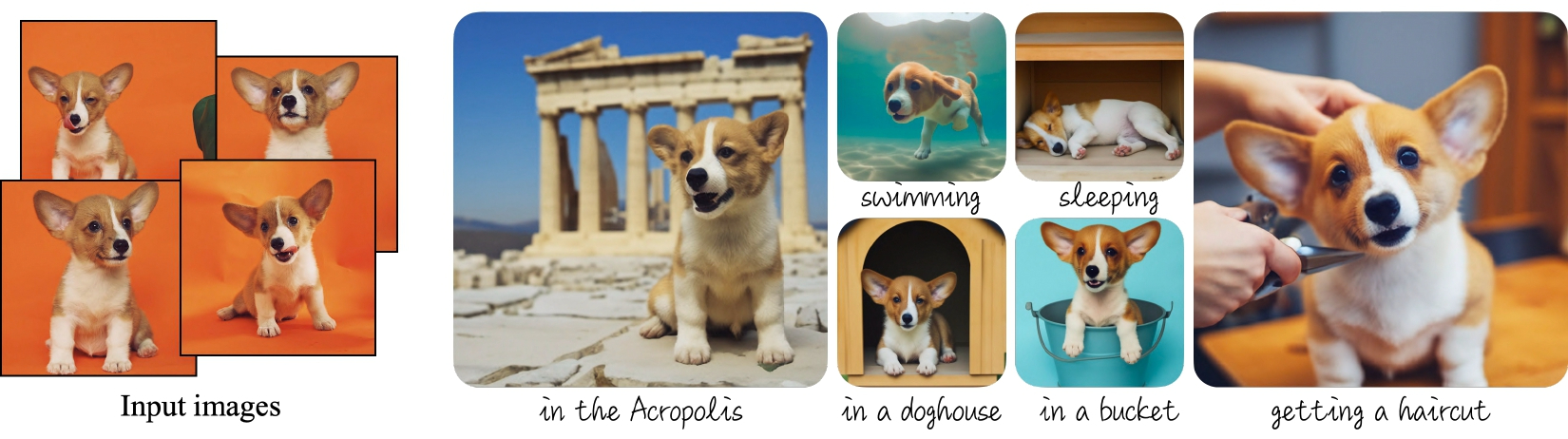
@@ -499,9 +500,68 @@ You may also run inference from any of the [saved training checkpoints](#inferen
## IF
You can use the lora and full dreambooth scripts to also train the text to image [IF model](https://huggingface.co/DeepFloyd/IF-I-XL-v1.0). A few alternative cli flags are needed due to the model size, the expected input resolution, and the text encoder conventions.
You can use the lora and full dreambooth scripts to train the text to image [IF model](https://huggingface.co/DeepFloyd/IF-I-XL-v1.0) and the stage II upscaler
Note that IF has a predicted variance, and our finetuning scripts only train the models predicted error, so for finetuned IF models we switch to a fixed
variance schedule. The full finetuning scripts will update the scheduler config for the full saved model. However, when loading saved LoRA weights, you
Additionally, a few alternative cli flags are needed for IF.
`--resolution=64`: IF is a pixel space diffusion model. In order to operate on un-compressed pixels, the input images are of a much smaller resolution.
`--pre_compute_text_embeddings`: IF uses [T5](https://huggingface.co/docs/transformers/model_doc/t5) for its text encoder. In order to save GPU memory, we pre compute all text embeddings and then de-allocate
T5.
`--tokenizer_max_length=77`: T5 has a longer default text length, but the default IF encoding procedure uses a smaller number.
`--text_encoder_use_attention_mask`: T5 passes the attention mask to the text encoder.
### Tips and Tricks
We find LoRA to be sufficient for finetuning the stage I model as the low resolution of the model makes representing finegrained detail hard regardless.
For common and/or not-visually complex object concepts, you can get away with not-finetuning the upscaler. Just be sure to adjust the prompt passed to the
upscaler to remove the new token from the instance prompt. I.e. if your stage I prompt is "a sks dog", use "a dog" for your stage II prompt.
For finegrained detail like faces that aren't present in the original training set, we find that full finetuning of the stage II upscaler is better than
LoRA finetuning stage II.
For finegrained detail like faces, we find that lower learning rates along with larger batch sizes work best.
For stage II, we find that lower learning rates are also needed.
We found experimentally that the DDPM scheduler with the default larger number of denoising steps to sometimes work better than the DPM Solver scheduler
used in the training scripts.
### Stage II additional validation images
The stage II validation requires images to upscale, we can download a downsized version of the training set:
`--skip_save_text_encoder`: When training the full model, this will skip saving the entire T5 with the finetuned model. You can still load the pipeline
with a T5 loaded from the original model.
`use_8bit_adam`: Due to the size of the optimizer states, we recommend training the full XL IF model with 8bit adam.
`--learning_rate=1e-7`: For full dreambooth, IF requires very low learning rates. With higher learning rates model quality will degrade. Note that it is
likely the learning rate can be increased with larger batch sizes.
Using 8bit adam and a batch size of 4, the model can be trained in ~48 GB VRAM.
We support fine-tuning of the UNet shipped in [Stable Diffusion XL](https://huggingface.co/papers/2307.01952) with DreamBooth and LoRA via the `train_dreambooth_lora_sdxl.py` script. Please refer to the docs [here](https://github.com/huggingface/diffusers/blob/main/examples/dreambooth/README_sdxl.md).
We recommend this type of validation as it can be useful for model debugging. Note that you need `wandb` installed to use this. You can install `wandb` by running `pip install wandb`.
@@ -204,3 +207,5 @@ speed and quality during performance:
Particularly, `image_guidance_scale` and `guidance_scale` can have a profound impact
on the generated ("edited") image (see [here](https://twitter.com/RisingSayak/status/1628392199196151808?s=20) for an example).
If you're looking for some interesting ways to use the InstructPix2Pix training methodology, we welcome you to check out this blog post: [Instruction-tuning Stable Diffusion with InstructPix2Pix](https://huggingface.co/blog/instruction-tuning-sd).
image = pipe("A picture of a sks dog in a bucket", num_inference_steps=25).images[0]
```
<Tip>
If your LoRA parameters involve the UNet as well as the Text Encoder, then passing
`cross_attention_kwargs={"scale": 0.5}` will apply the `scale` value to both the UNet
and the Text Encoder.
</Tip>
Note that the use of [`~diffusers.loaders.LoraLoaderMixin.load_lora_weights`] is preferred to [`~diffusers.loaders.UNet2DConditionLoadersMixin.load_attn_procs`] for loading LoRA parameters. This is because
[`~diffusers.loaders.LoraLoaderMixin.load_lora_weights`] can handle the following situations:
@@ -272,4 +278,79 @@ Note that the use of [`~diffusers.loaders.LoraLoaderMixin.load_lora_weights`] is
* LoRA parameters that have separate identifiers for the UNet and the text encoder such as: [`"sayakpaul/dreambooth"`](https://huggingface.co/sayakpaul/dreambooth).
**Note** that it is possible to provide a local directory path to [`~diffusers.loaders.LoraLoaderMixin.load_lora_weights`] as well as [`~diffusers.loaders.UNet2DConditionLoadersMixin.load_attn_procs`]. To know about the supported inputs,
refer to the respective docstrings.
refer to the respective docstrings.
## Unloading LoRA parameters
You can call [`~diffusers.loaders.LoraLoaderMixin.unload_lora_weights`] on a pipeline to unload the LoRA parameters.
## Supporting A1111 themed LoRA checkpoints from Diffusers
To provide seamless interoperability with A1111 to our users, we support loading A1111 formatted
LoRA checkpoints using [`~diffusers.loaders.LoraLoaderMixin.load_lora_weights`] in a limited capacity.
In this section, we explain how to load an A1111 formatted LoRA checkpoint from [CivitAI](https://civitai.com/)
in Diffusers and perform inference with it.
First, download a checkpoint. We'll use
[this one](https://civitai.com/models/13239/light-and-shadow) for demonstration purposes.
@@ -76,13 +76,25 @@ Launch the [PyTorch training script](https://github.com/huggingface/diffusers/bl
Specify the `MODEL_NAME` environment variable (either a Hub model repository id or a path to the directory containing the model weights) and pass it to the [`pretrained_model_name_or_path`](https://huggingface.co/docs/diffusers/en/api/diffusion_pipeline#diffusers.DiffusionPipeline.from_pretrained.pretrained_model_name_or_path) argument.
To finetune on your own dataset, prepare the dataset according to the format required by 🤗 [Datasets](https://huggingface.co/docs/datasets/index). You can [upload your dataset to the Hub](https://huggingface.co/docs/datasets/image_dataset#upload-dataset-to-the-hub), or you can [prepare a local folder with your files](https://huggingface.co/docs/datasets/image_dataset#imagefolder).
To finetune on your own dataset, prepare the dataset according to the format required by 🤗 [Datasets](https://huggingface.co/docs/datasets/index). You can [upload your dataset to the Hub](https://huggingface.co/docs/datasets/image_dataset#upload-dataset-to-the-hub), or you can [prepare a local folder with your files](https://huggingface.co/docs/datasets/image_dataset#imagefolder).
@@ -14,8 +14,6 @@ specific language governing permissions and limitations under the License.
# Textual Inversion
[[open-in-colab]]
[Textual Inversion](https://arxiv.org/abs/2208.01618) is a technique for capturing novel concepts from a small number of example images. While the technique was originally demonstrated with a [latent diffusion model](https://github.com/CompVis/latent-diffusion), it has since been applied to other model variants like [Stable Diffusion](https://huggingface.co/docs/diffusers/main/en/conceptual/stable_diffusion). The learned concepts can be used to better control the images generated from text-to-image pipelines. It learns new "words" in the text encoder's embedding space, which are used within text prompts for personalized image generation.
@@ -26,8 +26,9 @@ This tutorial will teach you how to train a [`UNet2DModel`] from scratch on a su
Before you begin, make sure you have 🤗 Datasets installed to load and preprocess image datasets, and 🤗 Accelerate, to simplify training on any number of GPUs. The following command will also install [TensorBoard](https://www.tensorflow.org/tensorboard) to visualize training metrics (you can also use [Weights & Biases](https://docs.wandb.ai/) to track your training).
```bash
!pip install diffusers[training]
```py
# uncomment to install the necessary libraries in Colab
#!pip install diffusers[training]
```
We encourage you to share your model with the community, and in order to do that, you'll need to login to your Hugging Face account (create one [here](https://hf.co/join) if you don't already have one!). You can login from a notebook and enter your token when prompted:
@@ -312,7 +313,7 @@ Now you can wrap all these components together in a training loop with 🤗 Acce
@@ -407,9 +408,9 @@ Once training is complete, take a look at the final 🦋 images 🦋 generated b
## Next steps
Unconditional image generation is one example of a task that can be trained. You can explore other tasks and training techniques by visiting the [🧨 Diffusers Training Examples](./training/overview) page. Here are some examples of what you can learn:
Unconditional image generation is one example of a task that can be trained. You can explore other tasks and training techniques by visiting the [🧨 Diffusers Training Examples](../training/overview) page. Here are some examples of what you can learn:
* [Textual Inversion](./training/text_inversion), an algorithm that teaches a model a specific visual concept and integrates it into the generated image.
* [DreamBooth](./training/dreambooth), a technique for generating personalized images of a subject given several input images of the subject.
* [Guide](./training/text2image) to finetuning a Stable Diffusion model on your own dataset.
* [Guide](./training/lora) to using LoRA, a memory-efficient technique for finetuning really large models faster.
* [Textual Inversion](../training/text_inversion), an algorithm that teaches a model a specific visual concept and integrates it into the generated image.
* [DreamBooth](../training/dreambooth), a technique for generating personalized images of a subject given several input images of the subject.
* [Guide](../training/text2image) to finetuning a Stable Diffusion model on your own dataset.
* [Guide](../training/lora) to using LoRA, a memory-efficient technique for finetuning really large models faster.
@@ -20,12 +20,12 @@ The [`DiffusionPipeline`] is the easiest way to use a pre-trained diffusion syst
Start by creating an instance of [`DiffusionPipeline`] and specify which pipeline [checkpoint](https://huggingface.co/models?library=diffusers&sort=downloads) you would like to download.
In this guide, you'll use [`DiffusionPipeline`] for text-to-image generation with [Latent Diffusion](https://huggingface.co/CompVis/ldm-text2im-large-256):
In this guide, you'll use [`DiffusionPipeline`] for text-to-image generation with [`runwayml/stable-diffusion-v1-5`](https://huggingface.co/runwayml/stable-diffusion-v1-5):
The Stable Diffusion pipeline is mediocre at generating images that are either very bright or dark as explained in the [Common Diffusion Noise Schedules and Sample Steps are Flawed](https://huggingface.co/papers/2305.08891) paper. The solutions proposed in the paper are currently implemented in the [`DDIMScheduler`] which you can use to improve the lighting in your images.
<Tip>
💡 Take a look at the paper linked above for more details about the proposed solutions!
</Tip>
One of the solutions is to train a model with *v prediction* and *v loss*. Add the following flag to the [`train_text_to_image.py`](https://github.com/huggingface/diffusers/blob/main/examples/text_to_image/train_text_to_image.py) or [`train_text_to_image_lora.py`](https://github.com/huggingface/diffusers/blob/main/examples/text_to_image/train_text_to_image_lora.py) scripts to enable `v_prediction`:
```bash
--prediction_type="v_prediction"
```
For example, let's use the [`ptx0/pseudo-journey-v2`](https://huggingface.co/ptx0/pseudo-journey-v2) checkpoint which has been finetuned with `v_prediction`.
Next, configure the following parameters in the [`DDIMScheduler`]:
1. `rescale_betas_zero_snr=True`, rescales the noise schedule to zero terminal signal-to-noise ratio (SNR)
2. `timestep_spacing="trailing"`, starts sampling from the last timestep
```py
>>> from diffusers import DiffusionPipeline, DDIMScheduler
@@ -12,6 +12,8 @@ specific language governing permissions and limitations under the License.
# Load community pipelines
[[open-in-colab]]
Community pipelines are any [`DiffusionPipeline`] class that are different from the original implementation as specified in their paper (for example, the [`StableDiffusionControlNetPipeline`] corresponds to the [Text-to-Image Generation with ControlNet Conditioning](https://arxiv.org/abs/2302.05543) paper). They provide additional functionality or extend the original implementation of a pipeline.
There are many cool community pipelines like [Speech to Image](https://github.com/huggingface/diffusers/tree/main/examples/community#speech-to-image) or [Composable Stable Diffusion](https://github.com/huggingface/diffusers/tree/main/examples/community#composable-stable-diffusion), and you can find all the official community pipelines [here](https://github.com/huggingface/diffusers/tree/main/examples/community).
Get started by creating a [`StableDiffusionImg2ImgPipeline`] with a pretrained Stable Diffusion model like [`nitrosocke/Ghibli-Diffusion`](https://huggingface.co/nitrosocke/Ghibli-Diffusion).
<!--Copyright 2023 The HuggingFace Team. All rights reserved.
Licensed under the Apache License, Version 2.0 (the "License"); you may not use this file except in compliance with
the License. You may obtain a copy of the License at
http://www.apache.org/licenses/LICENSE-2.0
Unless required by applicable law or agreed to in writing, software distributed under the License is distributed on
an "AS IS" BASIS, WITHOUT WARRANTIES OR CONDITIONS OF ANY KIND, either express or implied. See the License for the
specific language governing permissions and limitations under the License.
-->
# Using KerasCV Stable Diffusion Checkpoints in Diffusers
<Tip warning={true}>
This is an experimental feature.
</Tip>
[KerasCV](https://github.com/keras-team/keras-cv/) provides APIs for implementing various computer vision workflows. It
also provides the Stable Diffusion [v1 and v2](https://github.com/keras-team/keras-cv/blob/master/keras_cv/models/stable_diffusion)
models. Many practitioners find it easy to fine-tune the Stable Diffusion models shipped by KerasCV. However, as of this writing, KerasCV offers limited support to experiment with Stable Diffusion models for inference and deployment. On the other hand,
Diffusers provides tooling dedicated to this purpose (and more), such as different [noise schedulers](https://huggingface.co/docs/diffusers/using-diffusers/schedulers), [flash attention](https://huggingface.co/docs/diffusers/optimization/xformers), and [other
How about fine-tuning Stable Diffusion models in KerasCV and exporting them such that they become compatible with Diffusers to combine the
best of both worlds? We have created a [tool](https://huggingface.co/spaces/sayakpaul/convert-kerascv-sd-diffusers) that
lets you do just that! It takes KerasCV Stable Diffusion checkpoints and exports them to Diffusers-compatible checkpoints.
More specifically, it first converts the checkpoints to PyTorch and then wraps them into a
[`StableDiffusionPipeline`](https://huggingface.co/docs/diffusers/api/pipelines/stable_diffusion/overview) which is ready
for inference. Finally, it pushes the converted checkpoints to a repository on the Hugging Face Hub.
We welcome you to try out the tool [here](https://huggingface.co/spaces/sayakpaul/convert-kerascv-sd-diffusers)
and share feedback via [discussions](https://huggingface.co/spaces/sayakpaul/convert-kerascv-sd-diffusers/discussions/new).
## Getting Started
First, you need to obtain the fine-tuned KerasCV Stable Diffusion checkpoints. We provide an
overview of the different ways Stable Diffusion models can be fine-tuned [using `diffusers`](https://huggingface.co/docs/diffusers/training/overview). For the Keras implementation of some of these methods, you can check out these resources:
* [Teach StableDiffusion new concepts via Textual Inversion](https://keras.io/examples/generative/fine_tune_via_textual_inversion/)
Stable Diffusion is comprised of the following models:
* Text encoder
* UNet
* VAE
Depending on the fine-tuning task, we may fine-tune one or more of these components (the VAE is almost always left untouched). Here are some common combinations:
* DreamBooth: UNet and text encoder
* Classical text to image fine-tuning: UNet
* Textual Inversion: Just the newly initialized embeddings in the text encoder
### Performing the Conversion
Let's use [this checkpoint](https://huggingface.co/sayakpaul/textual-inversion-kerasio/resolve/main/textual_inversion_kerasio.h5) which was generated
by conducting Textual Inversion with the following "placeholder token": `<my-funny-cat-token>`.
On the tool, we supply the following things:
* Path(s) to download the fine-tuned checkpoint(s) (KerasCV)
* An HF token
* Placeholder token (only applicable for Textual Inversion)
_**Note that if you specified a `placeholder_token` while performing the conversion, the tool will log it accordingly. Refer
to the model card of [this repository](https://huggingface.co/sayakpaul/textual-inversion-cat-kerascv_sd_diffusers_pipeline)
as an example.**_
We welcome you to use the tool for various Stable Diffusion fine-tuning scenarios and let us know your feedback! Here are some examples
of Diffusers checkpoints that were obtained using the tool:
* [sayakpaul/text-unet-dogs-kerascv_sd_diffusers_pipeline](https://huggingface.co/sayakpaul/text-unet-dogs-kerascv_sd_diffusers_pipeline) (DreamBooth with both the text encoder and UNet fine-tuned)
* [sayakpaul/unet-dogs-kerascv_sd_diffusers_pipeline](https://huggingface.co/sayakpaul/unet-dogs-kerascv_sd_diffusers_pipeline) (DreamBooth with only the UNet fine-tuned)
## Incorporating Diffusers Goodies 🎁
Diffusers provides various options that one can leverage to experiment with different inference setups. One particularly
useful option is the use of a different noise scheduler during inference other than what was used during fine-tuning.
Let's try out the [`DPMSolverMultistepScheduler`](https://huggingface.co/docs/diffusers/main/en/api/schedulers/multistep_dpm_solver)
which is different from the one ([`DDPMScheduler`](https://huggingface.co/docs/diffusers/main/en/api/schedulers/ddpm)) used during
fine-tuning.
You can read more details about this process in [this section](https://huggingface.co/docs/diffusers/using-diffusers/schedulers).
```py
from diffusers import DiffusionPipeline, DPMSolverMultistepScheduler
One can also continue fine-tuning from these Diffusers checkpoints by leveraging some relevant tools from Diffusers. Refer [here](https://huggingface.co/docs/diffusers/training/overview) for
more details. For inference-specific optimizations, refer [here](https://huggingface.co/docs/diffusers/main/en/optimization/fp16).
## Known Limitations
* Only Stable Diffusion v1 checkpoints are supported for conversion in this tool.
@@ -12,6 +12,8 @@ specific language governing permissions and limitations under the License.
# Load pipelines, models, and schedulers
[[open-in-colab]]
Having an easy way to use a diffusion system for inference is essential to 🧨 Diffusers. Diffusion systems often consist of multiple components like parameterized models, tokenizers, and schedulers that interact in complex ways. That is why we designed the [`DiffusionPipeline`] to wrap the complexity of the entire diffusion system into an easy-to-use API, while remaining flexible enough to be adapted for other use cases, such as loading each component individually as building blocks to assemble your own diffusion system.
Everything you need for inference or training is accessible with the `from_pretrained()` method.
@@ -172,7 +174,7 @@ A checkpoint variant is usually a checkpoint where it's weights are:
</Tip>
Otherwise, a variant is **identical** to the original checkpoint. They have exactly the same serialization format (like [Safetensors](./using-diffusers/using_safetensors)), model structure, and weights have identical tensor shapes.
Otherwise, a variant is **identical** to the original checkpoint. They have exactly the same serialization format (like [Safetensors](./using_safetensors)), model structure, and weights have identical tensor shapes.
<!--Copyright 2023 The HuggingFace Team. All rights reserved.
Licensed under the Apache License, Version 2.0 (the "License"); you may not use this file except in compliance with
the License. You may obtain a copy of the License at
http://www.apache.org/licenses/LICENSE-2.0
Unless required by applicable law or agreed to in writing, software distributed under the License is distributed on
an "AS IS" BASIS, WITHOUT WARRANTIES OR CONDITIONS OF ANY KIND, either express or implied. See the License for the
specific language governing permissions and limitations under the License.
-->
# Load different Stable Diffusion formats
[[open-in-colab]]
Stable Diffusion models are available in different formats depending on the framework they're trained and saved with, and where you download them from. Converting these formats for use in 🤗 Diffusers allows you to use all the features supported by the library, such as [using different schedulers](schedulers) for inference, [building your custom pipeline](write_own_pipeline), and a variety of techniques and methods for [optimizing inference speed](./optimization/opt_overview).
<Tip>
We highly recommend using the `.safetensors` format because it is more secure than traditional pickled files which are vulnerable and can be exploited to execute any code on your machine (learn more in the [Load safetensors](using_safetensors) guide).
</Tip>
This guide will show you how to convert other Stable Diffusion formats to be compatible with 🤗 Diffusers.
## PyTorch .ckpt
The checkpoint - or `.ckpt` - format is commonly used to store and save models. The `.ckpt` file contains the entire model and is typically several GBs in size. While you can load and use a `.ckpt` file directly with the [`~StableDiffusionPipeline.from_single_file`] method, it is generally better to convert the `.ckpt` file to 🤗 Diffusers so both formats are available.
There are two options for converting a `.ckpt` file; use a Space to convert the checkpoint or convert the `.ckpt` file with a script.
### Convert with a Space
The easiest and most convenient way to convert a `.ckpt` file is to use the [SD to Diffusers](https://huggingface.co/spaces/diffusers/sd-to-diffusers) Space. You can follow the instructions on the Space to convert the `.ckpt` file.
This approach works well for basic models, but it may struggle with more customized models. You'll know the Space failed if it returns an empty pull request or error. In this case, you can try converting the `.ckpt` file with a script.
### Convert with a script
🤗 Diffusers provides a [conversion script](https://github.com/huggingface/diffusers/blob/main/scripts/convert_original_stable_diffusion_to_diffusers.py) for converting `.ckpt` files. This approach is more reliable than the Space above.
Before you start, make sure you have a local clone of 🤗 Diffusers to run the script and log in to your Hugging Face account so you can open pull requests and push your converted model to the Hub.
```bash
huggingface-cli login
```
To use the script:
1. Git clone the repository containing the `.ckpt` file you want to convert. For this example, let's convert this [TemporalNet](https://huggingface.co/CiaraRowles/TemporalNet) `.ckpt` file:
2. Open a pull request on the repository where you're converting the checkpoint from:
```bash
cd TemporalNet && git fetch origin refs/pr/13:pr/13
git checkout pr/13
```
3. There are several input arguments to configure in the conversion script, but the most important ones are:
- `checkpoint_path`: the path to the `.ckpt` file to convert.
- `original_config_file`: a YAML file defining the configuration of the original architecture. If you can't find this file, try searching for the YAML file in the GitHub repository where you found the `.ckpt` file.
- `dump_path`: the path to the converted model.
For example, you can take the `cldm_v15.yaml` file from the [ControlNet](https://github.com/lllyasviel/ControlNet/tree/main/models) repository because the TemporalNet model is a Stable Diffusion v1.5 and ControlNet model.
4. Now you can run the script to convert the `.ckpt` file:
5. Once the conversion is done, upload your converted model and test out the resulting [pull request](https://huggingface.co/CiaraRowles/TemporalNet/discussions/13)!
```bash
git push origin pr/13:refs/pr/13
```
## Keras .pb or .h5
<Tip warning={true}>
🧪 This is an experimental feature. Only Stable Diffusion v1 checkpoints are supported by the Convert KerasCV Space at the moment.
</Tip>
[KerasCV](https://keras.io/keras_cv/) supports training for [Stable Diffusion](https://github.com/keras-team/keras-cv/blob/master/keras_cv/models/stable_diffusion) v1 and v2. However, it offers limited support for experimenting with Stable Diffusion models for inference and deployment whereas 🤗 Diffusers has a more complete set of features for this purpose, such as different [noise schedulers](https://huggingface.co/docs/diffusers/using-diffusers/schedulers), [flash attention](https://huggingface.co/docs/diffusers/optimization/xformers), and [other
The [Convert KerasCV](https://huggingface.co/spaces/sayakpaul/convert-kerascv-sd-diffusers) Space converts `.pb` or `.h5` files to PyTorch, and then wraps them in a [`StableDiffusionPipeline`] so it is ready for inference. The converted checkpoint is stored in a repository on the Hugging Face Hub.
For this example, let's convert the [`sayakpaul/textual-inversion-kerasio`](https://huggingface.co/sayakpaul/textual-inversion-kerasio/tree/main) checkpoint which was trained with Textual Inversion. It uses the special token `<my-funny-cat>` to personalize images with cats.
The Convert KerasCV Space allows you to input the following:
* Your Hugging Face token.
* Paths to download the UNet and text encoder weights from. Depending on how the model was trained, you don't necessarily need to provide the paths to both the UNet and text encoder. For example, Textual Inversion only requires the embeddings from the text encoder and a text-to-image model only requires the UNet weights.
* Placeholder token is only applicable for textual inversion models.
* The `output_repo_prefix` is the name of the repository where the converted model is stored.
Click the **Submit** button to automatically convert the KerasCV checkpoint! Once the checkpoint is successfully converted, you'll see a link to the new repository containing the converted checkpoint. Follow the link to the new repository, and you'll see the Convert KerasCV Space generated a model card with an inference widget to try out the converted model.
If you prefer to run inference with code, click on the **Use in Diffusers** button in the upper right corner of the model card to copy and paste the code snippet:
[Automatic1111](https://github.com/AUTOMATIC1111/stable-diffusion-webui) (A1111) is a popular web UI for Stable Diffusion that supports model sharing platforms like [Civitai](https://civitai.com/). Models trained with the Low-Rank Adaptation (LoRA) technique are especially popular because they're fast to train and have a much smaller file size than a fully finetuned model. 🤗 Diffusers supports loading A1111 LoRA checkpoints with [`~loaders.LoraLoaderMixin.load_lora_weights`]:
```py
from diffusers import DiffusionPipeline, UniPCMultistepScheduler
Download a LoRA checkpoint from Civitai; this example uses the [Howls Moving Castle,Interior/Scenery LoRA (Ghibli Stlye)](https://civitai.com/models/14605?modelVersionId=19998) checkpoint, but feel free to try out any LoRA checkpoint!
prompt = "masterpiece, illustration, ultra-detailed, cityscape, san francisco, golden gate bridge, california, bay area, in the snow, beautiful detailed starry sky"
negative_prompt = "lowres, cropped, worst quality, low quality, normal quality, artifacts, signature, watermark, username, blurry, more than one bridge, bad architecture"
images = pipeline(
prompt=prompt,
negative_prompt=negative_prompt,
width=512,
height=512,
num_inference_steps=25,
num_images_per_prompt=4,
generator=torch.manual_seed(0),
).images
```
Finally, create a helper function to display the images:
@@ -12,6 +12,8 @@ specific language governing permissions and limitations under the License.
# Create reproducible pipelines
[[open-in-colab]]
Reproducibility is important for testing, replicating results, and can even be used to [improve image quality](reusing_seeds). However, the randomness in diffusion models is a desired property because it allows the pipeline to generate different images every time it is run. While you can't expect to get the exact same results across platforms, you can expect results to be reproducible across releases and platforms within a certain tolerance range. Even then, tolerance varies depending on the diffusion pipeline and checkpoint.
This is why it's important to understand how to control sources of randomness in diffusion models or use deterministic algorithms.
@@ -111,7 +113,7 @@ print(np.abs(image).sum())
The result is not the same even though you're using an identical seed because the GPU uses a different random number generator than the CPU.
To circumvent this problem, 🧨 Diffusers has a [`randn_tensor`](#diffusers.utils.randn_tensor) function for creating random noise on the CPU, and then moving the tensor to a GPU if necessary. The `randn_tensor` function is used everywhere inside the pipeline, allowing the user to **always** pass a CPU `Generator` even if the pipeline is run on a GPU.
To circumvent this problem, 🧨 Diffusers has a [`~diffusers.utils.randn_tensor`] function for creating random noise on the CPU, and then moving the tensor to a GPU if necessary. The `randn_tensor` function is used everywhere inside the pipeline, allowing the user to **always** pass a CPU `Generator` even if the pipeline is run on a GPU.
You'll see the results are much closer now!
@@ -147,9 +149,6 @@ susceptible to precision error propagation. Don't expect similar results across
different GPU hardware or PyTorch versions. In this case, you'll need to run
exactly the same hardware and PyTorch version for full reproducibility.
### randn_tensor
[[autodoc]] diffusers.utils.randn_tensor
## Deterministic algorithms
You can also configure PyTorch to use deterministic algorithms to create a reproducible pipeline. However, you should be aware that deterministic algorithms may be slower than nondeterministic ones and you may observe a decrease in performance. But if reproducibility is important to you, then this is the way to go!
@@ -12,6 +12,8 @@ specific language governing permissions and limitations under the License.
# Improve image quality with deterministic generation
[[open-in-colab]]
A common way to improve the quality of generated images is with *deterministic batch generation*, generate a batch of images and select one image to improve with a more detailed prompt in a second round of inference. The key is to pass a list of [`torch.Generator`](https://pytorch.org/docs/stable/generated/torch.Generator.html#generator)'s to the pipeline for batched image generation, and tie each `Generator` to a seed so you can reuse it for an image.
Let's use [`runwayml/stable-diffusion-v1-5`](runwayml/stable-diffusion-v1-5) for example, and generate several versions of the following prompt:
@@ -12,6 +12,8 @@ specific language governing permissions and limitations under the License.
# Schedulers
[[open-in-colab]]
Diffusion pipelines are inherently a collection of diffusion models and schedulers that are partly independent from each other. This means that one is able to switch out parts of the pipeline to better customize
a pipeline to one's use case. The best example of this is the [Schedulers](../api/schedulers/overview.mdx).
@@ -28,18 +30,15 @@ The following paragraphs show how to do so with the 🧨 Diffusers library.
## Load pipeline
Let's start by loading the stable diffusion pipeline.
Remember that you have to be a registered user on the 🤗 Hugging Face Hub, and have "click-accepted" the [license](https://huggingface.co/runwayml/stable-diffusion-v1-5) in order to use stable diffusion.
Let's start by loading the [`runwayml/stable-diffusion-v1-5`](https://huggingface.co/runwayml/stable-diffusion-v1-5) model in the [`DiffusionPipeline`]:
[safetensors](https://github.com/huggingface/safetensors) is a safe and fast file format for storing and loading tensors. Typically, PyTorch model weights are saved or *pickled* into a `.bin` file with Python's [`pickle`](https://docs.python.org/3/library/pickle.html) utility. However, `pickle` is not secure and pickled files may contain malicious code that can be executed. safetensors is a secure alternative to `pickle`, making it ideal for sharing model weights.
This guide will show you how you load `.safetensor` files, and how to convert Stable Diffusion model weights stored in other formats to `.safetensor`. Before you start, make sure you have safetensors installed:
```bash
!pip install safetensors
```py
# uncomment to install the necessary libraries in Colab
#!pip install safetensors
```
If you look at the [`runwayml/stable-diffusion-v1-5`](https://huggingface.co/runwayml/stable-diffusion-v1-5/tree/main) repository, you'll see weights inside the `text_encoder`, `unet` and `vae` subfolders are stored in the `.safetensors` format. By default, 🤗 Diffusers automatically loads these `.safetensors` files from their subfolders if they're available in the model repository.
@@ -18,26 +21,19 @@ from diffusers import DiffusionPipeline
However, model weights are not necessarily stored in separate subfolders like in the example above. Sometimes, all the weights are stored in a single `.safetensors` file. In this case, if the weights are Stable Diffusion weights, you can load the file directly with the [`~diffusers.loaders.FromCkptMixin.from_ckpt`] method:
However, model weights are not necessarily stored in separate subfolders like in the example above. Sometimes, all the weights are stored in a single `.safetensors` file. In this case, if the weights are Stable Diffusion weights, you can load the file directly with the [`~diffusers.loaders.FromSingleFileMixin.from_single_file`] method:
Not all weights on the Hub are available in the `.safetensors` format, and you may encounter weights stored as `.bin`. In this case, use the Space below to convert the weights to `.safetensors`. The Convert Space downloads the pickled weights, converts them, and opens a Pull Request to upload the newly converted `.safetensors` file on the Hub. This way, if there is any malicious code contained in the pickled files, they're uploaded to the Hub - which has a [security scanner](https://huggingface.co/docs/hub/security-pickle#hubs-security-scanner) to detect unsafe files and suspicious pickle imports - instead of your computer.
<iframe
src="https://safetensors-convert.hf.space"
frameborder="0"
width="850"
height="450"
></iframe>
Not all weights on the Hub are available in the `.safetensors` format, and you may encounter weights stored as `.bin`. In this case, use the [Convert Space](https://huggingface.co/spaces/diffusers/convert) to convert the weights to `.safetensors`. The Convert Space downloads the pickled weights, converts them, and opens a Pull Request to upload the newly converted `.safetensors` file on the Hub. This way, if there is any malicious code contained in the pickled files, they're uploaded to the Hub - which has a [security scanner](https://huggingface.co/docs/hub/security-pickle#hubs-security-scanner) to detect unsafe files and suspicious pickle imports - instead of your computer.
You can use the model with the new `.safetensors` weights by specifying the reference to the Pull Request in the `revision` parameter (you can also test it in this [Check PR](https://huggingface.co/spaces/diffusers/check_pr) Space on the Hub), for example `refs/pr/22`:
Also, please check out the documentation of the [compel](https://github.com/damian0815/compel) library for
more information.
Some files were not shown because too many files have changed in this diff
Show More
Reference in New Issue
Block a user
Blocking a user prevents them from interacting with repositories, such as opening or commenting on pull requests or issues. Learn more about blocking a user.
 patrick@huggingface.co