Compare commits
142 Commits
| Author | SHA1 | Date | |
|---|---|---|---|
 Patrick von Platen Patrick von Platen
|
0dc0f98526 | ||
|
Sayak Paul
|
3045fb2763 | ||
|
clarencechen
|
7b0ba4820a | ||
|
Patrick von Platen
|
8d5906a331 | ||
|
Patrick von Platen
|
17470057d2 | ||
|
XinyuYe-Intel
|
a5b242d30d | ||
|
Mishig
|
a121e05feb | ||
|
nupurkmr9
|
3979aac996 | ||
|
Will Berman
|
7e6886f5e9 | ||
|
superhero-7
|
a4c91be73b | ||
|
hwuebben
|
3becd368b1 | ||
|
Chanchana Sornsoontorn
|
c8fdfe4572 | ||
|
asfiyab-nvidia
|
bba1c1de15 | ||
|
1lint
|
86ecd4b795 | ||
|
cmdr2
|
bdeff4d64a | ||
|
Will Berman
|
fc1883918f | ||
|
Will Berman
|
f0c74e9a75 | ||
|
Patrick von Platen
|
4bc157ffa9 | ||
|
Patrick von Platen
|
f2df39fa0e | ||
|
Cristian Garcia
|
8ecdd3ef65 | ||
|
YiYi Xu
|
cd8b7507c2 | ||
|
Sayak Paul
|
3b641eabe9 | ||
|
Patrick von Platen
|
703307efcc | ||
|
Patrick von Platen
|
ed8fd38337 | ||
|
Patrick von Platen
|
ca783a0f1f | ||
|
Patrick von Platen
|
beb848e2b6 | ||
|
Patrick von Platen
|
cfc99adf0f | ||
|
Tommaso De Rossi
|
807f69b328 | ||
|
Will Berman
|
b811964a7b | ||
|
YiYi Xu
|
1bd4c9e93d | ||
|
YiYi Xu
|
eb2ef31606 | ||
|
Takuma Mori
|
5c9dd0af95 | ||
|
Steven Liu
|
d0f258206d | ||
|
Joseph Coffland
|
3eaead0c4a | ||
|
Patrick von Platen
|
3bf5ce21ad | ||
|
Patrick von Platen
|
3a9d7d9758 | ||
|
YiYi Xu
|
e748b3c6e1 | ||
|
Patrick von Platen
|
46c52f9b96 | ||
|
Andreas Steiner
|
d06e06940b | ||
|
Patrick von Platen
|
0a73b4d3cd | ||
|
Sayak Paul
|
e126a82cc5 | ||
|
Patrick von Platen
|
e7534542a2 | ||
|
Andranik Movsisyan
|
b9b891621e | ||
|
Ernie Chu
|
a43934371a | ||
|
Pedro Cuenca
|
caa5884e8a | ||
|
Sayak Paul
|
fa736e321d | ||
|
Patrick von Platen
|
a4b233e5b5 | ||
|
Nipun Jindal
|
524535b5f2 | ||
|
Sean Sube
|
7b2407f4d7 | ||
|
Will Berman
|
639f6455b4 | ||
|
Andy
|
9d7c08f95e | ||
|
Pedro Cuenca
|
dc277501c7 | ||
|
Susung Hong
|
0df47efee2 | ||
|
Sayak Paul
|
5a7d35e29c | ||
|
Patrick von Platen
|
0c72006e3a | ||
|
Sayak Paul
|
a89a14fa7a | ||
|
Sayak Paul
|
e607a582cf | ||
|
Will Berman
|
ea39cd7e64 | ||
|
Will Berman
|
98c5e5da31 | ||
|
Will Berman
|
2d52e81cb9 | ||
|
Chanchana Sornsoontorn
|
52c4d32d41 | ||
|
Will Berman
|
c6180a311c | ||
|
Pedro Cuenca
|
e3095c5f47 | ||
|
Pedro Cuenca
|
526827c3d1 | ||
|
George Ogden
|
cb63febf2e | ||
|
Will Berman
|
8c6b47cfde | ||
|
Will Berman
|
67ec9cf513 | ||
|
Will Berman
|
80bc0c0ced | ||
|
Patrick von Platen
|
091a058236 | ||
|
J N Hearns
|
881a6b58c3 | ||
|
Steven Liu
|
cb9d77af23 | ||
|
Patrick von Platen
|
8b451eb63b | ||
|
Patrick von Platen
|
8369196703 | ||
|
Mishig
|
4f48476dd6 | ||
|
Pedro Cuenca
|
fbc9a736dd | ||
|
Rogério Júnior
|
67c3518f68 | ||
|
Andranik Movsisyan
|
ba49272db8 | ||
|
William Berman
|
074d281ae0 | ||
|
William Berman
|
953c9d14eb | ||
|
luanjintai
|
85f1c19282 | ||
|
luanjintai
|
b5d0a9131d | ||
|
Pedro Cuenca
|
983a7fbfd8 | ||
|
William Berman
|
c413353e8e | ||
|
William Berman
|
8db5e5b37d | ||
|
William Berman
|
707341aebe | ||
|
William Berman
|
26b4319ac5 | ||
|
William Berman
|
18ebd57bd8 | ||
|
William Berman
|
b6cc050245 | ||
|
William Berman
|
0cbefefac3 | ||
|
William Berman
|
1875c35aeb | ||
|
William Berman
|
1dc856e508 | ||
|
Will Berman
|
2cbdc586de | ||
|
YiYi Xu
|
dcfa6e1d20 | ||
|
Patrick von Platen
|
1c96f82ed9 | ||
|
Guspan Tanadi
|
ce144d6dd0 | ||
|
Pedro Cuenca
|
8c5c30f3b1 | ||
|
YiYi Xu
|
2de36fae7b | ||
|
FurryPotato
|
e40526431a | ||
|
Sayak Paul
|
24947317a6 | ||
|
cmdr2
|
8826bae655 | ||
|
Nipun Jindal
|
6e8e1ed77a | ||
|
Kadir Nar
|
37b359b2bd | ||
|
Patrick von Platen
|
a9477bbdac | ||
|
YiYi Xu
|
ee20d1f8b9 | ||
|
Steven Liu
|
0d0fa2a3e1 | ||
|
YiYi Xu
|
1a6def3ddb | ||
|
YiYi Xu
|
0c63c3839a | ||
|
Lucain
|
a87e88b783 | ||
|
Patrick von Platen
|
a0263b2e5b | ||
|
Ernie Chu
|
62c01d267a | ||
|
Guspan Tanadi
|
f3e72e9e57 | ||
|
M. Tolga Cangöz
|
4fd7e97f33 | ||
|
M. Tolga Cangöz
|
4a1eae07c7 | ||
|
M. Tolga Cangöz
|
e329edff7e | ||
|
M. Tolga Cangöz
|
3e2d1af867 | ||
|
M. Tolga Cangöz
|
715c25d344 | ||
|
M. Tolga Cangöz
|
4274a3a915 | ||
|
Sayak Paul
|
7139f0e874 | ||
|
Patrick von Platen
|
8c530fc2f6 | ||
|
Patrick von Platen
|
723933f5f1 | ||
|
Patrick von Platen
|
f23d6eb8f2 | ||
|
wfng92
|
cd634a8fbb | ||
|
Patrick von Platen
|
7447f75b9f | ||
|
Patrick von Platen
|
a5bdb678c0 | ||
|
M. Tolga Cangöz
|
c43356267b | ||
|
M. Tolga Cangöz
|
89b23d9869 | ||
|
Guspan Tanadi
|
419660c99b | ||
|
Patrick von Platen
|
d36103a089 | ||
|
Nipun Jindal
|
b3c437e009 | ||
|
mengfei25
|
7b6caca9eb | ||
|
Sandeep
|
f3fbf9bfc0 | ||
|
Patrick von Platen
|
e1144ac20c | ||
|
Guillermo Cique
|
1055175a18 | ||
|
Takuma Mori
|
0df4ad541f | ||
|
YiYi Xu
|
51d970d60d | ||
|
Pi Esposito
|
a937e1b594 | ||
|
Michael Gartsbein
|
1d033a95f6 | ||
|
Patrick von Platen
|
49609768b4 | ||
|
Alon Burg
|
9062b2847d | ||
|
YiYi Xu
|
b3d5cc4a36 | ||
|
Sayak Paul
|
b2021273eb | ||
|
Steven Liu
|
e47459c80f |
@@ -21,26 +21,31 @@ jobs:
|
||||
fail-fast: false
|
||||
matrix:
|
||||
config:
|
||||
- name: Fast PyTorch CPU tests on Ubuntu
|
||||
framework: pytorch
|
||||
- name: Fast PyTorch Pipeline CPU tests
|
||||
framework: pytorch_pipelines
|
||||
runner: docker-cpu
|
||||
image: diffusers/diffusers-pytorch-cpu
|
||||
report: torch_cpu
|
||||
- name: Fast Flax CPU tests on Ubuntu
|
||||
report: torch_cpu_pipelines
|
||||
- name: Fast PyTorch Models & Schedulers CPU tests
|
||||
framework: pytorch_models
|
||||
runner: docker-cpu
|
||||
image: diffusers/diffusers-pytorch-cpu
|
||||
report: torch_cpu_models_schedulers
|
||||
- name: Fast Flax CPU tests
|
||||
framework: flax
|
||||
runner: docker-cpu
|
||||
image: diffusers/diffusers-flax-cpu
|
||||
report: flax_cpu
|
||||
- name: Fast ONNXRuntime CPU tests on Ubuntu
|
||||
- name: Fast ONNXRuntime CPU tests
|
||||
framework: onnxruntime
|
||||
runner: docker-cpu
|
||||
image: diffusers/diffusers-onnxruntime-cpu
|
||||
report: onnx_cpu
|
||||
- name: PyTorch Example CPU tests on Ubuntu
|
||||
- name: PyTorch Example CPU tests
|
||||
framework: pytorch_examples
|
||||
runner: docker-cpu
|
||||
image: diffusers/diffusers-pytorch-cpu
|
||||
report: torch_cpu
|
||||
report: torch_example_cpu
|
||||
|
||||
name: ${{ matrix.config.name }}
|
||||
|
||||
@@ -71,13 +76,21 @@ jobs:
|
||||
run: |
|
||||
python utils/print_env.py
|
||||
|
||||
- name: Run fast PyTorch CPU tests
|
||||
if: ${{ matrix.config.framework == 'pytorch' }}
|
||||
- name: Run fast PyTorch Pipeline CPU tests
|
||||
if: ${{ matrix.config.framework == 'pytorch_pipelines' }}
|
||||
run: |
|
||||
python -m pytest -n 2 --max-worker-restart=0 --dist=loadfile \
|
||||
-s -v -k "not Flax and not Onnx" \
|
||||
--make-reports=tests_${{ matrix.config.report }} \
|
||||
tests/
|
||||
tests/pipelines
|
||||
|
||||
- name: Run fast PyTorch Model Scheduler CPU tests
|
||||
if: ${{ matrix.config.framework == 'pytorch_models' }}
|
||||
run: |
|
||||
python -m pytest -n 2 --max-worker-restart=0 --dist=loadfile \
|
||||
-s -v -k "not Flax and not Onnx" \
|
||||
--make-reports=tests_${{ matrix.config.report }} \
|
||||
tests/models tests/schedulers tests/others
|
||||
|
||||
- name: Run fast Flax TPU tests
|
||||
if: ${{ matrix.config.framework == 'flax' }}
|
||||
@@ -85,7 +98,7 @@ jobs:
|
||||
python -m pytest -n 2 --max-worker-restart=0 --dist=loadfile \
|
||||
-s -v -k "Flax" \
|
||||
--make-reports=tests_${{ matrix.config.report }} \
|
||||
tests/
|
||||
tests
|
||||
|
||||
- name: Run fast ONNXRuntime CPU tests
|
||||
if: ${{ matrix.config.framework == 'onnxruntime' }}
|
||||
|
||||
@@ -38,7 +38,7 @@ jobs:
|
||||
framework: pytorch_examples
|
||||
runner: docker-cpu
|
||||
image: diffusers/diffusers-pytorch-cpu
|
||||
report: torch_cpu
|
||||
report: torch_example_cpu
|
||||
|
||||
name: ${{ matrix.config.name }}
|
||||
|
||||
|
||||
+8
-1
@@ -394,8 +394,15 @@ passes. You should run the tests impacted by your changes like this:
|
||||
```bash
|
||||
$ pytest tests/<TEST_TO_RUN>.py
|
||||
```
|
||||
|
||||
Before you run the tests, please make sure you install the dependencies required for testing. You can do so
|
||||
with this command:
|
||||
|
||||
You can also run the full suite with the following command, but it takes
|
||||
```bash
|
||||
$ pip install -e ".[test]"
|
||||
```
|
||||
|
||||
You can run the full test suite with the following command, but it takes
|
||||
a beefy machine to produce a result in a decent amount of time now that
|
||||
Diffusers has grown a lot. Here is the command for it:
|
||||
|
||||
|
||||
@@ -4,7 +4,7 @@
|
||||
- local: quicktour
|
||||
title: Quicktour
|
||||
- local: stable_diffusion
|
||||
title: Stable Diffusion
|
||||
title: Effective and efficient diffusion
|
||||
- local: installation
|
||||
title: Installation
|
||||
title: Get started
|
||||
@@ -25,7 +25,7 @@
|
||||
- local: using-diffusers/schedulers
|
||||
title: Load and compare different schedulers
|
||||
- local: using-diffusers/custom_pipeline_overview
|
||||
title: Load and add custom pipelines
|
||||
title: Load community pipelines
|
||||
- local: using-diffusers/kerascv
|
||||
title: Load KerasCV Stable Diffusion checkpoints
|
||||
title: Loading & Hub
|
||||
@@ -47,11 +47,13 @@
|
||||
- local: using-diffusers/reproducibility
|
||||
title: Create reproducible pipelines
|
||||
- local: using-diffusers/custom_pipeline_examples
|
||||
title: Community Pipelines
|
||||
title: Community pipelines
|
||||
- local: using-diffusers/contribute_pipeline
|
||||
title: How to contribute a Pipeline
|
||||
title: How to contribute a community pipeline
|
||||
- local: using-diffusers/using_safetensors
|
||||
title: Using safetensors
|
||||
- local: using-diffusers/stable_diffusion_jax_how_to
|
||||
title: Stable Diffusion in JAX/Flax
|
||||
- local: using-diffusers/weighted_prompts
|
||||
title: Weighting Prompts
|
||||
title: Pipelines for Inference
|
||||
@@ -72,6 +74,8 @@
|
||||
title: ControlNet
|
||||
- local: training/instructpix2pix
|
||||
title: InstructPix2Pix Training
|
||||
- local: training/custom_diffusion
|
||||
title: Custom Diffusion
|
||||
title: Training
|
||||
- sections:
|
||||
- local: using-diffusers/rl
|
||||
@@ -95,6 +99,8 @@
|
||||
title: ONNX
|
||||
- local: optimization/open_vino
|
||||
title: OpenVINO
|
||||
- local: optimization/coreml
|
||||
title: Core ML
|
||||
- local: optimization/mps
|
||||
title: MPS
|
||||
- local: optimization/habana
|
||||
@@ -202,6 +208,8 @@
|
||||
title: Stochastic Karras VE
|
||||
- local: api/pipelines/text_to_video
|
||||
title: Text-to-Video
|
||||
- local: api/pipelines/text_to_video_zero
|
||||
title: Text-to-Video Zero
|
||||
- local: api/pipelines/unclip
|
||||
title: UnCLIP
|
||||
- local: api/pipelines/latent_diffusion_uncond
|
||||
|
||||
@@ -28,3 +28,15 @@ API to load such adapter neural networks via the [`loaders.py` module](https://g
|
||||
### UNet2DConditionLoadersMixin
|
||||
|
||||
[[autodoc]] loaders.UNet2DConditionLoadersMixin
|
||||
|
||||
### TextualInversionLoaderMixin
|
||||
|
||||
[[autodoc]] loaders.TextualInversionLoaderMixin
|
||||
|
||||
### LoraLoaderMixin
|
||||
|
||||
[[autodoc]] loaders.LoraLoaderMixin
|
||||
|
||||
### FromCkptMixin
|
||||
|
||||
[[autodoc]] loaders.FromCkptMixin
|
||||
|
||||
@@ -28,11 +28,11 @@ The abstract of the paper is the following:
|
||||
|
||||
## Tips
|
||||
|
||||
- AltDiffusion is conceptually exactly the same as [Stable Diffusion](./api/pipelines/stable_diffusion/overview).
|
||||
- AltDiffusion is conceptually exactly the same as [Stable Diffusion](./stable_diffusion/overview).
|
||||
|
||||
- *Run AltDiffusion*
|
||||
|
||||
AltDiffusion can be tested very easily with the [`AltDiffusionPipeline`], [`AltDiffusionImg2ImgPipeline`] and the `"BAAI/AltDiffusion-m9"` checkpoint exactly in the same way it is shown in the [Conditional Image Generation Guide](./using-diffusers/conditional_image_generation) and the [Image-to-Image Generation Guide](./using-diffusers/img2img).
|
||||
AltDiffusion can be tested very easily with the [`AltDiffusionPipeline`], [`AltDiffusionImg2ImgPipeline`] and the `"BAAI/AltDiffusion-m9"` checkpoint exactly in the same way it is shown in the [Conditional Image Generation Guide](../../using-diffusers/conditional_image_generation) and the [Image-to-Image Generation Guide](../../using-diffusers/img2img).
|
||||
|
||||
- *How to load and use different schedulers.*
|
||||
|
||||
|
||||
@@ -83,6 +83,7 @@ available a colab notebook to directly try them out.
|
||||
| [versatile_diffusion](./versatile_diffusion) | [Versatile Diffusion: Text, Images and Variations All in One Diffusion Model](https://arxiv.org/abs/2211.08332) | Image Variations Generation |
|
||||
| [versatile_diffusion](./versatile_diffusion) | [Versatile Diffusion: Text, Images and Variations All in One Diffusion Model](https://arxiv.org/abs/2211.08332) | Dual Image and Text Guided Generation |
|
||||
| [vq_diffusion](./vq_diffusion) | [Vector Quantized Diffusion Model for Text-to-Image Synthesis](https://arxiv.org/abs/2111.14822) | Text-to-Image Generation |
|
||||
| [text_to_video_zero](./text_to_video_zero) | [Text2Video-Zero: Text-to-Image Diffusion Models are Zero-Shot Video Generators](https://arxiv.org/abs/2303.13439) | Text-to-Video Generation |
|
||||
|
||||
|
||||
**Note**: Pipelines are simple examples of how to play around with the diffusion systems as described in the corresponding papers.
|
||||
|
||||
@@ -24,11 +24,11 @@ The abstract of the paper is the following:
|
||||
|
||||
| Pipeline | Tasks | Colab | Demo
|
||||
|---|---|:---:|:---:|
|
||||
| [pipeline_semantic_stable_diffusion.py](https://github.com/huggingface/diffusers/blob/main/src/diffusers/pipelines/semantic_stable_diffusion/pipeline_semantic_stable_diffusion) | *Text-to-Image Generation* | [](https://colab.research.google.com/github/ml-research/semantic-image-editing/blob/main/examples/SemanticGuidance.ipynb) | [Coming Soon](https://huggingface.co/AIML-TUDA)
|
||||
| [pipeline_semantic_stable_diffusion.py](https://github.com/huggingface/diffusers/blob/main/src/diffusers/pipelines/semantic_stable_diffusion/pipeline_semantic_stable_diffusion.py) | *Text-to-Image Generation* | [](https://colab.research.google.com/github/ml-research/semantic-image-editing/blob/main/examples/SemanticGuidance.ipynb) | [Coming Soon](https://huggingface.co/AIML-TUDA)
|
||||
|
||||
## Tips
|
||||
|
||||
- The Semantic Guidance pipeline can be used with any [Stable Diffusion](./api/pipelines/stable_diffusion/text2img) checkpoint.
|
||||
- The Semantic Guidance pipeline can be used with any [Stable Diffusion](./stable_diffusion/text2img) checkpoint.
|
||||
|
||||
### Run Semantic Guidance
|
||||
|
||||
@@ -67,7 +67,7 @@ out = pipe(
|
||||
)
|
||||
```
|
||||
|
||||
For more examples check the colab notebook.
|
||||
For more examples check the Colab notebook.
|
||||
|
||||
## StableDiffusionSafePipelineOutput
|
||||
[[autodoc]] pipelines.semantic_stable_diffusion.SemanticStableDiffusionPipelineOutput
|
||||
|
||||
@@ -30,7 +30,7 @@ As depicted above the model takes as input a MIDI file and tokenizes it into a s
|
||||
|
||||
| Pipeline | Tasks | Colab
|
||||
|---|---|:---:|
|
||||
| [pipeline_spectrogram_diffusion.py](https://github.com/huggingface/diffusers/blob/main/src/diffusers/pipelines/spectrogram_diffusion/pipeline_spectrogram_diffusion) | *Unconditional Audio Generation* | - |
|
||||
| [pipeline_spectrogram_diffusion.py](https://github.com/huggingface/diffusers/blob/main/src/diffusers/pipelines/spectrogram_diffusion/pipeline_spectrogram_diffusion.py) | *Unconditional Audio Generation* | - |
|
||||
|
||||
|
||||
## Example usage
|
||||
|
||||
@@ -131,7 +131,7 @@ This should take only around 3-4 seconds on GPU (depending on hardware). The out
|
||||
|
||||
|
||||
|
||||
**Note**: To see how to run all other ControlNet checkpoints, please have a look at [ControlNet with Stable Diffusion 1.5](#controlnet-with-stable-diffusion-1.5)
|
||||
**Note**: To see how to run all other ControlNet checkpoints, please have a look at [ControlNet with Stable Diffusion 1.5](#controlnet-with-stable-diffusion-1.5).
|
||||
|
||||
<!-- TODO: add space -->
|
||||
|
||||
@@ -242,6 +242,42 @@ image.save("./multi_controlnet_output.png")
|
||||
|
||||
<img src="https://huggingface.co/datasets/huggingface/documentation-images/resolve/main/blog/controlnet/multi_controlnet_output.png" width=600/>
|
||||
|
||||
### Guess Mode
|
||||
|
||||
Guess Mode is [a ControlNet feature that was implemented](https://github.com/lllyasviel/ControlNet#guess-mode--non-prompt-mode) after the publication of [the paper](https://arxiv.org/abs/2302.05543). The description states:
|
||||
|
||||
>In this mode, the ControlNet encoder will try best to recognize the content of the input control map, like depth map, edge map, scribbles, etc, even if you remove all prompts.
|
||||
|
||||
#### The core implementation:
|
||||
|
||||
It adjusts the scale of the output residuals from ControlNet by a fixed ratio depending on the block depth. The shallowest DownBlock corresponds to `0.1`. As the blocks get deeper, the scale increases exponentially, and the scale for the output of the MidBlock becomes `1.0`.
|
||||
|
||||
Since the core implementation is just this, **it does not have any impact on prompt conditioning**. While it is common to use it without specifying any prompts, it is also possible to provide prompts if desired.
|
||||
|
||||
#### Usage:
|
||||
|
||||
Just specify `guess_mode=True` in the pipe() function. A `guidance_scale` between 3.0 and 5.0 is [recommended](https://github.com/lllyasviel/ControlNet#guess-mode--non-prompt-mode).
|
||||
```py
|
||||
from diffusers import StableDiffusionControlNetPipeline, ControlNetModel
|
||||
import torch
|
||||
|
||||
controlnet = ControlNetModel.from_pretrained("lllyasviel/sd-controlnet-canny")
|
||||
pipe = StableDiffusionControlNetPipeline.from_pretrained("runwayml/stable-diffusion-v1-5", controlnet=controlnet).to(
|
||||
"cuda"
|
||||
)
|
||||
image = pipe("", image=canny_image, guess_mode=True, guidance_scale=3.0).images[0]
|
||||
image.save("guess_mode_generated.png")
|
||||
```
|
||||
|
||||
#### Output image comparison:
|
||||
Canny Control Example
|
||||
|
||||
|no guess_mode with prompt|guess_mode without prompt|
|
||||
|---|---|
|
||||
|<a href="https://huggingface.co/takuma104/controlnet_dev/resolve/main/gen_compare_guess_mode/output_images/diffusers/output_bird_canny_0.png"><img width="128" src="https://huggingface.co/takuma104/controlnet_dev/resolve/main/gen_compare_guess_mode/output_images/diffusers/output_bird_canny_0.png"/></a>|<a href="https://huggingface.co/takuma104/controlnet_dev/resolve/main/gen_compare_guess_mode/output_images/diffusers/output_bird_canny_0_gm.png"><img width="128" src="https://huggingface.co/takuma104/controlnet_dev/resolve/main/gen_compare_guess_mode/output_images/diffusers/output_bird_canny_0_gm.png"/></a>|
|
||||
|
||||
|
||||
|
||||
## Available checkpoints
|
||||
|
||||
ControlNet requires a *control image* in addition to the text-to-image *prompt*.
|
||||
@@ -272,6 +308,7 @@ All checkpoints can be found under the authors' namespace [lllyasviel](https://h
|
||||
- disable_vae_slicing
|
||||
- enable_xformers_memory_efficient_attention
|
||||
- disable_xformers_memory_efficient_attention
|
||||
- load_textual_inversion
|
||||
|
||||
## FlaxStableDiffusionControlNetPipeline
|
||||
[[autodoc]] FlaxStableDiffusionControlNetPipeline
|
||||
|
||||
@@ -30,4 +30,7 @@ Available Checkpoints are:
|
||||
- enable_attention_slicing
|
||||
- disable_attention_slicing
|
||||
- enable_xformers_memory_efficient_attention
|
||||
- disable_xformers_memory_efficient_attention
|
||||
- disable_xformers_memory_efficient_attention
|
||||
- load_textual_inversion
|
||||
- load_lora_weights
|
||||
- save_lora_weights
|
||||
|
||||
@@ -14,7 +14,7 @@ specific language governing permissions and limitations under the License.
|
||||
|
||||
## StableDiffusionImageVariationPipeline
|
||||
|
||||
[`StableDiffusionImageVariationPipeline`] lets you generate variations from an input image using Stable Diffusion. It uses a fine-tuned version of Stable Diffusion model, trained by [Justin Pinkney](https://www.justinpinkney.com/) (@Buntworthy) at [Lambda](https://lambdalabs.com/)
|
||||
[`StableDiffusionImageVariationPipeline`] lets you generate variations from an input image using Stable Diffusion. It uses a fine-tuned version of Stable Diffusion model, trained by [Justin Pinkney](https://www.justinpinkney.com/) (@Buntworthy) at [Lambda](https://lambdalabs.com/).
|
||||
|
||||
The original codebase can be found here:
|
||||
[Stable Diffusion Image Variations](https://github.com/LambdaLabsML/lambda-diffusers#stable-diffusion-image-variations)
|
||||
@@ -28,4 +28,4 @@ Available Checkpoints are:
|
||||
- enable_attention_slicing
|
||||
- disable_attention_slicing
|
||||
- enable_xformers_memory_efficient_attention
|
||||
- disable_xformers_memory_efficient_attention
|
||||
- disable_xformers_memory_efficient_attention
|
||||
|
||||
@@ -30,7 +30,11 @@ proposed by Chenlin Meng, Yutong He, Yang Song, Jiaming Song, Jiajun Wu, Jun-Yan
|
||||
- disable_attention_slicing
|
||||
- enable_xformers_memory_efficient_attention
|
||||
- disable_xformers_memory_efficient_attention
|
||||
- load_textual_inversion
|
||||
- from_ckpt
|
||||
- load_lora_weights
|
||||
- save_lora_weights
|
||||
|
||||
[[autodoc]] FlaxStableDiffusionImg2ImgPipeline
|
||||
- all
|
||||
- __call__
|
||||
- __call__
|
||||
|
||||
@@ -31,7 +31,10 @@ Available checkpoints are:
|
||||
- disable_attention_slicing
|
||||
- enable_xformers_memory_efficient_attention
|
||||
- disable_xformers_memory_efficient_attention
|
||||
- load_textual_inversion
|
||||
- load_lora_weights
|
||||
- save_lora_weights
|
||||
|
||||
[[autodoc]] FlaxStableDiffusionInpaintPipeline
|
||||
- all
|
||||
- __call__
|
||||
- __call__
|
||||
|
||||
@@ -68,3 +68,6 @@ images[0].save("snowy_mountains.png")
|
||||
[[autodoc]] StableDiffusionInstructPix2PixPipeline
|
||||
- __call__
|
||||
- all
|
||||
- load_textual_inversion
|
||||
- load_lora_weights
|
||||
- save_lora_weights
|
||||
|
||||
@@ -14,25 +14,26 @@ specific language governing permissions and limitations under the License.
|
||||
|
||||
## Overview
|
||||
|
||||
[Self-Attention Guidance](https://arxiv.org/abs/2210.00939) by Susung Hong et al.
|
||||
[Improving Sample Quality of Diffusion Models Using Self-Attention Guidance](https://arxiv.org/abs/2210.00939) by Susung Hong et al.
|
||||
|
||||
The abstract of the paper is the following:
|
||||
|
||||
*Denoising diffusion models (DDMs) have been drawing much attention for their appreciable sample quality and diversity. Despite their remarkable performance, DDMs remain black boxes on which further study is necessary to take a profound step. Motivated by this, we delve into the design of conventional U-shaped diffusion models. More specifically, we investigate the self-attention modules within these models through carefully designed experiments and explore their characteristics. In addition, inspired by the studies that substantiate the effectiveness of the guidance schemes, we present plug-and-play diffusion guidance, namely Self-Attention Guidance (SAG), that can drastically boost the performance of existing diffusion models. Our method, SAG, extracts the intermediate attention map from a diffusion model at every iteration and selects tokens above a certain attention score for masking and blurring to obtain a partially blurred input. Subsequently, we measure the dissimilarity between the predicted noises obtained from feeding the blurred and original input to the diffusion model and leverage it as guidance. With this guidance, we observe apparent improvements in a wide range of diffusion models, e.g., ADM, IDDPM, and Stable Diffusion, and show that the results further improve by combining our method with the conventional guidance scheme. We provide extensive ablation studies to verify our choices.*
|
||||
*Denoising diffusion models (DDMs) have attracted attention for their exceptional generation quality and diversity. This success is largely attributed to the use of class- or text-conditional diffusion guidance methods, such as classifier and classifier-free guidance. In this paper, we present a more comprehensive perspective that goes beyond the traditional guidance methods. From this generalized perspective, we introduce novel condition- and training-free strategies to enhance the quality of generated images. As a simple solution, blur guidance improves the suitability of intermediate samples for their fine-scale information and structures, enabling diffusion models to generate higher quality samples with a moderate guidance scale. Improving upon this, Self-Attention Guidance (SAG) uses the intermediate self-attention maps of diffusion models to enhance their stability and efficacy. Specifically, SAG adversarially blurs only the regions that diffusion models attend to at each iteration and guides them accordingly. Our experimental results show that our SAG improves the performance of various diffusion models, including ADM, IDDPM, Stable Diffusion, and DiT. Moreover, combining SAG with conventional guidance methods leads to further improvement.*
|
||||
|
||||
Resources:
|
||||
|
||||
* [Project Page](https://ku-cvlab.github.io/Self-Attention-Guidance).
|
||||
* [Paper](https://arxiv.org/abs/2210.00939).
|
||||
* [Original Code](https://github.com/KU-CVLAB/Self-Attention-Guidance).
|
||||
* [Demo](https://colab.research.google.com/github/SusungHong/Self-Attention-Guidance/blob/main/SAG_Stable.ipynb).
|
||||
* [Hugging Face Demo](https://huggingface.co/spaces/susunghong/Self-Attention-Guidance).
|
||||
* [Colab Demo](https://colab.research.google.com/github/SusungHong/Self-Attention-Guidance/blob/main/SAG_Stable.ipynb).
|
||||
|
||||
|
||||
## Available Pipelines:
|
||||
|
||||
| Pipeline | Tasks | Demo
|
||||
|---|---|:---:|
|
||||
| [StableDiffusionSAGPipeline](https://github.com/huggingface/diffusers/blob/main/src/diffusers/pipelines/stable_diffusion/pipeline_stable_diffusion_sag.py) | *Text-to-Image Generation* | [Colab](https://colab.research.google.com/github/SusungHong/Self-Attention-Guidance/blob/main/SAG_Stable.ipynb) |
|
||||
| [StableDiffusionSAGPipeline](https://github.com/huggingface/diffusers/blob/main/src/diffusers/pipelines/stable_diffusion/pipeline_stable_diffusion_sag.py) | *Text-to-Image Generation* | [🤗 Space](https://huggingface.co/spaces/susunghong/Self-Attention-Guidance) |
|
||||
|
||||
## Usage example
|
||||
|
||||
|
||||
@@ -39,6 +39,10 @@ Available Checkpoints are:
|
||||
- disable_xformers_memory_efficient_attention
|
||||
- enable_vae_tiling
|
||||
- disable_vae_tiling
|
||||
- load_textual_inversion
|
||||
- from_ckpt
|
||||
- load_lora_weights
|
||||
- save_lora_weights
|
||||
|
||||
[[autodoc]] FlaxStableDiffusionPipeline
|
||||
- all
|
||||
|
||||
@@ -28,11 +28,11 @@ The abstract of the paper is the following:
|
||||
|
||||
## Tips
|
||||
|
||||
- Safe Stable Diffusion may also be used with weights of [Stable Diffusion](./api/pipelines/stable_diffusion/text2img).
|
||||
- Safe Stable Diffusion may also be used with weights of [Stable Diffusion](./stable_diffusion/text2img).
|
||||
|
||||
### Run Safe Stable Diffusion
|
||||
|
||||
Safe Stable Diffusion can be tested very easily with the [`StableDiffusionPipelineSafe`], and the `"AIML-TUDA/stable-diffusion-safe"` checkpoint exactly in the same way it is shown in the [Conditional Image Generation Guide](./using-diffusers/conditional_image_generation).
|
||||
Safe Stable Diffusion can be tested very easily with the [`StableDiffusionPipelineSafe`], and the `"AIML-TUDA/stable-diffusion-safe"` checkpoint exactly in the same way it is shown in the [Conditional Image Generation Guide](../../using-diffusers/conditional_image_generation).
|
||||
|
||||
### Interacting with the Safety Concept
|
||||
|
||||
|
||||
@@ -32,12 +32,50 @@ we do not add any additional noise to the image embeddings i.e. `noise_level = 0
|
||||
* [stabilityai/stable-diffusion-2-1-unclip](https://hf.co/stabilityai/stable-diffusion-2-1-unclip)
|
||||
* [stabilityai/stable-diffusion-2-1-unclip-small](https://hf.co/stabilityai/stable-diffusion-2-1-unclip-small)
|
||||
* Text-to-image
|
||||
* Coming soon!
|
||||
* [stabilityai/stable-diffusion-2-1-unclip-small](https://hf.co/stabilityai/stable-diffusion-2-1-unclip-small)
|
||||
|
||||
### Text-to-Image Generation
|
||||
Stable unCLIP can be leveraged for text-to-image generation by pipelining it with the prior model of KakaoBrain's open source DALL-E 2 replication [Karlo](https://huggingface.co/kakaobrain/karlo-v1-alpha)
|
||||
|
||||
Coming soon!
|
||||
```python
|
||||
import torch
|
||||
from diffusers import UnCLIPScheduler, DDPMScheduler, StableUnCLIPPipeline
|
||||
from diffusers.models import PriorTransformer
|
||||
from transformers import CLIPTokenizer, CLIPTextModelWithProjection
|
||||
|
||||
prior_model_id = "kakaobrain/karlo-v1-alpha"
|
||||
data_type = torch.float16
|
||||
prior = PriorTransformer.from_pretrained(prior_model_id, subfolder="prior", torch_dtype=data_type)
|
||||
|
||||
prior_text_model_id = "openai/clip-vit-large-patch14"
|
||||
prior_tokenizer = CLIPTokenizer.from_pretrained(prior_text_model_id)
|
||||
prior_text_model = CLIPTextModelWithProjection.from_pretrained(prior_text_model_id, torch_dtype=data_type)
|
||||
prior_scheduler = UnCLIPScheduler.from_pretrained(prior_model_id, subfolder="prior_scheduler")
|
||||
prior_scheduler = DDPMScheduler.from_config(prior_scheduler.config)
|
||||
|
||||
stable_unclip_model_id = "stabilityai/stable-diffusion-2-1-unclip-small"
|
||||
|
||||
pipe = StableUnCLIPPipeline.from_pretrained(
|
||||
stable_unclip_model_id,
|
||||
torch_dtype=data_type,
|
||||
variant="fp16",
|
||||
prior_tokenizer=prior_tokenizer,
|
||||
prior_text_encoder=prior_text_model,
|
||||
prior=prior,
|
||||
prior_scheduler=prior_scheduler,
|
||||
)
|
||||
|
||||
pipe = pipe.to("cuda")
|
||||
wave_prompt = "dramatic wave, the Oceans roar, Strong wave spiral across the oceans as the waves unfurl into roaring crests; perfect wave form; perfect wave shape; dramatic wave shape; wave shape unbelievable; wave; wave shape spectacular"
|
||||
|
||||
images = pipe(prompt=wave_prompt).images
|
||||
images[0].save("waves.png")
|
||||
```
|
||||
<Tip warning={true}>
|
||||
|
||||
For text-to-image we use `stabilityai/stable-diffusion-2-1-unclip-small` as it was trained on CLIP ViT-L/14 embedding, the same as the Karlo model prior. [stabilityai/stable-diffusion-2-1-unclip](https://hf.co/stabilityai/stable-diffusion-2-1-unclip) was trained on OpenCLIP ViT-H, so we don't recommend its use.
|
||||
|
||||
</Tip>
|
||||
|
||||
### Text guided Image-to-Image Variation
|
||||
|
||||
|
||||
@@ -0,0 +1,240 @@
|
||||
<!--Copyright 2023 The HuggingFace Team. All rights reserved.
|
||||
|
||||
Licensed under the Apache License, Version 2.0 (the "License"); you may not use this file except in compliance with
|
||||
the License. You may obtain a copy of the License at
|
||||
|
||||
http://www.apache.org/licenses/LICENSE-2.0
|
||||
|
||||
Unless required by applicable law or agreed to in writing, software distributed under the License is distributed on
|
||||
an "AS IS" BASIS, WITHOUT WARRANTIES OR CONDITIONS OF ANY KIND, either express or implied. See the License for the
|
||||
specific language governing permissions and limitations under the License.
|
||||
-->
|
||||
|
||||
# Zero-Shot Text-to-Video Generation
|
||||
|
||||
## Overview
|
||||
|
||||
|
||||
[Text2Video-Zero: Text-to-Image Diffusion Models are Zero-Shot Video Generators](https://arxiv.org/abs/2303.13439) by
|
||||
Levon Khachatryan,
|
||||
Andranik Movsisyan,
|
||||
Vahram Tadevosyan,
|
||||
Roberto Henschel,
|
||||
[Zhangyang Wang](https://www.ece.utexas.edu/people/faculty/atlas-wang), Shant Navasardyan, [Humphrey Shi](https://www.humphreyshi.com).
|
||||
|
||||
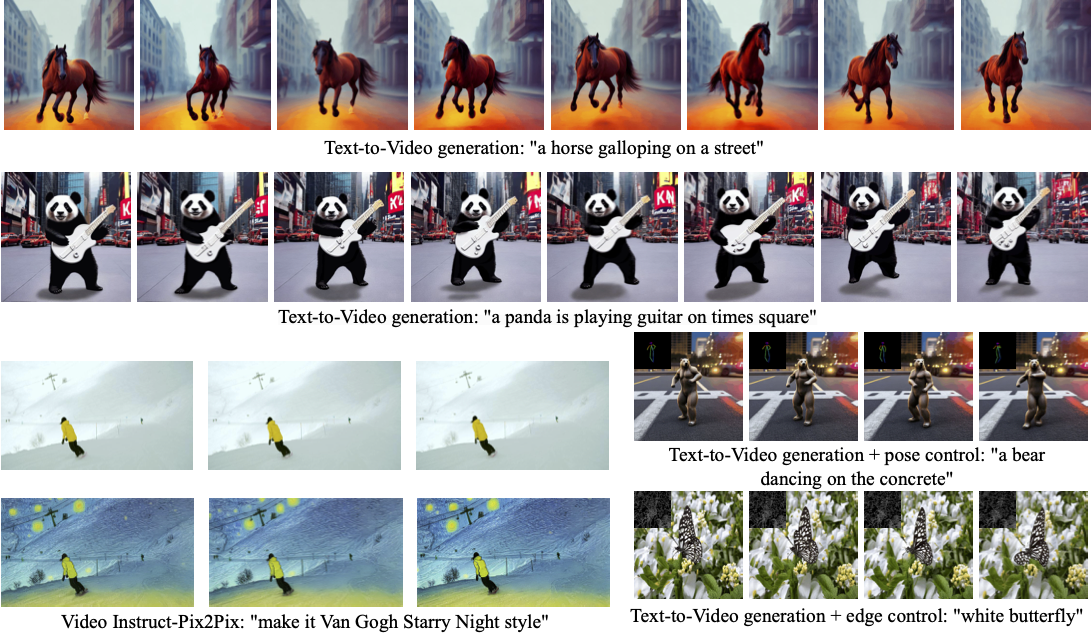
Our method Text2Video-Zero enables zero-shot video generation using either
|
||||
1. A textual prompt, or
|
||||
2. A prompt combined with guidance from poses or edges, or
|
||||
3. Video Instruct-Pix2Pix, i.e., instruction-guided video editing.
|
||||
|
||||
Results are temporally consistent and follow closely the guidance and textual prompts.
|
||||
|
||||
|
||||
|
||||
The abstract of the paper is the following:
|
||||
|
||||
*Recent text-to-video generation approaches rely on computationally heavy training and require large-scale video datasets. In this paper, we introduce a new task of zero-shot text-to-video generation and propose a low-cost approach (without any training or optimization) by leveraging the power of existing text-to-image synthesis methods (e.g., Stable Diffusion), making them suitable for the video domain.
|
||||
Our key modifications include (i) enriching the latent codes of the generated frames with motion dynamics to keep the global scene and the background time consistent; and (ii) reprogramming frame-level self-attention using a new cross-frame attention of each frame on the first frame, to preserve the context, appearance, and identity of the foreground object.
|
||||
Experiments show that this leads to low overhead, yet high-quality and remarkably consistent video generation. Moreover, our approach is not limited to text-to-video synthesis but is also applicable to other tasks such as conditional and content-specialized video generation, and Video Instruct-Pix2Pix, i.e., instruction-guided video editing.
|
||||
As experiments show, our method performs comparably or sometimes better than recent approaches, despite not being trained on additional video data.*
|
||||
|
||||
|
||||
|
||||
Resources:
|
||||
|
||||
* [Project Page](https://text2video-zero.github.io/)
|
||||
* [Paper](https://arxiv.org/abs/2303.13439)
|
||||
* [Original Code](https://github.com/Picsart-AI-Research/Text2Video-Zero)
|
||||
|
||||
|
||||
## Available Pipelines:
|
||||
|
||||
| Pipeline | Tasks | Demo
|
||||
|---|---|:---:|
|
||||
| [TextToVideoZeroPipeline](https://github.com/huggingface/diffusers/blob/main/src/diffusers/pipelines/text_to_video_synthesis/pipeline_text_to_video_zero.py) | *Zero-shot Text-to-Video Generation* | [🤗 Space](https://huggingface.co/spaces/PAIR/Text2Video-Zero)
|
||||
|
||||
|
||||
## Usage example
|
||||
|
||||
### Text-To-Video
|
||||
|
||||
To generate a video from prompt, run the following python command
|
||||
```python
|
||||
import torch
|
||||
import imageio
|
||||
from diffusers import TextToVideoZeroPipeline
|
||||
|
||||
model_id = "runwayml/stable-diffusion-v1-5"
|
||||
pipe = TextToVideoZeroPipeline.from_pretrained(model_id, torch_dtype=torch.float16).to("cuda")
|
||||
|
||||
prompt = "A panda is playing guitar on times square"
|
||||
result = pipe(prompt=prompt).images
|
||||
result = [(r * 255).astype("uint8") for r in result]
|
||||
imageio.mimsave("video.mp4", result, fps=4)
|
||||
```
|
||||
You can change these parameters in the pipeline call:
|
||||
* Motion field strength (see the [paper](https://arxiv.org/abs/2303.13439), Sect. 3.3.1):
|
||||
* `motion_field_strength_x` and `motion_field_strength_y`. Default: `motion_field_strength_x=12`, `motion_field_strength_y=12`
|
||||
* `T` and `T'` (see the [paper](https://arxiv.org/abs/2303.13439), Sect. 3.3.1)
|
||||
* `t0` and `t1` in the range `{0, ..., num_inference_steps}`. Default: `t0=45`, `t1=48`
|
||||
* Video length:
|
||||
* `video_length`, the number of frames video_length to be generated. Default: `video_length=8`
|
||||
|
||||
|
||||
### Text-To-Video with Pose Control
|
||||
To generate a video from prompt with additional pose control
|
||||
|
||||
1. Download a demo video
|
||||
|
||||
```python
|
||||
from huggingface_hub import hf_hub_download
|
||||
|
||||
filename = "__assets__/poses_skeleton_gifs/dance1_corr.mp4"
|
||||
repo_id = "PAIR/Text2Video-Zero"
|
||||
video_path = hf_hub_download(repo_type="space", repo_id=repo_id, filename=filename)
|
||||
```
|
||||
|
||||
|
||||
2. Read video containing extracted pose images
|
||||
```python
|
||||
from PIL import Image
|
||||
import imageio
|
||||
|
||||
reader = imageio.get_reader(video_path, "ffmpeg")
|
||||
frame_count = 8
|
||||
pose_images = [Image.fromarray(reader.get_data(i)) for i in range(frame_count)]
|
||||
```
|
||||
To extract pose from actual video, read [ControlNet documentation](./stable_diffusion/controlnet).
|
||||
|
||||
3. Run `StableDiffusionControlNetPipeline` with our custom attention processor
|
||||
|
||||
```python
|
||||
import torch
|
||||
from diffusers import StableDiffusionControlNetPipeline, ControlNetModel
|
||||
from diffusers.pipelines.text_to_video_synthesis.pipeline_text_to_video_zero import CrossFrameAttnProcessor
|
||||
|
||||
model_id = "runwayml/stable-diffusion-v1-5"
|
||||
controlnet = ControlNetModel.from_pretrained("lllyasviel/sd-controlnet-openpose", torch_dtype=torch.float16)
|
||||
pipe = StableDiffusionControlNetPipeline.from_pretrained(
|
||||
model_id, controlnet=controlnet, torch_dtype=torch.float16
|
||||
).to("cuda")
|
||||
|
||||
# Set the attention processor
|
||||
pipe.unet.set_attn_processor(CrossFrameAttnProcessor(batch_size=2))
|
||||
pipe.controlnet.set_attn_processor(CrossFrameAttnProcessor(batch_size=2))
|
||||
|
||||
# fix latents for all frames
|
||||
latents = torch.randn((1, 4, 64, 64), device="cuda", dtype=torch.float16).repeat(len(pose_images), 1, 1, 1)
|
||||
|
||||
prompt = "Darth Vader dancing in a desert"
|
||||
result = pipe(prompt=[prompt] * len(pose_images), image=pose_images, latents=latents).images
|
||||
imageio.mimsave("video.mp4", result, fps=4)
|
||||
```
|
||||
|
||||
|
||||
### Text-To-Video with Edge Control
|
||||
|
||||
To generate a video from prompt with additional pose control,
|
||||
follow the steps described above for pose-guided generation using [Canny edge ControlNet model](https://huggingface.co/lllyasviel/sd-controlnet-canny).
|
||||
|
||||
|
||||
### Video Instruct-Pix2Pix
|
||||
|
||||
To perform text-guided video editing (with [InstructPix2Pix](./stable_diffusion/pix2pix)):
|
||||
|
||||
1. Download a demo video
|
||||
|
||||
```python
|
||||
from huggingface_hub import hf_hub_download
|
||||
|
||||
filename = "__assets__/pix2pix video/camel.mp4"
|
||||
repo_id = "PAIR/Text2Video-Zero"
|
||||
video_path = hf_hub_download(repo_type="space", repo_id=repo_id, filename=filename)
|
||||
```
|
||||
|
||||
2. Read video from path
|
||||
```python
|
||||
from PIL import Image
|
||||
import imageio
|
||||
|
||||
reader = imageio.get_reader(video_path, "ffmpeg")
|
||||
frame_count = 8
|
||||
video = [Image.fromarray(reader.get_data(i)) for i in range(frame_count)]
|
||||
```
|
||||
|
||||
3. Run `StableDiffusionInstructPix2PixPipeline` with our custom attention processor
|
||||
```python
|
||||
import torch
|
||||
from diffusers import StableDiffusionInstructPix2PixPipeline
|
||||
from diffusers.pipelines.text_to_video_synthesis.pipeline_text_to_video_zero import CrossFrameAttnProcessor
|
||||
|
||||
model_id = "timbrooks/instruct-pix2pix"
|
||||
pipe = StableDiffusionInstructPix2PixPipeline.from_pretrained(model_id, torch_dtype=torch.float16).to("cuda")
|
||||
pipe.unet.set_attn_processor(CrossFrameAttnProcessor(batch_size=3))
|
||||
|
||||
prompt = "make it Van Gogh Starry Night style"
|
||||
result = pipe(prompt=[prompt] * len(video), image=video).images
|
||||
imageio.mimsave("edited_video.mp4", result, fps=4)
|
||||
```
|
||||
|
||||
|
||||
### DreamBooth specialization
|
||||
|
||||
Methods **Text-To-Video**, **Text-To-Video with Pose Control** and **Text-To-Video with Edge Control**
|
||||
can run with custom [DreamBooth](../training/dreambooth) models, as shown below for
|
||||
[Canny edge ControlNet model](https://huggingface.co/lllyasviel/sd-controlnet-canny) and
|
||||
[Avatar style DreamBooth](https://huggingface.co/PAIR/text2video-zero-controlnet-canny-avatar) model
|
||||
|
||||
1. Download a demo video
|
||||
|
||||
```python
|
||||
from huggingface_hub import hf_hub_download
|
||||
|
||||
filename = "__assets__/canny_videos_mp4/girl_turning.mp4"
|
||||
repo_id = "PAIR/Text2Video-Zero"
|
||||
video_path = hf_hub_download(repo_type="space", repo_id=repo_id, filename=filename)
|
||||
```
|
||||
|
||||
2. Read video from path
|
||||
```python
|
||||
from PIL import Image
|
||||
import imageio
|
||||
|
||||
reader = imageio.get_reader(video_path, "ffmpeg")
|
||||
frame_count = 8
|
||||
video = [Image.fromarray(reader.get_data(i)) for i in range(frame_count)]
|
||||
```
|
||||
|
||||
3. Run `StableDiffusionControlNetPipeline` with custom trained DreamBooth model
|
||||
```python
|
||||
import torch
|
||||
from diffusers import StableDiffusionControlNetPipeline, ControlNetModel
|
||||
from diffusers.pipelines.text_to_video_synthesis.pipeline_text_to_video_zero import CrossFrameAttnProcessor
|
||||
|
||||
# set model id to custom model
|
||||
model_id = "PAIR/text2video-zero-controlnet-canny-avatar"
|
||||
controlnet = ControlNetModel.from_pretrained("lllyasviel/sd-controlnet-canny", torch_dtype=torch.float16)
|
||||
pipe = StableDiffusionControlNetPipeline.from_pretrained(
|
||||
model_id, controlnet=controlnet, torch_dtype=torch.float16
|
||||
).to("cuda")
|
||||
|
||||
# Set the attention processor
|
||||
pipe.unet.set_attn_processor(CrossFrameAttnProcessor(batch_size=2))
|
||||
pipe.controlnet.set_attn_processor(CrossFrameAttnProcessor(batch_size=2))
|
||||
|
||||
# fix latents for all frames
|
||||
latents = torch.randn((1, 4, 64, 64), device="cuda", dtype=torch.float16).repeat(len(pose_images), 1, 1, 1)
|
||||
|
||||
prompt = "oil painting of a beautiful girl avatar style"
|
||||
result = pipe(prompt=[prompt] * len(pose_images), image=pose_images, latents=latents).images
|
||||
imageio.mimsave("video.mp4", result, fps=4)
|
||||
```
|
||||
|
||||
You can filter out some available DreamBooth-trained models with [this link](https://huggingface.co/models?search=dreambooth).
|
||||
|
||||
|
||||
|
||||
## TextToVideoZeroPipeline
|
||||
[[autodoc]] TextToVideoZeroPipeline
|
||||
- all
|
||||
- __call__
|
||||
@@ -20,7 +20,7 @@ The abstract of the paper is the following:
|
||||
|
||||
## Tips
|
||||
|
||||
- VersatileDiffusion is conceptually very similar as [Stable Diffusion](./api/pipelines/stable_diffusion/overview), but instead of providing just a image data stream conditioned on text, VersatileDiffusion provides both a image and text data stream and can be conditioned on both text and image.
|
||||
- VersatileDiffusion is conceptually very similar as [Stable Diffusion](./stable_diffusion/overview), but instead of providing just a image data stream conditioned on text, VersatileDiffusion provides both a image and text data stream and can be conditioned on both text and image.
|
||||
|
||||
### *Run VersatileDiffusion*
|
||||
|
||||
|
||||
@@ -10,7 +10,7 @@ an "AS IS" BASIS, WITHOUT WARRANTIES OR CONDITIONS OF ANY KIND, either express o
|
||||
specific language governing permissions and limitations under the License.
|
||||
-->
|
||||
|
||||
# Denoising diffusion implicit models (DDIM)
|
||||
# Denoising Diffusion Implicit Models (DDIM)
|
||||
|
||||
## Overview
|
||||
|
||||
@@ -24,4 +24,4 @@ The original codebase of this paper can be found here: [ermongroup/ddim](https:/
|
||||
For questions, feel free to contact the author on [tsong.me](https://tsong.me/).
|
||||
|
||||
## DDIMScheduler
|
||||
[[autodoc]] DDIMScheduler
|
||||
[[autodoc]] DDIMScheduler
|
||||
|
||||
@@ -10,7 +10,7 @@ an "AS IS" BASIS, WITHOUT WARRANTIES OR CONDITIONS OF ANY KIND, either express o
|
||||
specific language governing permissions and limitations under the License.
|
||||
-->
|
||||
|
||||
# Denoising diffusion probabilistic models (DDPM)
|
||||
# Denoising Diffusion Probabilistic Models (DDPM)
|
||||
|
||||
## Overview
|
||||
|
||||
@@ -24,4 +24,4 @@ We present high quality image synthesis results using diffusion probabilistic mo
|
||||
The original paper can be found [here](https://arxiv.org/abs/2010.02502).
|
||||
|
||||
## DDPMScheduler
|
||||
[[autodoc]] DDPMScheduler
|
||||
[[autodoc]] DDPMScheduler
|
||||
|
||||
@@ -14,8 +14,8 @@ specific language governing permissions and limitations under the License.
|
||||
|
||||
## Overview
|
||||
|
||||
Ancestral sampling with Euler method steps. Based on the original (k-diffusion)[https://github.com/crowsonkb/k-diffusion/blob/481677d114f6ea445aa009cf5bd7a9cdee909e47/k_diffusion/sampling.py#L72] implementation by Katherine Crowson.
|
||||
Ancestral sampling with Euler method steps. Based on the original [k-diffusion](https://github.com/crowsonkb/k-diffusion/blob/481677d114f6ea445aa009cf5bd7a9cdee909e47/k_diffusion/sampling.py#L72) implementation by Katherine Crowson.
|
||||
Fast scheduler which often times generates good outputs with 20-30 steps.
|
||||
|
||||
## EulerAncestralDiscreteScheduler
|
||||
[[autodoc]] EulerAncestralDiscreteScheduler
|
||||
[[autodoc]] EulerAncestralDiscreteScheduler
|
||||
|
||||
@@ -10,11 +10,11 @@ an "AS IS" BASIS, WITHOUT WARRANTIES OR CONDITIONS OF ANY KIND, either express o
|
||||
specific language governing permissions and limitations under the License.
|
||||
-->
|
||||
|
||||
# variance exploding stochastic differential equation (VE-SDE) scheduler
|
||||
# Variance Exploding Stochastic Differential Equation (VE-SDE) scheduler
|
||||
|
||||
## Overview
|
||||
|
||||
Original paper can be found [here](https://arxiv.org/abs/2011.13456).
|
||||
|
||||
## ScoreSdeVeScheduler
|
||||
[[autodoc]] ScoreSdeVeScheduler
|
||||
[[autodoc]] ScoreSdeVeScheduler
|
||||
|
||||
@@ -10,7 +10,7 @@ an "AS IS" BASIS, WITHOUT WARRANTIES OR CONDITIONS OF ANY KIND, either express o
|
||||
specific language governing permissions and limitations under the License.
|
||||
-->
|
||||
|
||||
# Variance preserving stochastic differential equation (VP-SDE) scheduler
|
||||
# Variance Preserving Stochastic Differential Equation (VP-SDE) scheduler
|
||||
|
||||
## Overview
|
||||
|
||||
@@ -23,4 +23,4 @@ Score SDE-VP is under construction.
|
||||
</Tip>
|
||||
|
||||
## ScoreSdeVpScheduler
|
||||
[[autodoc]] schedulers.scheduling_sde_vp.ScoreSdeVpScheduler
|
||||
[[autodoc]] schedulers.scheduling_sde_vp.ScoreSdeVpScheduler
|
||||
|
||||
@@ -16,7 +16,7 @@ specific language governing permissions and limitations under the License.
|
||||
|
||||
UniPC is a training-free framework designed for the fast sampling of diffusion models, which consists of a corrector (UniC) and a predictor (UniP) that share a unified analytical form and support arbitrary orders.
|
||||
|
||||
For more details about the method, please refer to the [[paper]](https://arxiv.org/abs/2302.04867) and the [[code]](https://github.com/wl-zhao/UniPC).
|
||||
For more details about the method, please refer to the [paper](https://arxiv.org/abs/2302.04867) and the [code](https://github.com/wl-zhao/UniPC).
|
||||
|
||||
Fast Sampling of Diffusion Models with Exponential Integrator.
|
||||
|
||||
|
||||
@@ -170,7 +170,7 @@ please have a look at the next sections.
|
||||
|
||||
For all of the following contributions, you will need to open a PR. It is explained in detail how to do so in the [Opening a pull requst](#how-to-open-a-pr) section.
|
||||
|
||||
### 4. Fixing a "Good first issue"
|
||||
### 4. Fixing a `Good first issue`
|
||||
|
||||
*Good first issues* are marked by the [Good first issue](https://github.com/huggingface/diffusers/issues?q=is%3Aopen+is%3Aissue+label%3A%22good+first+issue%22) label. Usually, the issue already
|
||||
explains how a potential solution should look so that it is easier to fix.
|
||||
@@ -275,7 +275,7 @@ Once an example script works, please make sure to add a comprehensive `README.md
|
||||
|
||||
If you are contributing to the official training examples, please also make sure to add a test to [examples/test_examples.py](https://github.com/huggingface/diffusers/blob/main/examples/test_examples.py). This is not necessary for non-official training examples.
|
||||
|
||||
### 8. Fixing a "Good second issue"
|
||||
### 8. Fixing a `Good second issue`
|
||||
|
||||
*Good second issues* are marked by the [Good second issue](https://github.com/huggingface/diffusers/issues?q=is%3Aopen+is%3Aissue+label%3A%22Good+second+issue%22) label. Good second issues are
|
||||
usually more complicated to solve than [Good first issues](https://github.com/huggingface/diffusers/issues?q=is%3Aopen+is%3Aissue+label%3A%22good+first+issue%22).
|
||||
|
||||
@@ -73,7 +73,7 @@ The library has three main components:
|
||||
| [stable_diffusion_pix2pix](./api/pipelines/stable_diffusion/pix2pix) | [InstructPix2Pix: Learning to Follow Image Editing Instructions](https://arxiv.org/abs/2211.09800) | Text-Guided Image Editing|
|
||||
| [stable_diffusion_pix2pix_zero](./api/pipelines/stable_diffusion/pix2pix_zero) | [Zero-shot Image-to-Image Translation](https://pix2pixzero.github.io/) | Text-Guided Image Editing |
|
||||
| [stable_diffusion_attend_and_excite](./api/pipelines/stable_diffusion/attend_and_excite) | [Attend-and-Excite: Attention-Based Semantic Guidance for Text-to-Image Diffusion Models](https://arxiv.org/abs/2301.13826) | Text-to-Image Generation |
|
||||
| [stable_diffusion_self_attention_guidance](./api/pipelines/stable_diffusion/self_attention_guidance) | [Improving Sample Quality of Diffusion Models Using Self-Attention Guidance](https://arxiv.org/abs/2210.00939) | Text-to-Image Generation |
|
||||
| [stable_diffusion_self_attention_guidance](./api/pipelines/stable_diffusion/self_attention_guidance) | [Improving Sample Quality of Diffusion Models Using Self-Attention Guidance](https://arxiv.org/abs/2210.00939) | Text-to-Image Generation Unconditional Image Generation |
|
||||
| [stable_diffusion_image_variation](./stable_diffusion/image_variation) | [Stable Diffusion Image Variations](https://github.com/LambdaLabsML/lambda-diffusers#stable-diffusion-image-variations) | Image-to-Image Generation |
|
||||
| [stable_diffusion_latent_upscale](./stable_diffusion/latent_upscale) | [Stable Diffusion Latent Upscaler](https://twitter.com/StabilityAI/status/1590531958815064065) | Text-Guided Super Resolution Image-to-Image |
|
||||
| [stable_diffusion_model_editing](./api/pipelines/stable_diffusion/model_editing) | [Editing Implicit Assumptions in Text-to-Image Diffusion Models](https://time-diffusion.github.io/) | Text-to-Image Model Editing |
|
||||
@@ -90,4 +90,4 @@ The library has three main components:
|
||||
| [versatile_diffusion](./api/pipelines/versatile_diffusion) | [Versatile Diffusion: Text, Images and Variations All in One Diffusion Model](https://arxiv.org/abs/2211.08332) | Text-to-Image Generation |
|
||||
| [versatile_diffusion](./api/pipelines/versatile_diffusion) | [Versatile Diffusion: Text, Images and Variations All in One Diffusion Model](https://arxiv.org/abs/2211.08332) | Image Variations Generation |
|
||||
| [versatile_diffusion](./api/pipelines/versatile_diffusion) | [Versatile Diffusion: Text, Images and Variations All in One Diffusion Model](https://arxiv.org/abs/2211.08332) | Dual Image and Text Guided Generation |
|
||||
| [vq_diffusion](./api/pipelines/vq_diffusion) | [Vector Quantized Diffusion Model for Text-to-Image Synthesis](https://arxiv.org/abs/2111.14822) | Text-to-Image Generation |
|
||||
| [vq_diffusion](./api/pipelines/vq_diffusion) | [Vector Quantized Diffusion Model for Text-to-Image Synthesis](https://arxiv.org/abs/2111.14822) | Text-to-Image Generation |
|
||||
|
||||
@@ -0,0 +1,167 @@
|
||||
<!--Copyright 2023 The HuggingFace Team. All rights reserved.
|
||||
|
||||
Licensed under the Apache License, Version 2.0 (the "License"); you may not use this file except in compliance with
|
||||
the License. You may obtain a copy of the License at
|
||||
|
||||
http://www.apache.org/licenses/LICENSE-2.0
|
||||
|
||||
Unless required by applicable law or agreed to in writing, software distributed under the License is distributed on
|
||||
an "AS IS" BASIS, WITHOUT WARRANTIES OR CONDITIONS OF ANY KIND, either express or implied. See the License for the
|
||||
specific language governing permissions and limitations under the License.
|
||||
-->
|
||||
|
||||
# How to run Stable Diffusion with Core ML
|
||||
|
||||
[Core ML](https://developer.apple.com/documentation/coreml) is the model format and machine learning library supported by Apple frameworks. If you are interested in running Stable Diffusion models inside your macOS or iOS/iPadOS apps, this guide will show you how to convert existing PyTorch checkpoints into the Core ML format and use them for inference with Python or Swift.
|
||||
|
||||
Core ML models can leverage all the compute engines available in Apple devices: the CPU, the GPU, and the Apple Neural Engine (or ANE, a tensor-optimized accelerator available in Apple Silicon Macs and modern iPhones/iPads). Depending on the model and the device it's running on, Core ML can mix and match compute engines too, so some portions of the model may run on the CPU while others run on GPU, for example.
|
||||
|
||||
<Tip>
|
||||
|
||||
You can also run the `diffusers` Python codebase on Apple Silicon Macs using the `mps` accelerator built into PyTorch. This approach is explained in depth in [the mps guide](mps), but it is not compatible with native apps.
|
||||
|
||||
</Tip>
|
||||
|
||||
## Stable Diffusion Core ML Checkpoints
|
||||
|
||||
Stable Diffusion weights (or checkpoints) are stored in the PyTorch format, so you need to convert them to the Core ML format before we can use them inside native apps.
|
||||
|
||||
Thankfully, Apple engineers developed [a conversion tool](https://github.com/apple/ml-stable-diffusion#-converting-models-to-core-ml) based on `diffusers` to convert the PyTorch checkpoints to Core ML.
|
||||
|
||||
Before you convert a model, though, take a moment to explore the Hugging Face Hub – chances are the model you're interested in is already available in Core ML format:
|
||||
|
||||
- the [Apple](https://huggingface.co/apple) organization includes Stable Diffusion versions 1.4, 1.5, 2.0 base, and 2.1 base
|
||||
- [coreml](https://huggingface.co/coreml) organization includes custom DreamBoothed and finetuned models
|
||||
- use this [filter](https://huggingface.co/models?pipeline_tag=text-to-image&library=coreml&p=2&sort=likes) to return all available Core ML checkpoints
|
||||
|
||||
If you can't find the model you're interested in, we recommend you follow the instructions for [Converting Models to Core ML](https://github.com/apple/ml-stable-diffusion#-converting-models-to-core-ml) by Apple.
|
||||
|
||||
## Selecting the Core ML Variant to Use
|
||||
|
||||
Stable Diffusion models can be converted to different Core ML variants intended for different purposes:
|
||||
|
||||
- The type of attention blocks used. The attention operation is used to "pay attention" to the relationship between different areas in the image representations and to understand how the image and text representations are related. Attention is compute- and memory-intensive, so different implementations exist that consider the hardware characteristics of different devices. For Core ML Stable Diffusion models, there are two attention variants:
|
||||
* `split_einsum` ([introduced by Apple](https://machinelearning.apple.com/research/neural-engine-transformers)) is optimized for ANE devices, which is available in modern iPhones, iPads and M-series computers.
|
||||
* The "original" attention (the base implementation used in `diffusers`) is only compatible with CPU/GPU and not ANE. It can be *faster* to run your model on CPU + GPU using `original` attention than ANE. See [this performance benchmark](https://huggingface.co/blog/fast-mac-diffusers#performance-benchmarks) as well as some [additional measures provided by the community](https://github.com/huggingface/swift-coreml-diffusers/issues/31) for additional details.
|
||||
|
||||
- The supported inference framework.
|
||||
* `packages` are suitable for Python inference. This can be used to test converted Core ML models before attempting to integrate them inside native apps, or if you want to explore Core ML performance but don't need to support native apps. For example, an application with a web UI could perfectly use a Python Core ML backend.
|
||||
* `compiled` models are required for Swift code. The `compiled` models in the Hub split the large UNet model weights into several files for compatibility with iOS and iPadOS devices. This corresponds to the [`--chunk-unet` conversion option](https://github.com/apple/ml-stable-diffusion#-converting-models-to-core-ml). If you want to support native apps, then you need to select the `compiled` variant.
|
||||
|
||||
The official Core ML Stable Diffusion [models](https://huggingface.co/apple/coreml-stable-diffusion-v1-4/tree/main) include these variants, but the community ones may vary:
|
||||
|
||||
```
|
||||
coreml-stable-diffusion-v1-4
|
||||
├── README.md
|
||||
├── original
|
||||
│ ├── compiled
|
||||
│ └── packages
|
||||
└── split_einsum
|
||||
├── compiled
|
||||
└── packages
|
||||
```
|
||||
|
||||
You can download and use the variant you need as shown below.
|
||||
|
||||
## Core ML Inference in Python
|
||||
|
||||
Install the following libraries to run Core ML inference in Python:
|
||||
|
||||
```bash
|
||||
pip install huggingface_hub
|
||||
pip install git+https://github.com/apple/ml-stable-diffusion
|
||||
```
|
||||
|
||||
### Download the Model Checkpoints
|
||||
|
||||
To run inference in Python, use one of the versions stored in the `packages` folders because the `compiled` ones are only compatible with Swift. You may choose whether you want to use `original` or `split_einsum` attention.
|
||||
|
||||
This is how you'd download the `original` attention variant from the Hub to a directory called `models`:
|
||||
|
||||
```Python
|
||||
from huggingface_hub import snapshot_download
|
||||
from pathlib import Path
|
||||
|
||||
repo_id = "apple/coreml-stable-diffusion-v1-4"
|
||||
variant = "original/packages"
|
||||
|
||||
model_path = Path("./models") / (repo_id.split("/")[-1] + "_" + variant.replace("/", "_"))
|
||||
snapshot_download(repo_id, allow_patterns=f"{variant}/*", local_dir=model_path, local_dir_use_symlinks=False)
|
||||
print(f"Model downloaded at {model_path}")
|
||||
```
|
||||
|
||||
|
||||
### Inference[[python-inference]]
|
||||
|
||||
Once you have downloaded a snapshot of the model, you can test it using Apple's Python script.
|
||||
|
||||
```shell
|
||||
python -m python_coreml_stable_diffusion.pipeline --prompt "a photo of an astronaut riding a horse on mars" -i models/coreml-stable-diffusion-v1-4_original_packages -o </path/to/output/image> --compute-unit CPU_AND_GPU --seed 93
|
||||
```
|
||||
|
||||
`<output-mlpackages-directory>` should point to the checkpoint you downloaded in the step above, and `--compute-unit` indicates the hardware you want to allow for inference. It must be one of the following options: `ALL`, `CPU_AND_GPU`, `CPU_ONLY`, `CPU_AND_NE`. You may also provide an optional output path, and a seed for reproducibility.
|
||||
|
||||
The inference script assumes you're using the original version of the Stable Diffusion model, `CompVis/stable-diffusion-v1-4`. If you use another model, you *have* to specify its Hub id in the inference command line, using the `--model-version` option. This works for models already supported and custom models you trained or fine-tuned yourself.
|
||||
|
||||
For example, if you want to use [`runwayml/stable-diffusion-v1-5`](https://huggingface.co/runwayml/stable-diffusion-v1-5):
|
||||
|
||||
```shell
|
||||
python -m python_coreml_stable_diffusion.pipeline --prompt "a photo of an astronaut riding a horse on mars" --compute-unit ALL -o output --seed 93 -i models/coreml-stable-diffusion-v1-5_original_packages --model-version runwayml/stable-diffusion-v1-5
|
||||
```
|
||||
|
||||
|
||||
## Core ML inference in Swift
|
||||
|
||||
Running inference in Swift is slightly faster than in Python because the models are already compiled in the `mlmodelc` format. This is noticeable on app startup when the model is loaded but shouldn’t be noticeable if you run several generations afterward.
|
||||
|
||||
### Download
|
||||
|
||||
To run inference in Swift on your Mac, you need one of the `compiled` checkpoint versions. We recommend you download them locally using Python code similar to the previous example, but with one of the `compiled` variants:
|
||||
|
||||
```Python
|
||||
from huggingface_hub import snapshot_download
|
||||
from pathlib import Path
|
||||
|
||||
repo_id = "apple/coreml-stable-diffusion-v1-4"
|
||||
variant = "original/compiled"
|
||||
|
||||
model_path = Path("./models") / (repo_id.split("/")[-1] + "_" + variant.replace("/", "_"))
|
||||
snapshot_download(repo_id, allow_patterns=f"{variant}/*", local_dir=model_path, local_dir_use_symlinks=False)
|
||||
print(f"Model downloaded at {model_path}")
|
||||
```
|
||||
|
||||
### Inference[[swift-inference]]
|
||||
|
||||
To run inference, please clone Apple's repo:
|
||||
|
||||
```bash
|
||||
git clone https://github.com/apple/ml-stable-diffusion
|
||||
cd ml-stable-diffusion
|
||||
```
|
||||
|
||||
And then use Apple's command line tool, [Swift Package Manager](https://www.swift.org/package-manager/#):
|
||||
|
||||
```bash
|
||||
swift run StableDiffusionSample --resource-path models/coreml-stable-diffusion-v1-4_original_compiled --compute-units all "a photo of an astronaut riding a horse on mars"
|
||||
```
|
||||
|
||||
You have to specify in `--resource-path` one of the checkpoints downloaded in the previous step, so please make sure it contains compiled Core ML bundles with the extension `.mlmodelc`. The `--compute-units` has to be one of these values: `all`, `cpuOnly`, `cpuAndGPU`, `cpuAndNeuralEngine`.
|
||||
|
||||
For more details, please refer to the [instructions in Apple's repo](https://github.com/apple/ml-stable-diffusion).
|
||||
|
||||
|
||||
## Supported Diffusers Features
|
||||
|
||||
The Core ML models and inference code don't support many of the features, options, and flexibility of 🧨 Diffusers. These are some of the limitations to keep in mind:
|
||||
|
||||
- Core ML models are only suitable for inference. They can't be used for training or fine-tuning.
|
||||
- Only two schedulers have been ported to Swift, the default one used by Stable Diffusion and `DPMSolverMultistepScheduler`, which we ported to Swift from our `diffusers` implementation. We recommend you use `DPMSolverMultistepScheduler`, since it produces the same quality in about half the steps.
|
||||
- Negative prompts, classifier-free guidance scale, and image-to-image tasks are available in the inference code. Advanced features such as depth guidance, ControlNet, and latent upscalers are not available yet.
|
||||
|
||||
Apple's [conversion and inference repo](https://github.com/apple/ml-stable-diffusion) and our own [swift-coreml-diffusers](https://github.com/huggingface/swift-coreml-diffusers) repos are intended as technology demonstrators to enable other developers to build upon.
|
||||
|
||||
If you feel strongly about any missing features, please feel free to open a feature request or, better yet, a contribution PR :)
|
||||
|
||||
## Native Diffusers Swift app
|
||||
|
||||
One easy way to run Stable Diffusion on your own Apple hardware is to use [our open-source Swift repo](https://github.com/huggingface/swift-coreml-diffusers), based on `diffusers` and Apple's conversion and inference repo. You can study the code, compile it with [Xcode](https://developer.apple.com/xcode/) and adapt it for your own needs. For your convenience, there's also a [standalone Mac app in the App Store](https://apps.apple.com/app/diffusers/id1666309574), so you can play with it without having to deal with the code or IDE. If you are a developer and have determined that Core ML is the best solution to build your Stable Diffusion app, then you can use the rest of this guide to get started with your project. We can't wait to see what you'll build :)
|
||||
+209
-271
@@ -1,333 +1,271 @@
|
||||
<!--Copyright 2023 The HuggingFace Team. All rights reserved.
|
||||
|
||||
Licensed under the Apache License, Version 2.0 (the "License"); you may not use this file except in compliance with
|
||||
the License. You may obtain a copy of the License at
|
||||
|
||||
http://www.apache.org/licenses/LICENSE-2.0
|
||||
|
||||
Unless required by applicable law or agreed to in writing, software distributed under the License is distributed on
|
||||
an "AS IS" BASIS, WITHOUT WARRANTIES OR CONDITIONS OF ANY KIND, either express or implied. See the License for the
|
||||
specific language governing permissions and limitations under the License.
|
||||
-->
|
||||
|
||||
# The Stable Diffusion Guide 🎨
|
||||
<a target="_blank" href="https://colab.research.google.com/github/huggingface/notebooks/blob/main/diffusers/sd_101_guide.ipynb">
|
||||
<img src="https://colab.research.google.com/assets/colab-badge.svg" alt="Open In Colab"/>
|
||||
</a>
|
||||
|
||||
## Intro
|
||||
|
||||
Stable Diffusion is a [Latent Diffusion model](https://github.com/CompVis/latent-diffusion) developed by researchers from the Machine Vision and Learning group at LMU Munich, *a.k.a* CompVis.
|
||||
Model checkpoints were publicly released at the end of August 2022 by a collaboration of Stability AI, CompVis, and Runway with support from EleutherAI and LAION. For more information, you can check out [the official blog post](https://stability.ai/blog/stable-diffusion-public-release).
|
||||
|
||||
Since its public release the community has done an incredible job at working together to make the stable diffusion checkpoints **faster**, **more memory efficient**, and **more performant**.
|
||||
|
||||
🧨 Diffusers offers a simple API to run stable diffusion with all memory, computing, and quality improvements.
|
||||
|
||||
This notebook walks you through the improvements one-by-one so you can best leverage [`StableDiffusionPipeline`] for **inference**.
|
||||
|
||||
## Prompt Engineering 🎨
|
||||
|
||||
When running *Stable Diffusion* in inference, we usually want to generate a certain type, or style of image and then improve upon it. Improving upon a previously generated image means running inference over and over again with a different prompt and potentially a different seed until we are happy with our generation.
|
||||
|
||||
So to begin with, it is most important to speed up stable diffusion as much as possible to generate as many pictures as possible in a given amount of time.
|
||||
|
||||
This can be done by both improving the **computational efficiency** (speed) and the **memory efficiency** (GPU RAM).
|
||||
|
||||
Let's start by looking into computational efficiency first.
|
||||
|
||||
Throughout the notebook, we will focus on [runwayml/stable-diffusion-v1-5](https://huggingface.co/runwayml/stable-diffusion-v1-5):
|
||||
|
||||
``` python
|
||||
model_id = "runwayml/stable-diffusion-v1-5"
|
||||
```
|
||||
|
||||
Let's load the pipeline.
|
||||
|
||||
## Speed Optimization
|
||||
|
||||
``` python
|
||||
from diffusers import DiffusionPipeline
|
||||
|
||||
pipe = DiffusionPipeline.from_pretrained(model_id)
|
||||
```
|
||||
|
||||
We aim at generating a beautiful photograph of an *old warrior chief* and will later try to find the best prompt to generate such a photograph. For now, let's keep the prompt simple:
|
||||
|
||||
``` python
|
||||
prompt = "portrait photo of a old warrior chief"
|
||||
```
|
||||
|
||||
To begin with, we should make sure we run inference on GPU, so let's move the pipeline to GPU, just like you would with any PyTorch module.
|
||||
|
||||
``` python
|
||||
pipe = pipe.to("cuda")
|
||||
```
|
||||
|
||||
To generate an image, you should use the [~`StableDiffusionPipeline.__call__`] method.
|
||||
|
||||
To make sure we can reproduce more or less the same image in every call, let's make use of the generator. See the documentation on reproducibility [here](./conceptual/reproducibility) for more information.
|
||||
|
||||
``` python
|
||||
generator = torch.Generator("cuda").manual_seed(0)
|
||||
```
|
||||
|
||||
Now, let's take a spin on it.
|
||||
|
||||
``` python
|
||||
image = pipe(prompt, generator=generator).images[0]
|
||||
image
|
||||
```
|
||||
|
||||

|
||||
|
||||
Cool, this now took roughly 30 seconds on a T4 GPU (you might see faster inference if your allocated GPU is better than a T4).
|
||||
|
||||
The default run we did above used full float32 precision and ran the default number of inference steps (50). The easiest speed-ups come from switching to float16 (or half) precision and simply running fewer inference steps. Let's load the model now in float16 instead.
|
||||
|
||||
``` python
|
||||
import torch
|
||||
|
||||
pipe = DiffusionPipeline.from_pretrained(model_id, torch_dtype=torch.float16)
|
||||
pipe = pipe.to("cuda")
|
||||
```
|
||||
|
||||
And we can again call the pipeline to generate an image.
|
||||
|
||||
``` python
|
||||
generator = torch.Generator("cuda").manual_seed(0)
|
||||
|
||||
image = pipe(prompt, generator=generator).images[0]
|
||||
image
|
||||
```
|
||||

|
||||
|
||||
Cool, this is almost three times as fast for arguably the same image quality.
|
||||
|
||||
We strongly suggest always running your pipelines in float16 as so far we have very rarely seen degradations in quality because of it.
|
||||
|
||||
Next, let's see if we need to use 50 inference steps or whether we could use significantly fewer. The number of inference steps is associated with the denoising scheduler we use. Choosing a more efficient scheduler could help us decrease the number of steps.
|
||||
|
||||
Let's have a look at all the schedulers the stable diffusion pipeline is compatible with.
|
||||
|
||||
``` python
|
||||
pipe.scheduler.compatibles
|
||||
```
|
||||
|
||||
```
|
||||
[diffusers.schedulers.scheduling_dpmsolver_singlestep.DPMSolverSinglestepScheduler,
|
||||
diffusers.schedulers.scheduling_lms_discrete.LMSDiscreteScheduler,
|
||||
diffusers.schedulers.scheduling_heun_discrete.HeunDiscreteScheduler,
|
||||
diffusers.schedulers.scheduling_pndm.PNDMScheduler,
|
||||
diffusers.schedulers.scheduling_euler_discrete.EulerDiscreteScheduler,
|
||||
diffusers.schedulers.scheduling_euler_ancestral_discrete.EulerAncestralDiscreteScheduler,
|
||||
diffusers.schedulers.scheduling_dpmsolver_multistep.DPMSolverMultistepScheduler,
|
||||
diffusers.schedulers.scheduling_ddpm.DDPMScheduler,
|
||||
diffusers.schedulers.scheduling_ddim.DDIMScheduler]
|
||||
```
|
||||
|
||||
Cool, that's a lot of schedulers.
|
||||
|
||||
🧨 Diffusers is constantly adding a bunch of novel schedulers/samplers that can be used with Stable Diffusion. For more information, we recommend taking a look at the official documentation [here](https://huggingface.co/docs/diffusers/main/en/api/schedulers/overview).
|
||||
|
||||
Alright, right now Stable Diffusion is using the `PNDMScheduler` which usually requires around 50 inference steps. However, other schedulers such as `DPMSolverMultistepScheduler` or `DPMSolverSinglestepScheduler` seem to get away with just 20 to 25 inference steps. Let's try them out.
|
||||
|
||||
You can set a new scheduler by making use of the [from_config](https://huggingface.co/docs/diffusers/main/en/api/configuration#diffusers.ConfigMixin.from_config) function.
|
||||
|
||||
``` python
|
||||
from diffusers import DPMSolverMultistepScheduler
|
||||
|
||||
pipe.scheduler = DPMSolverMultistepScheduler.from_config(pipe.scheduler.config)
|
||||
```
|
||||
|
||||
Now, let's try to reduce the number of inference steps to just 20.
|
||||
|
||||
``` python
|
||||
generator = torch.Generator("cuda").manual_seed(0)
|
||||
|
||||
image = pipe(prompt, generator=generator, num_inference_steps=20).images[0]
|
||||
image
|
||||
```
|
||||
|
||||
|
||||
|
||||
The image now does look a little different, but it's arguably still of equally high quality. We now cut inference time to just 4 seconds though 😍.
|
||||
|
||||
## Memory Optimization
|
||||
<!--Copyright 2023 The HuggingFace Team. All rights reserved.
|
||||
|
||||
Less memory used in generation indirectly implies more speed, since we're often trying to maximize how many images we can generate per second. Usually, the more images per inference run, the more images per second too.
|
||||
Licensed under the Apache License, Version 2.0 (the "License"); you may not use this file except in compliance with
|
||||
the License. You may obtain a copy of the License at
|
||||
|
||||
The easiest way to see how many images we can generate at once is to simply try it out, and see when we get a *"Out-of-memory (OOM)"* error.
|
||||
http://www.apache.org/licenses/LICENSE-2.0
|
||||
|
||||
We can run batched inference by simply passing a list of prompts and generators. Let's define a quick function that generates a batch for us.
|
||||
Unless required by applicable law or agreed to in writing, software distributed under the License is distributed on
|
||||
an "AS IS" BASIS, WITHOUT WARRANTIES OR CONDITIONS OF ANY KIND, either express or implied. See the License for the
|
||||
specific language governing permissions and limitations under the License.
|
||||
-->
|
||||
|
||||
# Effective and efficient diffusion
|
||||
|
||||
``` python
|
||||
def get_inputs(batch_size=1):
|
||||
generator = [torch.Generator("cuda").manual_seed(i) for i in range(batch_size)]
|
||||
prompts = batch_size * [prompt]
|
||||
num_inference_steps = 20
|
||||
[[open-in-colab]]
|
||||
|
||||
return {"prompt": prompts, "generator": generator, "num_inference_steps": num_inference_steps}
|
||||
```
|
||||
This function returns a list of prompts and a list of generators, so we can reuse the generator that produced a result we like.
|
||||
Getting the [`DiffusionPipeline`] to generate images in a certain style or include what you want can be tricky. Often times, you have to run the [`DiffusionPipeline`] several times before you end up with an image you're happy with. But generating something out of nothing is a computationally intensive process, especially if you're running inference over and over again.
|
||||
|
||||
We also need a method that allows us to easily display a batch of images.
|
||||
This is why it's important to get the most *computational* (speed) and *memory* (GPU RAM) efficiency from the pipeline to reduce the time between inference cycles so you can iterate faster.
|
||||
|
||||
``` python
|
||||
from PIL import Image
|
||||
This tutorial walks you through how to generate faster and better with the [`DiffusionPipeline`].
|
||||
|
||||
def image_grid(imgs, rows=2, cols=2):
|
||||
w, h = imgs[0].size
|
||||
grid = Image.new('RGB', size=(cols*w, rows*h))
|
||||
|
||||
for i, img in enumerate(imgs):
|
||||
grid.paste(img, box=(i%cols*w, i//cols*h))
|
||||
return grid
|
||||
```
|
||||
Begin by loading the [`runwayml/stable-diffusion-v1-5`](https://huggingface.co/runwayml/stable-diffusion-v1-5) model:
|
||||
|
||||
Cool, let's see how much memory we can use starting with `batch_size=4`.
|
||||
```python
|
||||
from diffusers import DiffusionPipeline
|
||||
|
||||
``` python
|
||||
images = pipe(**get_inputs(batch_size=4)).images
|
||||
image_grid(images)
|
||||
```
|
||||
model_id = "runwayml/stable-diffusion-v1-5"
|
||||
pipeline = DiffusionPipeline.from_pretrained(model_id)
|
||||
```
|
||||
|
||||
|
||||
The example prompt you'll use is a portrait of an old warrior chief, but feel free to use your own prompt:
|
||||
|
||||
Going over a batch_size of 4 will error out in this notebook (assuming we are running it on a T4 GPU). Also, we can see we only generate slightly more images per second (3.75s/image) compared to 4s/image previously.
|
||||
```python
|
||||
prompt = "portrait photo of a old warrior chief"
|
||||
```
|
||||
|
||||
However, the community has found some nice tricks to improve the memory constraints further. After stable diffusion was released, the community found improvements within days and shared them freely over GitHub - open-source at its finest! I believe the original idea came from [this](https://github.com/basujindal/stable-diffusion/pull/117) GitHub thread.
|
||||
## Speed
|
||||
|
||||
By far most of the memory is taken up by the cross-attention layers. Instead of running this operation in batch, one can run it sequentially to save a significant amount of memory.
|
||||
<Tip>
|
||||
|
||||
It can easily be enabled by calling `enable_attention_slicing` as is documented [here](https://huggingface.co/docs/diffusers/main/en/api/pipelines/stable_diffusion/text2img#diffusers.StableDiffusionPipeline.enable_attention_slicing).
|
||||
💡 If you don't have access to a GPU, you can use one for free from a GPU provider like [Colab](https://colab.research.google.com/)!
|
||||
|
||||
``` python
|
||||
pipe.enable_attention_slicing()
|
||||
```
|
||||
</Tip>
|
||||
|
||||
Great, now that attention slicing is enabled, let's try to double the batch size again, going for `batch_size=8`.
|
||||
One of the simplest ways to speed up inference is to place the pipeline on a GPU the same way you would with any PyTorch module:
|
||||
|
||||
``` python
|
||||
images = pipe(**get_inputs(batch_size=8)).images
|
||||
image_grid(images, rows=2, cols=4)
|
||||
```
|
||||
```python
|
||||
pipeline = pipeline.to("cuda")
|
||||
```
|
||||
|
||||
|
||||
To make sure you can use the same image and improve on it, use a [`Generator`](https://pytorch.org/docs/stable/generated/torch.Generator.html) and set a seed for [reproducibility](./using-diffusers/reproducibility):
|
||||
|
||||
Nice, it works. However, the speed gain is again not very big (it might however be much more significant on other GPUs).
|
||||
```python
|
||||
generator = torch.Generator("cuda").manual_seed(0)
|
||||
```
|
||||
|
||||
We're at roughly 3.5 seconds per image 🔥 which is probably the fastest we can be with a simple T4 without sacrificing quality.
|
||||
Now you can generate an image:
|
||||
|
||||
Next, let's look into how to improve the quality!
|
||||
```python
|
||||
image = pipeline(prompt, generator=generator).images[0]
|
||||
image
|
||||
```
|
||||
|
||||
## Quality Improvements
|
||||
<div class="flex justify-center">
|
||||
<img src="https://huggingface.co/datasets/diffusers/docs-images/resolve/main/stable_diffusion_101/sd_101_1.png">
|
||||
</div>
|
||||
|
||||
Now that our image generation pipeline is blazing fast, let's try to get maximum image quality.
|
||||
This process took ~30 seconds on a T4 GPU (it might be faster if your allocated GPU is better than a T4). By default, the [`DiffusionPipeline`] runs inference with full `float32` precision for 50 inference steps. You can speed this up by switching to a lower precision like `float16` or running fewer inference steps.
|
||||
|
||||
First of all, image quality is extremely subjective, so it's difficult to make general claims here.
|
||||
Let's start by loading the model in `float16` and generate an image:
|
||||
|
||||
The most obvious step to take to improve quality is to use *better checkpoints*. Since the release of Stable Diffusion, many improved versions have been released, which are summarized here:
|
||||
```python
|
||||
import torch
|
||||
|
||||
- *Official Release - 22 Aug 2022*: [Stable-Diffusion 1.4](https://huggingface.co/CompVis/stable-diffusion-v1-4)
|
||||
- *20 October 2022*: [Stable-Diffusion 1.5](https://huggingface.co/runwayml/stable-diffusion-v1-5)
|
||||
- *24 Nov 2022*: [Stable-Diffusion 2.0](https://huggingface.co/stabilityai/stable-diffusion-2-0)
|
||||
- *7 Dec 2022*: [Stable-Diffusion 2.1](https://huggingface.co/stabilityai/stable-diffusion-2-1)
|
||||
pipeline = DiffusionPipeline.from_pretrained(model_id, torch_dtype=torch.float16)
|
||||
pipeline = pipeline.to("cuda")
|
||||
generator = torch.Generator("cuda").manual_seed(0)
|
||||
image = pipeline(prompt, generator=generator).images[0]
|
||||
image
|
||||
```
|
||||
|
||||
Newer versions don't necessarily mean better image quality with the same parameters. People mentioned that *2.0* is slightly worse than *1.5* for certain prompts, but given the right prompt engineering *2.0* and *2.1* seem to be better.
|
||||
<div class="flex justify-center">
|
||||
<img src="https://huggingface.co/datasets/diffusers/docs-images/resolve/main/stable_diffusion_101/sd_101_2.png">
|
||||
</div>
|
||||
|
||||
Overall, we strongly recommend just trying the models out and reading up on advice online (e.g. it has been shown that using negative prompts is very important for 2.0 and 2.1 to get the highest possible quality. See for example [this nice blog post](https://minimaxir.com/2022/11/stable-diffusion-negative-prompt/).
|
||||
This time, it only took ~11 seconds to generate the image, which is almost 3x faster than before!
|
||||
|
||||
Additionally, the community has started fine-tuning many of the above versions on certain styles with some of them having an extremely high quality and gaining a lot of traction.
|
||||
<Tip>
|
||||
|
||||
We recommend having a look at all [diffusers checkpoints sorted by downloads and trying out the different checkpoints](https://huggingface.co/models?library=diffusers).
|
||||
💡 We strongly suggest always running your pipelines in `float16`, and so far, we've rarely seen any degradation in output quality.
|
||||
|
||||
For the following, we will stick to v1.5 for simplicity.
|
||||
</Tip>
|
||||
|
||||
Next, we can also try to optimize single components of the pipeline, e.g. switching out the latent decoder. For more details on how the whole Stable Diffusion pipeline works, please have a look at [this blog post](https://huggingface.co/blog/stable_diffusion).
|
||||
Another option is to reduce the number of inference steps. Choosing a more efficient scheduler could help decrease the number of steps without sacrificing output quality. You can find which schedulers are compatible with the current model in the [`DiffusionPipeline`] by calling the `compatibles` method:
|
||||
|
||||
Let's load [stabilityai's newest auto-decoder](https://huggingface.co/stabilityai/stable-diffusion-2-1).
|
||||
```python
|
||||
pipeline.scheduler.compatibles
|
||||
[
|
||||
diffusers.schedulers.scheduling_lms_discrete.LMSDiscreteScheduler,
|
||||
diffusers.schedulers.scheduling_unipc_multistep.UniPCMultistepScheduler,
|
||||
diffusers.schedulers.scheduling_k_dpm_2_discrete.KDPM2DiscreteScheduler,
|
||||
diffusers.schedulers.scheduling_deis_multistep.DEISMultistepScheduler,
|
||||
diffusers.schedulers.scheduling_euler_discrete.EulerDiscreteScheduler,
|
||||
diffusers.schedulers.scheduling_dpmsolver_multistep.DPMSolverMultistepScheduler,
|
||||
diffusers.schedulers.scheduling_ddpm.DDPMScheduler,
|
||||
diffusers.schedulers.scheduling_dpmsolver_singlestep.DPMSolverSinglestepScheduler,
|
||||
diffusers.schedulers.scheduling_k_dpm_2_ancestral_discrete.KDPM2AncestralDiscreteScheduler,
|
||||
diffusers.schedulers.scheduling_heun_discrete.HeunDiscreteScheduler,
|
||||
diffusers.schedulers.scheduling_pndm.PNDMScheduler,
|
||||
diffusers.schedulers.scheduling_euler_ancestral_discrete.EulerAncestralDiscreteScheduler,
|
||||
diffusers.schedulers.scheduling_ddim.DDIMScheduler,
|
||||
]
|
||||
```
|
||||
|
||||
``` python
|
||||
from diffusers import AutoencoderKL
|
||||
The Stable Diffusion model uses the [`PNDMScheduler`] by default which usually requires ~50 inference steps, but more performant schedulers like [`DPMSolverMultistepScheduler`], require only ~20 or 25 inference steps. Use the [`ConfigMixin.from_config`] method to load a new scheduler:
|
||||
|
||||
vae = AutoencoderKL.from_pretrained("stabilityai/sd-vae-ft-mse", torch_dtype=torch.float16).to("cuda")
|
||||
```
|
||||
```python
|
||||
from diffusers import DPMSolverMultistepScheduler
|
||||
|
||||
Now we can set it to the vae of the pipeline to use it.
|
||||
pipeline.scheduler = DPMSolverMultistepScheduler.from_config(pipeline.scheduler.config)
|
||||
```
|
||||
|
||||
``` python
|
||||
pipe.vae = vae
|
||||
```
|
||||
Now set the `num_inference_steps` to 20:
|
||||
|
||||
Let's run the same prompt as before to compare quality.
|
||||
```python
|
||||
generator = torch.Generator("cuda").manual_seed(0)
|
||||
image = pipeline(prompt, generator=generator, num_inference_steps=20).images[0]
|
||||
image
|
||||
```
|
||||
|
||||
``` python
|
||||
images = pipe(**get_inputs(batch_size=8)).images
|
||||
image_grid(images, rows=2, cols=4)
|
||||
```
|
||||
<div class="flex justify-center">
|
||||
<img src="https://huggingface.co/datasets/diffusers/docs-images/resolve/main/stable_diffusion_101/sd_101_3.png">
|
||||
</div>
|
||||
|
||||

|
||||
Great, you've managed to cut the inference time to just 4 seconds! ⚡️
|
||||
|
||||
Seems like the difference is only very minor, but the new generations are arguably a bit *sharper*.
|
||||
## Memory
|
||||
|
||||
Cool, finally, let's look a bit into prompt engineering.
|
||||
The other key to improving pipeline performance is consuming less memory, which indirectly implies more speed, since you're often trying to maximize the number of images generated per second. The easiest way to see how many images you can generate at once is to try out different batch sizes until you get an `OutOfMemoryError` (OOM).
|
||||
|
||||
Our goal was to generate a photo of an old warrior chief. Let's now try to bring a bit more color into the photos and make the look more impressive.
|
||||
Create a function that'll generate a batch of images from a list of prompts and `Generators`. Make sure to assign each `Generator` a seed so you can reuse it if it produces a good result.
|
||||
|
||||
Originally our prompt was "*portrait photo of an old warrior chief*".
|
||||
```python
|
||||
def get_inputs(batch_size=1):
|
||||
generator = [torch.Generator("cuda").manual_seed(i) for i in range(batch_size)]
|
||||
prompts = batch_size * [prompt]
|
||||
num_inference_steps = 20
|
||||
|
||||
To improve the prompt, it often helps to add cues that could have been used online to save high-quality photos, as well as add more details.
|
||||
Essentially, when doing prompt engineering, one has to think:
|
||||
return {"prompt": prompts, "generator": generator, "num_inference_steps": num_inference_steps}
|
||||
```
|
||||
|
||||
- How was the photo or similar photos of the one I want probably stored on the internet?
|
||||
- What additional detail can I give that steers the models into the style that I want?
|
||||
You'll also need a function that'll display each batch of images:
|
||||
|
||||
Cool, let's add more details.
|
||||
```python
|
||||
from PIL import image
|
||||
|
||||
``` python
|
||||
prompt += ", tribal panther make up, blue on red, side profile, looking away, serious eyes"
|
||||
```
|
||||
|
||||
and let's also add some cues that usually help to generate higher quality images.
|
||||
def image_grid(imgs, rows=2, cols=2):
|
||||
w, h = imgs[0].size
|
||||
grid = Image.new("RGB", size=(cols * w, rows * h))
|
||||
|
||||
``` python
|
||||
prompt += " 50mm portrait photography, hard rim lighting photography--beta --ar 2:3 --beta --upbeta"
|
||||
prompt
|
||||
```
|
||||
for i, img in enumerate(imgs):
|
||||
grid.paste(img, box=(i % cols * w, i // cols * h))
|
||||
return grid
|
||||
```
|
||||
|
||||
Cool, let's now try this prompt.
|
||||
Start with `batch_size=4` and see how much memory you've consumed:
|
||||
|
||||
``` python
|
||||
images = pipe(**get_inputs(batch_size=8)).images
|
||||
image_grid(images, rows=2, cols=4)
|
||||
```
|
||||
```python
|
||||
images = pipeline(**get_inputs(batch_size=4)).images
|
||||
image_grid(images)
|
||||
```
|
||||
|
||||
|
||||
Unless you have a GPU with more RAM, the code above probably returned an `OOM` error! Most of the memory is taken up by the cross-attention layers. Instead of running this operation in a batch, you can run it sequentially to save a significant amount of memory. All you have to do is configure the pipeline to use the [`~DiffusionPipeline.enable_attention_slicing`] function:
|
||||
|
||||
Pretty impressive! We got some very high-quality image generations there. The 2nd image is my personal favorite, so I'll re-use this seed and see whether I can tweak the prompts slightly by using "oldest warrior", "old", "", and "young" instead of "old".
|
||||
```python
|
||||
pipeline.enable_attention_slicing()
|
||||
```
|
||||
|
||||
``` python
|
||||
prompts = [
|
||||
"portrait photo of the oldest warrior chief, tribal panther make up, blue on red, side profile, looking away, serious eyes 50mm portrait photography, hard rim lighting photography--beta --ar 2:3 --beta --upbeta",
|
||||
"portrait photo of a old warrior chief, tribal panther make up, blue on red, side profile, looking away, serious eyes 50mm portrait photography, hard rim lighting photography--beta --ar 2:3 --beta --upbeta",
|
||||
"portrait photo of a warrior chief, tribal panther make up, blue on red, side profile, looking away, serious eyes 50mm portrait photography, hard rim lighting photography--beta --ar 2:3 --beta --upbeta",
|
||||
"portrait photo of a young warrior chief, tribal panther make up, blue on red, side profile, looking away, serious eyes 50mm portrait photography, hard rim lighting photography--beta --ar 2:3 --beta --upbeta",
|
||||
]
|
||||
Now try increasing the `batch_size` to 8!
|
||||
|
||||
generator = [torch.Generator("cuda").manual_seed(1) for _ in range(len(prompts))] # 1 because we want the 2nd image
|
||||
```python
|
||||
images = pipeline(**get_inputs(batch_size=8)).images
|
||||
image_grid(images, rows=2, cols=4)
|
||||
```
|
||||
|
||||
images = pipe(prompt=prompts, generator=generator, num_inference_steps=25).images
|
||||
image_grid(images)
|
||||
```
|
||||
<div class="flex justify-center">
|
||||
<img src="https://huggingface.co/datasets/diffusers/docs-images/resolve/main/stable_diffusion_101/sd_101_5.png">
|
||||
</div>
|
||||
|
||||

|
||||
Whereas before you couldn't even generate a batch of 4 images, now you can generate a batch of 8 images at ~3.5 seconds per image! This is probably the fastest you can go on a T4 GPU without sacrificing quality.
|
||||
|
||||
The first picture looks nice! The eye movement slightly changed and looks nice. This finished up our 101-guide on how to use Stable Diffusion 🤗.
|
||||
## Quality
|
||||
|
||||
For more information on optimization or other guides, I recommend taking a look at the following:
|
||||
In the last two sections, you learned how to optimize the speed of your pipeline by using `fp16`, reducing the number of inference steps by using a more performant scheduler, and enabling attention slicing to reduce memory consumption. Now you're going to focus on how to improve the quality of generated images.
|
||||
|
||||
- [Blog post about Stable Diffusion](https://huggingface.co/blog/stable_diffusion): In-detail blog post explaining Stable Diffusion.
|
||||
- [FlashAttention](https://huggingface.co/docs/diffusers/optimization/xformers): XFormers flash attention can optimize your model even further with more speed and memory improvements.
|
||||
- [Dreambooth](https://huggingface.co/docs/diffusers/training/dreambooth) - Quickly customize the model by fine-tuning it.
|
||||
- [General info on Stable Diffusion](https://huggingface.co/docs/diffusers/main/en/api/pipelines/stable_diffusion/overview) - Info on other tasks that are powered by Stable Diffusion.
|
||||
### Better checkpoints
|
||||
|
||||
The most obvious step is to use better checkpoints. The Stable Diffusion model is a good starting point, and since its official launch, several improved versions have also been released. However, using a newer version doesn't automatically mean you'll get better results. You'll still have to experiment with different checkpoints yourself, and do a little research (such as using [negative prompts](https://minimaxir.com/2022/11/stable-diffusion-negative-prompt/)) to get the best results.
|
||||
|
||||
As the field grows, there are more and more high-quality checkpoints finetuned to produce certain styles. Try exploring the [Hub](https://huggingface.co/models?library=diffusers&sort=downloads) and [Diffusers Gallery](https://huggingface.co/spaces/huggingface-projects/diffusers-gallery) to find one you're interested in!
|
||||
|
||||
### Better pipeline components
|
||||
|
||||
You can also try replacing the current pipeline components with a newer version. Let's try loading the latest [autodecoder](https://huggingface.co/stabilityai/stable-diffusion-2-1/tree/main/vae) from Stability AI into the pipeline, and generate some images:
|
||||
|
||||
```python
|
||||
from diffusers import AutoencoderKL
|
||||
|
||||
vae = AutoencoderKL.from_pretrained("stabilityai/sd-vae-ft-mse", torch_dtype=torch.float16).to("cuda")
|
||||
pipeline.vae = vae
|
||||
images = pipeline(**get_inputs(batch_size=8)).images
|
||||
image_grid(images, rows=2, cols=4)
|
||||
```
|
||||
|
||||
<div class="flex justify-center">
|
||||
<img src="https://huggingface.co/datasets/diffusers/docs-images/resolve/main/stable_diffusion_101/sd_101_6.png">
|
||||
</div>
|
||||
|
||||
### Better prompt engineering
|
||||
|
||||
The text prompt you use to generate an image is super important, so much so that it is called *prompt engineering*. Some considerations to keep during prompt engineering are:
|
||||
|
||||
- How is the image or similar images of the one I want to generate stored on the internet?
|
||||
- What additional detail can I give that steers the model towards the style I want?
|
||||
|
||||
With this in mind, let's improve the prompt to include color and higher quality details:
|
||||
|
||||
```python
|
||||
prompt += ", tribal panther make up, blue on red, side profile, looking away, serious eyes"
|
||||
prompt += " 50mm portrait photography, hard rim lighting photography--beta --ar 2:3 --beta --upbeta"
|
||||
```
|
||||
|
||||
Generate a batch of images with the new prompt:
|
||||
|
||||
```python
|
||||
images = pipeline(**get_inputs(batch_size=8)).images
|
||||
image_grid(images, rows=2, cols=4)
|
||||
```
|
||||
|
||||
<div class="flex justify-center">
|
||||
<img src="https://huggingface.co/datasets/diffusers/docs-images/resolve/main/stable_diffusion_101/sd_101_7.png">
|
||||
</div>
|
||||
|
||||
Pretty impressive! Let's tweak the second image - corresponding to the `Generator` with a seed of `1` - a bit more by adding some text about the age of the subject:
|
||||
|
||||
```python
|
||||
prommpts = [
|
||||
"portrait photo of the oldest warrior chief, tribal panther make up, blue on red, side profile, looking away, serious eyes 50mm portrait photography, hard rim lighting photography--beta --ar 2:3 --beta --upbeta",
|
||||
"portrait photo of a old warrior chief, tribal panther make up, blue on red, side profile, looking away, serious eyes 50mm portrait photography, hard rim lighting photography--beta --ar 2:3 --beta --upbeta",
|
||||
"portrait photo of a warrior chief, tribal panther make up, blue on red, side profile, looking away, serious eyes 50mm portrait photography, hard rim lighting photography--beta --ar 2:3 --beta --upbeta",
|
||||
"portrait photo of a young warrior chief, tribal panther make up, blue on red, side profile, looking away, serious eyes 50mm portrait photography, hard rim lighting photography--beta --ar 2:3 --beta --upbeta",
|
||||
]
|
||||
|
||||
generator = [torch.Generator("cuda").manual_seed(1) for _ in range(len(prompts))]
|
||||
images = pipeline(prompt=prompts, generator=generator, num_inference_steps=25).images
|
||||
image_grid(images)
|
||||
```
|
||||
|
||||
<div class="flex justify-center">
|
||||
<img src="https://huggingface.co/datasets/diffusers/docs-images/resolve/main/stable_diffusion_101/sd_101_8.png">
|
||||
</div>
|
||||
|
||||
## Next steps
|
||||
|
||||
In this tutorial, you learned how to optimize a [`DiffusionPipeline`] for computational and memory efficiency as well as improving the quality of generated outputs. If you're interested in making your pipeline even faster, take a look at the following resources:
|
||||
|
||||
- Enable [xFormers](./optimization/xformers) memory efficient attention mechanism for faster speed and reduced memory consumption.
|
||||
- Learn how in [PyTorch 2.0](./optimization/torch2.0), [`torch.compile`](https://pytorch.org/docs/stable/generated/torch.compile.html) can yield 2-9% faster inference speed.
|
||||
- Many optimization techniques for inference are also included in this memory and speed [guide](./optimization/fp16), such as memory offloading.
|
||||
@@ -113,6 +113,29 @@ accelerate launch train_controlnet.py \
|
||||
--gradient_accumulation_steps=4
|
||||
```
|
||||
|
||||
## Training with multiple GPUs
|
||||
|
||||
`accelerate` allows for seamless multi-GPU training. Follow the instructions [here](https://huggingface.co/docs/accelerate/basic_tutorials/launch)
|
||||
for running distributed training with `accelerate`. Here is an example command:
|
||||
|
||||
```bash
|
||||
export MODEL_DIR="runwayml/stable-diffusion-v1-5"
|
||||
export OUTPUT_DIR="path to save model"
|
||||
|
||||
accelerate launch --mixed_precision="fp16" --multi_gpu train_controlnet.py \
|
||||
--pretrained_model_name_or_path=$MODEL_DIR \
|
||||
--output_dir=$OUTPUT_DIR \
|
||||
--dataset_name=fusing/fill50k \
|
||||
--resolution=512 \
|
||||
--learning_rate=1e-5 \
|
||||
--validation_image "./conditioning_image_1.png" "./conditioning_image_2.png" \
|
||||
--validation_prompt "red circle with blue background" "cyan circle with brown floral background" \
|
||||
--train_batch_size=4 \
|
||||
--mixed_precision="fp16" \
|
||||
--tracker_project_name="controlnet-demo" \
|
||||
--report_to=wandb
|
||||
```
|
||||
|
||||
## Example results
|
||||
|
||||
#### After 300 steps with batch size 8
|
||||
|
||||
@@ -0,0 +1,289 @@
|
||||
<!--Copyright 2023 Custom Diffusion authors The HuggingFace Team. All rights reserved.
|
||||
|
||||
Licensed under the Apache License, Version 2.0 (the "License"); you may not use this file except in compliance with
|
||||
the License. You may obtain a copy of the License at
|
||||
|
||||
http://www.apache.org/licenses/LICENSE-2.0
|
||||
|
||||
Unless required by applicable law or agreed to in writing, software distributed under the License is distributed on
|
||||
an "AS IS" BASIS, WITHOUT WARRANTIES OR CONDITIONS OF ANY KIND, either express or implied. See the License for the
|
||||
specific language governing permissions and limitations under the License.
|
||||
-->
|
||||
|
||||
# Custom Diffusion training example
|
||||
|
||||
[Custom Diffusion](https://arxiv.org/abs/2212.04488) is a method to customize text-to-image models like Stable Diffusion given just a few (4~5) images of a subject.
|
||||
The `train_custom_diffusion.py` script shows how to implement the training procedure and adapt it for stable diffusion.
|
||||
|
||||
## Running locally with PyTorch
|
||||
|
||||
### Installing the dependencies
|
||||
|
||||
Before running the scripts, make sure to install the library's training dependencies:
|
||||
|
||||
**Important**
|
||||
|
||||
To make sure you can successfully run the latest versions of the example scripts, we highly recommend **installing from source** and keeping the install up to date as we update the example scripts frequently and install some example-specific requirements. To do this, execute the following steps in a new virtual environment:
|
||||
|
||||
```bash
|
||||
git clone https://github.com/huggingface/diffusers
|
||||
cd diffusers
|
||||
pip install -e .
|
||||
```
|
||||
|
||||
Then cd in the example folder and run
|
||||
|
||||
```bash
|
||||
pip install -r requirements.txt
|
||||
pip install clip-retrieval
|
||||
```
|
||||
|
||||
And initialize an [🤗Accelerate](https://github.com/huggingface/accelerate/) environment with:
|
||||
|
||||
```bash
|
||||
accelerate config
|
||||
```
|
||||
|
||||
Or for a default accelerate configuration without answering questions about your environment
|
||||
|
||||
```bash
|
||||
accelerate config default
|
||||
```
|
||||
|
||||
Or if your environment doesn't support an interactive shell e.g. a notebook
|
||||
|
||||
```python
|
||||
from accelerate.utils import write_basic_config
|
||||
|
||||
write_basic_config()
|
||||
```
|
||||
### Cat example 😺
|
||||
|
||||
Now let's get our dataset. Download dataset from [here](https://www.cs.cmu.edu/~custom-diffusion/assets/data.zip) and unzip it.
|
||||
|
||||
We also collect 200 real images using `clip-retrieval` which are combined with the target images in the training dataset as a regularization. This prevents overfitting to the the given target image. The following flags enable the regularization `with_prior_preservation`, `real_prior` with `prior_loss_weight=1.`.
|
||||
The `class_prompt` should be the category name same as target image. The collected real images are with text captions similar to the `class_prompt`. The retrieved image are saved in `class_data_dir`. You can disable `real_prior` to use generated images as regularization. To collect the real images use this command first before training.
|
||||
|
||||
```bash
|
||||
pip install clip-retrieval
|
||||
python retrieve.py --class_prompt cat --class_data_dir real_reg/samples_cat --num_class_images 200
|
||||
```
|
||||
|
||||
**___Note: Change the `resolution` to 768 if you are using the [stable-diffusion-2](https://huggingface.co/stabilityai/stable-diffusion-2) 768x768 model.___**
|
||||
|
||||
```bash
|
||||
export MODEL_NAME="CompVis/stable-diffusion-v1-4"
|
||||
export OUTPUT_DIR="path-to-save-model"
|
||||
export INSTANCE_DIR="./data/cat"
|
||||
|
||||
accelerate launch train_custom_diffusion.py \
|
||||
--pretrained_model_name_or_path=$MODEL_NAME \
|
||||
--instance_data_dir=$INSTANCE_DIR \
|
||||
--output_dir=$OUTPUT_DIR \
|
||||
--class_data_dir=./real_reg/samples_cat/ \
|
||||
--with_prior_preservation --real_prior --prior_loss_weight=1.0 \
|
||||
--class_prompt="cat" --num_class_images=200 \
|
||||
--instance_prompt="photo of a <new1> cat" \
|
||||
--resolution=512 \
|
||||
--train_batch_size=2 \
|
||||
--learning_rate=1e-5 \
|
||||
--lr_warmup_steps=0 \
|
||||
--max_train_steps=250 \
|
||||
--scale_lr --hflip \
|
||||
--modifier_token "<new1>"
|
||||
```
|
||||
|
||||
**Use `--enable_xformers_memory_efficient_attention` for faster training with lower VRAM requirement (16GB per GPU). Follow [this guide](https://github.com/facebookresearch/xformers) for installation instructions.**
|
||||
|
||||
To track your experiments using Weights and Biases (`wandb`) and to save intermediate results (whcih we HIGHLY recommend), follow these steps:
|
||||
|
||||
* Install `wandb`: `pip install wandb`.
|
||||
* Authorize: `wandb login`.
|
||||
* Then specify a `validation_prompt` and set `report_to` to `wandb` while launching training. You can also configure the following related arguments:
|
||||
* `num_validation_images`
|
||||
* `validation_steps`
|
||||
|
||||
Here is an example command:
|
||||
|
||||
```bash
|
||||
accelerate launch train_custom_diffusion.py \
|
||||
--pretrained_model_name_or_path=$MODEL_NAME \
|
||||
--instance_data_dir=$INSTANCE_DIR \
|
||||
--output_dir=$OUTPUT_DIR \
|
||||
--class_data_dir=./real_reg/samples_cat/ \
|
||||
--with_prior_preservation --real_prior --prior_loss_weight=1.0 \
|
||||
--class_prompt="cat" --num_class_images=200 \
|
||||
--instance_prompt="photo of a <new1> cat" \
|
||||
--resolution=512 \
|
||||
--train_batch_size=2 \
|
||||
--learning_rate=1e-5 \
|
||||
--lr_warmup_steps=0 \
|
||||
--max_train_steps=250 \
|
||||
--scale_lr --hflip \
|
||||
--modifier_token "<new1>" \
|
||||
--validation_prompt="<new1> cat sitting in a bucket" \
|
||||
--report_to="wandb"
|
||||
```
|
||||
|
||||
Here is an example [Weights and Biases page](https://wandb.ai/sayakpaul/custom-diffusion/runs/26ghrcau) where you can check out the intermediate results along with other training details.
|
||||
|
||||
If you specify `--push_to_hub`, the learned parameters will be pushed to a repository on the Hugging Face Hub. Here is an [example repository](https://huggingface.co/sayakpaul/custom-diffusion-cat).
|
||||
|
||||
### Training on multiple concepts 🐱🪵
|
||||
|
||||
Provide a [json](https://github.com/adobe-research/custom-diffusion/blob/main/assets/concept_list.json) file with the info about each concept, similar to [this](https://github.com/ShivamShrirao/diffusers/blob/main/examples/dreambooth/train_dreambooth.py).
|
||||
|
||||
To collect the real images run this command for each concept in the json file.
|
||||
|
||||
```bash
|
||||
pip install clip-retrieval
|
||||
python retrieve.py --class_prompt {} --class_data_dir {} --num_class_images 200
|
||||
```
|
||||
|
||||
And then we're ready to start training!
|
||||
|
||||
```bash
|
||||
export MODEL_NAME="CompVis/stable-diffusion-v1-4"
|
||||
export OUTPUT_DIR="path-to-save-model"
|
||||
|
||||
accelerate launch train_custom_diffusion.py \
|
||||
--pretrained_model_name_or_path=$MODEL_NAME \
|
||||
--output_dir=$OUTPUT_DIR \
|
||||
--concepts_list=./concept_list.json \
|
||||
--with_prior_preservation --real_prior --prior_loss_weight=1.0 \
|
||||
--resolution=512 \
|
||||
--train_batch_size=2 \
|
||||
--learning_rate=1e-5 \
|
||||
--lr_warmup_steps=0 \
|
||||
--max_train_steps=500 \
|
||||
--num_class_images=200 \
|
||||
--scale_lr --hflip \
|
||||
--modifier_token "<new1>+<new2>"
|
||||
```
|
||||
|
||||
Here is an example [Weights and Biases page](https://wandb.ai/sayakpaul/custom-diffusion/runs/3990tzkg) where you can check out the intermediate results along with other training details.
|
||||
|
||||
### Training on human faces
|
||||
|
||||
For fine-tuning on human faces we found the following configuration to work better: `learning_rate=5e-6`, `max_train_steps=1000 to 2000`, and `freeze_model=crossattn` with at least 15-20 images.
|
||||
|
||||
To collect the real images use this command first before training.
|
||||
|
||||
```bash
|
||||
pip install clip-retrieval
|
||||
python retrieve.py --class_prompt person --class_data_dir real_reg/samples_person --num_class_images 200
|
||||
```
|
||||
|
||||
Then start training!
|
||||
|
||||
```bash
|
||||
export MODEL_NAME="CompVis/stable-diffusion-v1-4"
|
||||
export OUTPUT_DIR="path-to-save-model"
|
||||
export INSTANCE_DIR="path-to-images"
|
||||
|
||||
accelerate launch train_custom_diffusion.py \
|
||||
--pretrained_model_name_or_path=$MODEL_NAME \
|
||||
--instance_data_dir=$INSTANCE_DIR \
|
||||
--output_dir=$OUTPUT_DIR \
|
||||
--class_data_dir=./real_reg/samples_person/ \
|
||||
--with_prior_preservation --real_prior --prior_loss_weight=1.0 \
|
||||
--class_prompt="person" --num_class_images=200 \
|
||||
--instance_prompt="photo of a <new1> person" \
|
||||
--resolution=512 \
|
||||
--train_batch_size=2 \
|
||||
--learning_rate=5e-6 \
|
||||
--lr_warmup_steps=0 \
|
||||
--max_train_steps=1000 \
|
||||
--scale_lr --hflip --noaug \
|
||||
--freeze_model crossattn \
|
||||
--modifier_token "<new1>" \
|
||||
--enable_xformers_memory_efficient_attention
|
||||
```
|
||||
|
||||
## Inference
|
||||
|
||||
Once you have trained a model using the above command, you can run inference using the below command. Make sure to include the `modifier token` (e.g. \<new1\> in above example) in your prompt.
|
||||
|
||||
```python
|
||||
import torch
|
||||
from diffusers import DiffusionPipeline
|
||||
|
||||
pipe = DiffusionPipeline.from_pretrained("CompVis/stable-diffusion-v1-4", torch_dtype=torch.float16).to("cuda")
|
||||
pipe.unet.load_attn_procs("path-to-save-model", weight_name="pytorch_custom_diffusion_weights.bin")
|
||||
pipe.load_textual_inversion("path-to-save-model", weight_name="<new1>.bin")
|
||||
|
||||
image = pipe(
|
||||
"<new1> cat sitting in a bucket",
|
||||
num_inference_steps=100,
|
||||
guidance_scale=6.0,
|
||||
eta=1.0,
|
||||
).images[0]
|
||||
image.save("cat.png")
|
||||
```
|
||||
|
||||
It's possible to directly load these parameters from a Hub repository:
|
||||
|
||||
```python
|
||||
import torch
|
||||
from huggingface_hub.repocard import RepoCard
|
||||
from diffusers import DiffusionPipeline
|
||||
|
||||
model_id = "sayakpaul/custom-diffusion-cat"
|
||||
card = RepoCard.load(model_id)
|
||||
base_model_id = card.data.to_dict()["base_model"]
|
||||
|
||||
pipe = DiffusionPipeline.from_pretrained(base_model_id, torch_dtype=torch.float16).to("cuda")
|
||||
pipe.unet.load_attn_procs(model_id, weight_name="pytorch_custom_diffusion_weights.bin")
|
||||
pipe.load_textual_inversion(model_id, weight_name="<new1>.bin")
|
||||
|
||||
image = pipe(
|
||||
"<new1> cat sitting in a bucket",
|
||||
num_inference_steps=100,
|
||||
guidance_scale=6.0,
|
||||
eta=1.0,
|
||||
).images[0]
|
||||
image.save("cat.png")
|
||||
```
|
||||
|
||||
Here is an example of performing inference with multiple concepts:
|
||||
|
||||
```python
|
||||
import torch
|
||||
from huggingface_hub.repocard import RepoCard
|
||||
from diffusers import DiffusionPipeline
|
||||
|
||||
model_id = "sayakpaul/custom-diffusion-cat-wooden-pot"
|
||||
card = RepoCard.load(model_id)
|
||||
base_model_id = card.data.to_dict()["base_model"]
|
||||
|
||||
pipe = DiffusionPipeline.from_pretrained(base_model_id, torch_dtype=torch.float16).to("cuda")
|
||||
pipe.unet.load_attn_procs(model_id, weight_name="pytorch_custom_diffusion_weights.bin")
|
||||
pipe.load_textual_inversion(model_id, weight_name="<new1>.bin")
|
||||
pipe.load_textual_inversion(model_id, weight_name="<new2>.bin")
|
||||
|
||||
image = pipe(
|
||||
"the <new1> cat sculpture in the style of a <new2> wooden pot",
|
||||
num_inference_steps=100,
|
||||
guidance_scale=6.0,
|
||||
eta=1.0,
|
||||
).images[0]
|
||||
image.save("multi-subject.png")
|
||||
```
|
||||
|
||||
Here, `cat` and `wooden pot` refer to the multiple concepts.
|
||||
|
||||
### Inference from a training checkpoint
|
||||
|
||||
You can also perform inference from one of the complete checkpoint saved during the training process, if you used the `--checkpointing_steps` argument.
|
||||
|
||||
TODO.
|
||||
|
||||
## Set grads to none
|
||||
|
||||
To save even more memory, pass the `--set_grads_to_none` argument to the script. This will set grads to None instead of zero. However, be aware that it changes certain behaviors, so if you start experiencing any problems, remove this argument.
|
||||
|
||||
More info: https://pytorch.org/docs/stable/generated/torch.optim.Optimizer.zero_grad.html
|
||||
|
||||
## Experimental results
|
||||
|
||||
You can refer to [our webpage](https://www.cs.cmu.edu/~custom-diffusion/) that discusses our experiments in detail.
|
||||
@@ -60,7 +60,18 @@ DreamBooth finetuning is very sensitive to hyperparameters and easy to overfit.
|
||||
|
||||
<frameworkcontent>
|
||||
<pt>
|
||||
Let's try DreamBooth with a [few images of a dog](https://drive.google.com/drive/folders/1BO_dyz-p65qhBRRMRA4TbZ8qW4rB99JZ); download and save them to a directory and then set the `INSTANCE_DIR` environment variable to that path:
|
||||
Let's try DreamBooth with a
|
||||
[few images of a dog](https://huggingface.co/datasets/diffusers/dog-example);
|
||||
download and save them to a directory and then set the `INSTANCE_DIR` environment variable to that path:
|
||||
|
||||
```python
|
||||
local_dir = "./path_to_training_images"
|
||||
snapshot_download(
|
||||
"diffusers/dog-example",
|
||||
local_dir=local_dir, repo_type="dataset",
|
||||
ignore_patterns=".gitattributes",
|
||||
)
|
||||
```
|
||||
|
||||
```bash
|
||||
export MODEL_NAME="CompVis/stable-diffusion-v1-4"
|
||||
|
||||
@@ -126,6 +126,27 @@ accelerate launch --mixed_precision="fp16" train_instruct_pix2pix.py \
|
||||
|
||||
***Note: In the original paper, the authors observed that even when the model is trained with an image resolution of 256x256, it generalizes well to bigger resolutions such as 512x512. This is likely because of the larger dataset they used during training.***
|
||||
|
||||
## Training with multiple GPUs
|
||||
|
||||
`accelerate` allows for seamless multi-GPU training. Follow the instructions [here](https://huggingface.co/docs/accelerate/basic_tutorials/launch)
|
||||
for running distributed training with `accelerate`. Here is an example command:
|
||||
|
||||
```bash
|
||||
accelerate launch --mixed_precision="fp16" --multi_gpu train_instruct_pix2pix.py \
|
||||
--pretrained_model_name_or_path=runwayml/stable-diffusion-v1-5 \
|
||||
--dataset_name=sayakpaul/instructpix2pix-1000-samples \
|
||||
--use_ema \
|
||||
--enable_xformers_memory_efficient_attention \
|
||||
--resolution=512 --random_flip \
|
||||
--train_batch_size=4 --gradient_accumulation_steps=4 --gradient_checkpointing \
|
||||
--max_train_steps=15000 \
|
||||
--checkpointing_steps=5000 --checkpoints_total_limit=1 \
|
||||
--learning_rate=5e-05 --lr_warmup_steps=0 \
|
||||
--conditioning_dropout_prob=0.05 \
|
||||
--mixed_precision=fp16 \
|
||||
--seed=42
|
||||
```
|
||||
|
||||
## Inference
|
||||
|
||||
Once training is complete, we can perform inference:
|
||||
|
||||
@@ -16,7 +16,9 @@ specific language governing permissions and limitations under the License.
|
||||
|
||||
<Tip warning={true}>
|
||||
|
||||
Currently, LoRA is only supported for the attention layers of the [`UNet2DConditionalModel`].
|
||||
Currently, LoRA is only supported for the attention layers of the [`UNet2DConditionalModel`]. We also
|
||||
support LoRA fine-tuning of the text encoder for DreamBooth in a limited capacity. For more details on how we support
|
||||
LoRA fine-tuning of the text encoder, refer to the discussion on [this PR](https://github.com/huggingface/diffusers/pull/2918).
|
||||
|
||||
</Tip>
|
||||
|
||||
@@ -175,6 +177,11 @@ accelerate launch train_dreambooth_lora.py \
|
||||
--push_to_hub
|
||||
```
|
||||
|
||||
It's also possible to additionally fine-tune the text encoder with LoRA. This, in most cases, leads
|
||||
to better results with a slight increase in the compute. To allow fine-tuning the text encoder with LoRA,
|
||||
specify the `--train_text_encoder` while launching the `train_dreambooth_lora.py` script.
|
||||
|
||||
|
||||
### Inference[[dreambooth-inference]]
|
||||
|
||||
Now you can use the model for inference by loading the base model in the [`StableDiffusionPipeline`]:
|
||||
|
||||
@@ -39,6 +39,8 @@ Training examples show how to pretrain or fine-tune diffusion models for a varie
|
||||
- [Dreambooth](./dreambooth)
|
||||
- [LoRA Support](./lora)
|
||||
- [ControlNet](./controlnet)
|
||||
- [InstructPix2Pix](./instructpix2pix)
|
||||
- [Custom Diffusion](./custom_diffusion)
|
||||
|
||||
If possible, please [install xFormers](../optimization/xformers) for memory efficient attention. This could help make your training faster and less memory intensive.
|
||||
|
||||
@@ -50,6 +52,8 @@ If possible, please [install xFormers](../optimization/xformers) for memory effi
|
||||
| [**Dreambooth**](./dreambooth) | ✅ | - | [](https://colab.research.google.com/github/huggingface/notebooks/blob/main/diffusers/sd_dreambooth_training.ipynb)
|
||||
| [**Training with LoRA**](./lora) | ✅ | - | - |
|
||||
| [**ControlNet**](./controlnet) | ✅ | ✅ | - |
|
||||
| [**InstructPix2Pix**](./instructpix2pix) | ✅ | ✅ | - |
|
||||
| [**Custom Diffusion**](./custom_diffusion) | ✅ | ✅ | - |
|
||||
|
||||
## Community
|
||||
|
||||
|
||||
@@ -106,6 +106,31 @@ accelerate launch train_text_to_image.py \
|
||||
--lr_scheduler="constant" --lr_warmup_steps=0 \
|
||||
--output_dir=${OUTPUT_DIR}
|
||||
```
|
||||
|
||||
#### Training with multiple GPUs
|
||||
|
||||
`accelerate` allows for seamless multi-GPU training. Follow the instructions [here](https://huggingface.co/docs/accelerate/basic_tutorials/launch)
|
||||
for running distributed training with `accelerate`. Here is an example command:
|
||||
|
||||
```bash
|
||||
export MODEL_NAME="CompVis/stable-diffusion-v1-4"
|
||||
export dataset_name="lambdalabs/pokemon-blip-captions"
|
||||
|
||||
accelerate launch --mixed_precision="fp16" --multi_gpu train_text_to_image.py \
|
||||
--pretrained_model_name_or_path=$MODEL_NAME \
|
||||
--dataset_name=$dataset_name \
|
||||
--use_ema \
|
||||
--resolution=512 --center_crop --random_flip \
|
||||
--train_batch_size=1 \
|
||||
--gradient_accumulation_steps=4 \
|
||||
--gradient_checkpointing \
|
||||
--max_train_steps=15000 \
|
||||
--learning_rate=1e-05 \
|
||||
--max_grad_norm=1 \
|
||||
--lr_scheduler="constant" --lr_warmup_steps=0 \
|
||||
--output_dir="sd-pokemon-model"
|
||||
```
|
||||
|
||||
</pt>
|
||||
<jax>
|
||||
With Flax, it's possible to train a Stable Diffusion model faster on TPUs and GPUs thanks to [@duongna211](https://github.com/duongna21). This is very efficient on TPU hardware but works great on GPUs too. The Flax training script doesn't support features like gradient checkpointing or gradient accumulation yet, so you'll need a GPU with at least 30GB of memory or a TPU v3.
|
||||
@@ -155,6 +180,28 @@ python train_text_to_image_flax.py \
|
||||
</jax>
|
||||
</frameworkcontent>
|
||||
|
||||
## Training with Min-SNR weighting
|
||||
|
||||
We support training with the Min-SNR weighting strategy proposed in [Efficient Diffusion Training via Min-SNR Weighting Strategy](https://arxiv.org/abs/2303.09556) which helps to achieve faster convergence
|
||||
by rebalancing the loss. In order to use it, one needs to set the `--snr_gamma` argument. The recommended
|
||||
value when using it is 5.0.
|
||||
|
||||
You can find [this project on Weights and Biases](https://wandb.ai/sayakpaul/text2image-finetune-minsnr) that compares the loss surfaces of the following setups:
|
||||
|
||||
* Training without the Min-SNR weighting strategy
|
||||
* Training with the Min-SNR weighting strategy (`snr_gamma` set to 5.0)
|
||||
* Training with the Min-SNR weighting strategy (`snr_gamma` set to 1.0)
|
||||
|
||||
For our small Pokemons dataset, the effects of Min-SNR weighting strategy might not appear to be pronounced, but for larger datasets, we believe the effects will be more pronounced.
|
||||
|
||||
Also, note that in this example, we either predict `epsilon` (i.e., the noise) or the `v_prediction`. For both of these cases, the formulation of the Min-SNR weighting strategy that we have used holds.
|
||||
|
||||
<Tip warning={true}>
|
||||
|
||||
Training with Min-SNR weighting strategy is only supported in PyTorch.
|
||||
|
||||
</Tip>
|
||||
|
||||
## LoRA
|
||||
|
||||
You can also use Low-Rank Adaptation of Large Language Models (LoRA), a fine-tuning technique for accelerating training large models, for fine-tuning text-to-image models. For more details, take a look at the [LoRA training](lora#text-to-image) guide.
|
||||
|
||||
@@ -157,24 +157,61 @@ If you're interested in following along with your model training progress, you c
|
||||
|
||||
## Inference
|
||||
|
||||
Once you have trained a model, you can use it for inference with the [`StableDiffusionPipeline`]. Make sure you include the `placeholder_token` in your prompt, in this case, it is `<cat-toy>`.
|
||||
Once you have trained a model, you can use it for inference with the [`StableDiffusionPipeline`].
|
||||
|
||||
The textual inversion script will by default only save the textual inversion embedding vector(s) that have
|
||||
been added to the text encoder embedding matrix and consequently been trained.
|
||||
|
||||
<frameworkcontent>
|
||||
<pt>
|
||||
<Tip>
|
||||
|
||||
💡 The community has created a large library of different textual inversion embedding vectors, called [sd-concepts-library](https://huggingface.co/sd-concepts-library).
|
||||
Instead of training textual inversion embeddings from scratch you can also see whether a fitting textual inversion embedding has already been added to the libary.
|
||||
|
||||
</Tip>
|
||||
|
||||
To load the textual inversion embeddings you first need to load the base model that was used when training
|
||||
your textual inversion embedding vectors. Here we assume that [`runwayml/stable-diffusion-v1-5`](runwayml/stable-diffusion-v1-5)
|
||||
was used as a base model so we load it first:
|
||||
```python
|
||||
from diffusers import StableDiffusionPipeline
|
||||
import torch
|
||||
|
||||
model_id = "path-to-your-trained-model"
|
||||
model_id = "runwayml/stable-diffusion-v1-5"
|
||||
pipe = StableDiffusionPipeline.from_pretrained(model_id, torch_dtype=torch.float16).to("cuda")
|
||||
```
|
||||
|
||||
Next, we need to load the textual inversion embedding vector which can be done via the [`TextualInversionLoaderMixin.load_textual_inversion`]
|
||||
function. Here we'll load the embeddings of the "<cat-toy>" example from before.
|
||||
```python
|
||||
pipe.load_textual_inversion("sd-concepts-library/cat-toy")
|
||||
```
|
||||
|
||||
Now we can run the pipeline making sure that the placeholder token `<cat-toy>` is used in our prompt.
|
||||
|
||||
```python
|
||||
prompt = "A <cat-toy> backpack"
|
||||
|
||||
image = pipe(prompt, num_inference_steps=50, guidance_scale=7.5).images[0]
|
||||
|
||||
image = pipe(prompt, num_inference_steps=50).images[0]
|
||||
image.save("cat-backpack.png")
|
||||
```
|
||||
|
||||
The function [`TextualInversionLoaderMixin.load_textual_inversion`] can not only
|
||||
load textual embedding vectors saved in Diffusers' format, but also embedding vectors
|
||||
saved in [Automatic1111](https://github.com/AUTOMATIC1111/stable-diffusion-webui) format.
|
||||
To do so, you can first download an embedding vector from [civitAI](https://civitai.com/models/3036?modelVersionId=8387)
|
||||
and then load it locally:
|
||||
```python
|
||||
pipe.load_textual_inversion("./charturnerv2.pt")
|
||||
```
|
||||
</pt>
|
||||
<jax>
|
||||
Currently there is no `load_textual_inversion` function for Flax so one has to make sure the textual inversion
|
||||
embedding vector is saved as part of the model after training.
|
||||
|
||||
The model can then be run just like any other Flax model:
|
||||
|
||||
```python
|
||||
import jax
|
||||
import numpy as np
|
||||
|
||||
@@ -122,6 +122,26 @@ accelerate launch train_unconditional.py \
|
||||
<img src="https://user-images.githubusercontent.com/26864830/180248200-928953b4-db38-48db-b0c6-8b740fe6786f.png"/>
|
||||
</div>
|
||||
|
||||
### Training with multiple GPUs
|
||||
|
||||
`accelerate` allows for seamless multi-GPU training. Follow the instructions [here](https://huggingface.co/docs/accelerate/basic_tutorials/launch)
|
||||
for running distributed training with `accelerate`. Here is an example command:
|
||||
|
||||
```bash
|
||||
accelerate launch --mixed_precision="fp16" --multi_gpu train_unconditional.py \
|
||||
--dataset_name="huggan/pokemon" \
|
||||
--resolution=64 --center_crop --random_flip \
|
||||
--output_dir="ddpm-ema-pokemon-64" \
|
||||
--train_batch_size=16 \
|
||||
--num_epochs=100 \
|
||||
--gradient_accumulation_steps=1 \
|
||||
--use_ema \
|
||||
--learning_rate=1e-4 \
|
||||
--lr_warmup_steps=500 \
|
||||
--mixed_precision="fp16" \
|
||||
--logger="wandb"
|
||||
```
|
||||
|
||||
## Finetuning with your own data
|
||||
|
||||
There are two ways to finetune a model on your own dataset:
|
||||
|
||||
@@ -344,7 +344,7 @@ Now you can wrap all these components together in a training loop with 🤗 Acce
|
||||
|
||||
... # Sample a random timestep for each image
|
||||
... timesteps = torch.randint(
|
||||
... 0, noise_scheduler.num_train_timesteps, (bs,), device=clean_images.device
|
||||
... 0, noise_scheduler.config.num_train_timesteps, (bs,), device=clean_images.device
|
||||
... ).long()
|
||||
|
||||
... # Add noise to the clean images according to the noise magnitude at each timestep
|
||||
|
||||
@@ -10,17 +10,21 @@ an "AS IS" BASIS, WITHOUT WARRANTIES OR CONDITIONS OF ANY KIND, either express o
|
||||
specific language governing permissions and limitations under the License.
|
||||
-->
|
||||
|
||||
# How to build a community pipeline
|
||||
# How to contribute a community pipeline
|
||||
|
||||
*Note*: this page was built from the GitHub Issue on Community Pipelines [#841](https://github.com/huggingface/diffusers/issues/841).
|
||||
<Tip>
|
||||
|
||||
Let's make an example!
|
||||
Say you want to define a pipeline that just does a single forward pass to a U-Net and then calls a scheduler only once (Note, this doesn't make any sense from a scientific point of view, but only represents an example of how things work under the hood).
|
||||
💡 Take a look at GitHub Issue [#841](https://github.com/huggingface/diffusers/issues/841) for more context about why we're adding community pipelines to help everyone easily share their work without being slowed down.
|
||||
|
||||
Cool! So you open your favorite IDE and start creating your pipeline 💻.
|
||||
First, what model weights and configurations do we need?
|
||||
We have a U-Net and a scheduler, so our pipeline should take a U-Net and a scheduler as an argument.
|
||||
Also, as stated above, you'd like to be able to load weights and the scheduler config for Hub and share your code with others, so we'll inherit from `DiffusionPipeline`:
|
||||
</Tip>
|
||||
|
||||
Community pipelines allow you to add any additional features you'd like on top of the [`DiffusionPipeline`]. The main benefit of building on top of the `DiffusionPipeline` is anyone can load and use your pipeline by only adding one more argument, making it super easy for the community to access.
|
||||
|
||||
This guide will show you how to create a community pipeline and explain how they work. To keep things simple, you'll create a "one-step" pipeline where the `UNet` does a single forward pass and calls the scheduler once.
|
||||
|
||||
## Initialize the pipeline
|
||||
|
||||
You should start by creating a `one_step_unet.py` file for your community pipeline. In this file, create a pipeline class that inherits from the [`DiffusionPipeline`] to be able to load model weights and the scheduler configuration from the Hub. The one-step pipeline needs a `UNet` and a scheduler, so you'll need to add these as arguments to the `__init__` function:
|
||||
|
||||
```python
|
||||
from diffusers import DiffusionPipeline
|
||||
@@ -32,50 +36,52 @@ class UnetSchedulerOneForwardPipeline(DiffusionPipeline):
|
||||
super().__init__()
|
||||
```
|
||||
|
||||
Now, we must save the `unet` and `scheduler` in a config file so that you can save your pipeline with `save_pretrained`.
|
||||
Therefore, make sure you add every component that is save-able to the `register_modules` function:
|
||||
To ensure your pipeline and its components (`unet` and `scheduler`) can be saved with [`~DiffusionPipeline.save_pretrained`], add them to the `register_modules` function:
|
||||
|
||||
```python
|
||||
from diffusers import DiffusionPipeline
|
||||
import torch
|
||||
```diff
|
||||
from diffusers import DiffusionPipeline
|
||||
import torch
|
||||
|
||||
class UnetSchedulerOneForwardPipeline(DiffusionPipeline):
|
||||
def __init__(self, unet, scheduler):
|
||||
super().__init__()
|
||||
|
||||
class UnetSchedulerOneForwardPipeline(DiffusionPipeline):
|
||||
def __init__(self, unet, scheduler):
|
||||
super().__init__()
|
||||
|
||||
self.register_modules(unet=unet, scheduler=scheduler)
|
||||
+ self.register_modules(unet=unet, scheduler=scheduler)
|
||||
```
|
||||
|
||||
Cool, the init is done! 🔥 Now, let's go into the forward pass, which we recommend defining as `__call__` . Here you're given all the creative freedom there is. For our amazing "one-step" pipeline, we simply create a random image and call the unet once and the scheduler once:
|
||||
Cool, the `__init__` step is done and you can move to the forward pass now! 🔥
|
||||
|
||||
```python
|
||||
from diffusers import DiffusionPipeline
|
||||
import torch
|
||||
## Define the forward pass
|
||||
|
||||
In the forward pass, which we recommend defining as `__call__`, you have complete creative freedom to add whatever feature you'd like. For our amazing one-step pipeline, create a random image and only call the `unet` and `scheduler` once by setting `timestep=1`:
|
||||
|
||||
```diff
|
||||
from diffusers import DiffusionPipeline
|
||||
import torch
|
||||
|
||||
|
||||
class UnetSchedulerOneForwardPipeline(DiffusionPipeline):
|
||||
def __init__(self, unet, scheduler):
|
||||
super().__init__()
|
||||
class UnetSchedulerOneForwardPipeline(DiffusionPipeline):
|
||||
def __init__(self, unet, scheduler):
|
||||
super().__init__()
|
||||
|
||||
self.register_modules(unet=unet, scheduler=scheduler)
|
||||
self.register_modules(unet=unet, scheduler=scheduler)
|
||||
|
||||
def __call__(self):
|
||||
image = torch.randn(
|
||||
(1, self.unet.in_channels, self.unet.sample_size, self.unet.sample_size),
|
||||
)
|
||||
timestep = 1
|
||||
+ def __call__(self):
|
||||
+ image = torch.randn(
|
||||
+ (1, self.unet.config.in_channels, self.unet.config.sample_size, self.unet.config.sample_size),
|
||||
+ )
|
||||
+ timestep = 1
|
||||
|
||||
model_output = self.unet(image, timestep).sample
|
||||
scheduler_output = self.scheduler.step(model_output, timestep, image).prev_sample
|
||||
+ model_output = self.unet(image, timestep).sample
|
||||
+ scheduler_output = self.scheduler.step(model_output, timestep, image).prev_sample
|
||||
|
||||
return scheduler_output
|
||||
+ return scheduler_output
|
||||
```
|
||||
|
||||
Cool, that's it! 🚀 You can now run this pipeline by passing a `unet` and a `scheduler` to the init:
|
||||
That's it! 🚀 You can now run this pipeline by passing a `unet` and `scheduler` to it:
|
||||
|
||||
```python
|
||||
from diffusers import DDPMScheduler, Unet2DModel
|
||||
from diffusers import DDPMScheduler, UNet2DModel
|
||||
|
||||
scheduler = DDPMScheduler()
|
||||
unet = UNet2DModel()
|
||||
@@ -85,7 +91,7 @@ pipeline = UnetSchedulerOneForwardPipeline(unet=unet, scheduler=scheduler)
|
||||
output = pipeline()
|
||||
```
|
||||
|
||||
But what's even better is that you can load pre-existing weights into the pipeline if they match exactly your pipeline structure. This is e.g. the case for [https://huggingface.co/google/ddpm-cifar10-32](https://huggingface.co/google/ddpm-cifar10-32) so that we can do the following:
|
||||
But what's even better is you can load pre-existing weights into the pipeline if the pipeline structure is identical. For example, you can load the [`google/ddpm-cifar10-32`](https://huggingface.co/google/ddpm-cifar10-32) weights into the one-step pipeline:
|
||||
|
||||
```python
|
||||
pipeline = UnetSchedulerOneForwardPipeline.from_pretrained("google/ddpm-cifar10-32")
|
||||
@@ -93,33 +99,11 @@ pipeline = UnetSchedulerOneForwardPipeline.from_pretrained("google/ddpm-cifar10-
|
||||
output = pipeline()
|
||||
```
|
||||
|
||||
We want to share this amazing pipeline with the community, so we would open a PR request to add the following code under `one_step_unet.py` to [https://github.com/huggingface/diffusers/tree/main/examples/community](https://github.com/huggingface/diffusers/tree/main/examples/community) .
|
||||
## Share your pipeline
|
||||
|
||||
```python
|
||||
from diffusers import DiffusionPipeline
|
||||
import torch
|
||||
Open a Pull Request on the 🧨 Diffusers [repository](https://github.com/huggingface/diffusers) to add your awesome pipeline in `one_step_unet.py` to the [examples/community](https://github.com/huggingface/diffusers/tree/main/examples/community) subfolder.
|
||||
|
||||
|
||||
class UnetSchedulerOneForwardPipeline(DiffusionPipeline):
|
||||
def __init__(self, unet, scheduler):
|
||||
super().__init__()
|
||||
|
||||
self.register_modules(unet=unet, scheduler=scheduler)
|
||||
|
||||
def __call__(self):
|
||||
image = torch.randn(
|
||||
(1, self.unet.in_channels, self.unet.sample_size, self.unet.sample_size),
|
||||
)
|
||||
timestep = 1
|
||||
|
||||
model_output = self.unet(image, timestep).sample
|
||||
scheduler_output = self.scheduler.step(model_output, timestep, image).prev_sample
|
||||
|
||||
return scheduler_output
|
||||
```
|
||||
|
||||
Our amazing pipeline got merged here: [#840](https://github.com/huggingface/diffusers/pull/840).
|
||||
Now everybody that has `diffusers >= 0.4.0` installed can use our pipeline magically 🪄 as follows:
|
||||
Once it is merged, anyone with `diffusers >= 0.4.0` installed can use this pipeline magically 🪄 by specifying it in the `custom_pipeline` argument:
|
||||
|
||||
```python
|
||||
from diffusers import DiffusionPipeline
|
||||
@@ -128,28 +112,59 @@ pipe = DiffusionPipeline.from_pretrained("google/ddpm-cifar10-32", custom_pipeli
|
||||
pipe()
|
||||
```
|
||||
|
||||
Another way to upload your custom_pipeline, besides sending a PR, is uploading the code that contains it to the Hugging Face Hub, [as exemplified here](https://huggingface.co/docs/diffusers/using-diffusers/custom_pipeline_overview#loading-custom-pipelines-from-the-hub).
|
||||
Another way to share your community pipeline is to upload the `one_step_unet.py` file directly to your preferred [model repository](https://huggingface.co/docs/hub/models-uploading) on the Hub. Instead of specifying the `one_step_unet.py` file, pass the model repository id to the `custom_pipeline` argument:
|
||||
|
||||
**Try it out now - it works!**
|
||||
```python
|
||||
from diffusers import DiffusionPipeline
|
||||
|
||||
In general, you will want to create much more sophisticated pipelines, so we recommend looking at existing pipelines here: [https://github.com/huggingface/diffusers/tree/main/examples/community](https://github.com/huggingface/diffusers/tree/main/examples/community).
|
||||
pipeline = DiffusionPipeline.from_pretrained("google/ddpm-cifar10-32", custom_pipeline="stevhliu/one_step_unet")
|
||||
```
|
||||
|
||||
IMPORTANT:
|
||||
You can use whatever package you want in your community pipeline file - as long as the user has it installed, everything will work fine. Make sure you have one and only one pipeline class that inherits from `DiffusionPipeline` as this will be automatically detected.
|
||||
Take a look at the following table to compare the two sharing workflows to help you decide the best option for you:
|
||||
|
||||
| | GitHub community pipeline | HF Hub community pipeline |
|
||||
|----------------|------------------------------------------------------------------------------------------------------------------|-------------------------------------------------------------------------------------------|
|
||||
| usage | same | same |
|
||||
| review process | open a Pull Request on GitHub and undergo a review process from the Diffusers team before merging; may be slower | upload directly to a Hub repository without any review; this is the fastest workflow |
|
||||
| visibility | included in the official Diffusers repository and documentation | included on your HF Hub profile and relies on your own usage/promotion to gain visibility |
|
||||
|
||||
<Tip>
|
||||
|
||||
💡 You can use whatever package you want in your community pipeline file - as long as the user has it installed, everything will work fine. Make sure you have one and only one pipeline class that inherits from `DiffusionPipeline` because this is automatically detected.
|
||||
|
||||
</Tip>
|
||||
|
||||
## How do community pipelines work?
|
||||
A community pipeline is a class that has to inherit from ['DiffusionPipeline']:
|
||||
and that has been added to `examples/community` [files](https://github.com/huggingface/diffusers/tree/main/examples/community).
|
||||
The community can load the pipeline code via the custom_pipeline argument from DiffusionPipeline. See docs [here](https://huggingface.co/docs/diffusers/api/diffusion_pipeline#diffusers.DiffusionPipeline.from_pretrained.custom_pipeline):
|
||||
|
||||
This means:
|
||||
The model weights and configs of the pipeline should be loaded from the `pretrained_model_name_or_path` [argument](https://huggingface.co/docs/diffusers/api/diffusion_pipeline#diffusers.DiffusionPipeline.from_pretrained.pretrained_model_name_or_path):
|
||||
whereas the code that powers the community pipeline is defined in a file added in [`examples/community`](https://github.com/huggingface/diffusers/tree/main/examples/community).
|
||||
A community pipeline is a class that inherits from [`DiffusionPipeline`] which means:
|
||||
|
||||
Now, it might very well be that only some of your pipeline components weights can be downloaded from an official repo.
|
||||
The other components should then be passed directly to init as is the case for the ClIP guidance notebook [here](https://colab.research.google.com/github/huggingface/notebooks/blob/main/diffusers/CLIP_Guided_Stable_diffusion_with_diffusers.ipynb#scrollTo=z9Kglma6hjki).
|
||||
- It can be loaded with the [`custom_pipeline`] argument.
|
||||
- The model weights and scheduler configuration are loaded from [`pretrained_model_name_or_path`].
|
||||
- The code that implements a feature in the community pipeline is defined in a `pipeline.py` file.
|
||||
|
||||
The magic behind all of this is that we load the code directly from GitHub. You can check it out in more detail if you follow the functionality defined here:
|
||||
Sometimes you can't load all the pipeline components weights from an official repository. In this case, the other components should be passed directly to the pipeline:
|
||||
|
||||
```python
|
||||
from diffusers import DiffusionPipeline
|
||||
from transformers import CLIPFeatureExtractor, CLIPModel
|
||||
|
||||
model_id = "CompVis/stable-diffusion-v1-4"
|
||||
clip_model_id = "laion/CLIP-ViT-B-32-laion2B-s34B-b79K"
|
||||
|
||||
feature_extractor = CLIPFeatureExtractor.from_pretrained(clip_model_id)
|
||||
clip_model = CLIPModel.from_pretrained(clip_model_id, torch_dtype=torch.float16)
|
||||
|
||||
pipeline = DiffusionPipeline.from_pretrained(
|
||||
model_id,
|
||||
custom_pipeline="clip_guided_stable_diffusion",
|
||||
clip_model=clip_model,
|
||||
feature_extractor=feature_extractor,
|
||||
scheduler=scheduler,
|
||||
torch_dtype=torch.float16,
|
||||
)
|
||||
```
|
||||
|
||||
The magic behind community pipelines is contained in the following code. It allows the community pipeline to be loaded from GitHub or the Hub, and it'll be available to all 🧨 Diffusers packages.
|
||||
|
||||
```python
|
||||
# 2. Load the pipeline class, if using custom module then load it from the hub
|
||||
@@ -164,6 +179,3 @@ else:
|
||||
diffusers_module = importlib.import_module(cls.__module__.split(".")[0])
|
||||
pipeline_class = getattr(diffusers_module, config_dict["_class_name"])
|
||||
```
|
||||
|
||||
This is why a community pipeline merged to GitHub will be directly available to all `diffusers` packages.
|
||||
|
||||
|
||||
@@ -10,7 +10,7 @@ an "AS IS" BASIS, WITHOUT WARRANTIES OR CONDITIONS OF ANY KIND, either express o
|
||||
specific language governing permissions and limitations under the License.
|
||||
-->
|
||||
|
||||
# Custom Pipelines
|
||||
# Community pipelines
|
||||
|
||||
> **For more information about community pipelines, please have a look at [this issue](https://github.com/huggingface/diffusers/issues/841).**
|
||||
|
||||
|
||||
@@ -10,19 +10,21 @@ an "AS IS" BASIS, WITHOUT WARRANTIES OR CONDITIONS OF ANY KIND, either express o
|
||||
specific language governing permissions and limitations under the License.
|
||||
-->
|
||||
|
||||
# Loading and Adding Custom Pipelines
|
||||
# Load community pipelines
|
||||
|
||||
Diffusers allows you to conveniently load any custom pipeline from the Hugging Face Hub as well as any [official community pipeline](https://github.com/huggingface/diffusers/tree/main/examples/community)
|
||||
via the [`DiffusionPipeline`] class.
|
||||
Community pipelines are any [`DiffusionPipeline`] class that are different from the original implementation as specified in their paper (for example, the [`StableDiffusionControlNetPipeline`] corresponds to the [Text-to-Image Generation with ControlNet Conditioning](https://arxiv.org/abs/2302.05543) paper). They provide additional functionality or extend the original implementation of a pipeline.
|
||||
|
||||
## Loading custom pipelines from the Hub
|
||||
There are many cool community pipelines like [Speech to Image](https://github.com/huggingface/diffusers/tree/main/examples/community#speech-to-image) or [Composable Stable Diffusion](https://github.com/huggingface/diffusers/tree/main/examples/community#composable-stable-diffusion), and you can find all the official community pipelines [here](https://github.com/huggingface/diffusers/tree/main/examples/community).
|
||||
|
||||
Custom pipelines can be easily loaded from any model repository on the Hub that defines a diffusion pipeline in a `pipeline.py` file.
|
||||
Let's load a dummy pipeline from [hf-internal-testing/diffusers-dummy-pipeline](https://huggingface.co/hf-internal-testing/diffusers-dummy-pipeline).
|
||||
To load any community pipeline on the Hub, pass the repository id of the community pipeline to the `custom_pipeline` argument and the model repository where you'd like to load the pipeline weights and components from. For example, the example below loads a dummy pipeline from [`hf-internal-testing/diffusers-dummy-pipeline`](https://huggingface.co/hf-internal-testing/diffusers-dummy-pipeline/blob/main/pipeline.py) and the pipeline weights and components from [`google/ddpm-cifar10-32`](https://huggingface.co/google/ddpm-cifar10-32):
|
||||
|
||||
All you need to do is pass the custom pipeline repo id with the `custom_pipeline` argument alongside the repo from where you wish to load the pipeline modules.
|
||||
<Tip warning={true}>
|
||||
|
||||
```python
|
||||
🔒 By loading a community pipeline from the Hugging Face Hub, you are trusting that the code you are loading is safe. Make sure to inspect the code online before loading and running it automatically!
|
||||
|
||||
</Tip>
|
||||
|
||||
```py
|
||||
from diffusers import DiffusionPipeline
|
||||
|
||||
pipeline = DiffusionPipeline.from_pretrained(
|
||||
@@ -30,25 +32,9 @@ pipeline = DiffusionPipeline.from_pretrained(
|
||||
)
|
||||
```
|
||||
|
||||
This will load the custom pipeline as defined in the [model repository](https://huggingface.co/hf-internal-testing/diffusers-dummy-pipeline/blob/main/pipeline.py).
|
||||
Loading an official community pipeline is similar, but you can mix loading weights from an official repository id and pass pipeline components directly. The example below loads the community [CLIP Guided Stable Diffusion](https://github.com/huggingface/diffusers/tree/main/examples/community#clip-guided-stable-diffusion) pipeline, and you can pass the CLIP model components directly to it:
|
||||
|
||||
<Tip warning={true} >
|
||||
|
||||
By loading a custom pipeline from the Hugging Face Hub, you are trusting that the code you are loading
|
||||
is safe 🔒. Make sure to check out the code online before loading & running it automatically.
|
||||
|
||||
</Tip>
|
||||
|
||||
## Loading official community pipelines
|
||||
|
||||
Community pipelines are summarized in the [community examples folder](https://github.com/huggingface/diffusers/tree/main/examples/community).
|
||||
|
||||
Similarly, you need to pass both the *repo id* from where you wish to load the weights as well as the `custom_pipeline` argument. Here the `custom_pipeline` argument should consist simply of the filename of the community pipeline excluding the `.py` suffix, *e.g.* `clip_guided_stable_diffusion`.
|
||||
|
||||
Since community pipelines are often more complex, one can mix loading weights from an official *repo id*
|
||||
and passing pipeline modules directly.
|
||||
|
||||
```python
|
||||
```py
|
||||
from diffusers import DiffusionPipeline
|
||||
from transformers import CLIPImageProcessor, CLIPModel
|
||||
|
||||
@@ -65,57 +51,4 @@ pipeline = DiffusionPipeline.from_pretrained(
|
||||
)
|
||||
```
|
||||
|
||||
## Adding custom pipelines to the Hub
|
||||
|
||||
To add a custom pipeline to the Hub, all you need to do is to define a pipeline class that inherits
|
||||
from [`DiffusionPipeline`] in a `pipeline.py` file.
|
||||
Make sure that the whole pipeline is encapsulated within a single class and that the `pipeline.py` file
|
||||
has only one such class.
|
||||
|
||||
Let's quickly define an example pipeline.
|
||||
|
||||
|
||||
```python
|
||||
import torch
|
||||
from diffusers import DiffusionPipeline
|
||||
|
||||
|
||||
class MyPipeline(DiffusionPipeline):
|
||||
def __init__(self, unet, scheduler):
|
||||
super().__init__()
|
||||
|
||||
self.register_modules(unet=unet, scheduler=scheduler)
|
||||
|
||||
@torch.no_grad()
|
||||
def __call__(self, batch_size: int = 1, num_inference_steps: int = 50):
|
||||
# Sample gaussian noise to begin loop
|
||||
image = torch.randn((batch_size, self.unet.in_channels, self.unet.sample_size, self.unet.sample_size))
|
||||
|
||||
image = image.to(self.device)
|
||||
|
||||
# set step values
|
||||
self.scheduler.set_timesteps(num_inference_steps)
|
||||
|
||||
for t in self.progress_bar(self.scheduler.timesteps):
|
||||
# 1. predict noise model_output
|
||||
model_output = self.unet(image, t).sample
|
||||
|
||||
# 2. predict previous mean of image x_t-1 and add variance depending on eta
|
||||
# eta corresponds to η in paper and should be between [0, 1]
|
||||
# do x_t -> x_t-1
|
||||
image = self.scheduler.step(model_output, t, image, eta).prev_sample
|
||||
|
||||
image = (image / 2 + 0.5).clamp(0, 1)
|
||||
image = image.cpu().permute(0, 2, 3, 1).numpy()
|
||||
|
||||
return image
|
||||
```
|
||||
|
||||
Now you can upload this short file under the name `pipeline.py` in your preferred [model repository](https://huggingface.co/docs/hub/models-uploading). For Stable Diffusion pipelines, you may also [join the community organisation for shared pipelines](https://huggingface.co/organizations/sd-diffusers-pipelines-library/share/BUPyDUuHcciGTOKaExlqtfFcyCZsVFdrjr) to upload yours.
|
||||
Finally, we can load the custom pipeline by passing the model repository name, *e.g.* `sd-diffusers-pipelines-library/my_custom_pipeline` alongside the model repository from where we want to load the `unet` and `scheduler` components.
|
||||
|
||||
```python
|
||||
my_pipeline = DiffusionPipeline.from_pretrained(
|
||||
"google/ddpm-cifar10-32", custom_pipeline="patrickvonplaten/my_custom_pipeline"
|
||||
)
|
||||
```
|
||||
For more information about community pipelines, take a look at the [Community pipelines](custom_pipeline_examples) guide for how to use them and if you're interested in adding a community pipeline check out the [How to contribute a community pipeline](contribute_pipeline) guide!
|
||||
@@ -10,20 +10,28 @@ an "AS IS" BASIS, WITHOUT WARRANTIES OR CONDITIONS OF ANY KIND, either express o
|
||||
specific language governing permissions and limitations under the License.
|
||||
-->
|
||||
|
||||
# Loading
|
||||
# Load pipelines, models, and schedulers
|
||||
|
||||
A core premise of the diffusers library is to make diffusion models **as accessible as possible**.
|
||||
Accessibility is therefore achieved by providing an API to load complete diffusion pipelines as well as individual components with a single line of code.
|
||||
Having an easy way to use a diffusion system for inference is essential to 🧨 Diffusers. Diffusion systems often consist of multiple components like parameterized models, tokenizers, and schedulers that interact in complex ways. That is why we designed the [`DiffusionPipeline`] to wrap the complexity of the entire diffusion system into an easy-to-use API, while remaining flexible enough to be adapted for other use cases, such as loading each component individually as building blocks to assemble your own diffusion system.
|
||||
|
||||
In the following we explain in-detail how to easily load:
|
||||
Everything you need for inference or training is accessible with the `from_pretrained()` method.
|
||||
|
||||
- *Complete Diffusion Pipelines* via the [`DiffusionPipeline.from_pretrained`]
|
||||
- *Diffusion Models* via [`ModelMixin.from_pretrained`]
|
||||
- *Schedulers* via [`SchedulerMixin.from_pretrained`]
|
||||
This guide will show you how to load:
|
||||
|
||||
## Loading pipelines
|
||||
- pipelines from the Hub and locally
|
||||
- different components into a pipeline
|
||||
- checkpoint variants such as different floating point types or non-exponential mean averaged (EMA) weights
|
||||
- models and schedulers
|
||||
|
||||
The [`DiffusionPipeline`] class is the easiest way to access any diffusion model that is [available on the Hub](https://huggingface.co/models?library=diffusers). Let's look at an example on how to download [Runway's Stable Diffusion model](https://huggingface.co/runwayml/stable-diffusion-v1-5).
|
||||
## Diffusion Pipeline
|
||||
|
||||
<Tip>
|
||||
|
||||
💡 Skip to the [DiffusionPipeline explained](#diffusionpipeline-explained) section if you interested in learning in more detail about how the [`DiffusionPipeline`] class works.
|
||||
|
||||
</Tip>
|
||||
|
||||
The [`DiffusionPipeline`] class is the simplest and most generic way to load any diffusion model from the [Hub](https://huggingface.co/models?library=diffusers). The [`DiffusionPipeline.from_pretrained`] method automatically detects the correct pipeline class from the checkpoint, downloads and caches all the required configuration and weight files, and returns a pipeline instance ready for inference.
|
||||
|
||||
```python
|
||||
from diffusers import DiffusionPipeline
|
||||
@@ -32,10 +40,7 @@ repo_id = "runwayml/stable-diffusion-v1-5"
|
||||
pipe = DiffusionPipeline.from_pretrained(repo_id)
|
||||
```
|
||||
|
||||
Here [`DiffusionPipeline`] automatically detects the correct pipeline (*i.e.* [`StableDiffusionPipeline`]), downloads and caches all required configuration and weight files (if not already done so), and finally returns a pipeline instance, called `pipe`.
|
||||
The pipeline instance can then be called using [`StableDiffusionPipeline.__call__`] (i.e., `pipe("image of a astronaut riding a horse")`) for text-to-image generation.
|
||||
|
||||
Instead of using the generic [`DiffusionPipeline`] class for loading, you can also load the appropriate pipeline class directly. The code snippet above yields the same instance as when doing:
|
||||
You can also load a checkpoint with it's specific pipeline class. The example above loaded a Stable Diffusion model; to get the same result, use the [`StableDiffusionPipeline`] class:
|
||||
|
||||
```python
|
||||
from diffusers import StableDiffusionPipeline
|
||||
@@ -44,10 +49,7 @@ repo_id = "runwayml/stable-diffusion-v1-5"
|
||||
pipe = StableDiffusionPipeline.from_pretrained(repo_id)
|
||||
```
|
||||
|
||||
<Tip>
|
||||
|
||||
Many checkpoints, such as [CompVis/stable-diffusion-v1-4](https://huggingface.co/CompVis/stable-diffusion-v1-4) and [runwayml/stable-diffusion-v1-5](https://huggingface.co/runwayml/stable-diffusion-v1-5) can be used for multiple tasks, *e.g.* *text-to-image* or *image-to-image*.
|
||||
If you want to use those checkpoints for a task that is different from the default one, you have to load it directly from the corresponding task-specific pipeline class:
|
||||
A checkpoint (such as [`CompVis/stable-diffusion-v1-4`](https://huggingface.co/CompVis/stable-diffusion-v1-4) or [`runwayml/stable-diffusion-v1-5`](https://huggingface.co/runwayml/stable-diffusion-v1-5)) may also be used for more than one task, like text-to-image or image-to-image. To differentiate what task you want to use the checkpoint for, you have to load it directly with it's corresponding task-specific pipeline class:
|
||||
|
||||
```python
|
||||
from diffusers import StableDiffusionImg2ImgPipeline
|
||||
@@ -56,82 +58,16 @@ repo_id = "runwayml/stable-diffusion-v1-5"
|
||||
pipe = StableDiffusionImg2ImgPipeline.from_pretrained(repo_id)
|
||||
```
|
||||
|
||||
</Tip>
|
||||
### Local pipeline
|
||||
|
||||
To load a diffusion pipeline locally, use [`git-lfs`](https://git-lfs.github.com/) to manually download the checkpoint (in this case, [`runwayml/stable-diffusion-v1-5`](https://huggingface.co/runwayml/stable-diffusion-v1-5)) to your local disk. This creates a local folder, `./stable-diffusion-v1-5`, on your disk:
|
||||
|
||||
Diffusion pipelines like `StableDiffusionPipeline` or `StableDiffusionImg2ImgPipeline` consist of multiple components. These components can be both parameterized models, such as `"unet"`, `"vae"` and `"text_encoder"`, tokenizers or schedulers.
|
||||
These components often interact in complex ways with each other when using the pipeline in inference, *e.g.* for [`StableDiffusionPipeline`] the inference call is explained [here](https://huggingface.co/blog/stable_diffusion#how-does-stable-diffusion-work).
|
||||
The purpose of the [pipeline classes](./api/overview#diffusers-summary) is to wrap the complexity of these diffusion systems and give the user an easy-to-use API while staying flexible for customization, as will be shown later.
|
||||
|
||||
<!---
|
||||
THE FOLLOWING CAN BE UNCOMMENTED ONCE WE HAVE NEW MODELS WITH ACCESS REQUIREMENT
|
||||
|
||||
# Loading pipelines that require access request
|
||||
|
||||
Due to the capabilities of diffusion models to generate extremely realistic images, there is a certain danger that such models might be misused for unwanted applications, *e.g.* generating pornography or violent images.
|
||||
In order to minimize the possibility of such unsolicited use cases, some of the most powerful diffusion models require users to acknowledge a license before being able to use the model. If the user does not agree to the license, the pipeline cannot be downloaded.
|
||||
If you try to load [`runwayml/stable-diffusion-v1-5`](https://huggingface.co/runwayml/stable-diffusion-v1-5) the same way as done previously:
|
||||
|
||||
```python
|
||||
from diffusers import DiffusionPipeline
|
||||
|
||||
repo_id = "runwayml/stable-diffusion-v1-5"
|
||||
stable_diffusion = DiffusionPipeline.from_pretrained(repo_id)
|
||||
```
|
||||
|
||||
it will only work if you have both *click-accepted* the license on [the model card](https://huggingface.co/runwayml/stable-diffusion-v1-5) and are logged into the Hugging Face Hub. Otherwise you will get an error message
|
||||
such as the following:
|
||||
|
||||
```
|
||||
OSError: runwayml/stable-diffusion-v1-5 is not a local folder and is not a valid model identifier listed on 'https://huggingface.co/models'
|
||||
If this is a private repository, make sure to pass a token having permission to this repo with `use_auth_token` or log in with `huggingface-cli login`
|
||||
```
|
||||
|
||||
Therefore, we need to make sure to *click-accept* the license. You can do this by simply visiting
|
||||
the [model card](https://huggingface.co/runwayml/stable-diffusion-v1-5) and clicking on "Agree and access repository":
|
||||
|
||||
<p align="center">
|
||||
<br>
|
||||
<img src="https://raw.githubusercontent.com/huggingface/diffusers/main/docs/source/imgs/access_request.png" width="400"/>
|
||||
<br>
|
||||
</p>
|
||||
|
||||
Second, you need to login with your access token:
|
||||
|
||||
```
|
||||
huggingface-cli login
|
||||
```
|
||||
|
||||
before trying to load the model. Or alternatively, you can pass [your access token](https://huggingface.co/docs/hub/security-tokens#user-access-tokens) directly via the flag `use_auth_token`. In this case you do **not** need
|
||||
to run `huggingface-cli login` before:
|
||||
|
||||
```python
|
||||
from diffusers import DiffusionPipeline
|
||||
|
||||
repo_id = "runwayml/stable-diffusion-v1-5"
|
||||
stable_diffusion = DiffusionPipeline.from_pretrained(repo_id, use_auth_token="<your-access-token>")
|
||||
```
|
||||
|
||||
The final option to use pipelines that require access without having to rely on the Hugging Face Hub is to load the pipeline locally as explained in the next section.
|
||||
-->
|
||||
|
||||
### Loading pipelines locally
|
||||
|
||||
If you prefer to have complete control over the pipeline and its corresponding files or, as said before, if you want to use pipelines that require an access request without having to be connected to the Hugging Face Hub,
|
||||
we recommend loading pipelines locally.
|
||||
|
||||
To load a diffusion pipeline locally, you first need to manually download the whole folder structure on your local disk and then pass a local path to the [`DiffusionPipeline.from_pretrained`]. Let's again look at an example for
|
||||
[Runway's Stable Diffusion Diffusion model](https://huggingface.co/runwayml/stable-diffusion-v1-5).
|
||||
|
||||
First, you should make use of [`git-lfs`](https://git-lfs.github.com/) to download the whole folder structure that has been uploaded to the [model repository](https://huggingface.co/runwayml/stable-diffusion-v1-5/tree/main):
|
||||
|
||||
```
|
||||
```bash
|
||||
git lfs install
|
||||
git clone https://huggingface.co/runwayml/stable-diffusion-v1-5
|
||||
```
|
||||
|
||||
The command above will create a local folder called `./stable-diffusion-v1-5` on your disk.
|
||||
Now, all you have to do is to simply pass the local folder path to `from_pretrained`:
|
||||
Then pass the local path to [`~DiffusionPipeline.from_pretrained`]:
|
||||
|
||||
```python
|
||||
from diffusers import DiffusionPipeline
|
||||
@@ -140,17 +76,29 @@ repo_id = "./stable-diffusion-v1-5"
|
||||
stable_diffusion = DiffusionPipeline.from_pretrained(repo_id)
|
||||
```
|
||||
|
||||
If `repo_id` is a local path, as it is the case here, [`DiffusionPipeline.from_pretrained`] will automatically detect it and therefore not try to download any files from the Hub.
|
||||
While we usually recommend to load weights directly from the Hub to be certain to stay up to date with the newest changes, loading pipelines locally should be preferred if one
|
||||
wants to stay anonymous, self-contained applications, etc...
|
||||
The [`~DiffusionPipeline.from_pretrained`] method won't download any files from the Hub when it detects a local path, but this also means it won't download and cache the latest changes to a checkpoint.
|
||||
|
||||
### Loading customized pipelines
|
||||
### Swap components in a pipeline
|
||||
|
||||
Advanced users that want to load customized versions of diffusion pipelines can do so by swapping any of the default components, *e.g.* the scheduler, with other scheduler classes.
|
||||
A classical use case of this functionality is to swap the scheduler. [Stable Diffusion v1-5](https://huggingface.co/runwayml/stable-diffusion-v1-5) uses the [`PNDMScheduler`] by default which is generally not the most performant scheduler. Since the release
|
||||
of stable diffusion, multiple improved schedulers have been published. To use those, the user has to manually load their preferred scheduler and pass it into [`DiffusionPipeline.from_pretrained`].
|
||||
You can customize the default components of any pipeline with another compatible component. Customization is important because:
|
||||
|
||||
*E.g.* to use [`EulerDiscreteScheduler`] or [`DPMSolverMultistepScheduler`] to have a better quality vs. generation speed trade-off for inference, one could load them as follows:
|
||||
- Changing the scheduler is important for exploring the trade-off between generation speed and quality.
|
||||
- Different components of a model are typically trained independently and you can swap out a component with a better-performing one.
|
||||
- During finetuning, usually only some components - like the UNet or text encoder - are trained.
|
||||
|
||||
To find out which schedulers are compatible for customization, you can use the `compatibles` method:
|
||||
|
||||
```py
|
||||
from diffusers import DiffusionPipeline
|
||||
|
||||
repo_id = "runwayml/stable-diffusion-v1-5"
|
||||
stable_diffusion = DiffusionPipeline.from_pretrained(repo_id)
|
||||
stable_diffusion.scheduler.compatibles
|
||||
```
|
||||
|
||||
Let's use the [`SchedulerMixin.from_pretrained`] method to replace the default [`PNDMScheduler`] with a more performant scheduler, [`EulerDiscreteScheduler`]. The `subfolder="scheduler"` argument is required to load the scheduler configuration from the correct [subfolder](https://huggingface.co/runwayml/stable-diffusion-v1-5/tree/main/scheduler) of the pipeline repository.
|
||||
|
||||
Then you can pass the new [`EulerDiscreteScheduler`] instance to the `scheduler` argument in [`DiffusionPipeline`]:
|
||||
|
||||
```python
|
||||
from diffusers import DiffusionPipeline, EulerDiscreteScheduler, DPMSolverMultistepScheduler
|
||||
@@ -158,31 +106,24 @@ from diffusers import DiffusionPipeline, EulerDiscreteScheduler, DPMSolverMultis
|
||||
repo_id = "runwayml/stable-diffusion-v1-5"
|
||||
|
||||
scheduler = EulerDiscreteScheduler.from_pretrained(repo_id, subfolder="scheduler")
|
||||
# or
|
||||
# scheduler = DPMSolverMultistepScheduler.from_pretrained(repo_id, subfolder="scheduler")
|
||||
|
||||
stable_diffusion = DiffusionPipeline.from_pretrained(repo_id, scheduler=scheduler)
|
||||
```
|
||||
|
||||
Three things are worth paying attention to here.
|
||||
- First, the scheduler is loaded with [`SchedulerMixin.from_pretrained`]
|
||||
- Second, the scheduler is loaded with a function argument, called `subfolder="scheduler"` as the configuration of stable diffusion's scheduling is defined in a [subfolder of the official pipeline repository](https://huggingface.co/runwayml/stable-diffusion-v1-5/tree/main/scheduler)
|
||||
- Third, the scheduler instance can simply be passed with the `scheduler` keyword argument to [`DiffusionPipeline.from_pretrained`]. This works because the [`StableDiffusionPipeline`] defines its scheduler with the `scheduler` attribute. It's not possible to use a different name, such as `sampler=scheduler` since `sampler` is not a defined keyword for [`StableDiffusionPipeline.__init__`]
|
||||
### Safety checker
|
||||
|
||||
Not only the scheduler components can be customized for diffusion pipelines; in theory, all components of a pipeline can be customized. In practice, however, it often only makes sense to switch out a component that has **compatible** alternatives to what the pipeline expects.
|
||||
Many scheduler classes are compatible with each other as can be seen [here](https://github.com/huggingface/diffusers/blob/0dd8c6b4dbab4069de9ed1cafb53cbd495873879/src/diffusers/schedulers/scheduling_ddim.py#L112). This is not always the case for other components, such as the `"unet"`.
|
||||
|
||||
One special case that can also be customized is the `"safety_checker"` of stable diffusion. If you believe the safety checker doesn't serve you any good, you can simply disable it by passing `None`:
|
||||
Diffusion models like Stable Diffusion can generate harmful content, which is why 🧨 Diffusers has a [safety checker](https://github.com/huggingface/diffusers/blob/main/src/diffusers/pipelines/stable_diffusion/safety_checker.py) to check generated outputs against known hardcoded NSFW content. If you'd like to disable the safety checker for whatever reason, pass `None` to the `safety_checker` argument:
|
||||
|
||||
```python
|
||||
from diffusers import DiffusionPipeline, EulerDiscreteScheduler, DPMSolverMultistepScheduler
|
||||
from diffusers import DiffusionPipeline
|
||||
|
||||
repo_id = "runwayml/stable-diffusion-v1-5"
|
||||
stable_diffusion = DiffusionPipeline.from_pretrained(repo_id, safety_checker=None)
|
||||
```
|
||||
|
||||
Another common use case is to reuse the same components in multiple pipelines, *e.g.* the weights and configurations of [`"runwayml/stable-diffusion-v1-5"`](https://huggingface.co/runwayml/stable-diffusion-v1-5) can be used for both [`StableDiffusionPipeline`] and [`StableDiffusionImg2ImgPipeline`] and we might not want to
|
||||
use the exact same weights into RAM twice. In this case, customizing all the input instances would help us
|
||||
to only load the weights into RAM once:
|
||||
### Reuse components across pipelines
|
||||
|
||||
You can also reuse the same components in multiple pipelines to avoid loading the weights into RAM twice. Use the [`~DiffusionPipeline.components`] method to save the components:
|
||||
|
||||
```python
|
||||
from diffusers import StableDiffusionPipeline, StableDiffusionImg2ImgPipeline
|
||||
@@ -191,227 +132,212 @@ model_id = "runwayml/stable-diffusion-v1-5"
|
||||
stable_diffusion_txt2img = StableDiffusionPipeline.from_pretrained(model_id)
|
||||
|
||||
components = stable_diffusion_txt2img.components
|
||||
```
|
||||
|
||||
# weights are not reloaded into RAM
|
||||
Then you can pass the `components` to another pipeline without reloading the weights into RAM:
|
||||
|
||||
```py
|
||||
stable_diffusion_img2img = StableDiffusionImg2ImgPipeline(**components)
|
||||
```
|
||||
|
||||
Note how the above code snippet makes use of [`DiffusionPipeline.components`].
|
||||
|
||||
### Loading variants
|
||||
|
||||
Diffusion Pipeline checkpoints can offer variants of the "main" diffusion pipeline checkpoint.
|
||||
Such checkpoint variants are usually variations of the checkpoint that have advantages for specific use-cases and that are so similar to the "main" checkpoint that they **should not** be put in a new checkpoint.
|
||||
A variation of a checkpoint has to have **exactly** the same serialization format and **exactly** the same model structure, including all weights having the same tensor shapes.
|
||||
|
||||
Examples of variations are different floating point types and non-ema weights. I.e. "fp16", "bf16", and "no_ema" are common variations.
|
||||
|
||||
#### Let's first talk about whats **not** checkpoint variant,
|
||||
|
||||
Checkpoint variants do **not** include different serialization formats (such as [safetensors](https://huggingface.co/docs/diffusers/main/en/using-diffusers/using_safetensors)) as weights in different serialization formats are
|
||||
identical to the weights of the "main" checkpoint, just loaded in a different framework.
|
||||
|
||||
Also variants do not correspond to different model structures, *e.g.* [stable-diffusion-v1-5](https://huggingface.co/runwayml/stable-diffusion-v1-5) is not a variant of [stable-diffusion-2-0](https://huggingface.co/stabilityai/stable-diffusion-2) since the model structure is different (Stable Diffusion 1-5 uses a different `CLIPTextModel` compared to Stable Diffusion 2.0).
|
||||
|
||||
Pipeline checkpoints that are identical in model structure, but have been trained on different datasets, trained with vastly different training setups and thus correspond to different official releases (such as [Stable Diffusion v1-4](https://huggingface.co/CompVis/stable-diffusion-v1-4) and [Stable Diffusion v1-5](https://huggingface.co/runwayml/stable-diffusion-v1-5)) should probably be stored in individual repositories instead of as variations of each other.
|
||||
|
||||
#### So what are checkpoint variants then?
|
||||
|
||||
Checkpoint variants usually consist of the checkpoint stored in "*low-precision, low-storage*" dtype so that less bandwith is required to download them, or of *non-exponential-averaged* weights that shall be used when continuing fine-tuning from the checkpoint.
|
||||
Both use cases have clear advantages when their weights are considered variants: they share the same serialization format as the reference weights, and they correspond to a specialization of the "main" checkpoint which does not warrant a new model repository.
|
||||
A checkpoint stored in [torch's half-precision / float16 format](https://pytorch.org/blog/accelerating-training-on-nvidia-gpus-with-pytorch-automatic-mixed-precision/) requires only half the bandwith and storage when downloading the checkpoint,
|
||||
**but** cannot be used when continuing training or when running the checkpoint on CPU.
|
||||
Similarly the *non-exponential-averaged* (or non-EMA) version of the checkpoint should be used when continuing fine-tuning of the model checkpoint, **but** should not be used when using the checkpoint for inference.
|
||||
|
||||
#### How to save and load variants
|
||||
|
||||
Saving a diffusion pipeline as a variant can be done by providing [`DiffusionPipeline.save_pretrained`] with the `variant` argument.
|
||||
The `variant` extends the weight name by the provided variation, by changing the default weight name from `diffusion_pytorch_model.bin` to `diffusion_pytorch_model.{variant}.bin` or from `diffusion_pytorch_model.safetensors` to `diffusion_pytorch_model.{variant}.safetensors`. By doing so, one creates a variant of the pipeline checkpoint that can be loaded **instead** of the "main" pipeline checkpoint.
|
||||
|
||||
Let's have a look at how we could create a float16 variant of a pipeline. First, we load
|
||||
the "main" variant of a checkpoint (stored in `float32` precision) into mixed precision format, using `torch_dtype=torch.float16`.
|
||||
You can also pass the components individually to the pipeline if you want more flexibility over which components to reuse or disable. For example, to reuse the same components in the text-to-image pipeline, except for the safety checker and feature extractor, in the image-to-image pipeline:
|
||||
|
||||
```py
|
||||
from diffusers import DiffusionPipeline
|
||||
import torch
|
||||
from diffusers import StableDiffusionPipeline, StableDiffusionImg2ImgPipeline
|
||||
|
||||
pipe = DiffusionPipeline.from_pretrained("runwayml/stable-diffusion-v1-5", torch_dtype=torch.float16)
|
||||
model_id = "runwayml/stable-diffusion-v1-5"
|
||||
stable_diffusion_txt2img = StableDiffusionPipeline.from_pretrained(model_id)
|
||||
stable_diffusion_img2img = StableDiffusionImg2ImgPipeline(
|
||||
vae=stable_diffusion_txt2img.vae,
|
||||
text_encoder=stable_diffusion_txt2img.text_encoder,
|
||||
tokenizer=stable_diffusion_txt2img.tokenizer,
|
||||
unet=stable_diffusion_txt2img.unet,
|
||||
scheduler=stable_diffusion_txt2img.scheduler,
|
||||
safety_checker=None,
|
||||
feature_extractor=None,
|
||||
requires_safety_checker=False,
|
||||
)
|
||||
```
|
||||
|
||||
Now all model components of the pipeline are stored in half-precision dtype. We can now save the
|
||||
pipeline under a `"fp16"` variant as follows:
|
||||
## Checkpoint variants
|
||||
|
||||
```py
|
||||
pipe.save_pretrained("./stable-diffusion-v1-5", variant="fp16")
|
||||
```
|
||||
A checkpoint variant is usually a checkpoint where it's weights are:
|
||||
|
||||
If we don't save into an existing `stable-diffusion-v1-5` folder the new folder would look as follows:
|
||||
|
||||
```
|
||||
stable-diffusion-v1-5
|
||||
├── feature_extractor
|
||||
│ └── preprocessor_config.json
|
||||
├── model_index.json
|
||||
├── safety_checker
|
||||
│ ├── config.json
|
||||
│ └── pytorch_model.fp16.bin
|
||||
├── scheduler
|
||||
│ └── scheduler_config.json
|
||||
├── text_encoder
|
||||
│ ├── config.json
|
||||
│ └── pytorch_model.fp16.bin
|
||||
├── tokenizer
|
||||
│ ├── merges.txt
|
||||
│ ├── special_tokens_map.json
|
||||
│ ├── tokenizer_config.json
|
||||
│ └── vocab.json
|
||||
├── unet
|
||||
│ ├── config.json
|
||||
│ └── diffusion_pytorch_model.fp16.bin
|
||||
└── vae
|
||||
├── config.json
|
||||
└── diffusion_pytorch_model.fp16.bin
|
||||
```
|
||||
|
||||
As one can see, all model files now have a `.fp16.bin` extension instead of just `.bin`.
|
||||
The variant now has to be loaded by also passing a `variant="fp16"` to [`DiffusionPipeline.from_pretrained`], e.g.:
|
||||
|
||||
|
||||
```py
|
||||
DiffusionPipeline.from_pretrained("./stable-diffusion-v1-5", variant="fp16", torch_dtype=torch.float16)
|
||||
```
|
||||
|
||||
works just fine, while:
|
||||
|
||||
```py
|
||||
DiffusionPipeline.from_pretrained("./stable-diffusion-v1-5", torch_dtype=torch.float16)
|
||||
```
|
||||
|
||||
throws an Exception:
|
||||
```
|
||||
OSError: Error no file named diffusion_pytorch_model.bin found in directory ./stable-diffusion-v1-45/vae since we **only** stored the model
|
||||
```
|
||||
|
||||
This is expected as we don't have any "non-variant" checkpoint files saved locally.
|
||||
However, the whole idea of pipeline variants is that they can co-exist with the "main" variant,
|
||||
so one would typically also save the "main" variant in the same folder. Let's do this:
|
||||
|
||||
```py
|
||||
pipe = DiffusionPipeline.from_pretrained("runwayml/stable-diffusion-v1-5")
|
||||
pipe.save_pretrained("./stable-diffusion-v1-5")
|
||||
```
|
||||
|
||||
and upload the pipeline to the Hub under [diffusers/stable-diffusion-variants](https://huggingface.co/diffusers/stable-diffusion-variants).
|
||||
The file structure [on the Hub](https://huggingface.co/diffusers/stable-diffusion-variants/tree/main) now looks as follows:
|
||||
|
||||
```
|
||||
├── feature_extractor
|
||||
│ └── preprocessor_config.json
|
||||
├── model_index.json
|
||||
├── safety_checker
|
||||
│ ├── config.json
|
||||
│ ├── pytorch_model.bin
|
||||
│ └── pytorch_model.fp16.bin
|
||||
├── scheduler
|
||||
│ └── scheduler_config.json
|
||||
├── text_encoder
|
||||
│ ├── config.json
|
||||
│ ├── pytorch_model.bin
|
||||
│ └── pytorch_model.fp16.bin
|
||||
├── tokenizer
|
||||
│ ├── merges.txt
|
||||
│ ├── special_tokens_map.json
|
||||
│ ├── tokenizer_config.json
|
||||
│ └── vocab.json
|
||||
├── unet
|
||||
│ ├── config.json
|
||||
│ ├── diffusion_pytorch_model.bin
|
||||
│ ├── diffusion_pytorch_model.fp16.bin
|
||||
└── vae
|
||||
├── config.json
|
||||
├── diffusion_pytorch_model.bin
|
||||
└── diffusion_pytorch_model.fp16.bin
|
||||
```
|
||||
|
||||
We can now both download the "main" and the "fp16" variant from the Hub. Both:
|
||||
|
||||
```py
|
||||
pipe = DiffusionPipeline.from_pretrained("diffusers/stable-diffusion-variants")
|
||||
```
|
||||
|
||||
and
|
||||
|
||||
```py
|
||||
pipe = DiffusionPipeline.from_pretrained("diffusers/stable-diffusion-variants", variant="fp16")
|
||||
```
|
||||
|
||||
work.
|
||||
- Stored in a different floating point type for lower precision and lower storage, such as [`torch.float16`](https://pytorch.org/docs/stable/tensors.html#data-types), because it only requires half the bandwidth and storage to download. You can't use this variant if you're continuing training or using a CPU.
|
||||
- Non-exponential mean averaged (EMA) weights which shouldn't be used for inference. You should use these to continue finetuning a model.
|
||||
|
||||
<Tip>
|
||||
|
||||
Note that Diffusers never downloads more checkpoints than needed. E.g. when downloading
|
||||
the "main" variant, none of the "fp16.bin" files are downloaded and cached.
|
||||
Only when the user specifies `variant="fp16"` are those files downloaded and cached.
|
||||
💡 When the checkpoints have identical model structures, but they were trained on different datasets and with a different training setup, they should be stored in separate repositories instead of variations (for example, [`stable-diffusion-v1-4`] and [`stable-diffusion-v1-5`]).
|
||||
|
||||
</Tip>
|
||||
|
||||
Finally, there are cases where only some of the checkpoint files of the pipeline are of a certain
|
||||
variation. E.g. it's usually only the UNet checkpoint that has both a *exponential-mean-averaged* (EMA) and a *non-exponential-mean-averaged* (non-EMA) version. All other model components, e.g. the text encoder, safety checker or variational auto-encoder usually don't have such a variation.
|
||||
In such a case, one would upload just the UNet's checkpoint file with a `non_ema` version format (as done [here](https://huggingface.co/diffusers/stable-diffusion-variants/blob/main/unet/diffusion_pytorch_model.non_ema.bin)) and upon calling:
|
||||
Otherwise, a variant is **identical** to the original checkpoint. They have exactly the same serialization format (like [Safetensors](./using-diffusers/using_safetensors)), model structure, and weights have identical tensor shapes.
|
||||
|
||||
| **checkpoint type** | **weight name** | **argument for loading weights** |
|
||||
|---------------------|-------------------------------------|----------------------------------|
|
||||
| original | diffusion_pytorch_model.bin | |
|
||||
| floating point | diffusion_pytorch_model.fp16.bin | `variant`, `torch_dtype` |
|
||||
| non-EMA | diffusion_pytorch_model.non_ema.bin | `variant` |
|
||||
|
||||
There are two important arguments to know for loading variants:
|
||||
|
||||
- `torch_dtype` defines the floating point precision of the loaded checkpoints. For example, if you want to save bandwidth by loading a `fp16` variant, you should specify `torch_dtype=torch.float16` to *convert the weights* to `fp16`. Otherwise, the `fp16` weights are converted to the default `fp32` precision. You can also load the original checkpoint without defining the `variant` argument, and convert it to `fp16` with `torch_dtype=torch.float16`. In this case, the default `fp32` weights are downloaded first, and then they're converted to `fp16` after loading.
|
||||
|
||||
- `variant` defines which files should be loaded from the repository. For example, if you want to load a `non_ema` variant from the [`diffusers/stable-diffusion-variants`](https://huggingface.co/diffusers/stable-diffusion-variants/tree/main/unet) repository, you should specify `variant="non_ema"` to download the `non_ema` files.
|
||||
|
||||
```python
|
||||
pipe = DiffusionPipeline.from_pretrained("diffusers/stable-diffusion-variants", variant="non_ema")
|
||||
from diffusers import DiffusionPipeline
|
||||
|
||||
# load fp16 variant
|
||||
stable_diffusion = DiffusionPipeline.from_pretrained(
|
||||
"runwayml/stable-diffusion-v1-5", variant="fp16", torch_dtype=torch.float16
|
||||
)
|
||||
# load non_ema variant
|
||||
stable_diffusion = DiffusionPipeline.from_pretrained("runwayml/stable-diffusion-v1-5", variant="non_ema")
|
||||
```
|
||||
|
||||
the model will use only the "non_ema" checkpoint variant if it is available - otherwise it'll load the
|
||||
"main" variation. In the above example, `variant="non_ema"` would therefore download the following file structure:
|
||||
To save a checkpoint stored in a different floating point type or as a non-EMA variant, use the [`DiffusionPipeline.save_pretrained`] method and specify the `variant` argument. You should try and save a variant to the same folder as the original checkpoint, so you can load both from the same folder:
|
||||
|
||||
```
|
||||
├── feature_extractor
|
||||
│ └── preprocessor_config.json
|
||||
├── model_index.json
|
||||
├── safety_checker
|
||||
│ ├── config.json
|
||||
│ ├── pytorch_model.bin
|
||||
├── scheduler
|
||||
│ └── scheduler_config.json
|
||||
├── text_encoder
|
||||
│ ├── config.json
|
||||
│ ├── pytorch_model.bin
|
||||
├── tokenizer
|
||||
│ ├── merges.txt
|
||||
│ ├── special_tokens_map.json
|
||||
│ ├── tokenizer_config.json
|
||||
│ └── vocab.json
|
||||
├── unet
|
||||
│ ├── config.json
|
||||
│ └── diffusion_pytorch_model.non_ema.bin
|
||||
└── vae
|
||||
├── config.json
|
||||
├── diffusion_pytorch_model.bin
|
||||
```python
|
||||
from diffusers import DiffusionPipeline
|
||||
|
||||
# save as fp16 variant
|
||||
stable_diffusion.save_pretrained("runwayml/stable-diffusion-v1-5", variant="fp16")
|
||||
# save as non-ema variant
|
||||
stable_diffusion.save_pretrained("runwayml/stable-diffusion-v1-5", variant="non_ema")
|
||||
```
|
||||
|
||||
In a nutshell, using `variant="{variant}"` will download all files that match the `{variant}` and if for a model component such a file variant is not present it will download the "main" variant. If neither a "main" or `{variant}` variant is available, an error will the thrown.
|
||||
If you don't save the variant to an existing folder, you must specify the `variant` argument otherwise it'll throw an `Exception` because it can't find the original checkpoint:
|
||||
|
||||
### How does loading work?
|
||||
```python
|
||||
# 👎 this won't work
|
||||
stable_diffusion = DiffusionPipeline.from_pretrained("./stable-diffusion-v1-5", torch_dtype=torch.float16)
|
||||
# 👍 this works
|
||||
stable_diffusion = DiffusionPipeline.from_pretrained(
|
||||
"./stable-diffusion-v1-5", variant="fp16", torch_dtype=torch.float16
|
||||
)
|
||||
```
|
||||
|
||||
<!--
|
||||
TODO(Patrick) - Make sure to uncomment this part as soon as things are deprecated.
|
||||
|
||||
#### Using `revision` to load pipeline variants is deprecated
|
||||
|
||||
Previously the `revision` argument of [`DiffusionPipeline.from_pretrained`] was heavily used to
|
||||
load model variants, e.g.:
|
||||
|
||||
```python
|
||||
from diffusers import DiffusionPipeline
|
||||
|
||||
pipe = DiffusionPipeline.from_pretrained("CompVis/stable-diffusion-v1-4", revision="fp16")
|
||||
```
|
||||
|
||||
However, this behavior is now deprecated since the "revision" argument should (just as it's done in GitHub) better be used to load model checkpoints from a specific commit or branch in development.
|
||||
|
||||
The above example is therefore deprecated and won't be supported anymore for `diffusers >= 1.0.0`.
|
||||
|
||||
<Tip warning={true}>
|
||||
|
||||
If you load diffusers pipelines or models with `revision="fp16"` or `revision="non_ema"`,
|
||||
please make sure to update to code and use `variant="fp16"` or `variation="non_ema"` respectively
|
||||
instead.
|
||||
|
||||
</Tip>
|
||||
-->
|
||||
|
||||
## Models
|
||||
|
||||
Models are loaded from the [`ModelMixin.from_pretrained`] method, which downloads and caches the latest version of the model weights and configurations. If the latest files are available in the local cache, [`~ModelMixin.from_pretrained`] reuses files in the cache instead of redownloading them.
|
||||
|
||||
Models can be loaded from a subfolder with the `subfolder` argument. For example, the model weights for `runwayml/stable-diffusion-v1-5` are stored in the [`unet`](https://huggingface.co/runwayml/stable-diffusion-v1-5/tree/main/unet) subfolder:
|
||||
|
||||
```python
|
||||
from diffusers import UNet2DConditionModel
|
||||
|
||||
repo_id = "runwayml/stable-diffusion-v1-5"
|
||||
model = UNet2DConditionModel.from_pretrained(repo_id, subfolder="unet")
|
||||
```
|
||||
|
||||
Or directly from a repository's [directory](https://huggingface.co/google/ddpm-cifar10-32/tree/main):
|
||||
|
||||
```python
|
||||
from diffusers import UNet2DModel
|
||||
|
||||
repo_id = "google/ddpm-cifar10-32"
|
||||
model = UNet2DModel.from_pretrained(repo_id)
|
||||
```
|
||||
|
||||
You can also load and save model variants by specifying the `variant` argument in [`ModelMixin.from_pretrained`] and [`ModelMixin.save_pretrained`]:
|
||||
|
||||
```python
|
||||
from diffusers import UNet2DConditionModel
|
||||
|
||||
model = UNet2DConditionModel.from_pretrained("runwayml/stable-diffusion-v1-5", subfolder="unet", variant="non-ema")
|
||||
model.save_pretrained("./local-unet", variant="non-ema")
|
||||
```
|
||||
|
||||
## Schedulers
|
||||
|
||||
Schedulers are loaded from the [`SchedulerMixin.from_pretrained`] method, and unlike models, schedulers are **not parameterized** or **trained**; they are defined by a configuration file.
|
||||
|
||||
Loading schedulers does not consume any significant amount of memory and the same configuration file can be used for a variety of different schedulers.
|
||||
For example, the following schedulers are compatible with [`StableDiffusionPipeline`] which means you can load the same scheduler configuration file in any of these classes:
|
||||
|
||||
```python
|
||||
from diffusers import StableDiffusionPipeline
|
||||
from diffusers import (
|
||||
DDPMScheduler,
|
||||
DDIMScheduler,
|
||||
PNDMScheduler,
|
||||
LMSDiscreteScheduler,
|
||||
EulerDiscreteScheduler,
|
||||
EulerAncestralDiscreteScheduler,
|
||||
DPMSolverMultistepScheduler,
|
||||
)
|
||||
|
||||
repo_id = "runwayml/stable-diffusion-v1-5"
|
||||
|
||||
ddpm = DDPMScheduler.from_pretrained(repo_id, subfolder="scheduler")
|
||||
ddim = DDIMScheduler.from_pretrained(repo_id, subfolder="scheduler")
|
||||
pndm = PNDMScheduler.from_pretrained(repo_id, subfolder="scheduler")
|
||||
lms = LMSDiscreteScheduler.from_pretrained(repo_id, subfolder="scheduler")
|
||||
euler_anc = EulerAncestralDiscreteScheduler.from_pretrained(repo_id, subfolder="scheduler")
|
||||
euler = EulerDiscreteScheduler.from_pretrained(repo_id, subfolder="scheduler")
|
||||
dpm = DPMSolverMultistepScheduler.from_pretrained(repo_id, subfolder="scheduler")
|
||||
|
||||
# replace `dpm` with any of `ddpm`, `ddim`, `pndm`, `lms`, `euler_anc`, `euler`
|
||||
pipeline = StableDiffusionPipeline.from_pretrained(repo_id, scheduler=dpm)
|
||||
```
|
||||
|
||||
## DiffusionPipeline explained
|
||||
|
||||
As a class method, [`DiffusionPipeline.from_pretrained`] is responsible for two things:
|
||||
- Download the latest version of the folder structure required to run the `repo_id` with `diffusers` and cache them. If the latest folder structure is available in the local cache, [`DiffusionPipeline.from_pretrained`] will simply reuse the cache and **not** re-download the files.
|
||||
- Load the cached weights into the _correct_ pipeline class – one of the [officially supported pipeline classes](./api/overview#diffusers-summary) - and return an instance of the class. The _correct_ pipeline class is thereby retrieved from the `model_index.json` file.
|
||||
|
||||
The underlying folder structure of diffusion pipelines corresponds 1-to-1 to their corresponding class instances, *e.g.* [`StableDiffusionPipeline`] for [`runwayml/stable-diffusion-v1-5`](https://huggingface.co/runwayml/stable-diffusion-v1-5).
|
||||
This can be better understood by looking at an example. Let's load a pipeline class instance `pipe` and print it:
|
||||
- Download the latest version of the folder structure required for inference and cache it. If the latest folder structure is available in the local cache, [`DiffusionPipeline.from_pretrained`] reuses the cache and won't redownload the files.
|
||||
- Load the cached weights into the correct pipeline [class](./api/pipelines/overview#diffusers-summary) - retrieved from the `model_index.json` file - and return an instance of it.
|
||||
|
||||
The pipelines underlying folder structure corresponds directly with their class instances. For example, the [`StableDiffusionPipeline`] corresponds to the folder structure in [`runwayml/stable-diffusion-v1-5`](https://huggingface.co/runwayml/stable-diffusion-v1-5).
|
||||
|
||||
```python
|
||||
from diffusers import DiffusionPipeline
|
||||
|
||||
repo_id = "runwayml/stable-diffusion-v1-5"
|
||||
pipe = DiffusionPipeline.from_pretrained(repo_id)
|
||||
print(pipe)
|
||||
pipeline = DiffusionPipeline.from_pretrained(repo_id)
|
||||
print(pipeline)
|
||||
```
|
||||
|
||||
*Output*:
|
||||
```
|
||||
You'll see pipeline is an instance of [`StableDiffusionPipeline`], which consists of seven components:
|
||||
|
||||
- `"feature_extractor"`: a [`~transformers.CLIPFeatureExtractor`] from 🤗 Transformers.
|
||||
- `"safety_checker"`: a [component](https://github.com/huggingface/diffusers/blob/e55687e1e15407f60f32242027b7bb8170e58266/src/diffusers/pipelines/stable_diffusion/safety_checker.py#L32) for screening against harmful content.
|
||||
- `"scheduler"`: an instance of [`PNDMScheduler`].
|
||||
- `"text_encoder"`: a [`~transformers.CLIPTextModel`] from 🤗 Transformers.
|
||||
- `"tokenizer"`: a [`~transformers.CLIPTokenizer`] from 🤗 Transformers.
|
||||
- `"unet"`: an instance of [`UNet2DConditionModel`].
|
||||
- `"vae"` an instance of [`AutoencoderKL`].
|
||||
|
||||
```json
|
||||
StableDiffusionPipeline {
|
||||
"feature_extractor": [
|
||||
"transformers",
|
||||
@@ -444,16 +370,7 @@ StableDiffusionPipeline {
|
||||
}
|
||||
```
|
||||
|
||||
First, we see that the official pipeline is the [`StableDiffusionPipeline`], and second we see that the `StableDiffusionPipeline` consists of 7 components:
|
||||
- `"feature_extractor"` of class `CLIPImageProcessor` as defined [in `transformers`](https://huggingface.co/docs/transformers/main/en/model_doc/clip#transformers.CLIPImageProcessor).
|
||||
- `"safety_checker"` as defined [here](https://github.com/huggingface/diffusers/blob/e55687e1e15407f60f32242027b7bb8170e58266/src/diffusers/pipelines/stable_diffusion/safety_checker.py#L32).
|
||||
- `"scheduler"` of class [`PNDMScheduler`].
|
||||
- `"text_encoder"` of class `CLIPTextModel` as defined [in `transformers`](https://huggingface.co/docs/transformers/main/en/model_doc/clip#transformers.CLIPTextModel).
|
||||
- `"tokenizer"` of class `CLIPTokenizer` as defined [in `transformers`](https://huggingface.co/docs/transformers/main/en/model_doc/clip#transformers.CLIPTokenizer).
|
||||
- `"unet"` of class [`UNet2DConditionModel`].
|
||||
- `"vae"` of class [`AutoencoderKL`].
|
||||
|
||||
Let's now compare the pipeline instance to the folder structure of the model repository `runwayml/stable-diffusion-v1-5`. Looking at the folder structure of [`runwayml/stable-diffusion-v1-5`](https://huggingface.co/runwayml/stable-diffusion-v1-5/tree/main) on the Hub and excluding model and saving format variants, we can see it matches 1-to-1 the printed out instance of `StableDiffusionPipeline` above:
|
||||
Compare the components of the pipeline instance to the [`runwayml/stable-diffusion-v1-5`](https://huggingface.co/runwayml/stable-diffusion-v1-5) folder structure, and you'll see there is a separate folder for each of the components in the repository:
|
||||
|
||||
```
|
||||
.
|
||||
@@ -481,13 +398,33 @@ Let's now compare the pipeline instance to the folder structure of the model rep
|
||||
├── diffusion_pytorch_model.bin
|
||||
```
|
||||
|
||||
Each attribute of the instance of `StableDiffusionPipeline` has its configuration and possibly weights defined in a subfolder that is called **exactly** like the class attribute (`"feature_extractor"`, `"safety_checker"`, `"scheduler"`, `"text_encoder"`, `"tokenizer"`, `"unet"`, `"vae"`). Importantly, every pipeline expects a `model_index.json` file that tells the `DiffusionPipeline` both:
|
||||
- which pipeline class should be loaded, and
|
||||
- what sub-classes from which library are stored in which subfolders
|
||||
|
||||
In the case of `runwayml/stable-diffusion-v1-5` the `model_index.json` is therefore defined as follows:
|
||||
You can access each of the components of the pipeline as an attribute to view its configuration:
|
||||
|
||||
```py
|
||||
pipeline.tokenizer
|
||||
CLIPTokenizer(
|
||||
name_or_path="/root/.cache/huggingface/hub/models--runwayml--stable-diffusion-v1-5/snapshots/39593d5650112b4cc580433f6b0435385882d819/tokenizer",
|
||||
vocab_size=49408,
|
||||
model_max_length=77,
|
||||
is_fast=False,
|
||||
padding_side="right",
|
||||
truncation_side="right",
|
||||
special_tokens={
|
||||
"bos_token": AddedToken("<|startoftext|>", rstrip=False, lstrip=False, single_word=False, normalized=True),
|
||||
"eos_token": AddedToken("<|endoftext|>", rstrip=False, lstrip=False, single_word=False, normalized=True),
|
||||
"unk_token": AddedToken("<|endoftext|>", rstrip=False, lstrip=False, single_word=False, normalized=True),
|
||||
"pad_token": "<|endoftext|>",
|
||||
},
|
||||
)
|
||||
```
|
||||
|
||||
Every pipeline expects a `model_index.json` file that tells the [`DiffusionPipeline`]:
|
||||
|
||||
- which pipeline class to load from `_class_name`
|
||||
- which version of 🧨 Diffusers was used to create the model in `_diffusers_version`
|
||||
- what components from which library are stored in the subfolders (`name` corresponds to the component and subfolder name, `library` corresponds to the name of the library to load the class from, and `class` corresponds to the class name)
|
||||
|
||||
```json
|
||||
{
|
||||
"_class_name": "StableDiffusionPipeline",
|
||||
"_diffusers_version": "0.6.0",
|
||||
@@ -520,138 +457,4 @@ In the case of `runwayml/stable-diffusion-v1-5` the `model_index.json` is theref
|
||||
"AutoencoderKL"
|
||||
]
|
||||
}
|
||||
```
|
||||
|
||||
- `_class_name` tells `DiffusionPipeline` which pipeline class should be loaded.
|
||||
- `_diffusers_version` can be useful to know under which `diffusers` version this model was created.
|
||||
- Every component of the pipeline is then defined under the form:
|
||||
```
|
||||
"name" : [
|
||||
"library",
|
||||
"class"
|
||||
]
|
||||
```
|
||||
- The `"name"` field corresponds both to the name of the subfolder in which the configuration and weights are stored as well as the attribute name of the pipeline class (as can be seen [here](https://huggingface.co/runwayml/stable-diffusion-v1-5/tree/main/bert) and [here](https://github.com/huggingface/diffusers/blob/cd502b25cf0debac6f98d27a6638ef95208d1ea2/src/diffusers/pipelines/latent_diffusion/pipeline_latent_diffusion.py#L42))
|
||||
- The `"library"` field corresponds to the name of the library, *e.g.* `diffusers` or `transformers` from which the `"class"` should be loaded
|
||||
- The `"class"` field corresponds to the name of the class, *e.g.* [`CLIPTokenizer`](https://huggingface.co/docs/transformers/main/en/model_doc/clip#transformers.CLIPTokenizer) or [`UNet2DConditionModel`]
|
||||
|
||||
<!--
|
||||
TODO(Patrick) - Make sure to uncomment this part as soon as things are deprecated.
|
||||
|
||||
#### Using `revision` to load pipeline variants is deprecated
|
||||
|
||||
Previously the `revision` argument of [`DiffusionPipeline.from_pretrained`] was heavily used to
|
||||
load model variants, e.g.:
|
||||
|
||||
```python
|
||||
from diffusers import DiffusionPipeline
|
||||
|
||||
pipe = DiffusionPipeline.from_pretrained("CompVis/stable-diffusion-v1-4", revision="fp16")
|
||||
```
|
||||
|
||||
However, this behavior is now deprecated since the "revision" argument should (just as it's done in GitHub) better be used to load model checkpoints from a specific commit or branch in development.
|
||||
|
||||
The above example is therefore deprecated and won't be supported anymore for `diffusers >= 1.0.0`.
|
||||
|
||||
<Tip warning={true}>
|
||||
|
||||
If you load diffusers pipelines or models with `revision="fp16"` or `revision="non_ema"`,
|
||||
please make sure to update to code and use `variant="fp16"` or `variation="non_ema"` respectively
|
||||
instead.
|
||||
|
||||
</Tip>
|
||||
-->
|
||||
|
||||
## Loading models
|
||||
|
||||
Models as defined under [src/diffusers/models](https://github.com/huggingface/diffusers/tree/main/src/diffusers/models) can be loaded via the [`ModelMixin.from_pretrained`] function. The API is very similar the [`DiffusionPipeline.from_pretrained`] and works in the same way:
|
||||
- Download the latest version of the model weights and configuration with `diffusers` and cache them. If the latest files are available in the local cache, [`ModelMixin.from_pretrained`] will simply reuse the cache and **not** re-download the files.
|
||||
- Load the cached weights into the _defined_ model class - one of [the existing model classes](./api/models) - and return an instance of the class.
|
||||
|
||||
In constrast to [`DiffusionPipeline.from_pretrained`], models rely on fewer files that usually don't require a folder structure, but just a `diffusion_pytorch_model.bin` and `config.json` file.
|
||||
|
||||
Let's look at an example:
|
||||
|
||||
```python
|
||||
from diffusers import UNet2DConditionModel
|
||||
|
||||
repo_id = "runwayml/stable-diffusion-v1-5"
|
||||
model = UNet2DConditionModel.from_pretrained(repo_id, subfolder="unet")
|
||||
```
|
||||
|
||||
Note how we have to define the `subfolder="unet"` argument to tell [`ModelMixin.from_pretrained`] that the model weights are located in a [subfolder of the repository](https://huggingface.co/runwayml/stable-diffusion-v1-5/tree/main/unet).
|
||||
|
||||
As explained in [Loading customized pipelines]("./using-diffusers/loading#loading-customized-pipelines"), one can pass a loaded model to a diffusion pipeline, via [`DiffusionPipeline.from_pretrained`]:
|
||||
|
||||
```python
|
||||
from diffusers import DiffusionPipeline
|
||||
|
||||
repo_id = "runwayml/stable-diffusion-v1-5"
|
||||
pipe = DiffusionPipeline.from_pretrained(repo_id, unet=model)
|
||||
```
|
||||
|
||||
If the model files can be found directly at the root level, which is usually only the case for some very simple diffusion models, such as [`google/ddpm-cifar10-32`](https://huggingface.co/google/ddpm-cifar10-32), we don't
|
||||
need to pass a `subfolder` argument:
|
||||
|
||||
```python
|
||||
from diffusers import UNet2DModel
|
||||
|
||||
repo_id = "google/ddpm-cifar10-32"
|
||||
model = UNet2DModel.from_pretrained(repo_id)
|
||||
```
|
||||
|
||||
As motivated in [How to save and load variants?](#how-to-save-and-load-variants), models can load and
|
||||
save variants. To load a model variant, one should pass the `variant` function argument to [`ModelMixin.from_pretrained`]. Analogous, to save a model variant, one should pass the `variant` function argument to [`ModelMixin.save_pretrained`]:
|
||||
|
||||
```python
|
||||
from diffusers import UNet2DConditionModel
|
||||
|
||||
model = UNet2DConditionModel.from_pretrained(
|
||||
"diffusers/stable-diffusion-variants", subfolder="unet", variant="non_ema"
|
||||
)
|
||||
model.save_pretrained("./local-unet", variant="non_ema")
|
||||
```
|
||||
|
||||
## Loading schedulers
|
||||
|
||||
Schedulers rely on [`SchedulerMixin.from_pretrained`]. Schedulers are **not parameterized** or **trained**, but instead purely defined by a configuration file.
|
||||
For consistency, we use the same method name as we do for models or pipelines, but no weights are loaded in this case.
|
||||
|
||||
In constrast to pipelines or models, loading schedulers does not consume any significant amount of memory and the same configuration file can often be used for a variety of different schedulers.
|
||||
For example, all of:
|
||||
|
||||
- [`DDPMScheduler`]
|
||||
- [`DDIMScheduler`]
|
||||
- [`PNDMScheduler`]
|
||||
- [`LMSDiscreteScheduler`]
|
||||
- [`EulerDiscreteScheduler`]
|
||||
- [`EulerAncestralDiscreteScheduler`]
|
||||
- [`DPMSolverMultistepScheduler`]
|
||||
|
||||
are compatible with [`StableDiffusionPipeline`] and therefore the same scheduler configuration file can be loaded in any of those classes:
|
||||
|
||||
```python
|
||||
from diffusers import StableDiffusionPipeline
|
||||
from diffusers import (
|
||||
DDPMScheduler,
|
||||
DDIMScheduler,
|
||||
PNDMScheduler,
|
||||
LMSDiscreteScheduler,
|
||||
EulerDiscreteScheduler,
|
||||
EulerAncestralDiscreteScheduler,
|
||||
DPMSolverMultistepScheduler,
|
||||
)
|
||||
|
||||
repo_id = "runwayml/stable-diffusion-v1-5"
|
||||
|
||||
ddpm = DDPMScheduler.from_pretrained(repo_id, subfolder="scheduler")
|
||||
ddim = DDIMScheduler.from_pretrained(repo_id, subfolder="scheduler")
|
||||
pndm = PNDMScheduler.from_pretrained(repo_id, subfolder="scheduler")
|
||||
lms = LMSDiscreteScheduler.from_pretrained(repo_id, subfolder="scheduler")
|
||||
euler_anc = EulerAncestralDiscreteScheduler.from_pretrained(repo_id, subfolder="scheduler")
|
||||
euler = EulerDiscreteScheduler.from_pretrained(repo_id, subfolder="scheduler")
|
||||
dpm = DPMSolverMultistepScheduler.from_pretrained(repo_id, subfolder="scheduler")
|
||||
|
||||
# replace `dpm` with any of `ddpm`, `ddim`, `pndm`, `lms`, `euler_anc`, `euler`
|
||||
pipeline = StableDiffusionPipeline.from_pretrained(repo_id, scheduler=dpm)
|
||||
```
|
||||
```
|
||||
@@ -0,0 +1,250 @@
|
||||
# 🧨 Stable Diffusion in JAX / Flax !
|
||||
|
||||
[[open-in-colab]]
|
||||
|
||||
🤗 Hugging Face [Diffusers](https://github.com/huggingface/diffusers) supports Flax since version `0.5.1`! This allows for super fast inference on Google TPUs, such as those available in Colab, Kaggle or Google Cloud Platform.
|
||||
|
||||
This notebook shows how to run inference using JAX / Flax. If you want more details about how Stable Diffusion works or want to run it in GPU, please refer to [this notebook](https://huggingface.co/docs/diffusers/stable_diffusion).
|
||||
|
||||
First, make sure you are using a TPU backend. If you are running this notebook in Colab, select `Runtime` in the menu above, then select the option "Change runtime type" and then select `TPU` under the `Hardware accelerator` setting.
|
||||
|
||||
Note that JAX is not exclusive to TPUs, but it shines on that hardware because each TPU server has 8 TPU accelerators working in parallel.
|
||||
|
||||
## Setup
|
||||
|
||||
First make sure diffusers is installed.
|
||||
|
||||
```bash
|
||||
!pip install jax==0.3.25 jaxlib==0.3.25 flax transformers ftfy
|
||||
!pip install diffusers
|
||||
```
|
||||
|
||||
```python
|
||||
import jax.tools.colab_tpu
|
||||
|
||||
jax.tools.colab_tpu.setup_tpu()
|
||||
import jax
|
||||
```
|
||||
|
||||
```python
|
||||
num_devices = jax.device_count()
|
||||
device_type = jax.devices()[0].device_kind
|
||||
|
||||
print(f"Found {num_devices} JAX devices of type {device_type}.")
|
||||
assert (
|
||||
"TPU" in device_type
|
||||
), "Available device is not a TPU, please select TPU from Edit > Notebook settings > Hardware accelerator"
|
||||
```
|
||||
|
||||
```python out
|
||||
Found 8 JAX devices of type Cloud TPU.
|
||||
```
|
||||
|
||||
Then we import all the dependencies.
|
||||
|
||||
```python
|
||||
import numpy as np
|
||||
import jax
|
||||
import jax.numpy as jnp
|
||||
|
||||
from pathlib import Path
|
||||
from jax import pmap
|
||||
from flax.jax_utils import replicate
|
||||
from flax.training.common_utils import shard
|
||||
from PIL import Image
|
||||
|
||||
from huggingface_hub import notebook_login
|
||||
from diffusers import FlaxStableDiffusionPipeline
|
||||
```
|
||||
|
||||
## Model Loading
|
||||
|
||||
TPU devices support `bfloat16`, an efficient half-float type. We'll use it for our tests, but you can also use `float32` to use full precision instead.
|
||||
|
||||
```python
|
||||
dtype = jnp.bfloat16
|
||||
```
|
||||
|
||||
Flax is a functional framework, so models are stateless and parameters are stored outside them. Loading the pre-trained Flax pipeline will return both the pipeline itself and the model weights (or parameters). We are using a `bf16` version of the weights, which leads to type warnings that you can safely ignore.
|
||||
|
||||
```python
|
||||
pipeline, params = FlaxStableDiffusionPipeline.from_pretrained(
|
||||
"CompVis/stable-diffusion-v1-4",
|
||||
revision="bf16",
|
||||
dtype=dtype,
|
||||
)
|
||||
```
|
||||
|
||||
## Inference
|
||||
|
||||
Since TPUs usually have 8 devices working in parallel, we'll replicate our prompt as many times as devices we have. Then we'll perform inference on the 8 devices at once, each responsible for generating one image. Thus, we'll get 8 images in the same amount of time it takes for one chip to generate a single one.
|
||||
|
||||
After replicating the prompt, we obtain the tokenized text ids by invoking the `prepare_inputs` function of the pipeline. The length of the tokenized text is set to 77 tokens, as required by the configuration of the underlying CLIP Text model.
|
||||
|
||||
```python
|
||||
prompt = "A cinematic film still of Morgan Freeman starring as Jimi Hendrix, portrait, 40mm lens, shallow depth of field, close up, split lighting, cinematic"
|
||||
prompt = [prompt] * jax.device_count()
|
||||
prompt_ids = pipeline.prepare_inputs(prompt)
|
||||
prompt_ids.shape
|
||||
```
|
||||
|
||||
```python out
|
||||
(8, 77)
|
||||
```
|
||||
|
||||
### Replication and parallelization
|
||||
|
||||
Model parameters and inputs have to be replicated across the 8 parallel devices we have. The parameters dictionary is replicated using `flax.jax_utils.replicate`, which traverses the dictionary and changes the shape of the weights so they are repeated 8 times. Arrays are replicated using `shard`.
|
||||
|
||||
```python
|
||||
p_params = replicate(params)
|
||||
```
|
||||
|
||||
```python
|
||||
prompt_ids = shard(prompt_ids)
|
||||
prompt_ids.shape
|
||||
```
|
||||
|
||||
```python out
|
||||
(8, 1, 77)
|
||||
```
|
||||
|
||||
That shape means that each one of the `8` devices will receive as an input a `jnp` array with shape `(1, 77)`. `1` is therefore the batch size per device. In TPUs with sufficient memory, it could be larger than `1` if we wanted to generate multiple images (per chip) at once.
|
||||
|
||||
We are almost ready to generate images! We just need to create a random number generator to pass to the generation function. This is the standard procedure in Flax, which is very serious and opinionated about random numbers – all functions that deal with random numbers are expected to receive a generator. This ensures reproducibility, even when we are training across multiple distributed devices.
|
||||
|
||||
The helper function below uses a seed to initialize a random number generator. As long as we use the same seed, we'll get the exact same results. Feel free to use different seeds when exploring results later in the notebook.
|
||||
|
||||
```python
|
||||
def create_key(seed=0):
|
||||
return jax.random.PRNGKey(seed)
|
||||
```
|
||||
|
||||
We obtain a rng and then "split" it 8 times so each device receives a different generator. Therefore, each device will create a different image, and the full process is reproducible.
|
||||
|
||||
```python
|
||||
rng = create_key(0)
|
||||
rng = jax.random.split(rng, jax.device_count())
|
||||
```
|
||||
|
||||
JAX code can be compiled to an efficient representation that runs very fast. However, we need to ensure that all inputs have the same shape in subsequent calls; otherwise, JAX will have to recompile the code, and we wouldn't be able to take advantage of the optimized speed.
|
||||
|
||||
The Flax pipeline can compile the code for us if we pass `jit = True` as an argument. It will also ensure that the model runs in parallel in the 8 available devices.
|
||||
|
||||
The first time we run the following cell it will take a long time to compile, but subequent calls (even with different inputs) will be much faster. For example, it took more than a minute to compile in a TPU v2-8 when I tested, but then it takes about **`7s`** for future inference runs.
|
||||
|
||||
```
|
||||
%%time
|
||||
images = pipeline(prompt_ids, p_params, rng, jit=True)[0]
|
||||
```
|
||||
|
||||
```python out
|
||||
CPU times: user 56.2 s, sys: 42.5 s, total: 1min 38s
|
||||
Wall time: 1min 29s
|
||||
```
|
||||
|
||||
The returned array has shape `(8, 1, 512, 512, 3)`. We reshape it to get rid of the second dimension and obtain 8 images of `512 × 512 × 3` and then convert them to PIL.
|
||||
|
||||
```python
|
||||
images = images.reshape((images.shape[0] * images.shape[1],) + images.shape[-3:])
|
||||
images = pipeline.numpy_to_pil(images)
|
||||
```
|
||||
|
||||
### Visualization
|
||||
|
||||
Let's create a helper function to display images in a grid.
|
||||
|
||||
```python
|
||||
def image_grid(imgs, rows, cols):
|
||||
w, h = imgs[0].size
|
||||
grid = Image.new("RGB", size=(cols * w, rows * h))
|
||||
for i, img in enumerate(imgs):
|
||||
grid.paste(img, box=(i % cols * w, i // cols * h))
|
||||
return grid
|
||||
```
|
||||
|
||||
```python
|
||||
image_grid(images, 2, 4)
|
||||
```
|
||||
|
||||
|
||||
|
||||
|
||||
## Using different prompts
|
||||
|
||||
We don't have to replicate the _same_ prompt in all the devices. We can do whatever we want: generate 2 prompts 4 times each, or even generate 8 different prompts at once. Let's do that!
|
||||
|
||||
First, we'll refactor the input preparation code into a handy function:
|
||||
|
||||
```python
|
||||
prompts = [
|
||||
"Labrador in the style of Hokusai",
|
||||
"Painting of a squirrel skating in New York",
|
||||
"HAL-9000 in the style of Van Gogh",
|
||||
"Times Square under water, with fish and a dolphin swimming around",
|
||||
"Ancient Roman fresco showing a man working on his laptop",
|
||||
"Close-up photograph of young black woman against urban background, high quality, bokeh",
|
||||
"Armchair in the shape of an avocado",
|
||||
"Clown astronaut in space, with Earth in the background",
|
||||
]
|
||||
```
|
||||
|
||||
```python
|
||||
prompt_ids = pipeline.prepare_inputs(prompts)
|
||||
prompt_ids = shard(prompt_ids)
|
||||
|
||||
images = pipeline(prompt_ids, p_params, rng, jit=True).images
|
||||
images = images.reshape((images.shape[0] * images.shape[1],) + images.shape[-3:])
|
||||
images = pipeline.numpy_to_pil(images)
|
||||
|
||||
image_grid(images, 2, 4)
|
||||
```
|
||||
|
||||
|
||||
|
||||
|
||||
## How does parallelization work?
|
||||
|
||||
We said before that the `diffusers` Flax pipeline automatically compiles the model and runs it in parallel on all available devices. We'll now briefly look inside that process to show how it works.
|
||||
|
||||
JAX parallelization can be done in multiple ways. The easiest one revolves around using the `jax.pmap` function to achieve single-program, multiple-data (SPMD) parallelization. It means we'll run several copies of the same code, each on different data inputs. More sophisticated approaches are possible, we invite you to go over the [JAX documentation](https://jax.readthedocs.io/en/latest/index.html) and the [`pjit` pages](https://jax.readthedocs.io/en/latest/jax-101/08-pjit.html?highlight=pjit) to explore this topic if you are interested!
|
||||
|
||||
`jax.pmap` does two things for us:
|
||||
- Compiles (or `jit`s) the code, as if we had invoked `jax.jit()`. This does not happen when we call `pmap`, but the first time the pmapped function is invoked.
|
||||
- Ensures the compiled code runs in parallel in all the available devices.
|
||||
|
||||
To show how it works we `pmap` the `_generate` method of the pipeline, which is the private method that runs generates images. Please, note that this method may be renamed or removed in future releases of `diffusers`.
|
||||
|
||||
```python
|
||||
p_generate = pmap(pipeline._generate)
|
||||
```
|
||||
|
||||
After we use `pmap`, the prepared function `p_generate` will conceptually do the following:
|
||||
* Invoke a copy of the underlying function `pipeline._generate` in each device.
|
||||
* Send each device a different portion of the input arguments. That's what sharding is used for. In our case, `prompt_ids` has shape `(8, 1, 77, 768)`. This array will be split in `8` and each copy of `_generate` will receive an input with shape `(1, 77, 768)`.
|
||||
|
||||
We can code `_generate` completely ignoring the fact that it will be invoked in parallel. We just care about our batch size (`1` in this example) and the dimensions that make sense for our code, and don't have to change anything to make it work in parallel.
|
||||
|
||||
The same way as when we used the pipeline call, the first time we run the following cell it will take a while, but then it will be much faster.
|
||||
|
||||
```
|
||||
%%time
|
||||
images = p_generate(prompt_ids, p_params, rng)
|
||||
images = images.block_until_ready()
|
||||
images.shape
|
||||
```
|
||||
|
||||
```python out
|
||||
CPU times: user 1min 15s, sys: 18.2 s, total: 1min 34s
|
||||
Wall time: 1min 15s
|
||||
```
|
||||
|
||||
```python
|
||||
images.shape
|
||||
```
|
||||
|
||||
```python out
|
||||
(8, 1, 512, 512, 3)
|
||||
```
|
||||
|
||||
We use `block_until_ready()` to correctly measure inference time, because JAX uses asynchronous dispatch and returns control to the Python loop as soon as it can. You don't need to use that in your code; blocking will occur automatically when you want to use the result of a computation that has not yet been materialized.
|
||||
@@ -31,7 +31,7 @@ MagicMix | Diffusion Pipeline for semantic mixing of an image and a text prompt
|
||||
| UnCLIP Image Interpolation Pipeline | Diffusion Pipeline that allows passing two images/image_embeddings and produces images while interpolating between their image-embeddings | [UnCLIP Image Interpolation Pipeline](#unclip-image-interpolation-pipeline) | - | [Naga Sai Abhinay Devarinti](https://github.com/Abhinay1997/) |
|
||||
| DDIM Noise Comparative Analysis Pipeline | Investigating how the diffusion models learn visual concepts from each noise level (which is a contribution of [P2 weighting (CVPR 2022)](https://arxiv.org/abs/2204.00227)) | [DDIM Noise Comparative Analysis Pipeline](#ddim-noise-comparative-analysis-pipeline) | - |[Aengus (Duc-Anh)](https://github.com/aengusng8) |
|
||||
| CLIP Guided Img2Img Stable Diffusion Pipeline | Doing CLIP guidance for image to image generation with Stable Diffusion | [CLIP Guided Img2Img Stable Diffusion](#clip-guided-img2img-stable-diffusion) | - | [Nipun Jindal](https://github.com/nipunjindal/) |
|
||||
|
||||
| TensorRT Stable Diffusion Pipeline | Accelerates the Stable Diffusion Text2Image Pipeline using TensorRT | [TensorRT Stable Diffusion Pipeline](#tensorrt-text2image-stable-diffusion-pipeline) | - |[Asfiya Baig](https://github.com/asfiyab-nvidia) |
|
||||
|
||||
|
||||
To load a custom pipeline you just need to pass the `custom_pipeline` argument to `DiffusionPipeline`, as one of the files in `diffusers/examples/community`. Feel free to send a PR with your own pipelines, we will merge them quickly.
|
||||
@@ -1130,3 +1130,34 @@ Init Image
|
||||
Output Image
|
||||
|
||||

|
||||
|
||||
### TensorRT Text2Image Stable Diffusion Pipeline
|
||||
|
||||
The TensorRT Pipeline can be used to accelerate the Text2Image Stable Diffusion Inference run.
|
||||
|
||||
NOTE: The ONNX conversions and TensorRT engine build may take up to 30 minutes.
|
||||
|
||||
```python
|
||||
import torch
|
||||
from diffusers import DDIMScheduler
|
||||
from diffusers.pipelines.stable_diffusion import StableDiffusionPipeline
|
||||
|
||||
# Use the DDIMScheduler scheduler here instead
|
||||
scheduler = DDIMScheduler.from_pretrained("stabilityai/stable-diffusion-2-1",
|
||||
subfolder="scheduler")
|
||||
|
||||
pipe = StableDiffusionPipeline.from_pretrained("stabilityai/stable-diffusion-2-1",
|
||||
custom_pipeline="stable_diffusion_tensorrt_txt2img",
|
||||
revision='fp16',
|
||||
torch_dtype=torch.float16,
|
||||
scheduler=scheduler,)
|
||||
|
||||
# re-use cached folder to save ONNX models and TensorRT Engines
|
||||
pipe.set_cached_folder("stabilityai/stable-diffusion-2-1", revision='fp16',)
|
||||
|
||||
pipe = pipe.to("cuda")
|
||||
|
||||
prompt = "a beautiful photograph of Mt. Fuji during cherry blossom"
|
||||
image = pipe(prompt).images[0]
|
||||
image.save('tensorrt_mt_fuji.png')
|
||||
```
|
||||
|
||||
@@ -238,7 +238,7 @@ class BitDiffusion(DiffusionPipeline):
|
||||
**kwargs,
|
||||
) -> Union[Tuple, ImagePipelineOutput]:
|
||||
latents = torch.randn(
|
||||
(batch_size, self.unet.in_channels, height, width),
|
||||
(batch_size, self.unet.config.in_channels, height, width),
|
||||
generator=generator,
|
||||
)
|
||||
latents = decimal_to_bits(latents) * self.bit_scale
|
||||
|
||||
@@ -254,7 +254,7 @@ class CLIPGuidedStableDiffusion(DiffusionPipeline):
|
||||
# Unlike in other pipelines, latents need to be generated in the target device
|
||||
# for 1-to-1 results reproducibility with the CompVis implementation.
|
||||
# However this currently doesn't work in `mps`.
|
||||
latents_shape = (batch_size * num_images_per_prompt, self.unet.in_channels, height // 8, width // 8)
|
||||
latents_shape = (batch_size * num_images_per_prompt, self.unet.config.in_channels, height // 8, width // 8)
|
||||
latents_dtype = text_embeddings.dtype
|
||||
if latents is None:
|
||||
if self.device.type == "mps":
|
||||
|
||||
@@ -414,7 +414,7 @@ class CLIPGuidedStableDiffusion(DiffusionPipeline):
|
||||
# Unlike in other pipelines, latents need to be generated in the target device
|
||||
# for 1-to-1 results reproducibility with the CompVis implementation.
|
||||
# However this currently doesn't work in `mps`.
|
||||
latents_shape = (batch_size * num_images_per_prompt, self.unet.in_channels, height // 8, width // 8)
|
||||
latents_shape = (batch_size * num_images_per_prompt, self.unet.config.in_channels, height // 8, width // 8)
|
||||
latents_dtype = text_embeddings.dtype
|
||||
if latents is None:
|
||||
if self.device.type == "mps":
|
||||
|
||||
@@ -22,6 +22,8 @@ from transformers import CLIPImageProcessor, CLIPTextModel, CLIPTokenizer
|
||||
from diffusers import DiffusionPipeline
|
||||
from diffusers.configuration_utils import FrozenDict
|
||||
from diffusers.models import AutoencoderKL, UNet2DConditionModel
|
||||
from diffusers.pipelines.stable_diffusion.pipeline_stable_diffusion import StableDiffusionPipelineOutput
|
||||
from diffusers.pipelines.stable_diffusion.safety_checker import StableDiffusionSafetyChecker
|
||||
from diffusers.schedulers import (
|
||||
DDIMScheduler,
|
||||
DPMSolverMultistepScheduler,
|
||||
@@ -30,11 +32,7 @@ from diffusers.schedulers import (
|
||||
LMSDiscreteScheduler,
|
||||
PNDMScheduler,
|
||||
)
|
||||
from diffusers.utils import is_accelerate_available
|
||||
|
||||
from ...utils import deprecate, logging
|
||||
from . import StableDiffusionPipelineOutput
|
||||
from .safety_checker import StableDiffusionSafetyChecker
|
||||
from diffusers.utils import deprecate, is_accelerate_available, logging
|
||||
|
||||
|
||||
logger = logging.get_logger(__name__) # pylint: disable=invalid-name
|
||||
@@ -513,7 +511,7 @@ class ComposableStableDiffusionPipeline(DiffusionPipeline):
|
||||
timesteps = self.scheduler.timesteps
|
||||
|
||||
# 5. Prepare latent variables
|
||||
num_channels_latents = self.unet.in_channels
|
||||
num_channels_latents = self.unet.config.in_channels
|
||||
latents = self.prepare_latents(
|
||||
batch_size * num_images_per_prompt,
|
||||
num_channels_latents,
|
||||
|
||||
@@ -424,7 +424,7 @@ class ImagicStableDiffusionPipeline(DiffusionPipeline):
|
||||
# Unlike in other pipelines, latents need to be generated in the target device
|
||||
# for 1-to-1 results reproducibility with the CompVis implementation.
|
||||
# However this currently doesn't work in `mps`.
|
||||
latents_shape = (1, self.unet.in_channels, height // 8, width // 8)
|
||||
latents_shape = (1, self.unet.config.in_channels, height // 8, width // 8)
|
||||
latents_dtype = text_embeddings.dtype
|
||||
if self.device.type == "mps":
|
||||
# randn does not exist on mps
|
||||
|
||||
@@ -320,7 +320,7 @@ class StableDiffusionWalkPipeline(DiffusionPipeline):
|
||||
# Unlike in other pipelines, latents need to be generated in the target device
|
||||
# for 1-to-1 results reproducibility with the CompVis implementation.
|
||||
# However this currently doesn't work in `mps`.
|
||||
latents_shape = (batch_size * num_images_per_prompt, self.unet.in_channels, height // 8, width // 8)
|
||||
latents_shape = (batch_size * num_images_per_prompt, self.unet.config.in_channels, height // 8, width // 8)
|
||||
latents_dtype = text_embeddings.dtype
|
||||
if latents is None:
|
||||
if self.device.type == "mps":
|
||||
@@ -416,7 +416,7 @@ class StableDiffusionWalkPipeline(DiffusionPipeline):
|
||||
def get_noise(self, seed, dtype=torch.float32, height=512, width=512):
|
||||
"""Takes in random seed and returns corresponding noise vector"""
|
||||
return torch.randn(
|
||||
(1, self.unet.in_channels, height // 8, width // 8),
|
||||
(1, self.unet.config.in_channels, height // 8, width // 8),
|
||||
generator=torch.Generator(device=self.device).manual_seed(seed),
|
||||
device=self.device,
|
||||
dtype=dtype,
|
||||
|
||||
@@ -627,7 +627,7 @@ class StableDiffusionLongPromptWeightingPipeline(StableDiffusionPipeline):
|
||||
if image is None:
|
||||
shape = (
|
||||
batch_size,
|
||||
self.unet.in_channels,
|
||||
self.unet.config.in_channels,
|
||||
height // self.vae_scale_factor,
|
||||
width // self.vae_scale_factor,
|
||||
)
|
||||
|
||||
@@ -486,7 +486,7 @@ class OnnxStableDiffusionLongPromptWeightingPipeline(OnnxStableDiffusionPipeline
|
||||
self.__init__additional__()
|
||||
|
||||
def __init__additional__(self):
|
||||
self.unet_in_channels = 4
|
||||
self.unet.config.in_channels = 4
|
||||
self.vae_scale_factor = 8
|
||||
|
||||
def _encode_prompt(
|
||||
@@ -621,7 +621,7 @@ class OnnxStableDiffusionLongPromptWeightingPipeline(OnnxStableDiffusionPipeline
|
||||
if image is None:
|
||||
shape = (
|
||||
batch_size,
|
||||
self.unet_in_channels,
|
||||
self.unet.config.in_channels,
|
||||
height // self.vae_scale_factor,
|
||||
width // self.vae_scale_factor,
|
||||
)
|
||||
|
||||
@@ -93,7 +93,7 @@ class MagicMixPipeline(DiffusionPipeline):
|
||||
|
||||
torch.manual_seed(seed)
|
||||
noise = torch.randn(
|
||||
(1, self.unet.in_channels, height // 8, width // 8),
|
||||
(1, self.unet.config.in_channels, height // 8, width // 8),
|
||||
).to(self.device)
|
||||
|
||||
latents = self.scheduler.add_noise(
|
||||
|
||||
@@ -355,7 +355,7 @@ class MultilingualStableDiffusion(DiffusionPipeline):
|
||||
# Unlike in other pipelines, latents need to be generated in the target device
|
||||
# for 1-to-1 results reproducibility with the CompVis implementation.
|
||||
# However this currently doesn't work in `mps`.
|
||||
latents_shape = (batch_size * num_images_per_prompt, self.unet.in_channels, height // 8, width // 8)
|
||||
latents_shape = (batch_size * num_images_per_prompt, self.unet.config.in_channels, height // 8, width // 8)
|
||||
latents_dtype = text_embeddings.dtype
|
||||
if latents is None:
|
||||
if self.device.type == "mps":
|
||||
|
||||
@@ -12,7 +12,7 @@ class UnetSchedulerOneForwardPipeline(DiffusionPipeline):
|
||||
|
||||
def __call__(self):
|
||||
image = torch.randn(
|
||||
(1, self.unet.in_channels, self.unet.sample_size, self.unet.sample_size),
|
||||
(1, self.unet.config.in_channels, self.unet.config.sample_size, self.unet.config.sample_size),
|
||||
)
|
||||
timestep = 1
|
||||
|
||||
|
||||
@@ -105,7 +105,7 @@ class StableDiffusionPipeline(DiffusionPipeline):
|
||||
)
|
||||
|
||||
model = ModelWrapper(unet, scheduler.alphas_cumprod)
|
||||
if scheduler.prediction_type == "v_prediction":
|
||||
if scheduler.config.prediction_type == "v_prediction":
|
||||
self.k_diffusion_model = CompVisVDenoiser(model)
|
||||
else:
|
||||
self.k_diffusion_model = CompVisDenoiser(model)
|
||||
@@ -433,7 +433,7 @@ class StableDiffusionPipeline(DiffusionPipeline):
|
||||
sigmas = sigmas.to(text_embeddings.dtype)
|
||||
|
||||
# 5. Prepare latent variables
|
||||
num_channels_latents = self.unet.in_channels
|
||||
num_channels_latents = self.unet.config.in_channels
|
||||
latents = self.prepare_latents(
|
||||
batch_size * num_images_per_prompt,
|
||||
num_channels_latents,
|
||||
|
||||
@@ -262,8 +262,8 @@ class SeedResizeStableDiffusionPipeline(DiffusionPipeline):
|
||||
# Unlike in other pipelines, latents need to be generated in the target device
|
||||
# for 1-to-1 results reproducibility with the CompVis implementation.
|
||||
# However this currently doesn't work in `mps`.
|
||||
latents_shape = (batch_size * num_images_per_prompt, self.unet.in_channels, height // 8, width // 8)
|
||||
latents_shape_reference = (batch_size * num_images_per_prompt, self.unet.in_channels, 64, 64)
|
||||
latents_shape = (batch_size * num_images_per_prompt, self.unet.config.in_channels, height // 8, width // 8)
|
||||
latents_shape_reference = (batch_size * num_images_per_prompt, self.unet.config.in_channels, 64, 64)
|
||||
latents_dtype = text_embeddings.dtype
|
||||
if latents is None:
|
||||
if self.device.type == "mps":
|
||||
|
||||
@@ -190,7 +190,7 @@ class SpeechToImagePipeline(DiffusionPipeline):
|
||||
# Unlike in other pipelines, latents need to be generated in the target device
|
||||
# for 1-to-1 results reproducibility with the CompVis implementation.
|
||||
# However this currently doesn't work in `mps`.
|
||||
latents_shape = (batch_size * num_images_per_prompt, self.unet.in_channels, height // 8, width // 8)
|
||||
latents_shape = (batch_size * num_images_per_prompt, self.unet.config.in_channels, height // 8, width // 8)
|
||||
latents_dtype = text_embeddings.dtype
|
||||
if latents is None:
|
||||
if self.device.type == "mps":
|
||||
|
||||
@@ -1,7 +1,7 @@
|
||||
# Inspired by: https://github.com/haofanwang/ControlNet-for-Diffusers/
|
||||
|
||||
import inspect
|
||||
from typing import Any, Callable, Dict, List, Optional, Union
|
||||
from typing import Any, Callable, Dict, List, Optional, Tuple, Union
|
||||
|
||||
import numpy as np
|
||||
import PIL.Image
|
||||
@@ -10,6 +10,7 @@ from transformers import CLIPImageProcessor, CLIPTextModel, CLIPTokenizer
|
||||
|
||||
from diffusers import AutoencoderKL, ControlNetModel, DiffusionPipeline, UNet2DConditionModel, logging
|
||||
from diffusers.pipelines.stable_diffusion import StableDiffusionPipelineOutput, StableDiffusionSafetyChecker
|
||||
from diffusers.pipelines.stable_diffusion.pipeline_stable_diffusion_controlnet import MultiControlNetModel
|
||||
from diffusers.schedulers import KarrasDiffusionSchedulers
|
||||
from diffusers.utils import (
|
||||
PIL_INTERPOLATION,
|
||||
@@ -86,7 +87,14 @@ def prepare_image(image):
|
||||
|
||||
|
||||
def prepare_controlnet_conditioning_image(
|
||||
controlnet_conditioning_image, width, height, batch_size, num_images_per_prompt, device, dtype
|
||||
controlnet_conditioning_image,
|
||||
width,
|
||||
height,
|
||||
batch_size,
|
||||
num_images_per_prompt,
|
||||
device,
|
||||
dtype,
|
||||
do_classifier_free_guidance,
|
||||
):
|
||||
if not isinstance(controlnet_conditioning_image, torch.Tensor):
|
||||
if isinstance(controlnet_conditioning_image, PIL.Image.Image):
|
||||
@@ -116,6 +124,9 @@ def prepare_controlnet_conditioning_image(
|
||||
|
||||
controlnet_conditioning_image = controlnet_conditioning_image.to(device=device, dtype=dtype)
|
||||
|
||||
if do_classifier_free_guidance:
|
||||
controlnet_conditioning_image = torch.cat([controlnet_conditioning_image] * 2)
|
||||
|
||||
return controlnet_conditioning_image
|
||||
|
||||
|
||||
@@ -132,7 +143,7 @@ class StableDiffusionControlNetImg2ImgPipeline(DiffusionPipeline):
|
||||
text_encoder: CLIPTextModel,
|
||||
tokenizer: CLIPTokenizer,
|
||||
unet: UNet2DConditionModel,
|
||||
controlnet: ControlNetModel,
|
||||
controlnet: Union[ControlNetModel, List[ControlNetModel], Tuple[ControlNetModel], MultiControlNetModel],
|
||||
scheduler: KarrasDiffusionSchedulers,
|
||||
safety_checker: StableDiffusionSafetyChecker,
|
||||
feature_extractor: CLIPImageProcessor,
|
||||
@@ -156,6 +167,9 @@ class StableDiffusionControlNetImg2ImgPipeline(DiffusionPipeline):
|
||||
" checker. If you do not want to use the safety checker, you can pass `'safety_checker=None'` instead."
|
||||
)
|
||||
|
||||
if isinstance(controlnet, (list, tuple)):
|
||||
controlnet = MultiControlNetModel(controlnet)
|
||||
|
||||
self.register_modules(
|
||||
vae=vae,
|
||||
text_encoder=text_encoder,
|
||||
@@ -424,6 +438,42 @@ class StableDiffusionControlNetImg2ImgPipeline(DiffusionPipeline):
|
||||
extra_step_kwargs["generator"] = generator
|
||||
return extra_step_kwargs
|
||||
|
||||
def check_controlnet_conditioning_image(self, image, prompt, prompt_embeds):
|
||||
image_is_pil = isinstance(image, PIL.Image.Image)
|
||||
image_is_tensor = isinstance(image, torch.Tensor)
|
||||
image_is_pil_list = isinstance(image, list) and isinstance(image[0], PIL.Image.Image)
|
||||
image_is_tensor_list = isinstance(image, list) and isinstance(image[0], torch.Tensor)
|
||||
|
||||
if not image_is_pil and not image_is_tensor and not image_is_pil_list and not image_is_tensor_list:
|
||||
raise TypeError(
|
||||
"image must be passed and be one of PIL image, torch tensor, list of PIL images, or list of torch tensors"
|
||||
)
|
||||
|
||||
if image_is_pil:
|
||||
image_batch_size = 1
|
||||
elif image_is_tensor:
|
||||
image_batch_size = image.shape[0]
|
||||
elif image_is_pil_list:
|
||||
image_batch_size = len(image)
|
||||
elif image_is_tensor_list:
|
||||
image_batch_size = len(image)
|
||||
else:
|
||||
raise ValueError("controlnet condition image is not valid")
|
||||
|
||||
if prompt is not None and isinstance(prompt, str):
|
||||
prompt_batch_size = 1
|
||||
elif prompt is not None and isinstance(prompt, list):
|
||||
prompt_batch_size = len(prompt)
|
||||
elif prompt_embeds is not None:
|
||||
prompt_batch_size = prompt_embeds.shape[0]
|
||||
else:
|
||||
raise ValueError("prompt or prompt_embeds are not valid")
|
||||
|
||||
if image_batch_size != 1 and image_batch_size != prompt_batch_size:
|
||||
raise ValueError(
|
||||
f"If image batch size is not 1, image batch size must be same as prompt batch size. image batch size: {image_batch_size}, prompt batch size: {prompt_batch_size}"
|
||||
)
|
||||
|
||||
def check_inputs(
|
||||
self,
|
||||
prompt,
|
||||
@@ -438,6 +488,7 @@ class StableDiffusionControlNetImg2ImgPipeline(DiffusionPipeline):
|
||||
strength=None,
|
||||
controlnet_guidance_start=None,
|
||||
controlnet_guidance_end=None,
|
||||
controlnet_conditioning_scale=None,
|
||||
):
|
||||
if height % 8 != 0 or width % 8 != 0:
|
||||
raise ValueError(f"`height` and `width` have to be divisible by 8 but are {height} and {width}.")
|
||||
@@ -476,58 +527,51 @@ class StableDiffusionControlNetImg2ImgPipeline(DiffusionPipeline):
|
||||
f" {negative_prompt_embeds.shape}."
|
||||
)
|
||||
|
||||
controlnet_cond_image_is_pil = isinstance(controlnet_conditioning_image, PIL.Image.Image)
|
||||
controlnet_cond_image_is_tensor = isinstance(controlnet_conditioning_image, torch.Tensor)
|
||||
controlnet_cond_image_is_pil_list = isinstance(controlnet_conditioning_image, list) and isinstance(
|
||||
controlnet_conditioning_image[0], PIL.Image.Image
|
||||
)
|
||||
controlnet_cond_image_is_tensor_list = isinstance(controlnet_conditioning_image, list) and isinstance(
|
||||
controlnet_conditioning_image[0], torch.Tensor
|
||||
)
|
||||
# check controlnet condition image
|
||||
|
||||
if (
|
||||
not controlnet_cond_image_is_pil
|
||||
and not controlnet_cond_image_is_tensor
|
||||
and not controlnet_cond_image_is_pil_list
|
||||
and not controlnet_cond_image_is_tensor_list
|
||||
):
|
||||
raise TypeError(
|
||||
"image must be passed and be one of PIL image, torch tensor, list of PIL images, or list of torch tensors"
|
||||
)
|
||||
if isinstance(self.controlnet, ControlNetModel):
|
||||
self.check_controlnet_conditioning_image(controlnet_conditioning_image, prompt, prompt_embeds)
|
||||
elif isinstance(self.controlnet, MultiControlNetModel):
|
||||
if not isinstance(controlnet_conditioning_image, list):
|
||||
raise TypeError("For multiple controlnets: `image` must be type `list`")
|
||||
|
||||
if controlnet_cond_image_is_pil:
|
||||
controlnet_cond_image_batch_size = 1
|
||||
elif controlnet_cond_image_is_tensor:
|
||||
controlnet_cond_image_batch_size = controlnet_conditioning_image.shape[0]
|
||||
elif controlnet_cond_image_is_pil_list:
|
||||
controlnet_cond_image_batch_size = len(controlnet_conditioning_image)
|
||||
elif controlnet_cond_image_is_tensor_list:
|
||||
controlnet_cond_image_batch_size = len(controlnet_conditioning_image)
|
||||
if len(controlnet_conditioning_image) != len(self.controlnet.nets):
|
||||
raise ValueError(
|
||||
"For multiple controlnets: `image` must have the same length as the number of controlnets."
|
||||
)
|
||||
|
||||
if prompt is not None and isinstance(prompt, str):
|
||||
prompt_batch_size = 1
|
||||
elif prompt is not None and isinstance(prompt, list):
|
||||
prompt_batch_size = len(prompt)
|
||||
elif prompt_embeds is not None:
|
||||
prompt_batch_size = prompt_embeds.shape[0]
|
||||
for image_ in controlnet_conditioning_image:
|
||||
self.check_controlnet_conditioning_image(image_, prompt, prompt_embeds)
|
||||
else:
|
||||
assert False
|
||||
|
||||
if controlnet_cond_image_batch_size != 1 and controlnet_cond_image_batch_size != prompt_batch_size:
|
||||
raise ValueError(
|
||||
f"If image batch size is not 1, image batch size must be same as prompt batch size. image batch size: {controlnet_cond_image_batch_size}, prompt batch size: {prompt_batch_size}"
|
||||
)
|
||||
# Check `controlnet_conditioning_scale`
|
||||
|
||||
if isinstance(self.controlnet, ControlNetModel):
|
||||
if not isinstance(controlnet_conditioning_scale, float):
|
||||
raise TypeError("For single controlnet: `controlnet_conditioning_scale` must be type `float`.")
|
||||
elif isinstance(self.controlnet, MultiControlNetModel):
|
||||
if isinstance(controlnet_conditioning_scale, list) and len(controlnet_conditioning_scale) != len(
|
||||
self.controlnet.nets
|
||||
):
|
||||
raise ValueError(
|
||||
"For multiple controlnets: When `controlnet_conditioning_scale` is specified as `list`, it must have"
|
||||
" the same length as the number of controlnets"
|
||||
)
|
||||
else:
|
||||
assert False
|
||||
|
||||
if isinstance(image, torch.Tensor):
|
||||
if image.ndim != 3 and image.ndim != 4:
|
||||
raise ValueError("`image` must have 3 or 4 dimensions")
|
||||
|
||||
# if mask_image.ndim != 2 and mask_image.ndim != 3 and mask_image.ndim != 4:
|
||||
# raise ValueError("`mask_image` must have 2, 3, or 4 dimensions")
|
||||
|
||||
if image.ndim == 3:
|
||||
image_batch_size = 1
|
||||
image_channels, image_height, image_width = image.shape
|
||||
elif image.ndim == 4:
|
||||
image_batch_size, image_channels, image_height, image_width = image.shape
|
||||
else:
|
||||
assert False
|
||||
|
||||
if image_channels != 3:
|
||||
raise ValueError("`image` must have 3 channels")
|
||||
@@ -659,7 +703,7 @@ class StableDiffusionControlNetImg2ImgPipeline(DiffusionPipeline):
|
||||
callback: Optional[Callable[[int, int, torch.FloatTensor], None]] = None,
|
||||
callback_steps: int = 1,
|
||||
cross_attention_kwargs: Optional[Dict[str, Any]] = None,
|
||||
controlnet_conditioning_scale: float = 1.0,
|
||||
controlnet_conditioning_scale: Union[float, List[float]] = 1.0,
|
||||
controlnet_guidance_start: float = 0.0,
|
||||
controlnet_guidance_end: float = 1.0,
|
||||
):
|
||||
@@ -759,7 +803,6 @@ class StableDiffusionControlNetImg2ImgPipeline(DiffusionPipeline):
|
||||
self.check_inputs(
|
||||
prompt,
|
||||
image,
|
||||
# mask_image,
|
||||
controlnet_conditioning_image,
|
||||
height,
|
||||
width,
|
||||
@@ -770,6 +813,7 @@ class StableDiffusionControlNetImg2ImgPipeline(DiffusionPipeline):
|
||||
strength,
|
||||
controlnet_guidance_start,
|
||||
controlnet_guidance_end,
|
||||
controlnet_conditioning_scale,
|
||||
)
|
||||
|
||||
# 2. Define call parameters
|
||||
@@ -786,6 +830,9 @@ class StableDiffusionControlNetImg2ImgPipeline(DiffusionPipeline):
|
||||
# corresponds to doing no classifier free guidance.
|
||||
do_classifier_free_guidance = guidance_scale > 1.0
|
||||
|
||||
if isinstance(self.controlnet, MultiControlNetModel) and isinstance(controlnet_conditioning_scale, float):
|
||||
controlnet_conditioning_scale = [controlnet_conditioning_scale] * len(self.controlnet.nets)
|
||||
|
||||
# 3. Encode input prompt
|
||||
prompt_embeds = self._encode_prompt(
|
||||
prompt,
|
||||
@@ -797,22 +844,41 @@ class StableDiffusionControlNetImg2ImgPipeline(DiffusionPipeline):
|
||||
negative_prompt_embeds=negative_prompt_embeds,
|
||||
)
|
||||
|
||||
# 4. Prepare mask, image, and controlnet_conditioning_image
|
||||
# 4. Prepare image, and controlnet_conditioning_image
|
||||
image = prepare_image(image)
|
||||
|
||||
# mask_image = prepare_mask_image(mask_image)
|
||||
# condition image(s)
|
||||
if isinstance(self.controlnet, ControlNetModel):
|
||||
controlnet_conditioning_image = prepare_controlnet_conditioning_image(
|
||||
controlnet_conditioning_image=controlnet_conditioning_image,
|
||||
width=width,
|
||||
height=height,
|
||||
batch_size=batch_size * num_images_per_prompt,
|
||||
num_images_per_prompt=num_images_per_prompt,
|
||||
device=device,
|
||||
dtype=self.controlnet.dtype,
|
||||
do_classifier_free_guidance=do_classifier_free_guidance,
|
||||
)
|
||||
elif isinstance(self.controlnet, MultiControlNetModel):
|
||||
controlnet_conditioning_images = []
|
||||
|
||||
controlnet_conditioning_image = prepare_controlnet_conditioning_image(
|
||||
controlnet_conditioning_image,
|
||||
width,
|
||||
height,
|
||||
batch_size * num_images_per_prompt,
|
||||
num_images_per_prompt,
|
||||
device,
|
||||
self.controlnet.dtype,
|
||||
)
|
||||
for image_ in controlnet_conditioning_image:
|
||||
image_ = prepare_controlnet_conditioning_image(
|
||||
controlnet_conditioning_image=image_,
|
||||
width=width,
|
||||
height=height,
|
||||
batch_size=batch_size * num_images_per_prompt,
|
||||
num_images_per_prompt=num_images_per_prompt,
|
||||
device=device,
|
||||
dtype=self.controlnet.dtype,
|
||||
do_classifier_free_guidance=do_classifier_free_guidance,
|
||||
)
|
||||
|
||||
# masked_image = image * (mask_image < 0.5)
|
||||
controlnet_conditioning_images.append(image_)
|
||||
|
||||
controlnet_conditioning_image = controlnet_conditioning_images
|
||||
else:
|
||||
assert False
|
||||
|
||||
# 5. Prepare timesteps
|
||||
self.scheduler.set_timesteps(num_inference_steps, device=device)
|
||||
@@ -830,9 +896,6 @@ class StableDiffusionControlNetImg2ImgPipeline(DiffusionPipeline):
|
||||
generator,
|
||||
)
|
||||
|
||||
if do_classifier_free_guidance:
|
||||
controlnet_conditioning_image = torch.cat([controlnet_conditioning_image] * 2)
|
||||
|
||||
# 7. Prepare extra step kwargs. TODO: Logic should ideally just be moved out of the pipeline
|
||||
extra_step_kwargs = self.prepare_extra_step_kwargs(generator, eta)
|
||||
|
||||
@@ -862,15 +925,10 @@ class StableDiffusionControlNetImg2ImgPipeline(DiffusionPipeline):
|
||||
t,
|
||||
encoder_hidden_states=prompt_embeds,
|
||||
controlnet_cond=controlnet_conditioning_image,
|
||||
conditioning_scale=controlnet_conditioning_scale,
|
||||
return_dict=False,
|
||||
)
|
||||
|
||||
down_block_res_samples = [
|
||||
down_block_res_sample * controlnet_conditioning_scale
|
||||
for down_block_res_sample in down_block_res_samples
|
||||
]
|
||||
mid_block_res_sample *= controlnet_conditioning_scale
|
||||
|
||||
# predict the noise residual
|
||||
noise_pred = self.unet(
|
||||
latent_model_input,
|
||||
|
||||
@@ -0,0 +1,926 @@
|
||||
#
|
||||
# Copyright 2023 The HuggingFace Inc. team.
|
||||
# SPDX-FileCopyrightText: Copyright (c) 1993-2023 NVIDIA CORPORATION & AFFILIATES. All rights reserved.
|
||||
# SPDX-License-Identifier: Apache-2.0
|
||||
#
|
||||
# Licensed under the Apache License, Version 2.0 (the "License");
|
||||
# you may not use this file except in compliance with the License.
|
||||
# You may obtain a copy of the License at
|
||||
#
|
||||
# http://www.apache.org/licenses/LICENSE-2.0
|
||||
#
|
||||
# Unless required by applicable law or agreed to in writing, software
|
||||
# distributed under the License is distributed on an "AS IS" BASIS,
|
||||
# WITHOUT WARRANTIES OR CONDITIONS OF ANY KIND, either express or implied.
|
||||
# See the License for the specific language governing permissions and
|
||||
# limitations under the License.
|
||||
|
||||
import gc
|
||||
import os
|
||||
from collections import OrderedDict
|
||||
from copy import copy
|
||||
from typing import List, Optional, Union
|
||||
|
||||
import numpy as np
|
||||
import onnx
|
||||
import onnx_graphsurgeon as gs
|
||||
import tensorrt as trt
|
||||
import torch
|
||||
from huggingface_hub import snapshot_download
|
||||
from onnx import shape_inference
|
||||
from polygraphy import cuda
|
||||
from polygraphy.backend.common import bytes_from_path
|
||||
from polygraphy.backend.onnx.loader import fold_constants
|
||||
from polygraphy.backend.trt import (
|
||||
CreateConfig,
|
||||
Profile,
|
||||
engine_from_bytes,
|
||||
engine_from_network,
|
||||
network_from_onnx_path,
|
||||
save_engine,
|
||||
)
|
||||
from polygraphy.backend.trt import util as trt_util
|
||||
from transformers import CLIPFeatureExtractor, CLIPTextModel, CLIPTokenizer
|
||||
|
||||
from diffusers.models import AutoencoderKL, UNet2DConditionModel
|
||||
from diffusers.pipelines.stable_diffusion import (
|
||||
StableDiffusionPipeline,
|
||||
StableDiffusionPipelineOutput,
|
||||
StableDiffusionSafetyChecker,
|
||||
)
|
||||
from diffusers.schedulers import DDIMScheduler
|
||||
from diffusers.utils import DIFFUSERS_CACHE, logging
|
||||
|
||||
|
||||
"""
|
||||
Installation instructions
|
||||
python3 -m pip install --upgrade tensorrt
|
||||
python3 -m pip install --upgrade polygraphy onnx-graphsurgeon --extra-index-url https://pypi.ngc.nvidia.com
|
||||
python3 -m pip install onnxruntime
|
||||
"""
|
||||
|
||||
TRT_LOGGER = trt.Logger(trt.Logger.ERROR)
|
||||
logger = logging.get_logger(__name__) # pylint: disable=invalid-name
|
||||
|
||||
# Map of numpy dtype -> torch dtype
|
||||
numpy_to_torch_dtype_dict = {
|
||||
np.uint8: torch.uint8,
|
||||
np.int8: torch.int8,
|
||||
np.int16: torch.int16,
|
||||
np.int32: torch.int32,
|
||||
np.int64: torch.int64,
|
||||
np.float16: torch.float16,
|
||||
np.float32: torch.float32,
|
||||
np.float64: torch.float64,
|
||||
np.complex64: torch.complex64,
|
||||
np.complex128: torch.complex128,
|
||||
}
|
||||
if np.version.full_version >= "1.24.0":
|
||||
numpy_to_torch_dtype_dict[np.bool_] = torch.bool
|
||||
else:
|
||||
numpy_to_torch_dtype_dict[np.bool] = torch.bool
|
||||
|
||||
# Map of torch dtype -> numpy dtype
|
||||
torch_to_numpy_dtype_dict = {value: key for (key, value) in numpy_to_torch_dtype_dict.items()}
|
||||
|
||||
|
||||
def device_view(t):
|
||||
return cuda.DeviceView(ptr=t.data_ptr(), shape=t.shape, dtype=torch_to_numpy_dtype_dict[t.dtype])
|
||||
|
||||
|
||||
class Engine:
|
||||
def __init__(self, engine_path):
|
||||
self.engine_path = engine_path
|
||||
self.engine = None
|
||||
self.context = None
|
||||
self.buffers = OrderedDict()
|
||||
self.tensors = OrderedDict()
|
||||
|
||||
def __del__(self):
|
||||
[buf.free() for buf in self.buffers.values() if isinstance(buf, cuda.DeviceArray)]
|
||||
del self.engine
|
||||
del self.context
|
||||
del self.buffers
|
||||
del self.tensors
|
||||
|
||||
def build(
|
||||
self,
|
||||
onnx_path,
|
||||
fp16,
|
||||
input_profile=None,
|
||||
enable_preview=False,
|
||||
enable_all_tactics=False,
|
||||
timing_cache=None,
|
||||
workspace_size=0,
|
||||
):
|
||||
logger.warning(f"Building TensorRT engine for {onnx_path}: {self.engine_path}")
|
||||
p = Profile()
|
||||
if input_profile:
|
||||
for name, dims in input_profile.items():
|
||||
assert len(dims) == 3
|
||||
p.add(name, min=dims[0], opt=dims[1], max=dims[2])
|
||||
|
||||
config_kwargs = {}
|
||||
|
||||
config_kwargs["preview_features"] = [trt.PreviewFeature.DISABLE_EXTERNAL_TACTIC_SOURCES_FOR_CORE_0805]
|
||||
if enable_preview:
|
||||
# Faster dynamic shapes made optional since it increases engine build time.
|
||||
config_kwargs["preview_features"].append(trt.PreviewFeature.FASTER_DYNAMIC_SHAPES_0805)
|
||||
if workspace_size > 0:
|
||||
config_kwargs["memory_pool_limits"] = {trt.MemoryPoolType.WORKSPACE: workspace_size}
|
||||
if not enable_all_tactics:
|
||||
config_kwargs["tactic_sources"] = []
|
||||
|
||||
engine = engine_from_network(
|
||||
network_from_onnx_path(onnx_path),
|
||||
config=CreateConfig(fp16=fp16, profiles=[p], load_timing_cache=timing_cache, **config_kwargs),
|
||||
save_timing_cache=timing_cache,
|
||||
)
|
||||
save_engine(engine, path=self.engine_path)
|
||||
|
||||
def load(self):
|
||||
logger.warning(f"Loading TensorRT engine: {self.engine_path}")
|
||||
self.engine = engine_from_bytes(bytes_from_path(self.engine_path))
|
||||
|
||||
def activate(self):
|
||||
self.context = self.engine.create_execution_context()
|
||||
|
||||
def allocate_buffers(self, shape_dict=None, device="cuda"):
|
||||
for idx in range(trt_util.get_bindings_per_profile(self.engine)):
|
||||
binding = self.engine[idx]
|
||||
if shape_dict and binding in shape_dict:
|
||||
shape = shape_dict[binding]
|
||||
else:
|
||||
shape = self.engine.get_binding_shape(binding)
|
||||
dtype = trt.nptype(self.engine.get_binding_dtype(binding))
|
||||
if self.engine.binding_is_input(binding):
|
||||
self.context.set_binding_shape(idx, shape)
|
||||
tensor = torch.empty(tuple(shape), dtype=numpy_to_torch_dtype_dict[dtype]).to(device=device)
|
||||
self.tensors[binding] = tensor
|
||||
self.buffers[binding] = cuda.DeviceView(ptr=tensor.data_ptr(), shape=shape, dtype=dtype)
|
||||
|
||||
def infer(self, feed_dict, stream):
|
||||
start_binding, end_binding = trt_util.get_active_profile_bindings(self.context)
|
||||
# shallow copy of ordered dict
|
||||
device_buffers = copy(self.buffers)
|
||||
for name, buf in feed_dict.items():
|
||||
assert isinstance(buf, cuda.DeviceView)
|
||||
device_buffers[name] = buf
|
||||
bindings = [0] * start_binding + [buf.ptr for buf in device_buffers.values()]
|
||||
noerror = self.context.execute_async_v2(bindings=bindings, stream_handle=stream.ptr)
|
||||
if not noerror:
|
||||
raise ValueError("ERROR: inference failed.")
|
||||
|
||||
return self.tensors
|
||||
|
||||
|
||||
class Optimizer:
|
||||
def __init__(self, onnx_graph):
|
||||
self.graph = gs.import_onnx(onnx_graph)
|
||||
|
||||
def cleanup(self, return_onnx=False):
|
||||
self.graph.cleanup().toposort()
|
||||
if return_onnx:
|
||||
return gs.export_onnx(self.graph)
|
||||
|
||||
def select_outputs(self, keep, names=None):
|
||||
self.graph.outputs = [self.graph.outputs[o] for o in keep]
|
||||
if names:
|
||||
for i, name in enumerate(names):
|
||||
self.graph.outputs[i].name = name
|
||||
|
||||
def fold_constants(self, return_onnx=False):
|
||||
onnx_graph = fold_constants(gs.export_onnx(self.graph), allow_onnxruntime_shape_inference=True)
|
||||
self.graph = gs.import_onnx(onnx_graph)
|
||||
if return_onnx:
|
||||
return onnx_graph
|
||||
|
||||
def infer_shapes(self, return_onnx=False):
|
||||
onnx_graph = gs.export_onnx(self.graph)
|
||||
if onnx_graph.ByteSize() > 2147483648:
|
||||
raise TypeError("ERROR: model size exceeds supported 2GB limit")
|
||||
else:
|
||||
onnx_graph = shape_inference.infer_shapes(onnx_graph)
|
||||
|
||||
self.graph = gs.import_onnx(onnx_graph)
|
||||
if return_onnx:
|
||||
return onnx_graph
|
||||
|
||||
|
||||
class BaseModel:
|
||||
def __init__(self, model, fp16=False, device="cuda", max_batch_size=16, embedding_dim=768, text_maxlen=77):
|
||||
self.model = model
|
||||
self.name = "SD Model"
|
||||
self.fp16 = fp16
|
||||
self.device = device
|
||||
|
||||
self.min_batch = 1
|
||||
self.max_batch = max_batch_size
|
||||
self.min_image_shape = 256 # min image resolution: 256x256
|
||||
self.max_image_shape = 1024 # max image resolution: 1024x1024
|
||||
self.min_latent_shape = self.min_image_shape // 8
|
||||
self.max_latent_shape = self.max_image_shape // 8
|
||||
|
||||
self.embedding_dim = embedding_dim
|
||||
self.text_maxlen = text_maxlen
|
||||
|
||||
def get_model(self):
|
||||
return self.model
|
||||
|
||||
def get_input_names(self):
|
||||
pass
|
||||
|
||||
def get_output_names(self):
|
||||
pass
|
||||
|
||||
def get_dynamic_axes(self):
|
||||
return None
|
||||
|
||||
def get_sample_input(self, batch_size, image_height, image_width):
|
||||
pass
|
||||
|
||||
def get_input_profile(self, batch_size, image_height, image_width, static_batch, static_shape):
|
||||
return None
|
||||
|
||||
def get_shape_dict(self, batch_size, image_height, image_width):
|
||||
return None
|
||||
|
||||
def optimize(self, onnx_graph):
|
||||
opt = Optimizer(onnx_graph)
|
||||
opt.cleanup()
|
||||
opt.fold_constants()
|
||||
opt.infer_shapes()
|
||||
onnx_opt_graph = opt.cleanup(return_onnx=True)
|
||||
return onnx_opt_graph
|
||||
|
||||
def check_dims(self, batch_size, image_height, image_width):
|
||||
assert batch_size >= self.min_batch and batch_size <= self.max_batch
|
||||
assert image_height % 8 == 0 or image_width % 8 == 0
|
||||
latent_height = image_height // 8
|
||||
latent_width = image_width // 8
|
||||
assert latent_height >= self.min_latent_shape and latent_height <= self.max_latent_shape
|
||||
assert latent_width >= self.min_latent_shape and latent_width <= self.max_latent_shape
|
||||
return (latent_height, latent_width)
|
||||
|
||||
def get_minmax_dims(self, batch_size, image_height, image_width, static_batch, static_shape):
|
||||
min_batch = batch_size if static_batch else self.min_batch
|
||||
max_batch = batch_size if static_batch else self.max_batch
|
||||
latent_height = image_height // 8
|
||||
latent_width = image_width // 8
|
||||
min_image_height = image_height if static_shape else self.min_image_shape
|
||||
max_image_height = image_height if static_shape else self.max_image_shape
|
||||
min_image_width = image_width if static_shape else self.min_image_shape
|
||||
max_image_width = image_width if static_shape else self.max_image_shape
|
||||
min_latent_height = latent_height if static_shape else self.min_latent_shape
|
||||
max_latent_height = latent_height if static_shape else self.max_latent_shape
|
||||
min_latent_width = latent_width if static_shape else self.min_latent_shape
|
||||
max_latent_width = latent_width if static_shape else self.max_latent_shape
|
||||
return (
|
||||
min_batch,
|
||||
max_batch,
|
||||
min_image_height,
|
||||
max_image_height,
|
||||
min_image_width,
|
||||
max_image_width,
|
||||
min_latent_height,
|
||||
max_latent_height,
|
||||
min_latent_width,
|
||||
max_latent_width,
|
||||
)
|
||||
|
||||
|
||||
def getOnnxPath(model_name, onnx_dir, opt=True):
|
||||
return os.path.join(onnx_dir, model_name + (".opt" if opt else "") + ".onnx")
|
||||
|
||||
|
||||
def getEnginePath(model_name, engine_dir):
|
||||
return os.path.join(engine_dir, model_name + ".plan")
|
||||
|
||||
|
||||
def build_engines(
|
||||
models: dict,
|
||||
engine_dir,
|
||||
onnx_dir,
|
||||
onnx_opset,
|
||||
opt_image_height,
|
||||
opt_image_width,
|
||||
opt_batch_size=1,
|
||||
force_engine_rebuild=False,
|
||||
static_batch=False,
|
||||
static_shape=True,
|
||||
enable_preview=False,
|
||||
enable_all_tactics=False,
|
||||
timing_cache=None,
|
||||
max_workspace_size=0,
|
||||
):
|
||||
built_engines = {}
|
||||
if not os.path.isdir(onnx_dir):
|
||||
os.makedirs(onnx_dir)
|
||||
if not os.path.isdir(engine_dir):
|
||||
os.makedirs(engine_dir)
|
||||
|
||||
# Export models to ONNX
|
||||
for model_name, model_obj in models.items():
|
||||
engine_path = getEnginePath(model_name, engine_dir)
|
||||
if force_engine_rebuild or not os.path.exists(engine_path):
|
||||
logger.warning("Building Engines...")
|
||||
logger.warning("Engine build can take a while to complete")
|
||||
onnx_path = getOnnxPath(model_name, onnx_dir, opt=False)
|
||||
onnx_opt_path = getOnnxPath(model_name, onnx_dir)
|
||||
if force_engine_rebuild or not os.path.exists(onnx_opt_path):
|
||||
if force_engine_rebuild or not os.path.exists(onnx_path):
|
||||
logger.warning(f"Exporting model: {onnx_path}")
|
||||
model = model_obj.get_model()
|
||||
with torch.inference_mode(), torch.autocast("cuda"):
|
||||
inputs = model_obj.get_sample_input(opt_batch_size, opt_image_height, opt_image_width)
|
||||
torch.onnx.export(
|
||||
model,
|
||||
inputs,
|
||||
onnx_path,
|
||||
export_params=True,
|
||||
opset_version=onnx_opset,
|
||||
do_constant_folding=True,
|
||||
input_names=model_obj.get_input_names(),
|
||||
output_names=model_obj.get_output_names(),
|
||||
dynamic_axes=model_obj.get_dynamic_axes(),
|
||||
)
|
||||
del model
|
||||
torch.cuda.empty_cache()
|
||||
gc.collect()
|
||||
else:
|
||||
logger.warning(f"Found cached model: {onnx_path}")
|
||||
|
||||
# Optimize onnx
|
||||
if force_engine_rebuild or not os.path.exists(onnx_opt_path):
|
||||
logger.warning(f"Generating optimizing model: {onnx_opt_path}")
|
||||
onnx_opt_graph = model_obj.optimize(onnx.load(onnx_path))
|
||||
onnx.save(onnx_opt_graph, onnx_opt_path)
|
||||
else:
|
||||
logger.warning(f"Found cached optimized model: {onnx_opt_path} ")
|
||||
|
||||
# Build TensorRT engines
|
||||
for model_name, model_obj in models.items():
|
||||
engine_path = getEnginePath(model_name, engine_dir)
|
||||
engine = Engine(engine_path)
|
||||
onnx_path = getOnnxPath(model_name, onnx_dir, opt=False)
|
||||
onnx_opt_path = getOnnxPath(model_name, onnx_dir)
|
||||
|
||||
if force_engine_rebuild or not os.path.exists(engine.engine_path):
|
||||
engine.build(
|
||||
onnx_opt_path,
|
||||
fp16=True,
|
||||
input_profile=model_obj.get_input_profile(
|
||||
opt_batch_size,
|
||||
opt_image_height,
|
||||
opt_image_width,
|
||||
static_batch=static_batch,
|
||||
static_shape=static_shape,
|
||||
),
|
||||
enable_preview=enable_preview,
|
||||
timing_cache=timing_cache,
|
||||
workspace_size=max_workspace_size,
|
||||
)
|
||||
built_engines[model_name] = engine
|
||||
|
||||
# Load and activate TensorRT engines
|
||||
for model_name, model_obj in models.items():
|
||||
engine = built_engines[model_name]
|
||||
engine.load()
|
||||
engine.activate()
|
||||
|
||||
return built_engines
|
||||
|
||||
|
||||
def runEngine(engine, feed_dict, stream):
|
||||
return engine.infer(feed_dict, stream)
|
||||
|
||||
|
||||
class CLIP(BaseModel):
|
||||
def __init__(self, model, device, max_batch_size, embedding_dim):
|
||||
super(CLIP, self).__init__(
|
||||
model=model, device=device, max_batch_size=max_batch_size, embedding_dim=embedding_dim
|
||||
)
|
||||
self.name = "CLIP"
|
||||
|
||||
def get_input_names(self):
|
||||
return ["input_ids"]
|
||||
|
||||
def get_output_names(self):
|
||||
return ["text_embeddings", "pooler_output"]
|
||||
|
||||
def get_dynamic_axes(self):
|
||||
return {"input_ids": {0: "B"}, "text_embeddings": {0: "B"}}
|
||||
|
||||
def get_input_profile(self, batch_size, image_height, image_width, static_batch, static_shape):
|
||||
self.check_dims(batch_size, image_height, image_width)
|
||||
min_batch, max_batch, _, _, _, _, _, _, _, _ = self.get_minmax_dims(
|
||||
batch_size, image_height, image_width, static_batch, static_shape
|
||||
)
|
||||
return {
|
||||
"input_ids": [(min_batch, self.text_maxlen), (batch_size, self.text_maxlen), (max_batch, self.text_maxlen)]
|
||||
}
|
||||
|
||||
def get_shape_dict(self, batch_size, image_height, image_width):
|
||||
self.check_dims(batch_size, image_height, image_width)
|
||||
return {
|
||||
"input_ids": (batch_size, self.text_maxlen),
|
||||
"text_embeddings": (batch_size, self.text_maxlen, self.embedding_dim),
|
||||
}
|
||||
|
||||
def get_sample_input(self, batch_size, image_height, image_width):
|
||||
self.check_dims(batch_size, image_height, image_width)
|
||||
return torch.zeros(batch_size, self.text_maxlen, dtype=torch.int32, device=self.device)
|
||||
|
||||
def optimize(self, onnx_graph):
|
||||
opt = Optimizer(onnx_graph)
|
||||
opt.select_outputs([0]) # delete graph output#1
|
||||
opt.cleanup()
|
||||
opt.fold_constants()
|
||||
opt.infer_shapes()
|
||||
opt.select_outputs([0], names=["text_embeddings"]) # rename network output
|
||||
opt_onnx_graph = opt.cleanup(return_onnx=True)
|
||||
return opt_onnx_graph
|
||||
|
||||
|
||||
def make_CLIP(model, device, max_batch_size, embedding_dim, inpaint=False):
|
||||
return CLIP(model, device=device, max_batch_size=max_batch_size, embedding_dim=embedding_dim)
|
||||
|
||||
|
||||
class UNet(BaseModel):
|
||||
def __init__(
|
||||
self, model, fp16=False, device="cuda", max_batch_size=16, embedding_dim=768, text_maxlen=77, unet_dim=4
|
||||
):
|
||||
super(UNet, self).__init__(
|
||||
model=model,
|
||||
fp16=fp16,
|
||||
device=device,
|
||||
max_batch_size=max_batch_size,
|
||||
embedding_dim=embedding_dim,
|
||||
text_maxlen=text_maxlen,
|
||||
)
|
||||
self.unet_dim = unet_dim
|
||||
self.name = "UNet"
|
||||
|
||||
def get_input_names(self):
|
||||
return ["sample", "timestep", "encoder_hidden_states"]
|
||||
|
||||
def get_output_names(self):
|
||||
return ["latent"]
|
||||
|
||||
def get_dynamic_axes(self):
|
||||
return {
|
||||
"sample": {0: "2B", 2: "H", 3: "W"},
|
||||
"encoder_hidden_states": {0: "2B"},
|
||||
"latent": {0: "2B", 2: "H", 3: "W"},
|
||||
}
|
||||
|
||||
def get_input_profile(self, batch_size, image_height, image_width, static_batch, static_shape):
|
||||
latent_height, latent_width = self.check_dims(batch_size, image_height, image_width)
|
||||
(
|
||||
min_batch,
|
||||
max_batch,
|
||||
_,
|
||||
_,
|
||||
_,
|
||||
_,
|
||||
min_latent_height,
|
||||
max_latent_height,
|
||||
min_latent_width,
|
||||
max_latent_width,
|
||||
) = self.get_minmax_dims(batch_size, image_height, image_width, static_batch, static_shape)
|
||||
return {
|
||||
"sample": [
|
||||
(2 * min_batch, self.unet_dim, min_latent_height, min_latent_width),
|
||||
(2 * batch_size, self.unet_dim, latent_height, latent_width),
|
||||
(2 * max_batch, self.unet_dim, max_latent_height, max_latent_width),
|
||||
],
|
||||
"encoder_hidden_states": [
|
||||
(2 * min_batch, self.text_maxlen, self.embedding_dim),
|
||||
(2 * batch_size, self.text_maxlen, self.embedding_dim),
|
||||
(2 * max_batch, self.text_maxlen, self.embedding_dim),
|
||||
],
|
||||
}
|
||||
|
||||
def get_shape_dict(self, batch_size, image_height, image_width):
|
||||
latent_height, latent_width = self.check_dims(batch_size, image_height, image_width)
|
||||
return {
|
||||
"sample": (2 * batch_size, self.unet_dim, latent_height, latent_width),
|
||||
"encoder_hidden_states": (2 * batch_size, self.text_maxlen, self.embedding_dim),
|
||||
"latent": (2 * batch_size, 4, latent_height, latent_width),
|
||||
}
|
||||
|
||||
def get_sample_input(self, batch_size, image_height, image_width):
|
||||
latent_height, latent_width = self.check_dims(batch_size, image_height, image_width)
|
||||
dtype = torch.float16 if self.fp16 else torch.float32
|
||||
return (
|
||||
torch.randn(
|
||||
2 * batch_size, self.unet_dim, latent_height, latent_width, dtype=torch.float32, device=self.device
|
||||
),
|
||||
torch.tensor([1.0], dtype=torch.float32, device=self.device),
|
||||
torch.randn(2 * batch_size, self.text_maxlen, self.embedding_dim, dtype=dtype, device=self.device),
|
||||
)
|
||||
|
||||
|
||||
def make_UNet(model, device, max_batch_size, embedding_dim, inpaint=False):
|
||||
return UNet(
|
||||
model,
|
||||
fp16=True,
|
||||
device=device,
|
||||
max_batch_size=max_batch_size,
|
||||
embedding_dim=embedding_dim,
|
||||
unet_dim=(9 if inpaint else 4),
|
||||
)
|
||||
|
||||
|
||||
class VAE(BaseModel):
|
||||
def __init__(self, model, device, max_batch_size, embedding_dim):
|
||||
super(VAE, self).__init__(
|
||||
model=model, device=device, max_batch_size=max_batch_size, embedding_dim=embedding_dim
|
||||
)
|
||||
self.name = "VAE decoder"
|
||||
|
||||
def get_input_names(self):
|
||||
return ["latent"]
|
||||
|
||||
def get_output_names(self):
|
||||
return ["images"]
|
||||
|
||||
def get_dynamic_axes(self):
|
||||
return {"latent": {0: "B", 2: "H", 3: "W"}, "images": {0: "B", 2: "8H", 3: "8W"}}
|
||||
|
||||
def get_input_profile(self, batch_size, image_height, image_width, static_batch, static_shape):
|
||||
latent_height, latent_width = self.check_dims(batch_size, image_height, image_width)
|
||||
(
|
||||
min_batch,
|
||||
max_batch,
|
||||
_,
|
||||
_,
|
||||
_,
|
||||
_,
|
||||
min_latent_height,
|
||||
max_latent_height,
|
||||
min_latent_width,
|
||||
max_latent_width,
|
||||
) = self.get_minmax_dims(batch_size, image_height, image_width, static_batch, static_shape)
|
||||
return {
|
||||
"latent": [
|
||||
(min_batch, 4, min_latent_height, min_latent_width),
|
||||
(batch_size, 4, latent_height, latent_width),
|
||||
(max_batch, 4, max_latent_height, max_latent_width),
|
||||
]
|
||||
}
|
||||
|
||||
def get_shape_dict(self, batch_size, image_height, image_width):
|
||||
latent_height, latent_width = self.check_dims(batch_size, image_height, image_width)
|
||||
return {
|
||||
"latent": (batch_size, 4, latent_height, latent_width),
|
||||
"images": (batch_size, 3, image_height, image_width),
|
||||
}
|
||||
|
||||
def get_sample_input(self, batch_size, image_height, image_width):
|
||||
latent_height, latent_width = self.check_dims(batch_size, image_height, image_width)
|
||||
return torch.randn(batch_size, 4, latent_height, latent_width, dtype=torch.float32, device=self.device)
|
||||
|
||||
|
||||
def make_VAE(model, device, max_batch_size, embedding_dim, inpaint=False):
|
||||
return VAE(model, device=device, max_batch_size=max_batch_size, embedding_dim=embedding_dim)
|
||||
|
||||
|
||||
class TensorRTStableDiffusionPipeline(StableDiffusionPipeline):
|
||||
r"""
|
||||
Pipeline for text-to-image generation using TensorRT accelerated Stable Diffusion.
|
||||
|
||||
This model inherits from [`StableDiffusionPipeline`]. Check the superclass documentation for the generic methods the
|
||||
library implements for all the pipelines (such as downloading or saving, running on a particular device, etc.)
|
||||
|
||||
Args:
|
||||
vae ([`AutoencoderKL`]):
|
||||
Variational Auto-Encoder (VAE) Model to encode and decode images to and from latent representations.
|
||||
text_encoder ([`CLIPTextModel`]):
|
||||
Frozen text-encoder. Stable Diffusion uses the text portion of
|
||||
[CLIP](https://huggingface.co/docs/transformers/model_doc/clip#transformers.CLIPTextModel), specifically
|
||||
the [clip-vit-large-patch14](https://huggingface.co/openai/clip-vit-large-patch14) variant.
|
||||
tokenizer (`CLIPTokenizer`):
|
||||
Tokenizer of class
|
||||
[CLIPTokenizer](https://huggingface.co/docs/transformers/v4.21.0/en/model_doc/clip#transformers.CLIPTokenizer).
|
||||
unet ([`UNet2DConditionModel`]): Conditional U-Net architecture to denoise the encoded image latents.
|
||||
scheduler ([`SchedulerMixin`]):
|
||||
A scheduler to be used in combination with `unet` to denoise the encoded image latents. Can be one of
|
||||
[`DDIMScheduler`], [`LMSDiscreteScheduler`], or [`PNDMScheduler`].
|
||||
safety_checker ([`StableDiffusionSafetyChecker`]):
|
||||
Classification module that estimates whether generated images could be considered offensive or harmful.
|
||||
Please, refer to the [model card](https://huggingface.co/runwayml/stable-diffusion-v1-5) for details.
|
||||
feature_extractor ([`CLIPFeatureExtractor`]):
|
||||
Model that extracts features from generated images to be used as inputs for the `safety_checker`.
|
||||
"""
|
||||
|
||||
def __init__(
|
||||
self,
|
||||
vae: AutoencoderKL,
|
||||
text_encoder: CLIPTextModel,
|
||||
tokenizer: CLIPTokenizer,
|
||||
unet: UNet2DConditionModel,
|
||||
scheduler: DDIMScheduler,
|
||||
safety_checker: StableDiffusionSafetyChecker,
|
||||
feature_extractor: CLIPFeatureExtractor,
|
||||
requires_safety_checker: bool = True,
|
||||
stages=["clip", "unet", "vae"],
|
||||
image_height: int = 768,
|
||||
image_width: int = 768,
|
||||
max_batch_size: int = 16,
|
||||
# ONNX export parameters
|
||||
onnx_opset: int = 17,
|
||||
onnx_dir: str = "onnx",
|
||||
# TensorRT engine build parameters
|
||||
engine_dir: str = "engine",
|
||||
force_engine_rebuild: bool = False,
|
||||
timing_cache: str = "timing_cache",
|
||||
):
|
||||
super().__init__(
|
||||
vae, text_encoder, tokenizer, unet, scheduler, safety_checker, feature_extractor, requires_safety_checker
|
||||
)
|
||||
|
||||
self.vae.forward = self.vae.decode
|
||||
|
||||
self.stages = stages
|
||||
self.image_height, self.image_width = image_height, image_width
|
||||
self.inpaint = False
|
||||
self.onnx_opset = onnx_opset
|
||||
self.onnx_dir = onnx_dir
|
||||
self.engine_dir = engine_dir
|
||||
self.force_engine_rebuild = force_engine_rebuild
|
||||
self.timing_cache = timing_cache
|
||||
self.build_static_batch = False
|
||||
self.build_dynamic_shape = False
|
||||
self.build_preview_features = False
|
||||
|
||||
self.max_batch_size = max_batch_size
|
||||
# TODO: Restrict batch size to 4 for larger image dimensions as a WAR for TensorRT limitation.
|
||||
if self.build_dynamic_shape or self.image_height > 512 or self.image_width > 512:
|
||||
self.max_batch_size = 4
|
||||
|
||||
self.stream = None # loaded in loadResources()
|
||||
self.models = {} # loaded in __loadModels()
|
||||
self.engine = {} # loaded in build_engines()
|
||||
|
||||
def __loadModels(self):
|
||||
# Load pipeline models
|
||||
self.embedding_dim = self.text_encoder.config.hidden_size
|
||||
models_args = {
|
||||
"device": self.torch_device,
|
||||
"max_batch_size": self.max_batch_size,
|
||||
"embedding_dim": self.embedding_dim,
|
||||
"inpaint": self.inpaint,
|
||||
}
|
||||
if "clip" in self.stages:
|
||||
self.models["clip"] = make_CLIP(self.text_encoder, **models_args)
|
||||
if "unet" in self.stages:
|
||||
self.models["unet"] = make_UNet(self.unet, **models_args)
|
||||
if "vae" in self.stages:
|
||||
self.models["vae"] = make_VAE(self.vae, **models_args)
|
||||
|
||||
@classmethod
|
||||
def set_cached_folder(cls, pretrained_model_name_or_path: Optional[Union[str, os.PathLike]], **kwargs):
|
||||
cache_dir = kwargs.pop("cache_dir", DIFFUSERS_CACHE)
|
||||
resume_download = kwargs.pop("resume_download", False)
|
||||
proxies = kwargs.pop("proxies", None)
|
||||
local_files_only = kwargs.pop("local_files_only", False)
|
||||
use_auth_token = kwargs.pop("use_auth_token", None)
|
||||
revision = kwargs.pop("revision", None)
|
||||
|
||||
cls.cached_folder = (
|
||||
pretrained_model_name_or_path
|
||||
if os.path.isdir(pretrained_model_name_or_path)
|
||||
else snapshot_download(
|
||||
pretrained_model_name_or_path,
|
||||
cache_dir=cache_dir,
|
||||
resume_download=resume_download,
|
||||
proxies=proxies,
|
||||
local_files_only=local_files_only,
|
||||
use_auth_token=use_auth_token,
|
||||
revision=revision,
|
||||
)
|
||||
)
|
||||
|
||||
def to(self, torch_device: Optional[Union[str, torch.device]] = None, silence_dtype_warnings: bool = False):
|
||||
super().to(torch_device, silence_dtype_warnings)
|
||||
|
||||
self.onnx_dir = os.path.join(self.cached_folder, self.onnx_dir)
|
||||
self.engine_dir = os.path.join(self.cached_folder, self.engine_dir)
|
||||
self.timing_cache = os.path.join(self.cached_folder, self.timing_cache)
|
||||
|
||||
# set device
|
||||
self.torch_device = self._execution_device
|
||||
logger.warning(f"Running inference on device: {self.torch_device}")
|
||||
|
||||
# load models
|
||||
self.__loadModels()
|
||||
|
||||
# build engines
|
||||
self.engine = build_engines(
|
||||
self.models,
|
||||
self.engine_dir,
|
||||
self.onnx_dir,
|
||||
self.onnx_opset,
|
||||
opt_image_height=self.image_height,
|
||||
opt_image_width=self.image_width,
|
||||
force_engine_rebuild=self.force_engine_rebuild,
|
||||
static_batch=self.build_static_batch,
|
||||
static_shape=not self.build_dynamic_shape,
|
||||
enable_preview=self.build_preview_features,
|
||||
timing_cache=self.timing_cache,
|
||||
)
|
||||
|
||||
return self
|
||||
|
||||
def __encode_prompt(self, prompt, negative_prompt):
|
||||
r"""
|
||||
Encodes the prompt into text encoder hidden states.
|
||||
|
||||
Args:
|
||||
prompt (`str` or `List[str]`, *optional*):
|
||||
prompt to be encoded
|
||||
negative_prompt (`str` or `List[str]`, *optional*):
|
||||
The prompt or prompts not to guide the image generation. If not defined, one has to pass
|
||||
`negative_prompt_embeds`. instead. If not defined, one has to pass `negative_prompt_embeds`. instead.
|
||||
Ignored when not using guidance (i.e., ignored if `guidance_scale` is less than `1`).
|
||||
"""
|
||||
# Tokenize prompt
|
||||
text_input_ids = (
|
||||
self.tokenizer(
|
||||
prompt,
|
||||
padding="max_length",
|
||||
max_length=self.tokenizer.model_max_length,
|
||||
truncation=True,
|
||||
return_tensors="pt",
|
||||
)
|
||||
.input_ids.type(torch.int32)
|
||||
.to(self.torch_device)
|
||||
)
|
||||
|
||||
text_input_ids_inp = device_view(text_input_ids)
|
||||
# NOTE: output tensor for CLIP must be cloned because it will be overwritten when called again for negative prompt
|
||||
text_embeddings = runEngine(self.engine["clip"], {"input_ids": text_input_ids_inp}, self.stream)[
|
||||
"text_embeddings"
|
||||
].clone()
|
||||
|
||||
# Tokenize negative prompt
|
||||
uncond_input_ids = (
|
||||
self.tokenizer(
|
||||
negative_prompt,
|
||||
padding="max_length",
|
||||
max_length=self.tokenizer.model_max_length,
|
||||
truncation=True,
|
||||
return_tensors="pt",
|
||||
)
|
||||
.input_ids.type(torch.int32)
|
||||
.to(self.torch_device)
|
||||
)
|
||||
uncond_input_ids_inp = device_view(uncond_input_ids)
|
||||
uncond_embeddings = runEngine(self.engine["clip"], {"input_ids": uncond_input_ids_inp}, self.stream)[
|
||||
"text_embeddings"
|
||||
]
|
||||
|
||||
# Concatenate the unconditional and text embeddings into a single batch to avoid doing two forward passes for classifier free guidance
|
||||
text_embeddings = torch.cat([uncond_embeddings, text_embeddings]).to(dtype=torch.float16)
|
||||
|
||||
return text_embeddings
|
||||
|
||||
def __denoise_latent(
|
||||
self, latents, text_embeddings, timesteps=None, step_offset=0, mask=None, masked_image_latents=None
|
||||
):
|
||||
if not isinstance(timesteps, torch.Tensor):
|
||||
timesteps = self.scheduler.timesteps
|
||||
for step_index, timestep in enumerate(timesteps):
|
||||
# Expand the latents if we are doing classifier free guidance
|
||||
latent_model_input = torch.cat([latents] * 2)
|
||||
latent_model_input = self.scheduler.scale_model_input(latent_model_input, timestep)
|
||||
if isinstance(mask, torch.Tensor):
|
||||
latent_model_input = torch.cat([latent_model_input, mask, masked_image_latents], dim=1)
|
||||
|
||||
# Predict the noise residual
|
||||
timestep_float = timestep.float() if timestep.dtype != torch.float32 else timestep
|
||||
|
||||
sample_inp = device_view(latent_model_input)
|
||||
timestep_inp = device_view(timestep_float)
|
||||
embeddings_inp = device_view(text_embeddings)
|
||||
noise_pred = runEngine(
|
||||
self.engine["unet"],
|
||||
{"sample": sample_inp, "timestep": timestep_inp, "encoder_hidden_states": embeddings_inp},
|
||||
self.stream,
|
||||
)["latent"]
|
||||
|
||||
# Perform guidance
|
||||
noise_pred_uncond, noise_pred_text = noise_pred.chunk(2)
|
||||
noise_pred = noise_pred_uncond + self.guidance_scale * (noise_pred_text - noise_pred_uncond)
|
||||
|
||||
latents = self.scheduler.step(noise_pred, timestep, latents).prev_sample
|
||||
|
||||
latents = 1.0 / 0.18215 * latents
|
||||
return latents
|
||||
|
||||
def __decode_latent(self, latents):
|
||||
images = runEngine(self.engine["vae"], {"latent": device_view(latents)}, self.stream)["images"]
|
||||
images = (images / 2 + 0.5).clamp(0, 1)
|
||||
return images.cpu().permute(0, 2, 3, 1).float().numpy()
|
||||
|
||||
def __loadResources(self, image_height, image_width, batch_size):
|
||||
self.stream = cuda.Stream()
|
||||
|
||||
# Allocate buffers for TensorRT engine bindings
|
||||
for model_name, obj in self.models.items():
|
||||
self.engine[model_name].allocate_buffers(
|
||||
shape_dict=obj.get_shape_dict(batch_size, image_height, image_width), device=self.torch_device
|
||||
)
|
||||
|
||||
@torch.no_grad()
|
||||
def __call__(
|
||||
self,
|
||||
prompt: Union[str, List[str]] = None,
|
||||
num_inference_steps: int = 50,
|
||||
guidance_scale: float = 7.5,
|
||||
negative_prompt: Optional[Union[str, List[str]]] = None,
|
||||
generator: Optional[Union[torch.Generator, List[torch.Generator]]] = None,
|
||||
):
|
||||
r"""
|
||||
Function invoked when calling the pipeline for generation.
|
||||
|
||||
Args:
|
||||
prompt (`str` or `List[str]`, *optional*):
|
||||
The prompt or prompts to guide the image generation. If not defined, one has to pass `prompt_embeds`.
|
||||
instead.
|
||||
num_inference_steps (`int`, *optional*, defaults to 50):
|
||||
The number of denoising steps. More denoising steps usually lead to a higher quality image at the
|
||||
expense of slower inference.
|
||||
guidance_scale (`float`, *optional*, defaults to 7.5):
|
||||
Guidance scale as defined in [Classifier-Free Diffusion Guidance](https://arxiv.org/abs/2207.12598).
|
||||
`guidance_scale` is defined as `w` of equation 2. of [Imagen
|
||||
Paper](https://arxiv.org/pdf/2205.11487.pdf). Guidance scale is enabled by setting `guidance_scale >
|
||||
1`. Higher guidance scale encourages to generate images that are closely linked to the text `prompt`,
|
||||
usually at the expense of lower image quality.
|
||||
negative_prompt (`str` or `List[str]`, *optional*):
|
||||
The prompt or prompts not to guide the image generation. If not defined, one has to pass
|
||||
`negative_prompt_embeds`. instead. If not defined, one has to pass `negative_prompt_embeds`. instead.
|
||||
Ignored when not using guidance (i.e., ignored if `guidance_scale` is less than `1`).
|
||||
generator (`torch.Generator` or `List[torch.Generator]`, *optional*):
|
||||
One or a list of [torch generator(s)](https://pytorch.org/docs/stable/generated/torch.Generator.html)
|
||||
to make generation deterministic.
|
||||
|
||||
"""
|
||||
self.generator = generator
|
||||
self.denoising_steps = num_inference_steps
|
||||
self.guidance_scale = guidance_scale
|
||||
|
||||
# Pre-compute latent input scales and linear multistep coefficients
|
||||
self.scheduler.set_timesteps(self.denoising_steps, device=self.torch_device)
|
||||
|
||||
# Define call parameters
|
||||
if prompt is not None and isinstance(prompt, str):
|
||||
batch_size = 1
|
||||
prompt = [prompt]
|
||||
elif prompt is not None and isinstance(prompt, list):
|
||||
batch_size = len(prompt)
|
||||
else:
|
||||
raise ValueError(f"Expected prompt to be of type list or str but got {type(prompt)}")
|
||||
|
||||
if negative_prompt is None:
|
||||
negative_prompt = [""] * batch_size
|
||||
|
||||
if negative_prompt is not None and isinstance(negative_prompt, str):
|
||||
negative_prompt = [negative_prompt]
|
||||
|
||||
assert len(prompt) == len(negative_prompt)
|
||||
|
||||
if batch_size > self.max_batch_size:
|
||||
raise ValueError(
|
||||
f"Batch size {len(prompt)} is larger than allowed {self.max_batch_size}. If dynamic shape is used, then maximum batch size is 4"
|
||||
)
|
||||
|
||||
# load resources
|
||||
self.__loadResources(self.image_height, self.image_width, batch_size)
|
||||
|
||||
with torch.inference_mode(), torch.autocast("cuda"), trt.Runtime(TRT_LOGGER):
|
||||
# CLIP text encoder
|
||||
text_embeddings = self.__encode_prompt(prompt, negative_prompt)
|
||||
|
||||
# Pre-initialize latents
|
||||
num_channels_latents = self.unet.in_channels
|
||||
latents = self.prepare_latents(
|
||||
batch_size,
|
||||
num_channels_latents,
|
||||
self.image_height,
|
||||
self.image_width,
|
||||
torch.float32,
|
||||
self.torch_device,
|
||||
generator,
|
||||
)
|
||||
|
||||
# UNet denoiser
|
||||
latents = self.__denoise_latent(latents, text_embeddings)
|
||||
|
||||
# VAE decode latent
|
||||
images = self.__decode_latent(latents)
|
||||
|
||||
images, has_nsfw_concept = self.run_safety_checker(images, self.torch_device, text_embeddings.dtype)
|
||||
images = self.numpy_to_pil(images)
|
||||
return StableDiffusionPipelineOutput(images=images, nsfw_content_detected=has_nsfw_concept)
|
||||
@@ -372,9 +372,9 @@ class UnCLIPImageInterpolationPipeline(DiffusionPipeline):
|
||||
self.decoder_scheduler.set_timesteps(decoder_num_inference_steps, device=device)
|
||||
decoder_timesteps_tensor = self.decoder_scheduler.timesteps
|
||||
|
||||
num_channels_latents = self.decoder.in_channels
|
||||
height = self.decoder.sample_size
|
||||
width = self.decoder.sample_size
|
||||
num_channels_latents = self.decoder.config.in_channels
|
||||
height = self.decoder.config.sample_size
|
||||
width = self.decoder.config.sample_size
|
||||
|
||||
decoder_latents = self.prepare_latents(
|
||||
(batch_size, num_channels_latents, height, width),
|
||||
@@ -425,9 +425,9 @@ class UnCLIPImageInterpolationPipeline(DiffusionPipeline):
|
||||
self.super_res_scheduler.set_timesteps(super_res_num_inference_steps, device=device)
|
||||
super_res_timesteps_tensor = self.super_res_scheduler.timesteps
|
||||
|
||||
channels = self.super_res_first.in_channels // 2
|
||||
height = self.super_res_first.sample_size
|
||||
width = self.super_res_first.sample_size
|
||||
channels = self.super_res_first.config.in_channels // 2
|
||||
height = self.super_res_first.config.sample_size
|
||||
width = self.super_res_first.config.sample_size
|
||||
|
||||
super_res_latents = self.prepare_latents(
|
||||
(batch_size, channels, height, width),
|
||||
|
||||
@@ -452,9 +452,9 @@ class UnCLIPTextInterpolationPipeline(DiffusionPipeline):
|
||||
self.decoder_scheduler.set_timesteps(decoder_num_inference_steps, device=device)
|
||||
decoder_timesteps_tensor = self.decoder_scheduler.timesteps
|
||||
|
||||
num_channels_latents = self.decoder.in_channels
|
||||
height = self.decoder.sample_size
|
||||
width = self.decoder.sample_size
|
||||
num_channels_latents = self.decoder.config.in_channels
|
||||
height = self.decoder.config.sample_size
|
||||
width = self.decoder.config.sample_size
|
||||
|
||||
decoder_latents = self.prepare_latents(
|
||||
(batch_size, num_channels_latents, height, width),
|
||||
@@ -505,9 +505,9 @@ class UnCLIPTextInterpolationPipeline(DiffusionPipeline):
|
||||
self.super_res_scheduler.set_timesteps(super_res_num_inference_steps, device=device)
|
||||
super_res_timesteps_tensor = self.super_res_scheduler.timesteps
|
||||
|
||||
channels = self.super_res_first.in_channels // 2
|
||||
height = self.super_res_first.sample_size
|
||||
width = self.super_res_first.sample_size
|
||||
channels = self.super_res_first.config.in_channels // 2
|
||||
height = self.super_res_first.config.sample_size
|
||||
width = self.super_res_first.config.sample_size
|
||||
|
||||
super_res_latents = self.prepare_latents(
|
||||
(batch_size, channels, height, width),
|
||||
|
||||
@@ -337,7 +337,7 @@ class WildcardStableDiffusionPipeline(DiffusionPipeline):
|
||||
# Unlike in other pipelines, latents need to be generated in the target device
|
||||
# for 1-to-1 results reproducibility with the CompVis implementation.
|
||||
# However this currently doesn't work in `mps`.
|
||||
latents_shape = (batch_size * num_images_per_prompt, self.unet.in_channels, height // 8, width // 8)
|
||||
latents_shape = (batch_size * num_images_per_prompt, self.unet.config.in_channels, height // 8, width // 8)
|
||||
latents_dtype = text_embeddings.dtype
|
||||
if latents is None:
|
||||
if self.device.type == "mps":
|
||||
|
||||
@@ -96,6 +96,29 @@ accelerate launch train_controlnet.py \
|
||||
--gradient_accumulation_steps=4
|
||||
```
|
||||
|
||||
## Training with multiple GPUs
|
||||
|
||||
`accelerate` allows for seamless multi-GPU training. Follow the instructions [here](https://huggingface.co/docs/accelerate/basic_tutorials/launch)
|
||||
for running distributed training with `accelerate`. Here is an example command:
|
||||
|
||||
```bash
|
||||
export MODEL_DIR="runwayml/stable-diffusion-v1-5"
|
||||
export OUTPUT_DIR="path to save model"
|
||||
|
||||
accelerate launch --mixed_precision="fp16" --multi_gpu train_controlnet.py \
|
||||
--pretrained_model_name_or_path=$MODEL_DIR \
|
||||
--output_dir=$OUTPUT_DIR \
|
||||
--dataset_name=fusing/fill50k \
|
||||
--resolution=512 \
|
||||
--learning_rate=1e-5 \
|
||||
--validation_image "./conditioning_image_1.png" "./conditioning_image_2.png" \
|
||||
--validation_prompt "red circle with blue background" "cyan circle with brown floral background" \
|
||||
--train_batch_size=4 \
|
||||
--mixed_precision="fp16" \
|
||||
--tracker_project_name="controlnet-demo" \
|
||||
--report_to=wandb
|
||||
```
|
||||
|
||||
## Example results
|
||||
|
||||
#### After 300 steps with batch size 8
|
||||
@@ -284,9 +307,9 @@ TPU_TYPE=v4-8
|
||||
VM_NAME=hg_flax
|
||||
|
||||
gcloud alpha compute tpus tpu-vm create $VM_NAME \
|
||||
--zone $ZONE \
|
||||
--accelerator-type $TPU_TYPE \
|
||||
--version tpu-vm-v4-base
|
||||
--zone $ZONE \
|
||||
--accelerator-type $TPU_TYPE \
|
||||
--version tpu-vm-v4-base
|
||||
|
||||
gcloud alpha compute tpus tpu-vm ssh $VM_NAME --zone $ZONE -- \
|
||||
```
|
||||
@@ -320,6 +343,13 @@ Then cd in the example folder and run
|
||||
pip install -U -r requirements_flax.txt
|
||||
```
|
||||
|
||||
If you want to use Weights and Biases logging, you should also install `wandb` now
|
||||
|
||||
```bash
|
||||
pip install wandb
|
||||
```
|
||||
|
||||
|
||||
Now let's downloading two conditioning images that we will use to run validation during the training in order to track our progress
|
||||
|
||||
```
|
||||
@@ -337,8 +367,8 @@ Make sure you have the `MODEL_DIR`,`OUTPUT_DIR` and `HUB_MODEL_ID` environment v
|
||||
|
||||
```bash
|
||||
export MODEL_DIR="runwayml/stable-diffusion-v1-5"
|
||||
export OUTPUT_DIR="control_out"
|
||||
export HUB_MODEL_ID="fill-circle-controlnet"
|
||||
export OUTPUT_DIR="runs/fill-circle-{timestamp}"
|
||||
export HUB_MODEL_ID="controlnet-fill-circle"
|
||||
```
|
||||
|
||||
And finally start the training
|
||||
@@ -357,36 +387,76 @@ python3 train_controlnet_flax.py \
|
||||
--revision="non-ema" \
|
||||
--from_pt \
|
||||
--report_to="wandb" \
|
||||
--max_train_steps=10000 \
|
||||
--tracker_project_name=$HUB_MODEL_ID \
|
||||
--num_train_epochs=11 \
|
||||
--push_to_hub \
|
||||
--hub_model_id=$HUB_MODEL_ID
|
||||
```
|
||||
|
||||
Since we passed the `--push_to_hub` flag, it will automatically create a model repo under your huggingface account based on `$HUB_MODEL_ID`. By the end of training, the final checkpoint will be automatically stored on the hub. You can find an example model repo [here](https://huggingface.co/YiYiXu/fill-circle-controlnet).
|
||||
|
||||
Our training script also provides limited support for streaming large datasets from the Hugging Face Hub. In order to enable streaming, one must also set `--max_train_samples`. Here is an example command:
|
||||
Our training script also provides limited support for streaming large datasets from the Hugging Face Hub. In order to enable streaming, one must also set `--max_train_samples`. Here is an example command (from [this blog article](https://huggingface.co/blog/train-your-controlnet)):
|
||||
|
||||
```bash
|
||||
export MODEL_DIR="runwayml/stable-diffusion-v1-5"
|
||||
export OUTPUT_DIR="runs/uncanny-faces-{timestamp}"
|
||||
export HUB_MODEL_ID="controlnet-uncanny-faces"
|
||||
|
||||
python3 train_controlnet_flax.py \
|
||||
--pretrained_model_name_or_path=$MODEL_DIR \
|
||||
--output_dir=$OUTPUT_DIR \
|
||||
--dataset_name=multimodalart/facesyntheticsspigacaptioned \
|
||||
--streaming \
|
||||
--conditioning_image_column=spiga_seg \
|
||||
--image_column=image \
|
||||
--caption_column=image_caption \
|
||||
--resolution=512 \
|
||||
--max_train_samples 50 \
|
||||
--max_train_steps 5 \
|
||||
--learning_rate=1e-5 \
|
||||
--validation_steps=2 \
|
||||
--train_batch_size=1 \
|
||||
--revision="flax" \
|
||||
--report_to="wandb"
|
||||
--pretrained_model_name_or_path=$MODEL_DIR \
|
||||
--output_dir=$OUTPUT_DIR \
|
||||
--dataset_name=multimodalart/facesyntheticsspigacaptioned \
|
||||
--streaming \
|
||||
--conditioning_image_column=spiga_seg \
|
||||
--image_column=image \
|
||||
--caption_column=image_caption \
|
||||
--resolution=512 \
|
||||
--max_train_samples 100000 \
|
||||
--learning_rate=1e-5 \
|
||||
--train_batch_size=1 \
|
||||
--revision="flax" \
|
||||
--report_to="wandb" \
|
||||
--tracker_project_name=$HUB_MODEL_ID
|
||||
```
|
||||
|
||||
Note, however, that the performance of the TPUs might get bottlenecked as streaming with `datasets` is not optimized for images. For ensuring maximum throughput, we encourage you to explore the following options:
|
||||
|
||||
* [Webdataset](https://webdataset.github.io/webdataset/)
|
||||
* [TorchData](https://github.com/pytorch/data)
|
||||
* [TensorFlow Datasets](https://www.tensorflow.org/datasets/tfless_tfds)
|
||||
* [TensorFlow Datasets](https://www.tensorflow.org/datasets/tfless_tfds)
|
||||
|
||||
When work with a larger dataset, you may need to run training process for a long time and it’s useful to save regular checkpoints during the process. You can use the following argument to enable intermediate checkpointing:
|
||||
|
||||
```bash
|
||||
--checkpointing_steps=500
|
||||
```
|
||||
This will save the trained model in subfolders of your output_dir. Subfolder names is the number of steps performed so far; for example: a checkpoint saved after 500 training steps would be saved in a subfolder named 500
|
||||
|
||||
You can then start your training from this saved checkpoint with
|
||||
|
||||
```bash
|
||||
--controlnet_model_name_or_path="./control_out/500"
|
||||
```
|
||||
|
||||
We support training with the Min-SNR weighting strategy proposed in [Efficient Diffusion Training via Min-SNR Weighting Strategy](https://arxiv.org/abs/2303.09556) which helps to achieve faster convergence by rebalancing the loss. To use it, one needs to set the `--snr_gamma` argument. The recommended value when using it is `5.0`.
|
||||
|
||||
We also support gradient accumulation - it is a technique that lets you use a bigger batch size than your machine would normally be able to fit into memory. You can use `gradient_accumulation_steps` argument to set gradient accumulation steps. The ControlNet author recommends using gradient accumulation to achieve better convergence. Read more [here](https://github.com/lllyasviel/ControlNet/blob/main/docs/train.md#more-consideration-sudden-converge-phenomenon-and-gradient-accumulation).
|
||||
|
||||
You can **profile your code** with:
|
||||
|
||||
```bash
|
||||
--profile_steps==5
|
||||
```
|
||||
|
||||
Refer to the [JAX documentation on profiling](https://jax.readthedocs.io/en/latest/profiling.html). To inspect the profile trace, you'll have to install and start Tensorboard with the profile plugin:
|
||||
|
||||
```bash
|
||||
pip install tensorflow tensorboard-plugin-profile
|
||||
tensorboard --logdir runs/fill-circle-100steps-20230411_165612/
|
||||
```
|
||||
|
||||
The profile can then be inspected at http://localhost:6006/#profile
|
||||
|
||||
Sometimes you'll get version conflicts (error messages like `Duplicate plugins for name projector`), which means that you have to uninstall and reinstall all versions of Tensorflow/Tensorboard (e.g. with `pip uninstall tensorflow tf-nightly tensorboard tb-nightly tensorboard-plugin-profile && pip install tf-nightly tbp-nightly tensorboard-plugin-profile`).
|
||||
|
||||
Note that the debugging functionality of the Tensorboard `profile` plugin is still under active development. Not all views are fully functional, and for example the `trace_viewer` cuts off events after 1M (which can result in all your device traces getting lost if you for example profile the compilation step by accident).
|
||||
|
||||
@@ -1,4 +1,4 @@
|
||||
accelerate
|
||||
accelerate>=0.16.0
|
||||
torchvision
|
||||
transformers>=4.25.1
|
||||
ftfy
|
||||
|
||||
@@ -0,0 +1,9 @@
|
||||
transformers>=4.25.1
|
||||
datasets
|
||||
flax
|
||||
optax
|
||||
torch
|
||||
torchvision
|
||||
ftfy
|
||||
tensorboard
|
||||
Jinja2
|
||||
@@ -19,7 +19,6 @@ import math
|
||||
import os
|
||||
import random
|
||||
from pathlib import Path
|
||||
from typing import Optional
|
||||
|
||||
import accelerate
|
||||
import numpy as np
|
||||
@@ -31,7 +30,7 @@ from accelerate import Accelerator
|
||||
from accelerate.logging import get_logger
|
||||
from accelerate.utils import ProjectConfiguration, set_seed
|
||||
from datasets import load_dataset
|
||||
from huggingface_hub import HfFolder, Repository, create_repo, whoami
|
||||
from huggingface_hub import create_repo, upload_folder
|
||||
from packaging import version
|
||||
from PIL import Image
|
||||
from torchvision import transforms
|
||||
@@ -56,7 +55,7 @@ if is_wandb_available():
|
||||
import wandb
|
||||
|
||||
# Will error if the minimal version of diffusers is not installed. Remove at your own risks.
|
||||
check_min_version("0.15.0.dev0")
|
||||
check_min_version("0.16.0.dev0")
|
||||
|
||||
logger = get_logger(__name__)
|
||||
|
||||
@@ -106,7 +105,7 @@ def log_validation(vae, text_encoder, tokenizer, unet, controlnet, args, acceler
|
||||
image_logs = []
|
||||
|
||||
for validation_prompt, validation_image in zip(validation_prompts, validation_images):
|
||||
validation_image = Image.open(validation_image)
|
||||
validation_image = Image.open(validation_image).convert("RGB")
|
||||
|
||||
images = []
|
||||
|
||||
@@ -526,6 +525,11 @@ def parse_args(input_args=None):
|
||||
" or the same number of `--validation_prompt`s and `--validation_image`s"
|
||||
)
|
||||
|
||||
if args.resolution % 8 != 0:
|
||||
raise ValueError(
|
||||
"`--resolution` must be divisible by 8 for consistently sized encoded images between the VAE and the controlnet encoder."
|
||||
)
|
||||
|
||||
return args
|
||||
|
||||
|
||||
@@ -543,16 +547,13 @@ def make_train_dataset(args, tokenizer, accelerator):
|
||||
cache_dir=args.cache_dir,
|
||||
)
|
||||
else:
|
||||
data_files = {}
|
||||
if args.train_data_dir is not None:
|
||||
data_files["train"] = os.path.join(args.train_data_dir, "**")
|
||||
dataset = load_dataset(
|
||||
"imagefolder",
|
||||
data_files=data_files,
|
||||
cache_dir=args.cache_dir,
|
||||
)
|
||||
dataset = load_dataset(
|
||||
args.train_data_dir,
|
||||
cache_dir=args.cache_dir,
|
||||
)
|
||||
# See more about loading custom images at
|
||||
# https://huggingface.co/docs/datasets/v2.4.0/en/image_load#imagefolder
|
||||
# https://huggingface.co/docs/datasets/v2.0.0/en/dataset_script
|
||||
|
||||
# Preprocessing the datasets.
|
||||
# We need to tokenize inputs and targets.
|
||||
@@ -581,7 +582,7 @@ def make_train_dataset(args, tokenizer, accelerator):
|
||||
|
||||
if args.conditioning_image_column is None:
|
||||
conditioning_image_column = column_names[2]
|
||||
logger.info(f"conditioning image column defaulting to {caption_column}")
|
||||
logger.info(f"conditioning image column defaulting to {conditioning_image_column}")
|
||||
else:
|
||||
conditioning_image_column = args.conditioning_image_column
|
||||
if conditioning_image_column not in column_names:
|
||||
@@ -611,6 +612,7 @@ def make_train_dataset(args, tokenizer, accelerator):
|
||||
image_transforms = transforms.Compose(
|
||||
[
|
||||
transforms.Resize(args.resolution, interpolation=transforms.InterpolationMode.BILINEAR),
|
||||
transforms.CenterCrop(args.resolution),
|
||||
transforms.ToTensor(),
|
||||
transforms.Normalize([0.5], [0.5]),
|
||||
]
|
||||
@@ -619,6 +621,7 @@ def make_train_dataset(args, tokenizer, accelerator):
|
||||
conditioning_image_transforms = transforms.Compose(
|
||||
[
|
||||
transforms.Resize(args.resolution, interpolation=transforms.InterpolationMode.BILINEAR),
|
||||
transforms.CenterCrop(args.resolution),
|
||||
transforms.ToTensor(),
|
||||
]
|
||||
)
|
||||
@@ -661,16 +664,6 @@ def collate_fn(examples):
|
||||
}
|
||||
|
||||
|
||||
def get_full_repo_name(model_id: str, organization: Optional[str] = None, token: Optional[str] = None):
|
||||
if token is None:
|
||||
token = HfFolder.get_token()
|
||||
if organization is None:
|
||||
username = whoami(token)["name"]
|
||||
return f"{username}/{model_id}"
|
||||
else:
|
||||
return f"{organization}/{model_id}"
|
||||
|
||||
|
||||
def main(args):
|
||||
logging_dir = Path(args.output_dir, args.logging_dir)
|
||||
|
||||
@@ -704,22 +697,14 @@ def main(args):
|
||||
|
||||
# Handle the repository creation
|
||||
if accelerator.is_main_process:
|
||||
if args.push_to_hub:
|
||||
if args.hub_model_id is None:
|
||||
repo_name = get_full_repo_name(Path(args.output_dir).name, token=args.hub_token)
|
||||
else:
|
||||
repo_name = args.hub_model_id
|
||||
create_repo(repo_name, exist_ok=True, token=args.hub_token)
|
||||
repo = Repository(args.output_dir, clone_from=repo_name, token=args.hub_token)
|
||||
|
||||
with open(os.path.join(args.output_dir, ".gitignore"), "w+") as gitignore:
|
||||
if "step_*" not in gitignore:
|
||||
gitignore.write("step_*\n")
|
||||
if "epoch_*" not in gitignore:
|
||||
gitignore.write("epoch_*\n")
|
||||
elif args.output_dir is not None:
|
||||
if args.output_dir is not None:
|
||||
os.makedirs(args.output_dir, exist_ok=True)
|
||||
|
||||
if args.push_to_hub:
|
||||
repo_id = create_repo(
|
||||
repo_id=args.hub_model_id or Path(args.output_dir).name, exist_ok=True, token=args.hub_token
|
||||
).repo_id
|
||||
|
||||
# Load the tokenizer
|
||||
if args.tokenizer_name:
|
||||
tokenizer = AutoTokenizer.from_pretrained(args.tokenizer_name, revision=args.revision, use_fast=False)
|
||||
@@ -994,8 +979,10 @@ def main(args):
|
||||
noisy_latents,
|
||||
timesteps,
|
||||
encoder_hidden_states=encoder_hidden_states,
|
||||
down_block_additional_residuals=down_block_res_samples,
|
||||
mid_block_additional_residual=mid_block_res_sample,
|
||||
down_block_additional_residuals=[
|
||||
sample.to(dtype=weight_dtype) for sample in down_block_res_samples
|
||||
],
|
||||
mid_block_additional_residual=mid_block_res_sample.to(dtype=weight_dtype),
|
||||
).sample
|
||||
|
||||
# Get the target for loss depending on the prediction type
|
||||
@@ -1053,7 +1040,12 @@ def main(args):
|
||||
controlnet.save_pretrained(args.output_dir)
|
||||
|
||||
if args.push_to_hub:
|
||||
repo.push_to_hub(commit_message="End of training", blocking=False, auto_lfs_prune=True)
|
||||
upload_folder(
|
||||
repo_id=repo_id,
|
||||
folder_path=args.output_dir,
|
||||
commit_message="End of training",
|
||||
ignore_patterns=["step_*", "epoch_*"],
|
||||
)
|
||||
|
||||
accelerator.end_training()
|
||||
|
||||
|
||||
@@ -18,8 +18,8 @@ import logging
|
||||
import math
|
||||
import os
|
||||
import random
|
||||
import time
|
||||
from pathlib import Path
|
||||
from typing import Optional
|
||||
|
||||
import jax
|
||||
import jax.numpy as jnp
|
||||
@@ -28,13 +28,13 @@ import optax
|
||||
import torch
|
||||
import torch.utils.checkpoint
|
||||
import transformers
|
||||
from datasets import load_dataset
|
||||
from datasets import load_dataset, load_from_disk
|
||||
from flax import jax_utils
|
||||
from flax.core.frozen_dict import unfreeze
|
||||
from flax.training import train_state
|
||||
from flax.training.common_utils import shard
|
||||
from huggingface_hub import HfFolder, Repository, create_repo, whoami
|
||||
from PIL import Image
|
||||
from huggingface_hub import create_repo, upload_folder
|
||||
from PIL import Image, PngImagePlugin
|
||||
from torch.utils.data import IterableDataset
|
||||
from torchvision import transforms
|
||||
from tqdm.auto import tqdm
|
||||
@@ -50,11 +50,16 @@ from diffusers import (
|
||||
from diffusers.utils import check_min_version, is_wandb_available
|
||||
|
||||
|
||||
# To prevent an error that occurs when there are abnormally large compressed data chunk in the png image
|
||||
# see more https://github.com/python-pillow/Pillow/issues/5610
|
||||
LARGE_ENOUGH_NUMBER = 100
|
||||
PngImagePlugin.MAX_TEXT_CHUNK = LARGE_ENOUGH_NUMBER * (1024**2)
|
||||
|
||||
if is_wandb_available():
|
||||
import wandb
|
||||
|
||||
# Will error if the minimal version of diffusers is not installed. Remove at your own risks.
|
||||
check_min_version("0.15.0.dev0")
|
||||
check_min_version("0.16.0.dev0")
|
||||
|
||||
logger = logging.getLogger(__name__)
|
||||
|
||||
@@ -71,20 +76,11 @@ def image_grid(imgs, rows, cols):
|
||||
return grid
|
||||
|
||||
|
||||
def log_validation(controlnet, controlnet_params, tokenizer, args, rng, weight_dtype):
|
||||
logger.info("Running validation... ")
|
||||
def log_validation(pipeline, pipeline_params, controlnet_params, tokenizer, args, rng, weight_dtype):
|
||||
logger.info("Running validation...")
|
||||
|
||||
pipeline, params = FlaxStableDiffusionControlNetPipeline.from_pretrained(
|
||||
args.pretrained_model_name_or_path,
|
||||
tokenizer=tokenizer,
|
||||
controlnet=controlnet,
|
||||
safety_checker=None,
|
||||
dtype=weight_dtype,
|
||||
revision=args.revision,
|
||||
from_pt=args.from_pt,
|
||||
)
|
||||
params = jax_utils.replicate(params)
|
||||
params["controlnet"] = controlnet_params
|
||||
pipeline_params = pipeline_params.copy()
|
||||
pipeline_params["controlnet"] = controlnet_params
|
||||
|
||||
num_samples = jax.device_count()
|
||||
prng_seed = jax.random.split(rng, jax.device_count())
|
||||
@@ -110,13 +106,13 @@ def log_validation(controlnet, controlnet_params, tokenizer, args, rng, weight_d
|
||||
prompt_ids = pipeline.prepare_text_inputs(prompts)
|
||||
prompt_ids = shard(prompt_ids)
|
||||
|
||||
validation_image = Image.open(validation_image)
|
||||
validation_image = Image.open(validation_image).convert("RGB")
|
||||
processed_image = pipeline.prepare_image_inputs(num_samples * [validation_image])
|
||||
processed_image = shard(processed_image)
|
||||
images = pipeline(
|
||||
prompt_ids=prompt_ids,
|
||||
image=processed_image,
|
||||
params=params,
|
||||
params=pipeline_params,
|
||||
prng_seed=prng_seed,
|
||||
num_inference_steps=50,
|
||||
jit=True,
|
||||
@@ -148,17 +144,18 @@ def log_validation(controlnet, controlnet_params, tokenizer, args, rng, weight_d
|
||||
return image_logs
|
||||
|
||||
|
||||
def save_model_card(repo_name, image_logs=None, base_model=str, repo_folder=None):
|
||||
def save_model_card(repo_id: str, image_logs=None, base_model=str, repo_folder=None):
|
||||
img_str = ""
|
||||
for i, log in enumerate(image_logs):
|
||||
images = log["images"]
|
||||
validation_prompt = log["validation_prompt"]
|
||||
validation_image = log["validation_image"]
|
||||
validation_image.save(os.path.join(repo_folder, "image_control.png"))
|
||||
img_str += f"prompt: {validation_prompt}\n"
|
||||
images = [validation_image] + images
|
||||
image_grid(images, 1, len(images)).save(os.path.join(repo_folder, f"images_{i}.png"))
|
||||
img_str += f"\n"
|
||||
if image_logs is not None:
|
||||
for i, log in enumerate(image_logs):
|
||||
images = log["images"]
|
||||
validation_prompt = log["validation_prompt"]
|
||||
validation_image = log["validation_image"]
|
||||
validation_image.save(os.path.join(repo_folder, "image_control.png"))
|
||||
img_str += f"prompt: {validation_prompt}\n"
|
||||
images = [validation_image] + images
|
||||
image_grid(images, 1, len(images)).save(os.path.join(repo_folder, f"images_{i}.png"))
|
||||
img_str += f"\n"
|
||||
|
||||
yaml = f"""
|
||||
---
|
||||
@@ -170,11 +167,12 @@ tags:
|
||||
- text-to-image
|
||||
- diffusers
|
||||
- controlnet
|
||||
- jax-diffusers-event
|
||||
inference: true
|
||||
---
|
||||
"""
|
||||
model_card = f"""
|
||||
# controlnet- {repo_name}
|
||||
# controlnet- {repo_id}
|
||||
|
||||
These are controlnet weights trained on {base_model} with new type of conditioning. You can find some example images in the following. \n
|
||||
{img_str}
|
||||
@@ -209,6 +207,39 @@ def parse_args():
|
||||
action="store_true",
|
||||
help="Load the pretrained model from a PyTorch checkpoint.",
|
||||
)
|
||||
parser.add_argument(
|
||||
"--controlnet_revision",
|
||||
type=str,
|
||||
default=None,
|
||||
help="Revision of controlnet model identifier from huggingface.co/models.",
|
||||
)
|
||||
parser.add_argument(
|
||||
"--profile_steps",
|
||||
type=int,
|
||||
default=0,
|
||||
help="How many training steps to profile in the beginning.",
|
||||
)
|
||||
parser.add_argument(
|
||||
"--profile_validation",
|
||||
action="store_true",
|
||||
help="Whether to profile the (last) validation.",
|
||||
)
|
||||
parser.add_argument(
|
||||
"--profile_memory",
|
||||
action="store_true",
|
||||
help="Whether to dump an initial (before training loop) and a final (at program end) memory profile.",
|
||||
)
|
||||
parser.add_argument(
|
||||
"--ccache",
|
||||
type=str,
|
||||
default=None,
|
||||
help="Enables compilation cache.",
|
||||
)
|
||||
parser.add_argument(
|
||||
"--controlnet_from_pt",
|
||||
action="store_true",
|
||||
help="Load the controlnet model from a PyTorch checkpoint.",
|
||||
)
|
||||
parser.add_argument(
|
||||
"--tokenizer_name",
|
||||
type=str,
|
||||
@@ -218,8 +249,9 @@ def parse_args():
|
||||
parser.add_argument(
|
||||
"--output_dir",
|
||||
type=str,
|
||||
default="controlnet-model",
|
||||
help="The output directory where the model predictions and checkpoints will be written.",
|
||||
default="runs/{timestamp}",
|
||||
help="The output directory where the model predictions and checkpoints will be written. "
|
||||
"Can contain placeholders: {timestamp}.",
|
||||
)
|
||||
parser.add_argument(
|
||||
"--cache_dir",
|
||||
@@ -247,6 +279,12 @@ def parse_args():
|
||||
default=None,
|
||||
help="Total number of training steps to perform.",
|
||||
)
|
||||
parser.add_argument(
|
||||
"--checkpointing_steps",
|
||||
type=int,
|
||||
default=5000,
|
||||
help=("Save a checkpoint of the training state every X updates."),
|
||||
)
|
||||
parser.add_argument(
|
||||
"--learning_rate",
|
||||
type=float,
|
||||
@@ -267,6 +305,13 @@ def parse_args():
|
||||
' "constant", "constant_with_warmup"]'
|
||||
),
|
||||
)
|
||||
parser.add_argument(
|
||||
"--snr_gamma",
|
||||
type=float,
|
||||
default=None,
|
||||
help="SNR weighting gamma to be used if rebalancing the loss. Recommended value is 5.0. "
|
||||
"More details here: https://arxiv.org/abs/2303.09556.",
|
||||
)
|
||||
parser.add_argument(
|
||||
"--dataloader_num_workers",
|
||||
type=int,
|
||||
@@ -288,15 +333,6 @@ def parse_args():
|
||||
default=None,
|
||||
help="The name of the repository to keep in sync with the local `output_dir`.",
|
||||
)
|
||||
parser.add_argument(
|
||||
"--logging_dir",
|
||||
type=str,
|
||||
default="logs",
|
||||
help=(
|
||||
"[TensorBoard](https://www.tensorflow.org/tensorboard) log directory. Will default to"
|
||||
" *output_dir/runs/**CURRENT_DATETIME_HOSTNAME***."
|
||||
),
|
||||
)
|
||||
parser.add_argument(
|
||||
"--logging_steps",
|
||||
type=int,
|
||||
@@ -306,11 +342,8 @@ def parse_args():
|
||||
parser.add_argument(
|
||||
"--report_to",
|
||||
type=str,
|
||||
default="tensorboard",
|
||||
help=(
|
||||
'The integration to report the results and logs to. Supported platforms are `"tensorboard"`'
|
||||
' (default), `"wandb"` and `"comet_ml"`. Use `"all"` to report to all integrations.'
|
||||
),
|
||||
default="wandb",
|
||||
help=('The integration to report the results and logs to. Currently only supported platforms are `"wandb"`'),
|
||||
)
|
||||
parser.add_argument(
|
||||
"--mixed_precision",
|
||||
@@ -345,9 +378,17 @@ def parse_args():
|
||||
type=str,
|
||||
default=None,
|
||||
help=(
|
||||
"A folder containing the training data. Folder contents must follow the structure described in"
|
||||
" https://huggingface.co/docs/datasets/image_dataset#imagefolder. In particular, a `metadata.jsonl` file"
|
||||
" must exist to provide the captions for the images. Ignored if `dataset_name` is specified."
|
||||
"A folder containing the training dataset. By default it will use `load_dataset` method to load a custom dataset from the folder."
|
||||
"Folder must contain a dataset script as described here https://huggingface.co/docs/datasets/dataset_script) ."
|
||||
"If `--load_from_disk` flag is passed, it will use `load_from_disk` method instead. Ignored if `dataset_name` is specified."
|
||||
),
|
||||
)
|
||||
parser.add_argument(
|
||||
"--load_from_disk",
|
||||
action="store_true",
|
||||
help=(
|
||||
"If True, will load a dataset that was previously saved using `save_to_disk` from `--train_data_dir`"
|
||||
"See more https://huggingface.co/docs/datasets/package_reference/main_classes#datasets.Dataset.load_from_disk"
|
||||
),
|
||||
)
|
||||
parser.add_argument(
|
||||
@@ -412,6 +453,7 @@ def parse_args():
|
||||
" `args.validation_prompt` and logging the images."
|
||||
),
|
||||
)
|
||||
parser.add_argument("--wandb_entity", type=str, default=None, help=("The wandb entity to use (for teams)."))
|
||||
parser.add_argument(
|
||||
"--tracker_project_name",
|
||||
type=str,
|
||||
@@ -424,6 +466,8 @@ def parse_args():
|
||||
parser.add_argument("--local_rank", type=int, default=-1, help="For distributed training: local_rank")
|
||||
|
||||
args = parser.parse_args()
|
||||
args.output_dir = args.output_dir.replace("{timestamp}", time.strftime("%Y%m%d_%H%M%S"))
|
||||
|
||||
env_local_rank = int(os.environ.get("LOCAL_RANK", -1))
|
||||
if env_local_rank != -1 and env_local_rank != args.local_rank:
|
||||
args.local_rank = env_local_rank
|
||||
@@ -478,16 +522,18 @@ def make_train_dataset(args, tokenizer, batch_size=None):
|
||||
streaming=args.streaming,
|
||||
)
|
||||
else:
|
||||
data_files = {}
|
||||
if args.train_data_dir is not None:
|
||||
data_files["train"] = os.path.join(args.train_data_dir, "**")
|
||||
dataset = load_dataset(
|
||||
"imagefolder",
|
||||
data_files=data_files,
|
||||
cache_dir=args.cache_dir,
|
||||
)
|
||||
if args.load_from_disk:
|
||||
dataset = load_from_disk(
|
||||
args.train_data_dir,
|
||||
)
|
||||
else:
|
||||
dataset = load_dataset(
|
||||
args.train_data_dir,
|
||||
cache_dir=args.cache_dir,
|
||||
)
|
||||
# See more about loading custom images at
|
||||
# https://huggingface.co/docs/datasets/v2.4.0/en/image_load#imagefolder
|
||||
# https://huggingface.co/docs/datasets/v2.0.0/en/dataset_script
|
||||
|
||||
# Preprocessing the datasets.
|
||||
# We need to tokenize inputs and targets.
|
||||
@@ -549,6 +595,7 @@ def make_train_dataset(args, tokenizer, batch_size=None):
|
||||
image_transforms = transforms.Compose(
|
||||
[
|
||||
transforms.Resize(args.resolution, interpolation=transforms.InterpolationMode.BILINEAR),
|
||||
transforms.CenterCrop(args.resolution),
|
||||
transforms.ToTensor(),
|
||||
transforms.Normalize([0.5], [0.5]),
|
||||
]
|
||||
@@ -557,6 +604,7 @@ def make_train_dataset(args, tokenizer, batch_size=None):
|
||||
conditioning_image_transforms = transforms.Compose(
|
||||
[
|
||||
transforms.Resize(args.resolution, interpolation=transforms.InterpolationMode.BILINEAR),
|
||||
transforms.CenterCrop(args.resolution),
|
||||
transforms.ToTensor(),
|
||||
]
|
||||
)
|
||||
@@ -612,16 +660,6 @@ def collate_fn(examples):
|
||||
return batch
|
||||
|
||||
|
||||
def get_full_repo_name(model_id: str, organization: Optional[str] = None, token: Optional[str] = None):
|
||||
if token is None:
|
||||
token = HfFolder.get_token()
|
||||
if organization is None:
|
||||
username = whoami(token)["name"]
|
||||
return f"{username}/{model_id}"
|
||||
else:
|
||||
return f"{organization}/{model_id}"
|
||||
|
||||
|
||||
def get_params_to_save(params):
|
||||
return jax.device_get(jax.tree_util.tree_map(lambda x: x[0], params))
|
||||
|
||||
@@ -644,6 +682,7 @@ def main():
|
||||
# wandb init
|
||||
if jax.process_index() == 0 and args.report_to == "wandb":
|
||||
wandb.init(
|
||||
entity=args.wandb_entity,
|
||||
project=args.tracker_project_name,
|
||||
job_type="train",
|
||||
config=args,
|
||||
@@ -656,22 +695,14 @@ def main():
|
||||
|
||||
# Handle the repository creation
|
||||
if jax.process_index() == 0:
|
||||
if args.push_to_hub:
|
||||
if args.hub_model_id is None:
|
||||
repo_name = get_full_repo_name(Path(args.output_dir).name, token=args.hub_token)
|
||||
else:
|
||||
repo_name = args.hub_model_id
|
||||
repo_url = create_repo(repo_name, exist_ok=True, token=args.hub_token)
|
||||
repo = Repository(args.output_dir, clone_from=repo_url, token=args.hub_token)
|
||||
|
||||
with open(os.path.join(args.output_dir, ".gitignore"), "w+") as gitignore:
|
||||
if "step_*" not in gitignore:
|
||||
gitignore.write("step_*\n")
|
||||
if "epoch_*" not in gitignore:
|
||||
gitignore.write("epoch_*\n")
|
||||
elif args.output_dir is not None:
|
||||
if args.output_dir is not None:
|
||||
os.makedirs(args.output_dir, exist_ok=True)
|
||||
|
||||
if args.push_to_hub:
|
||||
repo_id = create_repo(
|
||||
repo_id=args.hub_model_id or Path(args.output_dir).name, exist_ok=True, token=args.hub_token
|
||||
).repo_id
|
||||
|
||||
# Load the tokenizer and add the placeholder token as a additional special token
|
||||
if args.tokenizer_name:
|
||||
tokenizer = CLIPTokenizer.from_pretrained(args.tokenizer_name)
|
||||
@@ -727,7 +758,10 @@ def main():
|
||||
if args.controlnet_model_name_or_path:
|
||||
logger.info("Loading existing controlnet weights")
|
||||
controlnet, controlnet_params = FlaxControlNetModel.from_pretrained(
|
||||
args.controlnet_model_name_or_path, from_pt=True, dtype=jnp.float32
|
||||
args.controlnet_model_name_or_path,
|
||||
revision=args.controlnet_revision,
|
||||
from_pt=args.controlnet_from_pt,
|
||||
dtype=jnp.float32,
|
||||
)
|
||||
else:
|
||||
logger.info("Initializing controlnet weights from unet")
|
||||
@@ -758,6 +792,17 @@ def main():
|
||||
]:
|
||||
controlnet_params[key] = unet_params[key]
|
||||
|
||||
pipeline, pipeline_params = FlaxStableDiffusionControlNetPipeline.from_pretrained(
|
||||
args.pretrained_model_name_or_path,
|
||||
tokenizer=tokenizer,
|
||||
controlnet=controlnet,
|
||||
safety_checker=None,
|
||||
dtype=weight_dtype,
|
||||
revision=args.revision,
|
||||
from_pt=args.from_pt,
|
||||
)
|
||||
pipeline_params = jax_utils.replicate(pipeline_params)
|
||||
|
||||
# Optimization
|
||||
if args.scale_lr:
|
||||
args.learning_rate = args.learning_rate * total_train_batch_size
|
||||
@@ -787,6 +832,20 @@ def main():
|
||||
validation_rng, train_rngs = jax.random.split(rng)
|
||||
train_rngs = jax.random.split(train_rngs, jax.local_device_count())
|
||||
|
||||
def compute_snr(timesteps):
|
||||
"""
|
||||
Computes SNR as per https://github.com/TiankaiHang/Min-SNR-Diffusion-Training/blob/521b624bd70c67cee4bdf49225915f5945a872e3/guided_diffusion/gaussian_diffusion.py#L847-L849
|
||||
"""
|
||||
alphas_cumprod = noise_scheduler_state.common.alphas_cumprod
|
||||
sqrt_alphas_cumprod = alphas_cumprod**0.5
|
||||
sqrt_one_minus_alphas_cumprod = (1.0 - alphas_cumprod) ** 0.5
|
||||
|
||||
alpha = sqrt_alphas_cumprod[timesteps]
|
||||
sigma = sqrt_one_minus_alphas_cumprod[timesteps]
|
||||
# Compute SNR.
|
||||
snr = (alpha / sigma) ** 2
|
||||
return snr
|
||||
|
||||
def train_step(state, unet_params, text_encoder_params, vae_params, batch, train_rng):
|
||||
# reshape batch, add grad_step_dim if gradient_accumulation_steps > 1
|
||||
if args.gradient_accumulation_steps > 1:
|
||||
@@ -857,6 +916,12 @@ def main():
|
||||
raise ValueError(f"Unknown prediction type {noise_scheduler.config.prediction_type}")
|
||||
|
||||
loss = (target - model_pred) ** 2
|
||||
|
||||
if args.snr_gamma is not None:
|
||||
snr = jnp.array(compute_snr(timesteps))
|
||||
snr_loss_weights = jnp.where(snr < args.snr_gamma, snr, jnp.ones_like(snr) * args.snr_gamma) / snr
|
||||
loss = loss * snr_loss_weights
|
||||
|
||||
loss = loss.mean()
|
||||
|
||||
return loss
|
||||
@@ -907,6 +972,11 @@ def main():
|
||||
metrics = {"loss": loss}
|
||||
metrics = jax.lax.pmean(metrics, axis_name="batch")
|
||||
|
||||
def l2(xs):
|
||||
return jnp.sqrt(sum([jnp.vdot(x, x) for x in jax.tree_util.tree_leaves(xs)]))
|
||||
|
||||
metrics["l2_grads"] = l2(jax.tree_util.tree_leaves(grad))
|
||||
|
||||
return new_state, metrics, new_train_rng
|
||||
|
||||
# Create parallel version of the train step
|
||||
@@ -938,32 +1008,38 @@ def main():
|
||||
logger.info(f" Total train batch size (w. parallel & distributed) = {total_train_batch_size}")
|
||||
logger.info(f" Total optimization steps = {args.num_train_epochs * num_update_steps_per_epoch}")
|
||||
|
||||
if jax.process_index() == 0:
|
||||
if jax.process_index() == 0 and args.report_to == "wandb":
|
||||
wandb.define_metric("*", step_metric="train/step")
|
||||
wandb.define_metric("train/step", step_metric="walltime")
|
||||
wandb.config.update(
|
||||
{
|
||||
"num_train_examples": args.max_train_samples if args.streaming else len(train_dataset),
|
||||
"total_train_batch_size": total_train_batch_size,
|
||||
"total_optimization_step": args.num_train_epochs * num_update_steps_per_epoch,
|
||||
"num_devices": jax.device_count(),
|
||||
"controlnet_params": sum(np.prod(x.shape) for x in jax.tree_util.tree_leaves(state.params)),
|
||||
}
|
||||
)
|
||||
|
||||
global_step = 0
|
||||
global_step = step0 = 0
|
||||
epochs = tqdm(
|
||||
range(args.num_train_epochs),
|
||||
desc="Epoch ... ",
|
||||
position=0,
|
||||
disable=jax.process_index() > 0,
|
||||
)
|
||||
if args.profile_memory:
|
||||
jax.profiler.save_device_memory_profile(os.path.join(args.output_dir, "memory_initial.prof"))
|
||||
t00 = t0 = time.monotonic()
|
||||
for epoch in epochs:
|
||||
# ======================== Training ================================
|
||||
|
||||
train_metrics = []
|
||||
train_metric = None
|
||||
|
||||
steps_per_epoch = (
|
||||
args.max_train_samples // total_train_batch_size
|
||||
if args.streaming
|
||||
if args.streaming or args.max_train_samples
|
||||
else len(train_dataset) // total_train_batch_size
|
||||
)
|
||||
train_step_progress_bar = tqdm(
|
||||
@@ -975,10 +1051,18 @@ def main():
|
||||
)
|
||||
# train
|
||||
for batch in train_dataloader:
|
||||
if args.profile_steps and global_step == 1:
|
||||
train_metric["loss"].block_until_ready()
|
||||
jax.profiler.start_trace(args.output_dir)
|
||||
if args.profile_steps and global_step == 1 + args.profile_steps:
|
||||
train_metric["loss"].block_until_ready()
|
||||
jax.profiler.stop_trace()
|
||||
|
||||
batch = shard(batch)
|
||||
state, train_metric, train_rngs = p_train_step(
|
||||
state, unet_params, text_encoder_params, vae_params, batch, train_rngs
|
||||
)
|
||||
with jax.profiler.StepTraceAnnotation("train", step_num=global_step):
|
||||
state, train_metric, train_rngs = p_train_step(
|
||||
state, unet_params, text_encoder_params, vae_params, batch, train_rngs
|
||||
)
|
||||
train_metrics.append(train_metric)
|
||||
|
||||
train_step_progress_bar.update(1)
|
||||
@@ -992,26 +1076,47 @@ def main():
|
||||
and global_step % args.validation_steps == 0
|
||||
and jax.process_index() == 0
|
||||
):
|
||||
_ = log_validation(controlnet, state.params, tokenizer, args, validation_rng, weight_dtype)
|
||||
_ = log_validation(
|
||||
pipeline, pipeline_params, state.params, tokenizer, args, validation_rng, weight_dtype
|
||||
)
|
||||
|
||||
if global_step % args.logging_steps == 0 and jax.process_index() == 0:
|
||||
if args.report_to == "wandb":
|
||||
train_metrics = jax_utils.unreplicate(train_metrics)
|
||||
train_metrics = jax.tree_util.tree_map(lambda *m: jnp.array(m).mean(), *train_metrics)
|
||||
wandb.log(
|
||||
{
|
||||
"walltime": time.monotonic() - t00,
|
||||
"train/step": global_step,
|
||||
"train/epoch": epoch,
|
||||
"train/loss": jax_utils.unreplicate(train_metric)["loss"],
|
||||
"train/epoch": global_step / dataset_length,
|
||||
"train/steps_per_sec": (global_step - step0) / (time.monotonic() - t0),
|
||||
**{f"train/{k}": v for k, v in train_metrics.items()},
|
||||
}
|
||||
)
|
||||
t0, step0 = time.monotonic(), global_step
|
||||
train_metrics = []
|
||||
if global_step % args.checkpointing_steps == 0 and jax.process_index() == 0:
|
||||
controlnet.save_pretrained(
|
||||
f"{args.output_dir}/{global_step}",
|
||||
params=get_params_to_save(state.params),
|
||||
)
|
||||
|
||||
train_metric = jax_utils.unreplicate(train_metric)
|
||||
train_step_progress_bar.close()
|
||||
epochs.write(f"Epoch... ({epoch + 1}/{args.num_train_epochs} | Loss: {train_metric['loss']})")
|
||||
|
||||
# Create the pipeline using using the trained modules and save it.
|
||||
# Final validation & store model.
|
||||
if jax.process_index() == 0:
|
||||
if args.validation_prompt is not None:
|
||||
image_logs = log_validation(controlnet, state.params, tokenizer, args, validation_rng, weight_dtype)
|
||||
if args.profile_validation:
|
||||
jax.profiler.start_trace(args.output_dir)
|
||||
image_logs = log_validation(
|
||||
pipeline, pipeline_params, state.params, tokenizer, args, validation_rng, weight_dtype
|
||||
)
|
||||
if args.profile_validation:
|
||||
jax.profiler.stop_trace()
|
||||
else:
|
||||
image_logs = None
|
||||
|
||||
controlnet.save_pretrained(
|
||||
args.output_dir,
|
||||
@@ -1020,12 +1125,21 @@ def main():
|
||||
|
||||
if args.push_to_hub:
|
||||
save_model_card(
|
||||
repo_name,
|
||||
repo_id,
|
||||
image_logs=image_logs,
|
||||
base_model=args.pretrained_model_name_or_path,
|
||||
repo_folder=args.output_dir,
|
||||
)
|
||||
repo.push_to_hub(commit_message="End of training", blocking=False, auto_lfs_prune=True)
|
||||
upload_folder(
|
||||
repo_id=repo_id,
|
||||
folder_path=args.output_dir,
|
||||
commit_message="End of training",
|
||||
ignore_patterns=["step_*", "epoch_*"],
|
||||
)
|
||||
|
||||
if args.profile_memory:
|
||||
jax.profiler.save_device_memory_profile(os.path.join(args.output_dir, "memory_final.prof"))
|
||||
logger.info("Finished training.")
|
||||
|
||||
|
||||
if __name__ == "__main__":
|
||||
|
||||
@@ -0,0 +1,280 @@
|
||||
# Custom Diffusion training example
|
||||
|
||||
[Custom Diffusion](https://arxiv.org/abs/2212.04488) is a method to customize text-to-image models like Stable Diffusion given just a few (4~5) images of a subject.
|
||||
The `train_custom_diffusion.py` script shows how to implement the training procedure and adapt it for stable diffusion.
|
||||
|
||||
## Running locally with PyTorch
|
||||
|
||||
### Installing the dependencies
|
||||
|
||||
Before running the scripts, make sure to install the library's training dependencies:
|
||||
|
||||
**Important**
|
||||
|
||||
To make sure you can successfully run the latest versions of the example scripts, we highly recommend **installing from source** and keeping the install up to date as we update the example scripts frequently and install some example-specific requirements. To do this, execute the following steps in a new virtual environment:
|
||||
|
||||
```bash
|
||||
git clone https://github.com/huggingface/diffusers
|
||||
cd diffusers
|
||||
pip install -e .
|
||||
```
|
||||
|
||||
Then cd in the example folder and run
|
||||
|
||||
```bash
|
||||
pip install -r requirements.txt
|
||||
pip install clip-retrieval
|
||||
```
|
||||
|
||||
And initialize an [🤗Accelerate](https://github.com/huggingface/accelerate/) environment with:
|
||||
|
||||
```bash
|
||||
accelerate config
|
||||
```
|
||||
|
||||
Or for a default accelerate configuration without answering questions about your environment
|
||||
|
||||
```bash
|
||||
accelerate config default
|
||||
```
|
||||
|
||||
Or if your environment doesn't support an interactive shell e.g. a notebook
|
||||
|
||||
```python
|
||||
from accelerate.utils import write_basic_config
|
||||
write_basic_config()
|
||||
```
|
||||
### Cat example 😺
|
||||
|
||||
Now let's get our dataset. Download dataset from [here](https://www.cs.cmu.edu/~custom-diffusion/assets/data.zip) and unzip it.
|
||||
|
||||
We also collect 200 real images using `clip-retrieval` which are combined with the target images in the training dataset as a regularization. This prevents overfitting to the the given target image. The following flags enable the regularization `with_prior_preservation`, `real_prior` with `prior_loss_weight=1.`.
|
||||
The `class_prompt` should be the category name same as target image. The collected real images are with text captions similar to the `class_prompt`. The retrieved image are saved in `class_data_dir`. You can disable `real_prior` to use generated images as regularization. To collect the real images use this command first before training.
|
||||
|
||||
```bash
|
||||
pip install clip-retrieval
|
||||
python retrieve.py --class_prompt cat --class_data_dir real_reg/samples_cat --num_class_images 200
|
||||
```
|
||||
|
||||
**___Note: Change the `resolution` to 768 if you are using the [stable-diffusion-2](https://huggingface.co/stabilityai/stable-diffusion-2) 768x768 model.___**
|
||||
|
||||
```bash
|
||||
export MODEL_NAME="CompVis/stable-diffusion-v1-4"
|
||||
export OUTPUT_DIR="path-to-save-model"
|
||||
export INSTANCE_DIR="./data/cat"
|
||||
|
||||
accelerate launch train_custom_diffusion.py \
|
||||
--pretrained_model_name_or_path=$MODEL_NAME \
|
||||
--instance_data_dir=$INSTANCE_DIR \
|
||||
--output_dir=$OUTPUT_DIR \
|
||||
--class_data_dir=./real_reg/samples_cat/ \
|
||||
--with_prior_preservation --real_prior --prior_loss_weight=1.0 \
|
||||
--class_prompt="cat" --num_class_images=200 \
|
||||
--instance_prompt="photo of a <new1> cat" \
|
||||
--resolution=512 \
|
||||
--train_batch_size=2 \
|
||||
--learning_rate=1e-5 \
|
||||
--lr_warmup_steps=0 \
|
||||
--max_train_steps=250 \
|
||||
--scale_lr --hflip \
|
||||
--modifier_token "<new1>"
|
||||
```
|
||||
|
||||
**Use `--enable_xformers_memory_efficient_attention` for faster training with lower VRAM requirement (16GB per GPU). Follow [this guide](https://github.com/facebookresearch/xformers) for installation instructions.**
|
||||
|
||||
To track your experiments using Weights and Biases (`wandb`) and to save intermediate results (whcih we HIGHLY recommend), follow these steps:
|
||||
|
||||
* Install `wandb`: `pip install wandb`.
|
||||
* Authorize: `wandb login`.
|
||||
* Then specify a `validation_prompt` and set `report_to` to `wandb` while launching training. You can also configure the following related arguments:
|
||||
* `num_validation_images`
|
||||
* `validation_steps`
|
||||
|
||||
Here is an example command:
|
||||
|
||||
```bash
|
||||
accelerate launch train_custom_diffusion.py \
|
||||
--pretrained_model_name_or_path=$MODEL_NAME \
|
||||
--instance_data_dir=$INSTANCE_DIR \
|
||||
--output_dir=$OUTPUT_DIR \
|
||||
--class_data_dir=./real_reg/samples_cat/ \
|
||||
--with_prior_preservation --real_prior --prior_loss_weight=1.0 \
|
||||
--class_prompt="cat" --num_class_images=200 \
|
||||
--instance_prompt="photo of a <new1> cat" \
|
||||
--resolution=512 \
|
||||
--train_batch_size=2 \
|
||||
--learning_rate=1e-5 \
|
||||
--lr_warmup_steps=0 \
|
||||
--max_train_steps=250 \
|
||||
--scale_lr --hflip \
|
||||
--modifier_token "<new1>" \
|
||||
--validation_prompt="<new1> cat sitting in a bucket" \
|
||||
--report_to="wandb"
|
||||
```
|
||||
|
||||
Here is an example [Weights and Biases page](https://wandb.ai/sayakpaul/custom-diffusion/runs/26ghrcau) where you can check out the intermediate results along with other training details.
|
||||
|
||||
If you specify `--push_to_hub`, the learned parameters will be pushed to a repository on the Hugging Face Hub. Here is an [example repository](https://huggingface.co/sayakpaul/custom-diffusion-cat).
|
||||
|
||||
### Training on multiple concepts 🐱🪵
|
||||
|
||||
Provide a [json](https://github.com/adobe-research/custom-diffusion/blob/main/assets/concept_list.json) file with the info about each concept, similar to [this](https://github.com/ShivamShrirao/diffusers/blob/main/examples/dreambooth/train_dreambooth.py).
|
||||
|
||||
To collect the real images run this command for each concept in the json file.
|
||||
|
||||
```bash
|
||||
pip install clip-retrieval
|
||||
python retrieve.py --class_prompt {} --class_data_dir {} --num_class_images 200
|
||||
```
|
||||
|
||||
And then we're ready to start training!
|
||||
|
||||
```bash
|
||||
export MODEL_NAME="CompVis/stable-diffusion-v1-4"
|
||||
export OUTPUT_DIR="path-to-save-model"
|
||||
|
||||
accelerate launch train_custom_diffusion.py \
|
||||
--pretrained_model_name_or_path=$MODEL_NAME \
|
||||
--output_dir=$OUTPUT_DIR \
|
||||
--concepts_list=./concept_list.json \
|
||||
--with_prior_preservation --real_prior --prior_loss_weight=1.0 \
|
||||
--resolution=512 \
|
||||
--train_batch_size=2 \
|
||||
--learning_rate=1e-5 \
|
||||
--lr_warmup_steps=0 \
|
||||
--max_train_steps=500 \
|
||||
--num_class_images=200 \
|
||||
--scale_lr --hflip \
|
||||
--modifier_token "<new1>+<new2>"
|
||||
```
|
||||
|
||||
Here is an example [Weights and Biases page](https://wandb.ai/sayakpaul/custom-diffusion/runs/3990tzkg) where you can check out the intermediate results along with other training details.
|
||||
|
||||
### Training on human faces
|
||||
|
||||
For fine-tuning on human faces we found the following configuration to work better: `learning_rate=5e-6`, `max_train_steps=1000 to 2000`, and `freeze_model=crossattn` with at least 15-20 images.
|
||||
|
||||
To collect the real images use this command first before training.
|
||||
|
||||
```bash
|
||||
pip install clip-retrieval
|
||||
python retrieve.py --class_prompt person --class_data_dir real_reg/samples_person --num_class_images 200
|
||||
```
|
||||
|
||||
Then start training!
|
||||
|
||||
```bash
|
||||
export MODEL_NAME="CompVis/stable-diffusion-v1-4"
|
||||
export OUTPUT_DIR="path-to-save-model"
|
||||
export INSTANCE_DIR="path-to-images"
|
||||
|
||||
accelerate launch train_custom_diffusion.py \
|
||||
--pretrained_model_name_or_path=$MODEL_NAME \
|
||||
--instance_data_dir=$INSTANCE_DIR \
|
||||
--output_dir=$OUTPUT_DIR \
|
||||
--class_data_dir=./real_reg/samples_person/ \
|
||||
--with_prior_preservation --real_prior --prior_loss_weight=1.0 \
|
||||
--class_prompt="person" --num_class_images=200 \
|
||||
--instance_prompt="photo of a <new1> person" \
|
||||
--resolution=512 \
|
||||
--train_batch_size=2 \
|
||||
--learning_rate=5e-6 \
|
||||
--lr_warmup_steps=0 \
|
||||
--max_train_steps=1000 \
|
||||
--scale_lr --hflip --noaug \
|
||||
--freeze_model crossattn \
|
||||
--modifier_token "<new1>" \
|
||||
--enable_xformers_memory_efficient_attention
|
||||
```
|
||||
|
||||
## Inference
|
||||
|
||||
Once you have trained a model using the above command, you can run inference using the below command. Make sure to include the `modifier token` (e.g. \<new1\> in above example) in your prompt.
|
||||
|
||||
```python
|
||||
import torch
|
||||
from diffusers import DiffusionPipeline
|
||||
|
||||
pipe = DiffusionPipeline.from_pretrained(
|
||||
"CompVis/stable-diffusion-v1-4", torch_dtype=torch.float16
|
||||
).to("cuda")
|
||||
pipe.unet.load_attn_procs(
|
||||
"path-to-save-model", weight_name="pytorch_custom_diffusion_weights.bin"
|
||||
)
|
||||
pipe.load_textual_inversion("path-to-save-model", weight_name="<new1>.bin")
|
||||
|
||||
image = pipe(
|
||||
"<new1> cat sitting in a bucket",
|
||||
num_inference_steps=100,
|
||||
guidance_scale=6.0,
|
||||
eta=1.0,
|
||||
).images[0]
|
||||
image.save("cat.png")
|
||||
```
|
||||
|
||||
It's possible to directly load these parameters from a Hub repository:
|
||||
|
||||
```python
|
||||
import torch
|
||||
from huggingface_hub.repocard import RepoCard
|
||||
from diffusers import DiffusionPipeline
|
||||
|
||||
model_id = "sayakpaul/custom-diffusion-cat"
|
||||
card = RepoCard.load(model_id)
|
||||
base_model_id = card.data.to_dict()["base_model"]
|
||||
|
||||
pipe = DiffusionPipeline.from_pretrained(base_model_id, torch_dtype=torch.float16).to(
|
||||
"cuda")
|
||||
pipe.unet.load_attn_procs(model_id, weight_name="pytorch_custom_diffusion_weights.bin")
|
||||
pipe.load_textual_inversion(model_id, weight_name="<new1>.bin")
|
||||
|
||||
image = pipe(
|
||||
"<new1> cat sitting in a bucket",
|
||||
num_inference_steps=100,
|
||||
guidance_scale=6.0,
|
||||
eta=1.0,
|
||||
).images[0]
|
||||
image.save("cat.png")
|
||||
```
|
||||
|
||||
Here is an example of performing inference with multiple concepts:
|
||||
|
||||
```python
|
||||
import torch
|
||||
from huggingface_hub.repocard import RepoCard
|
||||
from diffusers import DiffusionPipeline
|
||||
|
||||
model_id = "sayakpaul/custom-diffusion-cat-wooden-pot"
|
||||
card = RepoCard.load(model_id)
|
||||
base_model_id = card.data.to_dict()["base_model"]
|
||||
|
||||
pipe = DiffusionPipeline.from_pretrained(base_model_id, torch_dtype=torch.float16).to(
|
||||
"cuda")
|
||||
pipe.unet.load_attn_procs(model_id, weight_name="pytorch_custom_diffusion_weights.bin")
|
||||
pipe.load_textual_inversion(model_id, weight_name="<new1>.bin")
|
||||
pipe.load_textual_inversion(model_id, weight_name="<new2>.bin")
|
||||
|
||||
image = pipe(
|
||||
"the <new1> cat sculpture in the style of a <new2> wooden pot",
|
||||
num_inference_steps=100,
|
||||
guidance_scale=6.0,
|
||||
eta=1.0,
|
||||
).images[0]
|
||||
image.save("multi-subject.png")
|
||||
```
|
||||
|
||||
Here, `cat` and `wooden pot` refer to the multiple concepts.
|
||||
|
||||
### Inference from a training checkpoint
|
||||
|
||||
You can also perform inference from one of the complete checkpoint saved during the training process, if you used the `--checkpointing_steps` argument.
|
||||
|
||||
TODO.
|
||||
|
||||
## Set grads to none
|
||||
To save even more memory, pass the `--set_grads_to_none` argument to the script. This will set grads to None instead of zero. However, be aware that it changes certain behaviors, so if you start experiencing any problems, remove this argument.
|
||||
|
||||
More info: https://pytorch.org/docs/stable/generated/torch.optim.Optimizer.zero_grad.html
|
||||
|
||||
## Experimental results
|
||||
You can refer to [our webpage](https://www.cs.cmu.edu/~custom-diffusion/) that discusses our experiments in detail.
|
||||
@@ -0,0 +1,6 @@
|
||||
accelerate
|
||||
torchvision
|
||||
transformers>=4.25.1
|
||||
ftfy
|
||||
tensorboard
|
||||
Jinja2
|
||||
@@ -0,0 +1,87 @@
|
||||
# Copyright 2023 Custom Diffusion authors. All rights reserved.
|
||||
#
|
||||
# Licensed under the Apache License, Version 2.0 (the "License");
|
||||
# you may not use this file except in compliance with the License.
|
||||
# You may obtain a copy of the License at
|
||||
#
|
||||
# http://www.apache.org/licenses/LICENSE-2.0
|
||||
#
|
||||
# Unless required by applicable law or agreed to in writing, software
|
||||
# distributed under the License is distributed on an "AS IS" BASIS,
|
||||
# WITHOUT WARRANTIES OR CONDITIONS OF ANY KIND, either express or implied.
|
||||
# See the License for the specific language governing permissions and
|
||||
# limitations under the License.
|
||||
import argparse
|
||||
import os
|
||||
from io import BytesIO
|
||||
from pathlib import Path
|
||||
|
||||
import requests
|
||||
from clip_retrieval.clip_client import ClipClient
|
||||
from PIL import Image
|
||||
from tqdm import tqdm
|
||||
|
||||
|
||||
def retrieve(class_prompt, class_data_dir, num_class_images):
|
||||
factor = 1.5
|
||||
num_images = int(factor * num_class_images)
|
||||
client = ClipClient(
|
||||
url="https://knn.laion.ai/knn-service", indice_name="laion_400m", num_images=num_images, aesthetic_weight=0.1
|
||||
)
|
||||
|
||||
os.makedirs(f"{class_data_dir}/images", exist_ok=True)
|
||||
if len(list(Path(f"{class_data_dir}/images").iterdir())) >= num_class_images:
|
||||
return
|
||||
|
||||
while True:
|
||||
class_images = client.query(text=class_prompt)
|
||||
if len(class_images) >= factor * num_class_images or num_images > 1e4:
|
||||
break
|
||||
else:
|
||||
num_images = int(factor * num_images)
|
||||
client = ClipClient(
|
||||
url="https://knn.laion.ai/knn-service",
|
||||
indice_name="laion_400m",
|
||||
num_images=num_images,
|
||||
aesthetic_weight=0.1,
|
||||
)
|
||||
|
||||
count = 0
|
||||
total = 0
|
||||
pbar = tqdm(desc="downloading real regularization images", total=num_class_images)
|
||||
|
||||
with open(f"{class_data_dir}/caption.txt", "w") as f1, open(f"{class_data_dir}/urls.txt", "w") as f2, open(
|
||||
f"{class_data_dir}/images.txt", "w"
|
||||
) as f3:
|
||||
while total < num_class_images:
|
||||
images = class_images[count]
|
||||
count += 1
|
||||
try:
|
||||
img = requests.get(images["url"])
|
||||
if img.status_code == 200:
|
||||
_ = Image.open(BytesIO(img.content))
|
||||
with open(f"{class_data_dir}/images/{total}.jpg", "wb") as f:
|
||||
f.write(img.content)
|
||||
f1.write(images["caption"] + "\n")
|
||||
f2.write(images["url"] + "\n")
|
||||
f3.write(f"{class_data_dir}/images/{total}.jpg" + "\n")
|
||||
total += 1
|
||||
pbar.update(1)
|
||||
else:
|
||||
continue
|
||||
except Exception:
|
||||
continue
|
||||
return
|
||||
|
||||
|
||||
def parse_args():
|
||||
parser = argparse.ArgumentParser("", add_help=False)
|
||||
parser.add_argument("--class_prompt", help="text prompt to retrieve images", required=True, type=str)
|
||||
parser.add_argument("--class_data_dir", help="path to save images", required=True, type=str)
|
||||
parser.add_argument("--num_class_images", help="number of images to download", default=200, type=int)
|
||||
return parser.parse_args()
|
||||
|
||||
|
||||
if __name__ == "__main__":
|
||||
args = parse_args()
|
||||
retrieve(args.class_prompt, args.class_data_dir, args.num_class_images)
|
||||
File diff suppressed because it is too large
Load Diff
@@ -45,15 +45,28 @@ write_basic_config()
|
||||
|
||||
### Dog toy example
|
||||
|
||||
Now let's get our dataset. Download images from [here](https://drive.google.com/drive/folders/1BO_dyz-p65qhBRRMRA4TbZ8qW4rB99JZ) and save them in a directory. This will be our training data.
|
||||
Now let's get our dataset. For this example we will use some dog images: https://huggingface.co/datasets/diffusers/dog-example.
|
||||
|
||||
And launch the training using
|
||||
Let's first download it locally:
|
||||
|
||||
```python
|
||||
from huggingface_hub import snapshot_download
|
||||
|
||||
local_dir = "./dog"
|
||||
snapshot_download(
|
||||
"diffusers/dog-example",
|
||||
local_dir=local_dir, repo_type="dataset",
|
||||
ignore_patterns=".gitattributes",
|
||||
)
|
||||
```
|
||||
|
||||
And launch the training using:
|
||||
|
||||
**___Note: Change the `resolution` to 768 if you are using the [stable-diffusion-2](https://huggingface.co/stabilityai/stable-diffusion-2) 768x768 model.___**
|
||||
|
||||
```bash
|
||||
export MODEL_NAME="CompVis/stable-diffusion-v1-4"
|
||||
export INSTANCE_DIR="path-to-instance-images"
|
||||
export INSTANCE_DIR="dog"
|
||||
export OUTPUT_DIR="path-to-save-model"
|
||||
|
||||
accelerate launch train_dreambooth.py \
|
||||
@@ -77,7 +90,7 @@ According to the paper, it's recommended to generate `num_epochs * num_samples`
|
||||
|
||||
```bash
|
||||
export MODEL_NAME="CompVis/stable-diffusion-v1-4"
|
||||
export INSTANCE_DIR="path-to-instance-images"
|
||||
export INSTANCE_DIR="dog"
|
||||
export CLASS_DIR="path-to-class-images"
|
||||
export OUTPUT_DIR="path-to-save-model"
|
||||
|
||||
@@ -108,7 +121,7 @@ To install `bitandbytes` please refer to this [readme](https://github.com/TimDet
|
||||
|
||||
```bash
|
||||
export MODEL_NAME="CompVis/stable-diffusion-v1-4"
|
||||
export INSTANCE_DIR="path-to-instance-images"
|
||||
export INSTANCE_DIR="dog"
|
||||
export CLASS_DIR="path-to-class-images"
|
||||
export OUTPUT_DIR="path-to-save-model"
|
||||
|
||||
@@ -141,7 +154,7 @@ It is possible to run dreambooth on a 12GB GPU by using the following optimizati
|
||||
|
||||
```bash
|
||||
export MODEL_NAME="CompVis/stable-diffusion-v1-4"
|
||||
export INSTANCE_DIR="path-to-instance-images"
|
||||
export INSTANCE_DIR="dog"
|
||||
export CLASS_DIR="path-to-class-images"
|
||||
export OUTPUT_DIR="path-to-save-model"
|
||||
|
||||
@@ -185,7 +198,7 @@ does not seem to be compatible with DeepSpeed at the moment.
|
||||
|
||||
```bash
|
||||
export MODEL_NAME="CompVis/stable-diffusion-v1-4"
|
||||
export INSTANCE_DIR="path-to-instance-images"
|
||||
export INSTANCE_DIR="dog"
|
||||
export CLASS_DIR="path-to-class-images"
|
||||
export OUTPUT_DIR="path-to-save-model"
|
||||
|
||||
@@ -217,7 +230,7 @@ ___Note: Training text encoder requires more memory, with this option the traini
|
||||
|
||||
```bash
|
||||
export MODEL_NAME="CompVis/stable-diffusion-v1-4"
|
||||
export INSTANCE_DIR="path-to-instance-images"
|
||||
export INSTANCE_DIR="dog"
|
||||
export CLASS_DIR="path-to-class-images"
|
||||
export OUTPUT_DIR="path-to-save-model"
|
||||
|
||||
@@ -300,7 +313,7 @@ Now, you can launch the training. Here we will use [Stable Diffusion 1-5](https:
|
||||
|
||||
```bash
|
||||
export MODEL_NAME="runwayml/stable-diffusion-v1-5"
|
||||
export INSTANCE_DIR="path-to-instance-images"
|
||||
export INSTANCE_DIR="dog"
|
||||
export OUTPUT_DIR="path-to-save-model"
|
||||
```
|
||||
|
||||
@@ -342,6 +355,12 @@ The final LoRA embedding weights have been uploaded to [patrickvonplaten/lora_dr
|
||||
The training results are summarized [here](https://api.wandb.ai/report/patrickvonplaten/xm6cd5q5).
|
||||
You can use the `Step` slider to see how the model learned the features of our subject while the model trained.
|
||||
|
||||
Optionally, we can also train additional LoRA layers for the text encoder. Specify the `train_text_encoder` argument above for that. If you're interested to know more about how we
|
||||
enable this support, check out this [PR](https://github.com/huggingface/diffusers/pull/2918).
|
||||
|
||||
With the default hyperparameters from the above, the training seems to go in a positive direction. Check out [this panel](https://wandb.ai/sayakpaul/dreambooth-lora/reports/test-23-04-17-17-00-13---Vmlldzo0MDkwNjMy). The trained LoRA layers are available [here](https://huggingface.co/sayakpaul/dreambooth).
|
||||
|
||||
|
||||
### Inference
|
||||
|
||||
After training, LoRA weights can be loaded very easily into the original pipeline. First, you need to
|
||||
@@ -386,7 +405,7 @@ pip install -U -r requirements_flax.txt
|
||||
|
||||
```bash
|
||||
export MODEL_NAME="duongna/stable-diffusion-v1-4-flax"
|
||||
export INSTANCE_DIR="path-to-instance-images"
|
||||
export INSTANCE_DIR="dog"
|
||||
export OUTPUT_DIR="path-to-save-model"
|
||||
|
||||
python train_dreambooth_flax.py \
|
||||
@@ -405,7 +424,7 @@ python train_dreambooth_flax.py \
|
||||
|
||||
```bash
|
||||
export MODEL_NAME="duongna/stable-diffusion-v1-4-flax"
|
||||
export INSTANCE_DIR="path-to-instance-images"
|
||||
export INSTANCE_DIR="dog"
|
||||
export CLASS_DIR="path-to-class-images"
|
||||
export OUTPUT_DIR="path-to-save-model"
|
||||
|
||||
@@ -429,7 +448,7 @@ python train_dreambooth_flax.py \
|
||||
|
||||
```bash
|
||||
export MODEL_NAME="duongna/stable-diffusion-v1-4-flax"
|
||||
export INSTANCE_DIR="path-to-instance-images"
|
||||
export INSTANCE_DIR="dog"
|
||||
export CLASS_DIR="path-to-class-images"
|
||||
export OUTPUT_DIR="path-to-save-model"
|
||||
|
||||
|
||||
@@ -1,4 +1,4 @@
|
||||
accelerate
|
||||
accelerate>=0.16.0
|
||||
torchvision
|
||||
transformers>=4.25.1
|
||||
ftfy
|
||||
|
||||
@@ -21,7 +21,6 @@ import math
|
||||
import os
|
||||
import warnings
|
||||
from pathlib import Path
|
||||
from typing import Optional
|
||||
|
||||
import accelerate
|
||||
import numpy as np
|
||||
@@ -32,7 +31,7 @@ import transformers
|
||||
from accelerate import Accelerator
|
||||
from accelerate.logging import get_logger
|
||||
from accelerate.utils import ProjectConfiguration, set_seed
|
||||
from huggingface_hub import HfFolder, Repository, create_repo, whoami
|
||||
from huggingface_hub import create_repo, upload_folder
|
||||
from packaging import version
|
||||
from PIL import Image
|
||||
from torch.utils.data import Dataset
|
||||
@@ -57,7 +56,7 @@ if is_wandb_available():
|
||||
import wandb
|
||||
|
||||
# Will error if the minimal version of diffusers is not installed. Remove at your own risks.
|
||||
check_min_version("0.15.0.dev0")
|
||||
check_min_version("0.16.0.dev0")
|
||||
|
||||
logger = get_logger(__name__)
|
||||
|
||||
@@ -575,16 +574,6 @@ class PromptDataset(Dataset):
|
||||
return example
|
||||
|
||||
|
||||
def get_full_repo_name(model_id: str, organization: Optional[str] = None, token: Optional[str] = None):
|
||||
if token is None:
|
||||
token = HfFolder.get_token()
|
||||
if organization is None:
|
||||
username = whoami(token)["name"]
|
||||
return f"{username}/{model_id}"
|
||||
else:
|
||||
return f"{organization}/{model_id}"
|
||||
|
||||
|
||||
def main(args):
|
||||
logging_dir = Path(args.output_dir, args.logging_dir)
|
||||
|
||||
@@ -677,22 +666,14 @@ def main(args):
|
||||
|
||||
# Handle the repository creation
|
||||
if accelerator.is_main_process:
|
||||
if args.push_to_hub:
|
||||
if args.hub_model_id is None:
|
||||
repo_name = get_full_repo_name(Path(args.output_dir).name, token=args.hub_token)
|
||||
else:
|
||||
repo_name = args.hub_model_id
|
||||
create_repo(repo_name, exist_ok=True, token=args.hub_token)
|
||||
repo = Repository(args.output_dir, clone_from=repo_name, token=args.hub_token)
|
||||
|
||||
with open(os.path.join(args.output_dir, ".gitignore"), "w+") as gitignore:
|
||||
if "step_*" not in gitignore:
|
||||
gitignore.write("step_*\n")
|
||||
if "epoch_*" not in gitignore:
|
||||
gitignore.write("epoch_*\n")
|
||||
elif args.output_dir is not None:
|
||||
if args.output_dir is not None:
|
||||
os.makedirs(args.output_dir, exist_ok=True)
|
||||
|
||||
if args.push_to_hub:
|
||||
repo_id = create_repo(
|
||||
repo_id=args.hub_model_id or Path(args.output_dir).name, exist_ok=True, token=args.hub_token
|
||||
).repo_id
|
||||
|
||||
# Load the tokenizer
|
||||
if args.tokenizer_name:
|
||||
tokenizer = AutoTokenizer.from_pretrained(args.tokenizer_name, revision=args.revision, use_fast=False)
|
||||
@@ -1043,7 +1024,12 @@ def main(args):
|
||||
pipeline.save_pretrained(args.output_dir)
|
||||
|
||||
if args.push_to_hub:
|
||||
repo.push_to_hub(commit_message="End of training", blocking=False, auto_lfs_prune=True)
|
||||
upload_folder(
|
||||
repo_id=repo_id,
|
||||
folder_path=args.output_dir,
|
||||
commit_message="End of training",
|
||||
ignore_patterns=["step_*", "epoch_*"],
|
||||
)
|
||||
|
||||
accelerator.end_training()
|
||||
|
||||
|
||||
@@ -36,7 +36,7 @@ from diffusers.utils import check_min_version
|
||||
|
||||
|
||||
# Will error if the minimal version of diffusers is not installed. Remove at your own risks.
|
||||
check_min_version("0.15.0.dev0")
|
||||
check_min_version("0.16.0.dev0")
|
||||
|
||||
# Cache compiled models across invocations of this script.
|
||||
cc.initialize_cache(os.path.expanduser("~/.cache/jax/compilation_cache"))
|
||||
|
||||
@@ -15,12 +15,12 @@
|
||||
|
||||
import argparse
|
||||
import hashlib
|
||||
import itertools
|
||||
import logging
|
||||
import math
|
||||
import os
|
||||
import warnings
|
||||
from pathlib import Path
|
||||
from typing import Optional
|
||||
|
||||
import numpy as np
|
||||
import torch
|
||||
@@ -30,7 +30,7 @@ import transformers
|
||||
from accelerate import Accelerator
|
||||
from accelerate.logging import get_logger
|
||||
from accelerate.utils import ProjectConfiguration, set_seed
|
||||
from huggingface_hub import HfFolder, Repository, create_repo, whoami
|
||||
from huggingface_hub import create_repo, upload_folder
|
||||
from packaging import version
|
||||
from PIL import Image
|
||||
from torch.utils.data import Dataset
|
||||
@@ -44,22 +44,23 @@ from diffusers import (
|
||||
DDPMScheduler,
|
||||
DiffusionPipeline,
|
||||
DPMSolverMultistepScheduler,
|
||||
StableDiffusionPipeline,
|
||||
UNet2DConditionModel,
|
||||
)
|
||||
from diffusers.loaders import AttnProcsLayers
|
||||
from diffusers.loaders import AttnProcsLayers, LoraLoaderMixin
|
||||
from diffusers.models.attention_processor import LoRAAttnProcessor
|
||||
from diffusers.optimization import get_scheduler
|
||||
from diffusers.utils import check_min_version, is_wandb_available
|
||||
from diffusers.utils import TEXT_ENCODER_TARGET_MODULES, check_min_version, is_wandb_available
|
||||
from diffusers.utils.import_utils import is_xformers_available
|
||||
|
||||
|
||||
# Will error if the minimal version of diffusers is not installed. Remove at your own risks.
|
||||
check_min_version("0.15.0.dev0")
|
||||
check_min_version("0.16.0.dev0")
|
||||
|
||||
logger = get_logger(__name__)
|
||||
|
||||
|
||||
def save_model_card(repo_name, images=None, base_model=str, prompt=str, repo_folder=None):
|
||||
def save_model_card(repo_id: str, images=None, base_model=str, train_text_encoder=False, prompt=str, repo_folder=None):
|
||||
img_str = ""
|
||||
for i, image in enumerate(images):
|
||||
image.save(os.path.join(repo_folder, f"image_{i}.png"))
|
||||
@@ -80,10 +81,12 @@ inference: true
|
||||
---
|
||||
"""
|
||||
model_card = f"""
|
||||
# LoRA DreamBooth - {repo_name}
|
||||
# LoRA DreamBooth - {repo_id}
|
||||
|
||||
These are LoRA adaption weights for {base_model}. The weights were trained on {prompt} using [DreamBooth](https://dreambooth.github.io/). You can find some example images in the following. \n
|
||||
{img_str}
|
||||
|
||||
LoRA for the text encoder was enabled: {train_text_encoder}.
|
||||
"""
|
||||
with open(os.path.join(repo_folder, "README.md"), "w") as f:
|
||||
f.write(yaml + model_card)
|
||||
@@ -220,6 +223,11 @@ def parse_args(input_args=None):
|
||||
" cropped. The images will be resized to the resolution first before cropping."
|
||||
),
|
||||
)
|
||||
parser.add_argument(
|
||||
"--train_text_encoder",
|
||||
action="store_true",
|
||||
help="Whether to train the text encoder. If set, the text encoder should be float32 precision.",
|
||||
)
|
||||
parser.add_argument(
|
||||
"--train_batch_size", type=int, default=4, help="Batch size (per device) for the training dataloader."
|
||||
)
|
||||
@@ -528,16 +536,6 @@ class PromptDataset(Dataset):
|
||||
return example
|
||||
|
||||
|
||||
def get_full_repo_name(model_id: str, organization: Optional[str] = None, token: Optional[str] = None):
|
||||
if token is None:
|
||||
token = HfFolder.get_token()
|
||||
if organization is None:
|
||||
username = whoami(token)["name"]
|
||||
return f"{username}/{model_id}"
|
||||
else:
|
||||
return f"{organization}/{model_id}"
|
||||
|
||||
|
||||
def main(args):
|
||||
logging_dir = Path(args.output_dir, args.logging_dir)
|
||||
|
||||
@@ -558,7 +556,13 @@ def main(args):
|
||||
|
||||
# Currently, it's not possible to do gradient accumulation when training two models with accelerate.accumulate
|
||||
# This will be enabled soon in accelerate. For now, we don't allow gradient accumulation when training two models.
|
||||
# TODO (patil-suraj): Remove this check when gradient accumulation with two models is enabled in accelerate.
|
||||
# TODO (sayakpaul): Remove this check when gradient accumulation with two models is enabled in accelerate.
|
||||
if args.train_text_encoder and args.gradient_accumulation_steps > 1 and accelerator.num_processes > 1:
|
||||
raise ValueError(
|
||||
"Gradient accumulation is not supported when training the text encoder in distributed training. "
|
||||
"Please set gradient_accumulation_steps to 1. This feature will be supported in the future."
|
||||
)
|
||||
|
||||
# Make one log on every process with the configuration for debugging.
|
||||
logging.basicConfig(
|
||||
format="%(asctime)s - %(levelname)s - %(name)s - %(message)s",
|
||||
@@ -625,23 +629,14 @@ def main(args):
|
||||
|
||||
# Handle the repository creation
|
||||
if accelerator.is_main_process:
|
||||
if args.push_to_hub:
|
||||
if args.hub_model_id is None:
|
||||
repo_name = get_full_repo_name(Path(args.output_dir).name, token=args.hub_token)
|
||||
else:
|
||||
repo_name = args.hub_model_id
|
||||
|
||||
create_repo(repo_name, exist_ok=True, token=args.hub_token)
|
||||
repo = Repository(args.output_dir, clone_from=repo_name, token=args.hub_token)
|
||||
|
||||
with open(os.path.join(args.output_dir, ".gitignore"), "w+") as gitignore:
|
||||
if "step_*" not in gitignore:
|
||||
gitignore.write("step_*\n")
|
||||
if "epoch_*" not in gitignore:
|
||||
gitignore.write("epoch_*\n")
|
||||
elif args.output_dir is not None:
|
||||
if args.output_dir is not None:
|
||||
os.makedirs(args.output_dir, exist_ok=True)
|
||||
|
||||
if args.push_to_hub:
|
||||
repo_id = create_repo(
|
||||
repo_id=args.hub_model_id or Path(args.output_dir).name, exist_ok=True, token=args.hub_token
|
||||
).repo_id
|
||||
|
||||
# Load the tokenizer
|
||||
if args.tokenizer_name:
|
||||
tokenizer = AutoTokenizer.from_pretrained(args.tokenizer_name, revision=args.revision, use_fast=False)
|
||||
@@ -711,7 +706,7 @@ def main(args):
|
||||
# => 32 layers
|
||||
|
||||
# Set correct lora layers
|
||||
lora_attn_procs = {}
|
||||
unet_lora_attn_procs = {}
|
||||
for name in unet.attn_processors.keys():
|
||||
cross_attention_dim = None if name.endswith("attn1.processor") else unet.config.cross_attention_dim
|
||||
if name.startswith("mid_block"):
|
||||
@@ -723,12 +718,33 @@ def main(args):
|
||||
block_id = int(name[len("down_blocks.")])
|
||||
hidden_size = unet.config.block_out_channels[block_id]
|
||||
|
||||
lora_attn_procs[name] = LoRAAttnProcessor(hidden_size=hidden_size, cross_attention_dim=cross_attention_dim)
|
||||
unet_lora_attn_procs[name] = LoRAAttnProcessor(
|
||||
hidden_size=hidden_size, cross_attention_dim=cross_attention_dim
|
||||
)
|
||||
|
||||
unet.set_attn_processor(lora_attn_procs)
|
||||
lora_layers = AttnProcsLayers(unet.attn_processors)
|
||||
unet.set_attn_processor(unet_lora_attn_procs)
|
||||
unet_lora_layers = AttnProcsLayers(unet.attn_processors)
|
||||
accelerator.register_for_checkpointing(unet_lora_layers)
|
||||
|
||||
accelerator.register_for_checkpointing(lora_layers)
|
||||
# The text encoder comes from 🤗 transformers, so we cannot directly modify it.
|
||||
# So, instead, we monkey-patch the forward calls of its attention-blocks. For this,
|
||||
# we first load a dummy pipeline with the text encoder and then do the monkey-patching.
|
||||
text_encoder_lora_layers = None
|
||||
if args.train_text_encoder:
|
||||
text_lora_attn_procs = {}
|
||||
for name, module in text_encoder.named_modules():
|
||||
if any(x in name for x in TEXT_ENCODER_TARGET_MODULES):
|
||||
text_lora_attn_procs[name] = LoRAAttnProcessor(
|
||||
hidden_size=module.out_features, cross_attention_dim=None
|
||||
)
|
||||
text_encoder_lora_layers = AttnProcsLayers(text_lora_attn_procs)
|
||||
temp_pipeline = StableDiffusionPipeline.from_pretrained(
|
||||
args.pretrained_model_name_or_path, text_encoder=text_encoder
|
||||
)
|
||||
temp_pipeline._modify_text_encoder(text_lora_attn_procs)
|
||||
text_encoder = temp_pipeline.text_encoder
|
||||
accelerator.register_for_checkpointing(unet_lora_layers)
|
||||
del temp_pipeline
|
||||
|
||||
if args.scale_lr:
|
||||
args.learning_rate = (
|
||||
@@ -759,8 +775,13 @@ def main(args):
|
||||
optimizer_class = torch.optim.AdamW
|
||||
|
||||
# Optimizer creation
|
||||
params_to_optimize = (
|
||||
itertools.chain(unet_lora_layers.parameters(), text_encoder_lora_layers.parameters())
|
||||
if args.train_text_encoder
|
||||
else unet_lora_layers.parameters()
|
||||
)
|
||||
optimizer = optimizer_class(
|
||||
lora_layers.parameters(),
|
||||
params_to_optimize,
|
||||
lr=args.learning_rate,
|
||||
betas=(args.adam_beta1, args.adam_beta2),
|
||||
weight_decay=args.adam_weight_decay,
|
||||
@@ -804,9 +825,14 @@ def main(args):
|
||||
)
|
||||
|
||||
# Prepare everything with our `accelerator`.
|
||||
lora_layers, optimizer, train_dataloader, lr_scheduler = accelerator.prepare(
|
||||
lora_layers, optimizer, train_dataloader, lr_scheduler
|
||||
)
|
||||
if args.train_text_encoder:
|
||||
unet_lora_layers, text_encoder_lora_layers, optimizer, train_dataloader, lr_scheduler = accelerator.prepare(
|
||||
unet_lora_layers, text_encoder_lora_layers, optimizer, train_dataloader, lr_scheduler
|
||||
)
|
||||
else:
|
||||
unet_lora_layers, optimizer, train_dataloader, lr_scheduler = accelerator.prepare(
|
||||
unet_lora_layers, optimizer, train_dataloader, lr_scheduler
|
||||
)
|
||||
|
||||
# We need to recalculate our total training steps as the size of the training dataloader may have changed.
|
||||
num_update_steps_per_epoch = math.ceil(len(train_dataloader) / args.gradient_accumulation_steps)
|
||||
@@ -865,6 +891,8 @@ def main(args):
|
||||
|
||||
for epoch in range(first_epoch, args.num_train_epochs):
|
||||
unet.train()
|
||||
if args.train_text_encoder:
|
||||
text_encoder.train()
|
||||
for step, batch in enumerate(train_dataloader):
|
||||
# Skip steps until we reach the resumed step
|
||||
if args.resume_from_checkpoint and epoch == first_epoch and step < resume_step:
|
||||
@@ -920,7 +948,11 @@ def main(args):
|
||||
|
||||
accelerator.backward(loss)
|
||||
if accelerator.sync_gradients:
|
||||
params_to_clip = lora_layers.parameters()
|
||||
params_to_clip = (
|
||||
itertools.chain(unet_lora_layers.parameters(), text_encoder_lora_layers.parameters())
|
||||
if args.train_text_encoder
|
||||
else unet_lora_layers.parameters()
|
||||
)
|
||||
accelerator.clip_grad_norm_(params_to_clip, args.max_grad_norm)
|
||||
optimizer.step()
|
||||
lr_scheduler.step()
|
||||
@@ -934,7 +966,14 @@ def main(args):
|
||||
if global_step % args.checkpointing_steps == 0:
|
||||
if accelerator.is_main_process:
|
||||
save_path = os.path.join(args.output_dir, f"checkpoint-{global_step}")
|
||||
accelerator.save_state(save_path)
|
||||
# We combine the text encoder and UNet LoRA parameters with a simple
|
||||
# custom logic. `accelerator.save_state()` won't know that. So,
|
||||
# use `LoraLoaderMixin.save_lora_weights()`.
|
||||
LoraLoaderMixin.save_lora_weights(
|
||||
save_directory=save_path,
|
||||
unet_lora_layers=unet_lora_layers,
|
||||
text_encoder_lora_layers=text_encoder_lora_layers,
|
||||
)
|
||||
logger.info(f"Saved state to {save_path}")
|
||||
|
||||
logs = {"loss": loss.detach().item(), "lr": lr_scheduler.get_last_lr()[0]}
|
||||
@@ -990,7 +1029,12 @@ def main(args):
|
||||
accelerator.wait_for_everyone()
|
||||
if accelerator.is_main_process:
|
||||
unet = unet.to(torch.float32)
|
||||
unet.save_attn_procs(args.output_dir)
|
||||
text_encoder = text_encoder.to(torch.float32)
|
||||
LoraLoaderMixin.save_lora_weights(
|
||||
save_directory=args.output_dir,
|
||||
unet_lora_layers=unet_lora_layers,
|
||||
text_encoder_lora_layers=text_encoder_lora_layers,
|
||||
)
|
||||
|
||||
# Final inference
|
||||
# Load previous pipeline
|
||||
@@ -1001,7 +1045,7 @@ def main(args):
|
||||
pipeline = pipeline.to(accelerator.device)
|
||||
|
||||
# load attention processors
|
||||
pipeline.unet.load_attn_procs(args.output_dir)
|
||||
pipeline.load_attn_procs(args.output_dir)
|
||||
|
||||
# run inference
|
||||
if args.validation_prompt and args.num_validation_images > 0:
|
||||
@@ -1027,13 +1071,19 @@ def main(args):
|
||||
|
||||
if args.push_to_hub:
|
||||
save_model_card(
|
||||
repo_name,
|
||||
repo_id,
|
||||
images=images,
|
||||
base_model=args.pretrained_model_name_or_path,
|
||||
train_text_encoder=args.train_text_encoder,
|
||||
prompt=args.instance_prompt,
|
||||
repo_folder=args.output_dir,
|
||||
)
|
||||
repo.push_to_hub(commit_message="End of training", blocking=False, auto_lfs_prune=True)
|
||||
upload_folder(
|
||||
repo_id=repo_id,
|
||||
folder_path=args.output_dir,
|
||||
commit_message="End of training",
|
||||
ignore_patterns=["step_*", "epoch_*"],
|
||||
)
|
||||
|
||||
accelerator.end_training()
|
||||
|
||||
|
||||
@@ -113,6 +113,27 @@ accelerate launch --mixed_precision="fp16" train_instruct_pix2pix.py \
|
||||
|
||||
***Note: In the original paper, the authors observed that even when the model is trained with an image resolution of 256x256, it generalizes well to bigger resolutions such as 512x512. This is likely because of the larger dataset they used during training.***
|
||||
|
||||
## Training with multiple GPUs
|
||||
|
||||
`accelerate` allows for seamless multi-GPU training. Follow the instructions [here](https://huggingface.co/docs/accelerate/basic_tutorials/launch)
|
||||
for running distributed training with `accelerate`. Here is an example command:
|
||||
|
||||
```bash
|
||||
accelerate launch --mixed_precision="fp16" --multi_gpu train_instruct_pix2pix.py \
|
||||
--pretrained_model_name_or_path=runwayml/stable-diffusion-v1-5 \
|
||||
--dataset_name=sayakpaul/instructpix2pix-1000-samples \
|
||||
--use_ema \
|
||||
--enable_xformers_memory_efficient_attention \
|
||||
--resolution=512 --random_flip \
|
||||
--train_batch_size=4 --gradient_accumulation_steps=4 --gradient_checkpointing \
|
||||
--max_train_steps=15000 \
|
||||
--checkpointing_steps=5000 --checkpoints_total_limit=1 \
|
||||
--learning_rate=5e-05 --lr_warmup_steps=0 \
|
||||
--conditioning_dropout_prob=0.05 \
|
||||
--mixed_precision=fp16 \
|
||||
--seed=42
|
||||
```
|
||||
|
||||
## Inference
|
||||
|
||||
Once training is complete, we can perform inference:
|
||||
|
||||
@@ -1,4 +1,4 @@
|
||||
accelerate
|
||||
accelerate>=0.16.0
|
||||
torchvision
|
||||
transformers>=4.25.1
|
||||
datasets
|
||||
|
||||
@@ -21,7 +21,6 @@ import logging
|
||||
import math
|
||||
import os
|
||||
from pathlib import Path
|
||||
from typing import Optional
|
||||
|
||||
import accelerate
|
||||
import datasets
|
||||
@@ -37,7 +36,7 @@ from accelerate import Accelerator
|
||||
from accelerate.logging import get_logger
|
||||
from accelerate.utils import ProjectConfiguration, set_seed
|
||||
from datasets import load_dataset
|
||||
from huggingface_hub import HfFolder, Repository, create_repo, whoami
|
||||
from huggingface_hub import create_repo, upload_folder
|
||||
from packaging import version
|
||||
from torchvision import transforms
|
||||
from tqdm.auto import tqdm
|
||||
@@ -52,7 +51,7 @@ from diffusers.utils.import_utils import is_xformers_available
|
||||
|
||||
|
||||
# Will error if the minimal version of diffusers is not installed. Remove at your own risks.
|
||||
check_min_version("0.15.0.dev0")
|
||||
check_min_version("0.16.0.dev0")
|
||||
|
||||
logger = get_logger(__name__, log_level="INFO")
|
||||
|
||||
@@ -363,16 +362,6 @@ def parse_args():
|
||||
return args
|
||||
|
||||
|
||||
def get_full_repo_name(model_id: str, organization: Optional[str] = None, token: Optional[str] = None):
|
||||
if token is None:
|
||||
token = HfFolder.get_token()
|
||||
if organization is None:
|
||||
username = whoami(token)["name"]
|
||||
return f"{username}/{model_id}"
|
||||
else:
|
||||
return f"{organization}/{model_id}"
|
||||
|
||||
|
||||
def convert_to_np(image, resolution):
|
||||
image = image.convert("RGB").resize((resolution, resolution))
|
||||
return np.array(image).transpose(2, 0, 1)
|
||||
@@ -436,22 +425,14 @@ def main():
|
||||
|
||||
# Handle the repository creation
|
||||
if accelerator.is_main_process:
|
||||
if args.push_to_hub:
|
||||
if args.hub_model_id is None:
|
||||
repo_name = get_full_repo_name(Path(args.output_dir).name, token=args.hub_token)
|
||||
else:
|
||||
repo_name = args.hub_model_id
|
||||
create_repo(repo_name, exist_ok=True, token=args.hub_token)
|
||||
repo = Repository(args.output_dir, clone_from=repo_name, token=args.hub_token)
|
||||
|
||||
with open(os.path.join(args.output_dir, ".gitignore"), "w+") as gitignore:
|
||||
if "step_*" not in gitignore:
|
||||
gitignore.write("step_*\n")
|
||||
if "epoch_*" not in gitignore:
|
||||
gitignore.write("epoch_*\n")
|
||||
elif args.output_dir is not None:
|
||||
if args.output_dir is not None:
|
||||
os.makedirs(args.output_dir, exist_ok=True)
|
||||
|
||||
if args.push_to_hub:
|
||||
repo_id = create_repo(
|
||||
repo_id=args.hub_model_id or Path(args.output_dir).name, exist_ok=True, token=args.hub_token
|
||||
).repo_id
|
||||
|
||||
# Load scheduler, tokenizer and models.
|
||||
noise_scheduler = DDPMScheduler.from_pretrained(args.pretrained_model_name_or_path, subfolder="scheduler")
|
||||
tokenizer = CLIPTokenizer.from_pretrained(
|
||||
@@ -470,19 +451,18 @@ def main():
|
||||
# then fine-tuned on the custom InstructPix2Pix dataset. This modified UNet is initialized
|
||||
# from the pre-trained checkpoints. For the extra channels added to the first layer, they are
|
||||
# initialized to zero.
|
||||
if accelerator.is_main_process:
|
||||
logger.info("Initializing the InstructPix2Pix UNet from the pretrained UNet.")
|
||||
in_channels = 8
|
||||
out_channels = unet.conv_in.out_channels
|
||||
unet.register_to_config(in_channels=in_channels)
|
||||
logger.info("Initializing the InstructPix2Pix UNet from the pretrained UNet.")
|
||||
in_channels = 8
|
||||
out_channels = unet.conv_in.out_channels
|
||||
unet.register_to_config(in_channels=in_channels)
|
||||
|
||||
with torch.no_grad():
|
||||
new_conv_in = nn.Conv2d(
|
||||
in_channels, out_channels, unet.conv_in.kernel_size, unet.conv_in.stride, unet.conv_in.padding
|
||||
)
|
||||
new_conv_in.weight.zero_()
|
||||
new_conv_in.weight[:, :4, :, :].copy_(unet.conv_in.weight)
|
||||
unet.conv_in = new_conv_in
|
||||
with torch.no_grad():
|
||||
new_conv_in = nn.Conv2d(
|
||||
in_channels, out_channels, unet.conv_in.kernel_size, unet.conv_in.stride, unet.conv_in.padding
|
||||
)
|
||||
new_conv_in.weight.zero_()
|
||||
new_conv_in.weight[:, :4, :, :].copy_(unet.conv_in.weight)
|
||||
unet.conv_in = new_conv_in
|
||||
|
||||
# Freeze vae and text_encoder
|
||||
vae.requires_grad_(False)
|
||||
@@ -813,7 +793,7 @@ def main():
|
||||
noise = torch.randn_like(latents)
|
||||
bsz = latents.shape[0]
|
||||
# Sample a random timestep for each image
|
||||
timesteps = torch.randint(0, noise_scheduler.num_train_timesteps, (bsz,), device=latents.device)
|
||||
timesteps = torch.randint(0, noise_scheduler.config.num_train_timesteps, (bsz,), device=latents.device)
|
||||
timesteps = timesteps.long()
|
||||
|
||||
# Add noise to the latents according to the noise magnitude at each timestep
|
||||
@@ -911,9 +891,12 @@ def main():
|
||||
# Store the UNet parameters temporarily and load the EMA parameters to perform inference.
|
||||
ema_unet.store(unet.parameters())
|
||||
ema_unet.copy_to(unet.parameters())
|
||||
# The models need unwrapping because for compatibility in distributed training mode.
|
||||
pipeline = StableDiffusionInstructPix2PixPipeline.from_pretrained(
|
||||
args.pretrained_model_name_or_path,
|
||||
unet=unet,
|
||||
unet=accelerator.unwrap_model(unet),
|
||||
text_encoder=accelerator.unwrap_model(text_encoder),
|
||||
vae=accelerator.unwrap_model(vae),
|
||||
revision=args.revision,
|
||||
torch_dtype=weight_dtype,
|
||||
)
|
||||
@@ -923,7 +906,9 @@ def main():
|
||||
# run inference
|
||||
original_image = download_image(args.val_image_url)
|
||||
edited_images = []
|
||||
with torch.autocast(str(accelerator.device), enabled=accelerator.mixed_precision == "fp16"):
|
||||
with torch.autocast(
|
||||
str(accelerator.device).replace(":0", ""), enabled=accelerator.mixed_precision == "fp16"
|
||||
):
|
||||
for _ in range(args.num_validation_images):
|
||||
edited_images.append(
|
||||
pipeline(
|
||||
@@ -968,12 +953,17 @@ def main():
|
||||
pipeline.save_pretrained(args.output_dir)
|
||||
|
||||
if args.push_to_hub:
|
||||
repo.push_to_hub(commit_message="End of training", blocking=False, auto_lfs_prune=True)
|
||||
upload_folder(
|
||||
repo_id=repo_id,
|
||||
folder_path=args.output_dir,
|
||||
commit_message="End of training",
|
||||
ignore_patterns=["step_*", "epoch_*"],
|
||||
)
|
||||
|
||||
if args.validation_prompt is not None:
|
||||
edited_images = []
|
||||
pipeline = pipeline.to(accelerator.device)
|
||||
with torch.autocast(str(accelerator.device)):
|
||||
with torch.autocast(str(accelerator.device).replace(":0", "")):
|
||||
for _ in range(args.num_validation_images):
|
||||
edited_images.append(
|
||||
pipeline(
|
||||
|
||||
@@ -3,7 +3,6 @@ import hashlib
|
||||
import math
|
||||
import os
|
||||
from pathlib import Path
|
||||
from typing import Optional
|
||||
|
||||
import colossalai
|
||||
import torch
|
||||
@@ -16,7 +15,7 @@ from colossalai.nn.optimizer.gemini_optimizer import GeminiAdamOptimizer
|
||||
from colossalai.nn.parallel.utils import get_static_torch_model
|
||||
from colossalai.utils import get_current_device
|
||||
from colossalai.utils.model.colo_init_context import ColoInitContext
|
||||
from huggingface_hub import HfFolder, Repository, create_repo, whoami
|
||||
from huggingface_hub import create_repo, upload_folder
|
||||
from PIL import Image
|
||||
from torch.utils.data import Dataset
|
||||
from torchvision import transforms
|
||||
@@ -344,16 +343,6 @@ class PromptDataset(Dataset):
|
||||
return example
|
||||
|
||||
|
||||
def get_full_repo_name(model_id: str, organization: Optional[str] = None, token: Optional[str] = None):
|
||||
if token is None:
|
||||
token = HfFolder.get_token()
|
||||
if organization is None:
|
||||
username = whoami(token)["name"]
|
||||
return f"{username}/{model_id}"
|
||||
else:
|
||||
return f"{organization}/{model_id}"
|
||||
|
||||
|
||||
# Gemini + ZeRO DDP
|
||||
def gemini_zero_dpp(model: torch.nn.Module, placememt_policy: str = "auto"):
|
||||
from colossalai.nn.parallel import GeminiDDP
|
||||
@@ -413,22 +402,14 @@ def main(args):
|
||||
|
||||
# Handle the repository creation
|
||||
if local_rank == 0:
|
||||
if args.push_to_hub:
|
||||
if args.hub_model_id is None:
|
||||
repo_name = get_full_repo_name(Path(args.output_dir).name, token=args.hub_token)
|
||||
else:
|
||||
repo_name = args.hub_model_id
|
||||
create_repo(repo_name, exist_ok=True, token=args.hub_token)
|
||||
repo = Repository(args.output_dir, clone_from=repo_name, token=args.hub_token)
|
||||
|
||||
with open(os.path.join(args.output_dir, ".gitignore"), "w+") as gitignore:
|
||||
if "step_*" not in gitignore:
|
||||
gitignore.write("step_*\n")
|
||||
if "epoch_*" not in gitignore:
|
||||
gitignore.write("epoch_*\n")
|
||||
elif args.output_dir is not None:
|
||||
if args.output_dir is not None:
|
||||
os.makedirs(args.output_dir, exist_ok=True)
|
||||
|
||||
if args.push_to_hub:
|
||||
repo_id = create_repo(
|
||||
repo_id=args.hub_model_id or Path(args.output_dir).name, exist_ok=True, token=args.hub_token
|
||||
).repo_id
|
||||
|
||||
# Load the tokenizer
|
||||
if args.tokenizer_name:
|
||||
logger.info(f"Loading tokenizer from {args.tokenizer_name}", ranks=[0])
|
||||
@@ -679,7 +660,12 @@ def main(args):
|
||||
logger.info(f"Saving model checkpoint to {args.output_dir}", ranks=[0])
|
||||
|
||||
if args.push_to_hub:
|
||||
repo.push_to_hub(commit_message="End of training", blocking=False, auto_lfs_prune=True)
|
||||
upload_folder(
|
||||
repo_id=repo_id,
|
||||
folder_path=args.output_dir,
|
||||
commit_message="End of training",
|
||||
ignore_patterns=["step_*", "epoch_*"],
|
||||
)
|
||||
|
||||
|
||||
if __name__ == "__main__":
|
||||
|
||||
@@ -1,5 +1,5 @@
|
||||
diffusers==0.9.0
|
||||
accelerate
|
||||
accelerate>=0.16.0
|
||||
torchvision
|
||||
transformers>=4.21.0
|
||||
ftfy
|
||||
|
||||
@@ -5,7 +5,6 @@ import math
|
||||
import os
|
||||
import random
|
||||
from pathlib import Path
|
||||
from typing import Optional
|
||||
|
||||
import numpy as np
|
||||
import torch
|
||||
@@ -14,7 +13,7 @@ import torch.utils.checkpoint
|
||||
from accelerate import Accelerator
|
||||
from accelerate.logging import get_logger
|
||||
from accelerate.utils import ProjectConfiguration, set_seed
|
||||
from huggingface_hub import HfFolder, Repository, create_repo, whoami
|
||||
from huggingface_hub import create_repo, upload_folder
|
||||
from PIL import Image, ImageDraw
|
||||
from torch.utils.data import Dataset
|
||||
from torchvision import transforms
|
||||
@@ -402,28 +401,18 @@ class PromptDataset(Dataset):
|
||||
return example
|
||||
|
||||
|
||||
def get_full_repo_name(model_id: str, organization: Optional[str] = None, token: Optional[str] = None):
|
||||
if token is None:
|
||||
token = HfFolder.get_token()
|
||||
if organization is None:
|
||||
username = whoami(token)["name"]
|
||||
return f"{username}/{model_id}"
|
||||
else:
|
||||
return f"{organization}/{model_id}"
|
||||
|
||||
|
||||
def main():
|
||||
args = parse_args()
|
||||
logging_dir = Path(args.output_dir, args.logging_dir)
|
||||
|
||||
accelerator_project_config = ProjectConfiguration(total_limit=args.checkpoints_total_limit)
|
||||
project_config = ProjectConfiguration(total_limit=args.checkpoints_total_limit)
|
||||
|
||||
accelerator = Accelerator(
|
||||
gradient_accumulation_steps=args.gradient_accumulation_steps,
|
||||
mixed_precision=args.mixed_precision,
|
||||
log_with="tensorboard",
|
||||
logging_dir=logging_dir,
|
||||
accelerator_project_config=accelerator_project_config,
|
||||
project_config=project_config,
|
||||
)
|
||||
|
||||
# Currently, it's not possible to do gradient accumulation when training two models with accelerate.accumulate
|
||||
@@ -485,22 +474,14 @@ def main():
|
||||
|
||||
# Handle the repository creation
|
||||
if accelerator.is_main_process:
|
||||
if args.push_to_hub:
|
||||
if args.hub_model_id is None:
|
||||
repo_name = get_full_repo_name(Path(args.output_dir).name, token=args.hub_token)
|
||||
else:
|
||||
repo_name = args.hub_model_id
|
||||
create_repo(repo_name, exist_ok=True, token=args.hub_token)
|
||||
repo = Repository(args.output_dir, clone_from=repo_name, token=args.hub_token)
|
||||
|
||||
with open(os.path.join(args.output_dir, ".gitignore"), "w+") as gitignore:
|
||||
if "step_*" not in gitignore:
|
||||
gitignore.write("step_*\n")
|
||||
if "epoch_*" not in gitignore:
|
||||
gitignore.write("epoch_*\n")
|
||||
elif args.output_dir is not None:
|
||||
if args.output_dir is not None:
|
||||
os.makedirs(args.output_dir, exist_ok=True)
|
||||
|
||||
if args.push_to_hub:
|
||||
repo_id = create_repo(
|
||||
repo_id=args.hub_model_id or Path(args.output_dir).name, exist_ok=True, token=args.hub_token
|
||||
).repo_id
|
||||
|
||||
# Load the tokenizer
|
||||
if args.tokenizer_name:
|
||||
tokenizer = CLIPTokenizer.from_pretrained(args.tokenizer_name)
|
||||
@@ -816,7 +797,12 @@ def main():
|
||||
pipeline.save_pretrained(args.output_dir)
|
||||
|
||||
if args.push_to_hub:
|
||||
repo.push_to_hub(commit_message="End of training", blocking=False, auto_lfs_prune=True)
|
||||
upload_folder(
|
||||
repo_id=repo_id,
|
||||
folder_path=args.output_dir,
|
||||
commit_message="End of training",
|
||||
ignore_patterns=["step_*", "epoch_*"],
|
||||
)
|
||||
|
||||
accelerator.end_training()
|
||||
|
||||
|
||||
@@ -4,7 +4,6 @@ import math
|
||||
import os
|
||||
import random
|
||||
from pathlib import Path
|
||||
from typing import Optional
|
||||
|
||||
import numpy as np
|
||||
import torch
|
||||
@@ -13,7 +12,7 @@ import torch.utils.checkpoint
|
||||
from accelerate import Accelerator
|
||||
from accelerate.logging import get_logger
|
||||
from accelerate.utils import ProjectConfiguration, set_seed
|
||||
from huggingface_hub import HfFolder, Repository, create_repo, whoami
|
||||
from huggingface_hub import create_repo, upload_folder
|
||||
from PIL import Image, ImageDraw
|
||||
from torch.utils.data import Dataset
|
||||
from torchvision import transforms
|
||||
@@ -401,16 +400,6 @@ class PromptDataset(Dataset):
|
||||
return example
|
||||
|
||||
|
||||
def get_full_repo_name(model_id: str, organization: Optional[str] = None, token: Optional[str] = None):
|
||||
if token is None:
|
||||
token = HfFolder.get_token()
|
||||
if organization is None:
|
||||
username = whoami(token)["name"]
|
||||
return f"{username}/{model_id}"
|
||||
else:
|
||||
return f"{organization}/{model_id}"
|
||||
|
||||
|
||||
def main():
|
||||
args = parse_args()
|
||||
logging_dir = Path(args.output_dir, args.logging_dir)
|
||||
@@ -422,7 +411,7 @@ def main():
|
||||
mixed_precision=args.mixed_precision,
|
||||
log_with="tensorboard",
|
||||
logging_dir=logging_dir,
|
||||
accelerator_project_config=accelerator_project_config,
|
||||
project_config=accelerator_project_config,
|
||||
)
|
||||
|
||||
# Currently, it's not possible to do gradient accumulation when training two models with accelerate.accumulate
|
||||
@@ -484,22 +473,14 @@ def main():
|
||||
|
||||
# Handle the repository creation
|
||||
if accelerator.is_main_process:
|
||||
if args.push_to_hub:
|
||||
if args.hub_model_id is None:
|
||||
repo_name = get_full_repo_name(Path(args.output_dir).name, token=args.hub_token)
|
||||
else:
|
||||
repo_name = args.hub_model_id
|
||||
create_repo(repo_name, exist_ok=True, token=args.hub_token)
|
||||
repo = Repository(args.output_dir, clone_from=repo_name, token=args.hub_token)
|
||||
|
||||
with open(os.path.join(args.output_dir, ".gitignore"), "w+") as gitignore:
|
||||
if "step_*" not in gitignore:
|
||||
gitignore.write("step_*\n")
|
||||
if "epoch_*" not in gitignore:
|
||||
gitignore.write("epoch_*\n")
|
||||
elif args.output_dir is not None:
|
||||
if args.output_dir is not None:
|
||||
os.makedirs(args.output_dir, exist_ok=True)
|
||||
|
||||
if args.push_to_hub:
|
||||
repo_id = create_repo(
|
||||
repo_id=args.hub_model_id or Path(args.output_dir).name, exist_ok=True, token=args.hub_token
|
||||
).repo_id
|
||||
|
||||
# Load the tokenizer
|
||||
if args.tokenizer_name:
|
||||
tokenizer = CLIPTokenizer.from_pretrained(args.tokenizer_name)
|
||||
@@ -835,7 +816,12 @@ def main():
|
||||
unet.save_attn_procs(args.output_dir)
|
||||
|
||||
if args.push_to_hub:
|
||||
repo.push_to_hub(commit_message="End of training", blocking=False, auto_lfs_prune=True)
|
||||
upload_folder(
|
||||
repo_id=repo_id,
|
||||
folder_path=args.output_dir,
|
||||
commit_message="End of training",
|
||||
ignore_patterns=["step_*", "epoch_*"],
|
||||
)
|
||||
|
||||
accelerator.end_training()
|
||||
|
||||
|
||||
@@ -11,6 +11,26 @@ We accelereate the fine-tuning for textual inversion with Intel Extension for Py
|
||||
## Accelerating the inference for Stable Diffusion using Bfloat16
|
||||
|
||||
We start the inference acceleration with Bfloat16 using Intel Extension for PyTorch. The [script](inference_bf16.py) is generally designed to support standard Stable Diffusion models with Bfloat16 support.
|
||||
```bash
|
||||
pip install diffusers transformers accelerate scipy safetensors
|
||||
|
||||
export KMP_BLOCKTIME=1
|
||||
export KMP_SETTINGS=1
|
||||
export KMP_AFFINITY=granularity=fine,compact,1,0
|
||||
|
||||
# Intel OpenMP
|
||||
export OMP_NUM_THREADS=< Cores to use >
|
||||
export LD_PRELOAD=${LD_PRELOAD}:/path/to/lib/libiomp5.so
|
||||
# Jemalloc is a recommended malloc implementation that emphasizes fragmentation avoidance and scalable concurrency support.
|
||||
export LD_PRELOAD=${LD_PRELOAD}:/path/to/lib/libjemalloc.so
|
||||
export MALLOC_CONF="oversize_threshold:1,background_thread:true,metadata_thp:auto,dirty_decay_ms:-1,muzzy_decay_ms:9000000000"
|
||||
|
||||
# Launch with default DDIM
|
||||
numactl --membind <node N> -C <cpu list> python python inference_bf16.py
|
||||
# Launch with DPMSolverMultistepScheduler
|
||||
numactl --membind <node N> -C <cpu list> python python inference_bf16.py --dpm
|
||||
|
||||
```
|
||||
|
||||
## Accelerating the inference for Stable Diffusion using INT8
|
||||
|
||||
|
||||
@@ -1,49 +1,56 @@
|
||||
import argparse
|
||||
|
||||
import intel_extension_for_pytorch as ipex
|
||||
import torch
|
||||
from PIL import Image
|
||||
|
||||
from diffusers import StableDiffusionPipeline
|
||||
from diffusers import DPMSolverMultistepScheduler, StableDiffusionPipeline
|
||||
|
||||
|
||||
def image_grid(imgs, rows, cols):
|
||||
assert len(imgs) == rows * cols
|
||||
parser = argparse.ArgumentParser("Stable Diffusion script with intel optimization", add_help=False)
|
||||
parser.add_argument("--dpm", action="store_true", help="Enable DPMSolver or not")
|
||||
parser.add_argument("--steps", default=None, type=int, help="Num inference steps")
|
||||
args = parser.parse_args()
|
||||
|
||||
w, h = imgs[0].size
|
||||
grid = Image.new("RGB", size=(cols * w, rows * h))
|
||||
grid_w, grid_h = grid.size
|
||||
|
||||
for i, img in enumerate(imgs):
|
||||
grid.paste(img, box=(i % cols * w, i // cols * h))
|
||||
return grid
|
||||
|
||||
|
||||
prompt = ["a lovely <dicoo> in red dress and hat, in the snowly and brightly night, with many brighly buildings"]
|
||||
batch_size = 8
|
||||
prompt = prompt * batch_size
|
||||
|
||||
device = "cpu"
|
||||
prompt = "a lovely <dicoo> in red dress and hat, in the snowly and brightly night, with many brighly buildings"
|
||||
|
||||
model_id = "path-to-your-trained-model"
|
||||
model = StableDiffusionPipeline.from_pretrained(model_id)
|
||||
model = model.to(device)
|
||||
pipe = StableDiffusionPipeline.from_pretrained(model_id)
|
||||
if args.dpm:
|
||||
pipe.scheduler = DPMSolverMultistepScheduler.from_config(pipe.scheduler.config)
|
||||
pipe = pipe.to(device)
|
||||
|
||||
# to channels last
|
||||
model.unet = model.unet.to(memory_format=torch.channels_last)
|
||||
model.vae = model.vae.to(memory_format=torch.channels_last)
|
||||
model.text_encoder = model.text_encoder.to(memory_format=torch.channels_last)
|
||||
model.safety_checker = model.safety_checker.to(memory_format=torch.channels_last)
|
||||
pipe.unet = pipe.unet.to(memory_format=torch.channels_last)
|
||||
pipe.vae = pipe.vae.to(memory_format=torch.channels_last)
|
||||
pipe.text_encoder = pipe.text_encoder.to(memory_format=torch.channels_last)
|
||||
if pipe.requires_safety_checker:
|
||||
pipe.safety_checker = pipe.safety_checker.to(memory_format=torch.channels_last)
|
||||
|
||||
# optimize with ipex
|
||||
model.unet = ipex.optimize(model.unet.eval(), dtype=torch.bfloat16, inplace=True)
|
||||
model.vae = ipex.optimize(model.vae.eval(), dtype=torch.bfloat16, inplace=True)
|
||||
model.text_encoder = ipex.optimize(model.text_encoder.eval(), dtype=torch.bfloat16, inplace=True)
|
||||
model.safety_checker = ipex.optimize(model.safety_checker.eval(), dtype=torch.bfloat16, inplace=True)
|
||||
sample = torch.randn(2, 4, 64, 64)
|
||||
timestep = torch.rand(1) * 999
|
||||
encoder_hidden_status = torch.randn(2, 77, 768)
|
||||
input_example = (sample, timestep, encoder_hidden_status)
|
||||
try:
|
||||
pipe.unet = ipex.optimize(pipe.unet.eval(), dtype=torch.bfloat16, inplace=True, sample_input=input_example)
|
||||
except Exception:
|
||||
pipe.unet = ipex.optimize(pipe.unet.eval(), dtype=torch.bfloat16, inplace=True)
|
||||
pipe.vae = ipex.optimize(pipe.vae.eval(), dtype=torch.bfloat16, inplace=True)
|
||||
pipe.text_encoder = ipex.optimize(pipe.text_encoder.eval(), dtype=torch.bfloat16, inplace=True)
|
||||
if pipe.requires_safety_checker:
|
||||
pipe.safety_checker = ipex.optimize(pipe.safety_checker.eval(), dtype=torch.bfloat16, inplace=True)
|
||||
|
||||
# compute
|
||||
seed = 666
|
||||
generator = torch.Generator(device).manual_seed(seed)
|
||||
with torch.cpu.amp.autocast(enabled=True, dtype=torch.bfloat16):
|
||||
images = model(prompt, guidance_scale=7.5, num_inference_steps=50, generator=generator).images
|
||||
generate_kwargs = {"generator": generator}
|
||||
if args.steps is not None:
|
||||
generate_kwargs["num_inference_steps"] = args.steps
|
||||
|
||||
# save image
|
||||
grid = image_grid(images, rows=2, cols=4)
|
||||
grid.save(model_id + ".png")
|
||||
with torch.cpu.amp.autocast(enabled=True, dtype=torch.bfloat16):
|
||||
image = pipe(prompt, **generate_kwargs).images[0]
|
||||
|
||||
# save image
|
||||
image.save("generated.png")
|
||||
|
||||
@@ -1,4 +1,4 @@
|
||||
accelerate
|
||||
accelerate>=0.16.0
|
||||
torchvision
|
||||
transformers>=4.21.0
|
||||
ftfy
|
||||
|
||||
@@ -4,7 +4,6 @@ import math
|
||||
import os
|
||||
import random
|
||||
from pathlib import Path
|
||||
from typing import Optional
|
||||
|
||||
import intel_extension_for_pytorch as ipex
|
||||
import numpy as np
|
||||
@@ -15,7 +14,7 @@ import torch.utils.checkpoint
|
||||
from accelerate import Accelerator
|
||||
from accelerate.logging import get_logger
|
||||
from accelerate.utils import set_seed
|
||||
from huggingface_hub import HfFolder, Repository, create_repo, whoami
|
||||
from huggingface_hub import create_repo, upload_folder
|
||||
|
||||
# TODO: remove and import from diffusers.utils when the new version of diffusers is released
|
||||
from packaging import version
|
||||
@@ -356,16 +355,6 @@ class TextualInversionDataset(Dataset):
|
||||
return example
|
||||
|
||||
|
||||
def get_full_repo_name(model_id: str, organization: Optional[str] = None, token: Optional[str] = None):
|
||||
if token is None:
|
||||
token = HfFolder.get_token()
|
||||
if organization is None:
|
||||
username = whoami(token)["name"]
|
||||
return f"{username}/{model_id}"
|
||||
else:
|
||||
return f"{organization}/{model_id}"
|
||||
|
||||
|
||||
def freeze_params(params):
|
||||
for param in params:
|
||||
param.requires_grad = False
|
||||
@@ -388,22 +377,14 @@ def main():
|
||||
|
||||
# Handle the repository creation
|
||||
if accelerator.is_main_process:
|
||||
if args.push_to_hub:
|
||||
if args.hub_model_id is None:
|
||||
repo_name = get_full_repo_name(Path(args.output_dir).name, token=args.hub_token)
|
||||
else:
|
||||
repo_name = args.hub_model_id
|
||||
create_repo(repo_name, exist_ok=True, token=args.hub_token)
|
||||
repo = Repository(args.output_dir, clone_from=repo_name, token=args.hub_token)
|
||||
|
||||
with open(os.path.join(args.output_dir, ".gitignore"), "w+") as gitignore:
|
||||
if "step_*" not in gitignore:
|
||||
gitignore.write("step_*\n")
|
||||
if "epoch_*" not in gitignore:
|
||||
gitignore.write("epoch_*\n")
|
||||
elif args.output_dir is not None:
|
||||
if args.output_dir is not None:
|
||||
os.makedirs(args.output_dir, exist_ok=True)
|
||||
|
||||
if args.push_to_hub:
|
||||
repo_id = create_repo(
|
||||
repo_id=args.hub_model_id or Path(args.output_dir).name, exist_ok=True, token=args.hub_token
|
||||
).repo_id
|
||||
|
||||
# Load the tokenizer and add the placeholder token as a additional special token
|
||||
if args.tokenizer_name:
|
||||
tokenizer = CLIPTokenizer.from_pretrained(args.tokenizer_name)
|
||||
@@ -640,7 +621,12 @@ def main():
|
||||
save_progress(text_encoder, placeholder_token_id, accelerator, args, save_path)
|
||||
|
||||
if args.push_to_hub:
|
||||
repo.push_to_hub(commit_message="End of training", blocking=False, auto_lfs_prune=True)
|
||||
upload_folder(
|
||||
repo_id=repo_id,
|
||||
folder_path=args.output_dir,
|
||||
commit_message="End of training",
|
||||
ignore_patterns=["step_*", "epoch_*"],
|
||||
)
|
||||
|
||||
accelerator.end_training()
|
||||
|
||||
|
||||
@@ -0,0 +1,93 @@
|
||||
# Distillation for quantization on Textual Inversion models to personalize text2image
|
||||
|
||||
[Textual inversion](https://arxiv.org/abs/2208.01618) is a method to personalize text2image models like stable diffusion on your own images._By using just 3-5 images new concepts can be taught to Stable Diffusion and the model personalized on your own images_
|
||||
The `textual_inversion.py` script shows how to implement the training procedure and adapt it for stable diffusion.
|
||||
We have enabled distillation for quantization in `textual_inversion.py` to do quantization aware training as well as distillation on the model generated by Textual Inversion method.
|
||||
|
||||
## Installing the dependencies
|
||||
|
||||
Before running the scripts, make sure to install the library's training dependencies:
|
||||
|
||||
```bash
|
||||
pip install -r requirements.txt
|
||||
```
|
||||
|
||||
## Prepare Datasets
|
||||
|
||||
One picture which is from the huggingface datasets [sd-concepts-library/dicoo2](https://huggingface.co/sd-concepts-library/dicoo2) is needed, and save it to the `./dicoo` directory. The picture is shown below:
|
||||
|
||||
<a href="https://huggingface.co/sd-concepts-library/dicoo2/blob/main/concept_images/1.jpeg">
|
||||
<img src="https://huggingface.co/sd-concepts-library/dicoo2/resolve/main/concept_images/1.jpeg" width = "300" height="300">
|
||||
</a>
|
||||
|
||||
## Get a FP32 Textual Inversion model
|
||||
|
||||
Use the following command to fine-tune the Stable Diffusion model on the above dataset to obtain the FP32 Textual Inversion model.
|
||||
|
||||
```bash
|
||||
export MODEL_NAME="CompVis/stable-diffusion-v1-4"
|
||||
export DATA_DIR="./dicoo"
|
||||
|
||||
accelerate launch textual_inversion.py \
|
||||
--pretrained_model_name_or_path=$MODEL_NAME \
|
||||
--train_data_dir=$DATA_DIR \
|
||||
--learnable_property="object" \
|
||||
--placeholder_token="<dicoo>" --initializer_token="toy" \
|
||||
--resolution=512 \
|
||||
--train_batch_size=1 \
|
||||
--gradient_accumulation_steps=4 \
|
||||
--max_train_steps=3000 \
|
||||
--learning_rate=5.0e-04 --scale_lr \
|
||||
--lr_scheduler="constant" \
|
||||
--lr_warmup_steps=0 \
|
||||
--output_dir="dicoo_model"
|
||||
```
|
||||
|
||||
## Do distillation for quantization
|
||||
|
||||
Distillation for quantization is a method that combines [intermediate layer knowledge distillation](https://github.com/intel/neural-compressor/blob/master/docs/source/distillation.md#intermediate-layer-knowledge-distillation) and [quantization aware training](https://github.com/intel/neural-compressor/blob/master/docs/source/quantization.md#quantization-aware-training) in the same training process to improve the performance of the quantized model. Provided a FP32 model, the distillation for quantization approach will take this model itself as the teacher model and transfer the knowledges of the specified layers to the student model, i.e. quantized version of the FP32 model, during the quantization aware training process.
|
||||
|
||||
Once you have the FP32 Textual Inversion model, the following command will take the FP32 Textual Inversion model as input to do distillation for quantization and generate the INT8 Textual Inversion model.
|
||||
|
||||
```bash
|
||||
export FP32_MODEL_NAME="./dicoo_model"
|
||||
export DATA_DIR="./dicoo"
|
||||
|
||||
accelerate launch textual_inversion.py \
|
||||
--pretrained_model_name_or_path=$FP32_MODEL_NAME \
|
||||
--train_data_dir=$DATA_DIR \
|
||||
--use_ema --learnable_property="object" \
|
||||
--placeholder_token="<dicoo>" --initializer_token="toy" \
|
||||
--resolution=512 \
|
||||
--train_batch_size=1 \
|
||||
--gradient_accumulation_steps=4 \
|
||||
--max_train_steps=300 \
|
||||
--learning_rate=5.0e-04 --max_grad_norm=3 \
|
||||
--lr_scheduler="constant" \
|
||||
--lr_warmup_steps=0 \
|
||||
--output_dir="int8_model" \
|
||||
--do_quantization --do_distillation --verify_loading
|
||||
```
|
||||
|
||||
After the distillation for quantization process, the quantized UNet would be 4 times smaller (3279MB -> 827MB).
|
||||
|
||||
## Inference
|
||||
|
||||
Once you have trained a INT8 model with the above command, the inference can be done simply using the `text2images.py` script. Make sure to include the `placeholder_token` in your prompt.
|
||||
|
||||
```bash
|
||||
export INT8_MODEL_NAME="./int8_model"
|
||||
|
||||
python text2images.py \
|
||||
--pretrained_model_name_or_path=$INT8_MODEL_NAME \
|
||||
--caption "a lovely <dicoo> in red dress and hat, in the snowly and brightly night, with many brighly buildings." \
|
||||
--images_num 4
|
||||
```
|
||||
|
||||
Here is the comparison of images generated by the FP32 model (left) and INT8 model (right) respectively:
|
||||
|
||||
<p float="left">
|
||||
<img src="https://huggingface.co/datasets/Intel/textual_inversion_dicoo_dfq/resolve/main/FP32.png" width = "300" height = "300" alt="FP32" align=center />
|
||||
<img src="https://huggingface.co/datasets/Intel/textual_inversion_dicoo_dfq/resolve/main/INT8.png" width = "300" height = "300" alt="INT8" align=center />
|
||||
</p>
|
||||
|
||||
@@ -0,0 +1,7 @@
|
||||
accelerate
|
||||
torchvision
|
||||
transformers>=4.25.0
|
||||
ftfy
|
||||
tensorboard
|
||||
modelcards
|
||||
neural-compressor
|
||||
@@ -0,0 +1,112 @@
|
||||
import argparse
|
||||
import math
|
||||
import os
|
||||
|
||||
import torch
|
||||
from neural_compressor.utils.pytorch import load
|
||||
from PIL import Image
|
||||
from transformers import CLIPTextModel, CLIPTokenizer
|
||||
|
||||
from diffusers import AutoencoderKL, StableDiffusionPipeline, UNet2DConditionModel
|
||||
|
||||
|
||||
def parse_args():
|
||||
parser = argparse.ArgumentParser()
|
||||
parser.add_argument(
|
||||
"-m",
|
||||
"--pretrained_model_name_or_path",
|
||||
type=str,
|
||||
default=None,
|
||||
required=True,
|
||||
help="Path to pretrained model or model identifier from huggingface.co/models.",
|
||||
)
|
||||
parser.add_argument(
|
||||
"-c",
|
||||
"--caption",
|
||||
type=str,
|
||||
default="robotic cat with wings",
|
||||
help="Text used to generate images.",
|
||||
)
|
||||
parser.add_argument(
|
||||
"-n",
|
||||
"--images_num",
|
||||
type=int,
|
||||
default=4,
|
||||
help="How much images to generate.",
|
||||
)
|
||||
parser.add_argument(
|
||||
"-s",
|
||||
"--seed",
|
||||
type=int,
|
||||
default=42,
|
||||
help="Seed for random process.",
|
||||
)
|
||||
parser.add_argument(
|
||||
"-ci",
|
||||
"--cuda_id",
|
||||
type=int,
|
||||
default=0,
|
||||
help="cuda_id.",
|
||||
)
|
||||
args = parser.parse_args()
|
||||
return args
|
||||
|
||||
|
||||
def image_grid(imgs, rows, cols):
|
||||
if not len(imgs) == rows * cols:
|
||||
raise ValueError("The specified number of rows and columns are not correct.")
|
||||
|
||||
w, h = imgs[0].size
|
||||
grid = Image.new("RGB", size=(cols * w, rows * h))
|
||||
grid_w, grid_h = grid.size
|
||||
|
||||
for i, img in enumerate(imgs):
|
||||
grid.paste(img, box=(i % cols * w, i // cols * h))
|
||||
return grid
|
||||
|
||||
|
||||
def generate_images(
|
||||
pipeline,
|
||||
prompt="robotic cat with wings",
|
||||
guidance_scale=7.5,
|
||||
num_inference_steps=50,
|
||||
num_images_per_prompt=1,
|
||||
seed=42,
|
||||
):
|
||||
generator = torch.Generator(pipeline.device).manual_seed(seed)
|
||||
images = pipeline(
|
||||
prompt,
|
||||
guidance_scale=guidance_scale,
|
||||
num_inference_steps=num_inference_steps,
|
||||
generator=generator,
|
||||
num_images_per_prompt=num_images_per_prompt,
|
||||
).images
|
||||
_rows = int(math.sqrt(num_images_per_prompt))
|
||||
grid = image_grid(images, rows=_rows, cols=num_images_per_prompt // _rows)
|
||||
return grid, images
|
||||
|
||||
|
||||
args = parse_args()
|
||||
# Load models and create wrapper for stable diffusion
|
||||
tokenizer = CLIPTokenizer.from_pretrained(args.pretrained_model_name_or_path, subfolder="tokenizer")
|
||||
text_encoder = CLIPTextModel.from_pretrained(args.pretrained_model_name_or_path, subfolder="text_encoder")
|
||||
vae = AutoencoderKL.from_pretrained(args.pretrained_model_name_or_path, subfolder="vae")
|
||||
unet = UNet2DConditionModel.from_pretrained(args.pretrained_model_name_or_path, subfolder="unet")
|
||||
|
||||
pipeline = StableDiffusionPipeline.from_pretrained(
|
||||
args.pretrained_model_name_or_path, text_encoder=text_encoder, vae=vae, unet=unet, tokenizer=tokenizer
|
||||
)
|
||||
pipeline.safety_checker = lambda images, clip_input: (images, False)
|
||||
if os.path.exists(os.path.join(args.pretrained_model_name_or_path, "best_model.pt")):
|
||||
unet = load(args.pretrained_model_name_or_path, model=unet)
|
||||
unet.eval()
|
||||
setattr(pipeline, "unet", unet)
|
||||
else:
|
||||
unet = unet.to(torch.device("cuda", args.cuda_id))
|
||||
pipeline = pipeline.to(unet.device)
|
||||
grid, images = generate_images(pipeline, prompt=args.caption, num_images_per_prompt=args.images_num, seed=args.seed)
|
||||
grid.save(os.path.join(args.pretrained_model_name_or_path, "{}.png".format("_".join(args.caption.split()))))
|
||||
dirname = os.path.join(args.pretrained_model_name_or_path, "_".join(args.caption.split()))
|
||||
os.makedirs(dirname, exist_ok=True)
|
||||
for idx, image in enumerate(images):
|
||||
image.save(os.path.join(dirname, "{}.png".format(idx + 1)))
|
||||
File diff suppressed because it is too large
Load Diff
@@ -1,4 +1,4 @@
|
||||
accelerate
|
||||
accelerate>=0.16.0
|
||||
torchvision
|
||||
transformers>=4.25.1
|
||||
datasets
|
||||
|
||||
@@ -22,7 +22,6 @@ import math
|
||||
import os
|
||||
import random
|
||||
from pathlib import Path
|
||||
from typing import Optional
|
||||
|
||||
import datasets
|
||||
import numpy as np
|
||||
@@ -34,7 +33,7 @@ from accelerate import Accelerator
|
||||
from accelerate.logging import get_logger
|
||||
from accelerate.utils import ProjectConfiguration, set_seed
|
||||
from datasets import load_dataset
|
||||
from huggingface_hub import HfFolder, Repository, create_repo, whoami
|
||||
from huggingface_hub import create_repo, upload_folder
|
||||
from packaging import version
|
||||
from torchvision import transforms
|
||||
from tqdm.auto import tqdm
|
||||
@@ -55,7 +54,7 @@ check_min_version("0.14.0.dev0")
|
||||
logger = get_logger(__name__, log_level="INFO")
|
||||
|
||||
|
||||
def save_model_card(repo_name, images=None, base_model=str, dataset_name=str, repo_folder=None):
|
||||
def save_model_card(repo_id: str, images=None, base_model=str, dataset_name=str, repo_folder=None):
|
||||
img_str = ""
|
||||
for i, image in enumerate(images):
|
||||
image.save(os.path.join(repo_folder, f"image_{i}.png"))
|
||||
@@ -75,7 +74,7 @@ inference: true
|
||||
---
|
||||
"""
|
||||
model_card = f"""
|
||||
# LoRA text2image fine-tuning - {repo_name}
|
||||
# LoRA text2image fine-tuning - {repo_id}
|
||||
These are LoRA adaption weights for {base_model}. The weights were fine-tuned on the {dataset_name} dataset. You can find some example images in the following. \n
|
||||
{img_str}
|
||||
"""
|
||||
@@ -386,16 +385,6 @@ def parse_args():
|
||||
return args
|
||||
|
||||
|
||||
def get_full_repo_name(model_id: str, organization: Optional[str] = None, token: Optional[str] = None):
|
||||
if token is None:
|
||||
token = HfFolder.get_token()
|
||||
if organization is None:
|
||||
username = whoami(token)["name"]
|
||||
return f"{username}/{model_id}"
|
||||
else:
|
||||
return f"{organization}/{model_id}"
|
||||
|
||||
|
||||
DATASET_NAME_MAPPING = {
|
||||
"lambdalabs/pokemon-blip-captions": ("image", "text"),
|
||||
}
|
||||
@@ -441,22 +430,14 @@ def main():
|
||||
|
||||
# Handle the repository creation
|
||||
if accelerator.is_main_process:
|
||||
if args.push_to_hub:
|
||||
if args.hub_model_id is None:
|
||||
repo_name = get_full_repo_name(Path(args.output_dir).name, token=args.hub_token)
|
||||
else:
|
||||
repo_name = args.hub_model_id
|
||||
repo_name = create_repo(repo_name, exist_ok=True)
|
||||
repo = Repository(args.output_dir, clone_from=repo_name)
|
||||
|
||||
with open(os.path.join(args.output_dir, ".gitignore"), "w+") as gitignore:
|
||||
if "step_*" not in gitignore:
|
||||
gitignore.write("step_*\n")
|
||||
if "epoch_*" not in gitignore:
|
||||
gitignore.write("epoch_*\n")
|
||||
elif args.output_dir is not None:
|
||||
if args.output_dir is not None:
|
||||
os.makedirs(args.output_dir, exist_ok=True)
|
||||
|
||||
if args.push_to_hub:
|
||||
repo_id = create_repo(
|
||||
repo_id=args.hub_model_id or Path(args.output_dir).name, exist_ok=True, token=args.hub_token
|
||||
).repo_id
|
||||
|
||||
# Load scheduler, tokenizer and models.
|
||||
noise_scheduler = DDPMScheduler.from_pretrained(args.pretrained_model_name_or_path, subfolder="scheduler")
|
||||
tokenizer = CLIPTokenizer.from_pretrained(
|
||||
@@ -813,7 +794,7 @@ def main():
|
||||
noise = torch.randn_like(latents)
|
||||
bsz = latents.shape[0]
|
||||
# Sample a random timestep for each image
|
||||
timesteps = torch.randint(0, noise_scheduler.num_train_timesteps, (bsz,), device=latents.device)
|
||||
timesteps = torch.randint(0, noise_scheduler.config.num_train_timesteps, (bsz,), device=latents.device)
|
||||
timesteps = timesteps.long()
|
||||
|
||||
# Add noise to the latents according to the noise magnitude at each timestep
|
||||
@@ -945,13 +926,18 @@ def main():
|
||||
|
||||
if args.push_to_hub:
|
||||
save_model_card(
|
||||
repo_name,
|
||||
repo_id,
|
||||
images=images,
|
||||
base_model=args.pretrained_model_name_or_path,
|
||||
dataset_name=args.dataset_name,
|
||||
repo_folder=args.output_dir,
|
||||
)
|
||||
repo.push_to_hub(commit_message="End of training", blocking=False, auto_lfs_prune=True)
|
||||
upload_folder(
|
||||
repo_id=repo_id,
|
||||
folder_path=args.output_dir,
|
||||
commit_message="End of training",
|
||||
ignore_patterns=["step_*", "epoch_*"],
|
||||
)
|
||||
|
||||
# Final inference
|
||||
# Load previous pipeline
|
||||
|
||||
@@ -1,4 +1,4 @@
|
||||
accelerate
|
||||
accelerate>=0.16.0
|
||||
torchvision
|
||||
transformers>=4.25.1
|
||||
ftfy
|
||||
|
||||
@@ -19,7 +19,6 @@ import math
|
||||
import os
|
||||
import random
|
||||
from pathlib import Path
|
||||
from typing import Optional
|
||||
|
||||
import numpy as np
|
||||
import PIL
|
||||
@@ -30,7 +29,7 @@ import transformers
|
||||
from accelerate import Accelerator
|
||||
from accelerate.logging import get_logger
|
||||
from accelerate.utils import ProjectConfiguration, set_seed
|
||||
from huggingface_hub import HfFolder, Repository, create_repo, whoami
|
||||
from huggingface_hub import create_repo, upload_folder
|
||||
from multi_token_clip import MultiTokenCLIPTokenizer
|
||||
|
||||
# TODO: remove and import from diffusers.utils when the new version of diffusers is released
|
||||
@@ -547,16 +546,6 @@ class TextualInversionDataset(Dataset):
|
||||
return example
|
||||
|
||||
|
||||
def get_full_repo_name(model_id: str, organization: Optional[str] = None, token: Optional[str] = None):
|
||||
if token is None:
|
||||
token = HfFolder.get_token()
|
||||
if organization is None:
|
||||
username = whoami(token)["name"]
|
||||
return f"{username}/{model_id}"
|
||||
else:
|
||||
return f"{organization}/{model_id}"
|
||||
|
||||
|
||||
def main():
|
||||
args = parse_args()
|
||||
logging_dir = os.path.join(args.output_dir, args.logging_dir)
|
||||
@@ -596,22 +585,14 @@ def main():
|
||||
|
||||
# Handle the repository creation
|
||||
if accelerator.is_main_process:
|
||||
if args.push_to_hub:
|
||||
if args.hub_model_id is None:
|
||||
repo_name = get_full_repo_name(Path(args.output_dir).name, token=args.hub_token)
|
||||
else:
|
||||
repo_name = args.hub_model_id
|
||||
create_repo(repo_name, exist_ok=True, token=args.hub_token)
|
||||
repo = Repository(args.output_dir, clone_from=repo_name, token=args.hub_token)
|
||||
|
||||
with open(os.path.join(args.output_dir, ".gitignore"), "w+") as gitignore:
|
||||
if "step_*" not in gitignore:
|
||||
gitignore.write("step_*\n")
|
||||
if "epoch_*" not in gitignore:
|
||||
gitignore.write("epoch_*\n")
|
||||
elif args.output_dir is not None:
|
||||
if args.output_dir is not None:
|
||||
os.makedirs(args.output_dir, exist_ok=True)
|
||||
|
||||
if args.push_to_hub:
|
||||
repo_id = create_repo(
|
||||
repo_id=args.hub_model_id or Path(args.output_dir).name, exist_ok=True, token=args.hub_token
|
||||
).repo_id
|
||||
|
||||
# Load tokenizer
|
||||
if args.tokenizer_name:
|
||||
tokenizer = MultiTokenCLIPTokenizer.from_pretrained(args.tokenizer_name)
|
||||
@@ -932,7 +913,12 @@ def main():
|
||||
save_progress(tokenizer, text_encoder, accelerator, save_path)
|
||||
|
||||
if args.push_to_hub:
|
||||
repo.push_to_hub(commit_message="End of training", blocking=False, auto_lfs_prune=True)
|
||||
upload_folder(
|
||||
repo_id=repo_id,
|
||||
folder_path=args.output_dir,
|
||||
commit_message="End of training",
|
||||
ignore_patterns=["step_*", "epoch_*"],
|
||||
)
|
||||
|
||||
accelerator.end_training()
|
||||
|
||||
|
||||
+13
-27
@@ -4,7 +4,6 @@ import math
|
||||
import os
|
||||
import random
|
||||
from pathlib import Path
|
||||
from typing import Optional
|
||||
|
||||
import jax
|
||||
import jax.numpy as jnp
|
||||
@@ -17,7 +16,7 @@ import transformers
|
||||
from flax import jax_utils
|
||||
from flax.training import train_state
|
||||
from flax.training.common_utils import shard
|
||||
from huggingface_hub import HfFolder, Repository, create_repo, whoami
|
||||
from huggingface_hub import create_repo, upload_folder
|
||||
|
||||
# TODO: remove and import from diffusers.utils when the new version of diffusers is released
|
||||
from packaging import version
|
||||
@@ -326,16 +325,6 @@ class TextualInversionDataset(Dataset):
|
||||
return example
|
||||
|
||||
|
||||
def get_full_repo_name(model_id: str, organization: Optional[str] = None, token: Optional[str] = None):
|
||||
if token is None:
|
||||
token = HfFolder.get_token()
|
||||
if organization is None:
|
||||
username = whoami(token)["name"]
|
||||
return f"{username}/{model_id}"
|
||||
else:
|
||||
return f"{organization}/{model_id}"
|
||||
|
||||
|
||||
def resize_token_embeddings(model, new_num_tokens, initializer_token_id, placeholder_token_id, rng):
|
||||
if model.config.vocab_size == new_num_tokens or new_num_tokens is None:
|
||||
return
|
||||
@@ -367,22 +356,14 @@ def main():
|
||||
set_seed(args.seed)
|
||||
|
||||
if jax.process_index() == 0:
|
||||
if args.push_to_hub:
|
||||
if args.hub_model_id is None:
|
||||
repo_name = get_full_repo_name(Path(args.output_dir).name, token=args.hub_token)
|
||||
else:
|
||||
repo_name = args.hub_model_id
|
||||
create_repo(repo_name, exist_ok=True, token=args.hub_token)
|
||||
repo = Repository(args.output_dir, clone_from=repo_name, token=args.hub_token)
|
||||
|
||||
with open(os.path.join(args.output_dir, ".gitignore"), "w+") as gitignore:
|
||||
if "step_*" not in gitignore:
|
||||
gitignore.write("step_*\n")
|
||||
if "epoch_*" not in gitignore:
|
||||
gitignore.write("epoch_*\n")
|
||||
elif args.output_dir is not None:
|
||||
if args.output_dir is not None:
|
||||
os.makedirs(args.output_dir, exist_ok=True)
|
||||
|
||||
if args.push_to_hub:
|
||||
repo_id = create_repo(
|
||||
repo_id=args.hub_model_id or Path(args.output_dir).name, exist_ok=True, token=args.hub_token
|
||||
).repo_id
|
||||
|
||||
# Make one log on every process with the configuration for debugging.
|
||||
logging.basicConfig(
|
||||
format="%(asctime)s - %(levelname)s - %(name)s - %(message)s",
|
||||
@@ -661,7 +642,12 @@ def main():
|
||||
jnp.save(os.path.join(args.output_dir, "learned_embeds.npy"), learned_embeds_dict)
|
||||
|
||||
if args.push_to_hub:
|
||||
repo.push_to_hub(commit_message="End of training", blocking=False, auto_lfs_prune=True)
|
||||
upload_folder(
|
||||
repo_id=repo_id,
|
||||
folder_path=args.output_dir,
|
||||
commit_message="End of training",
|
||||
ignore_patterns=["step_*", "epoch_*"],
|
||||
)
|
||||
|
||||
|
||||
if __name__ == "__main__":
|
||||
|
||||
Some files were not shown because too many files have changed in this diff Show More
Reference in New Issue
Block a user